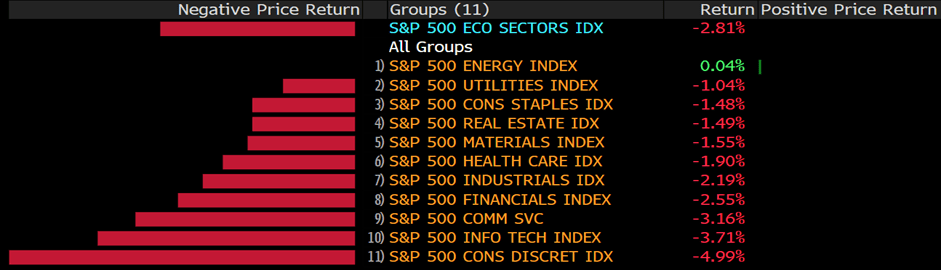
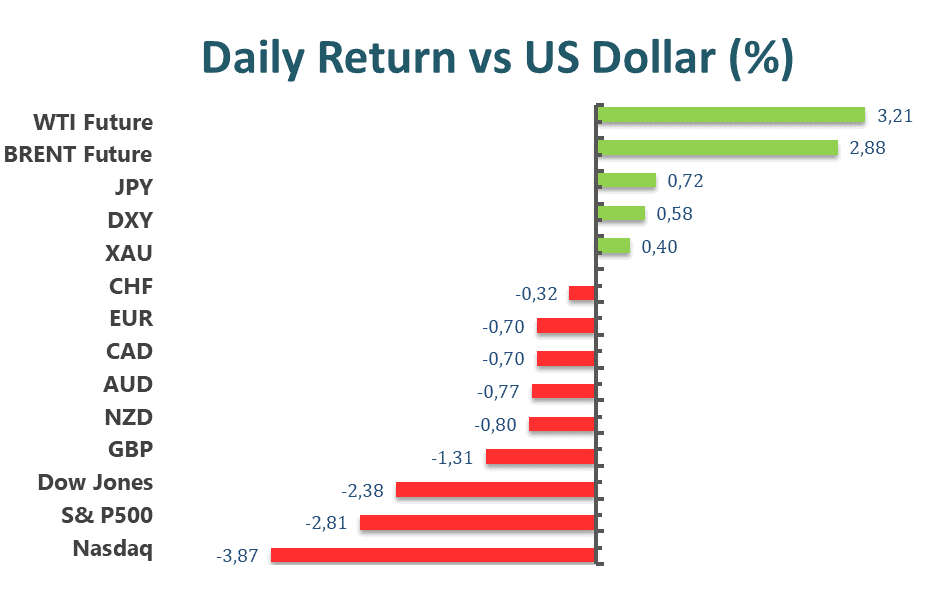
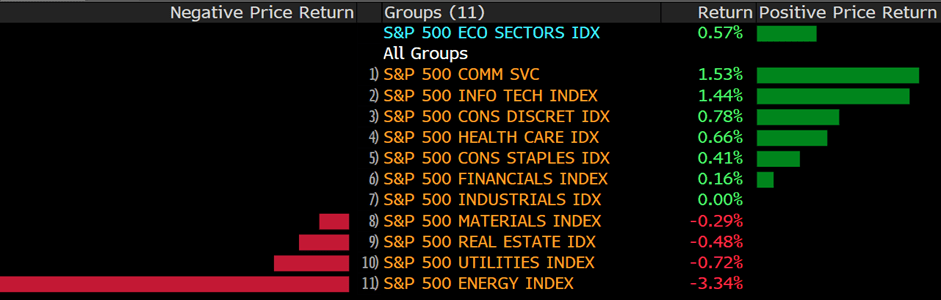
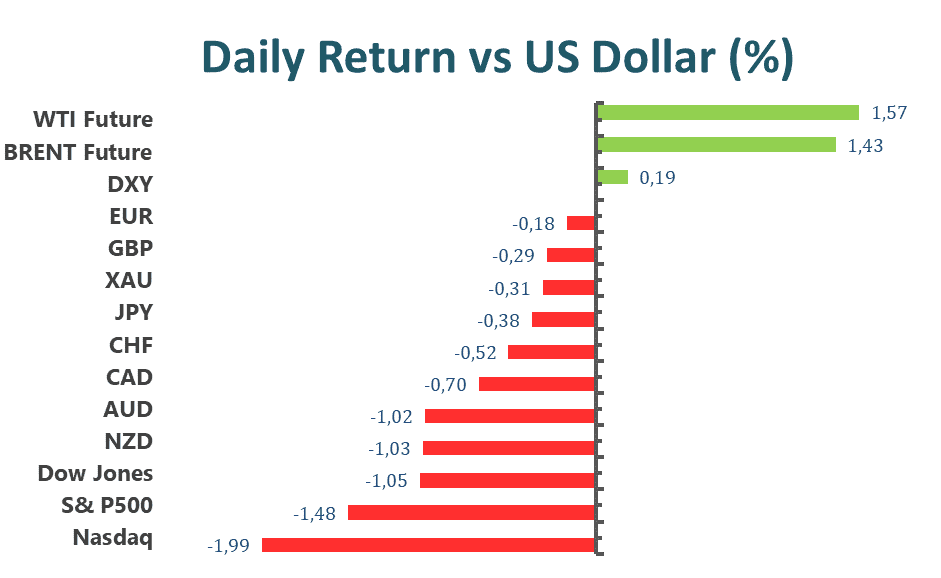
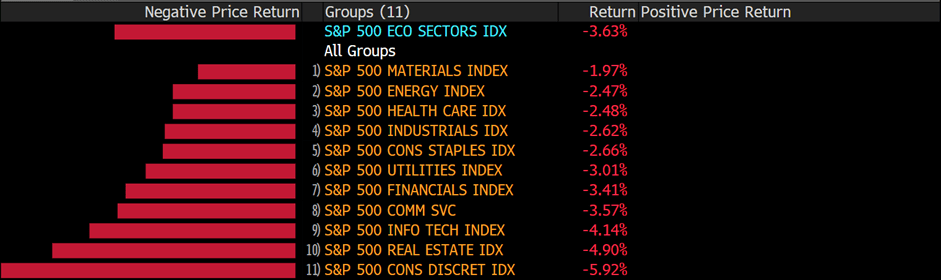
U.S. equities continue to lose ground on the last trading day of the week. The Dow Jones Industrial Average dropped 2.77% to close at 32977.21, the S&P 500 slipped 3.63% to close at 4131.93, and the Nasdaq Composite dived 4.17% to close at 12334.64. The Nasdaq’s sharp drop marked the index’s worst month since 2008. Amazon’s big sell-off dragged down the overall composite and the broader equities market. Ahead of the FOMC’s May meeting, market participants are pricing in interest rate uncertainty and a possible 50 basis point interest rate hike. The broader technology sector selloff also highlights the impact of China’s covid-related lockdowns and its impact on global supply chains.
On this week’s economic docket,  the Royal Bank of Australia is due to announce interest rate decisions on Tuesday, and the Federal Reserve’s interest rate decision is set on Wednesday. Bank of England’s PMI and inflation report is due on Thursday, and the BOE would also issue interest rate decisions on the same day.
Main Pairs Movement

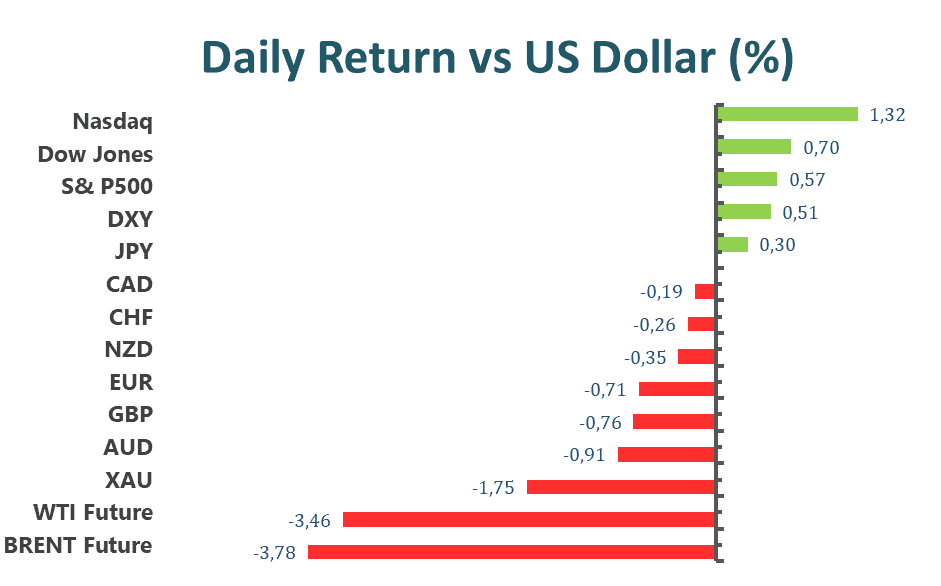
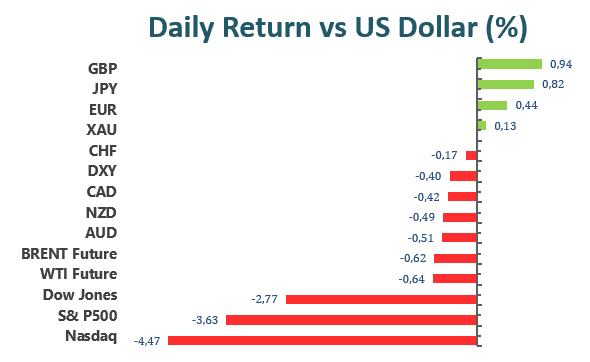
The Dollar showed weakness across the board on the last trading day of the week. The Dollar index closed 0.44% lower, while the benchmark U.S. 10-year Treasury yield rose to 2.937%. The sell-off of U.S. equities spilled over to the retreat of the Greenback. However, the FOMC meeting scheduled for May 4th will bring tremendous volatility to the Dollar index and the broader currency market.

USDJPY has risen to historical levels, but the broad weakness of the Dollar on Friday saw a slight retreat of the pair. Technical indicators continue to suggest a bullish outlook on the pair; furthermore, while the Bank of Japan has yet to announce any sort of monetary tightening, the Federal Reserve is set to begin its second round of tightening of the year.

Gold prices rebounded 0.13% on Friday, but could not close above the $1900 per ounce price level. As global central banks begin to ramp up interest rates, XAUUSD has begun to retrace and consolidate below the $1900 price level.

Cable rebounded 0.92% on Friday. The broad-based weakness of the Dollar helped boost the Sterling against the Greenback. With the BoE and the Fed both announcing interest rate decisions in the upcoming week, market participants can expect volatility for the pair.

Technical Analysis

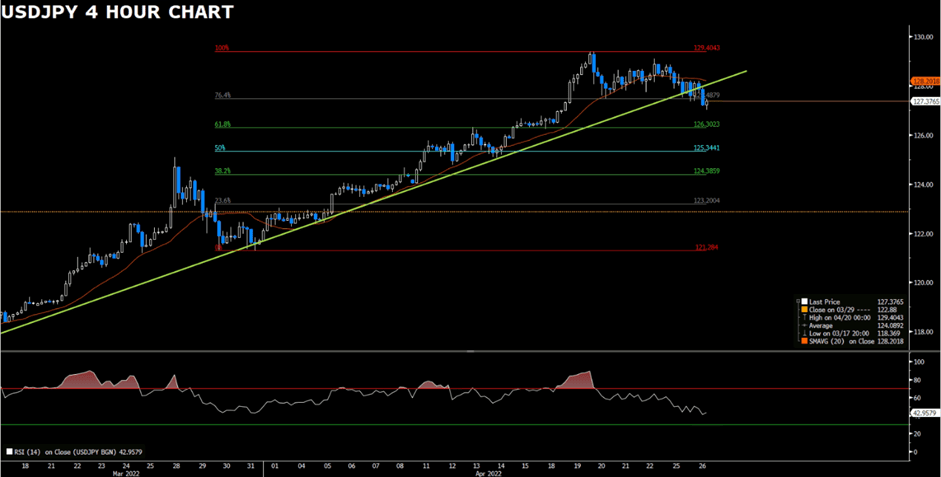
USDJPY (4-Hour Chart)
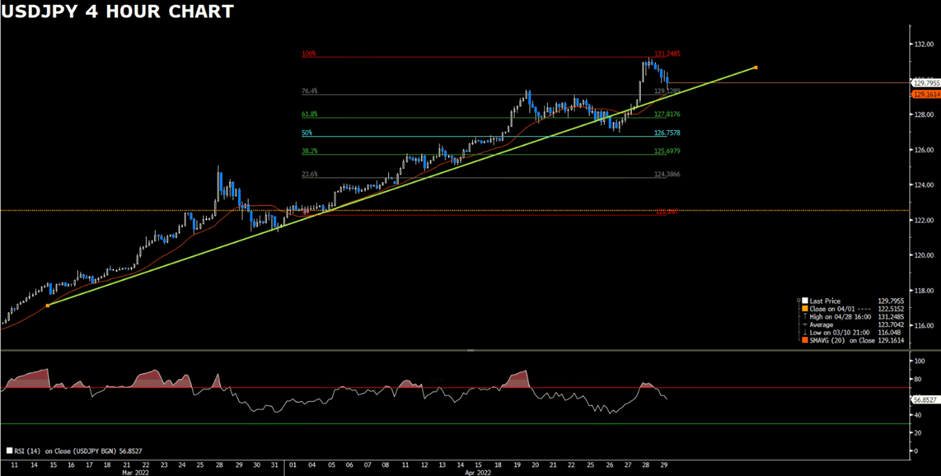
USDJPY corrects from the highest level, 131, in two decades amid an aggressive USD long-unwinding trade. Technically speaking, the four-hour outlook of USDJPY remains strongly bullish though the intraday downtick stalls near the 129.80 region. The pair continues to stay above the ascending trend line, suggesting that the trend is yet to confirm a bearish bias. The bears need to wait till the breakout of the support level at 129.12 to claim tractions. On the flip side, the rebound might happen once the downtick contests the support at 129.12, where the ascending trend-line is located. Succeed to defend the support is expected to give USDJPY another upside momentum toward the next immediate resistance at 131.24

Resistance:  131.24

Support:  129.12, 127.81, 126.75

XAUUSD (4-Hour Chart)
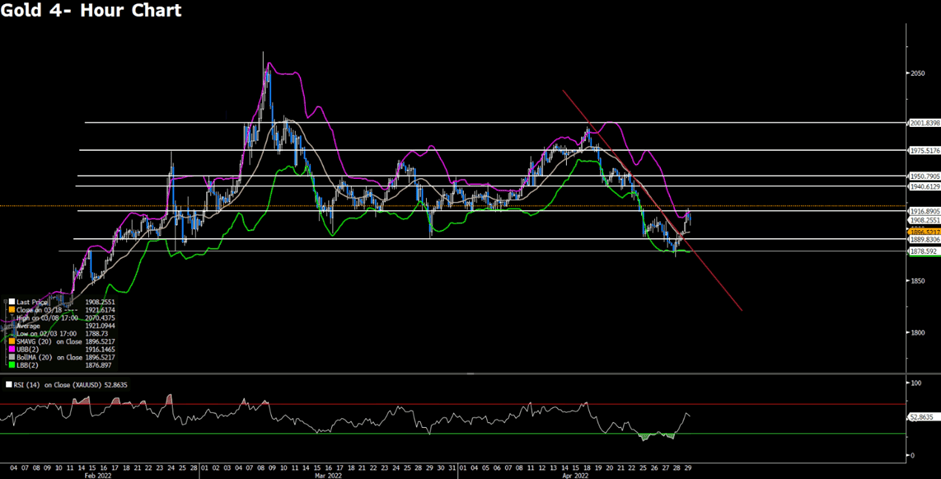
The precious metal, gold, edges higher on Friday following the benchmark 10- year Treasury bond yield is up more than 2% after the US PCE inflation data. From the technical point of view, the near-term outlook of gold seems to turn upside following the outbreak of descending trend line. The upside momentum from these two days has pushed gold above the $1,900 level, the psychological resistance on the four-hour chart. However, the current resistance at $1,916 is set to become the first obstacle that gold needs to overcome if bulls want to extend further north. From the RSI indicator, the reading is currently hovering around the positive territory and has not yet reached the overbought condition, suggesting that bulls still have rooms to head further. On the flip side, failure to defend the support of $1,889 will bear an opportunity to attract some follow-through selling.

Resistance: 1,916, 1,940, 1,950

Support: 1,889, 1,878

GBPUSD (4-Hour Chart)
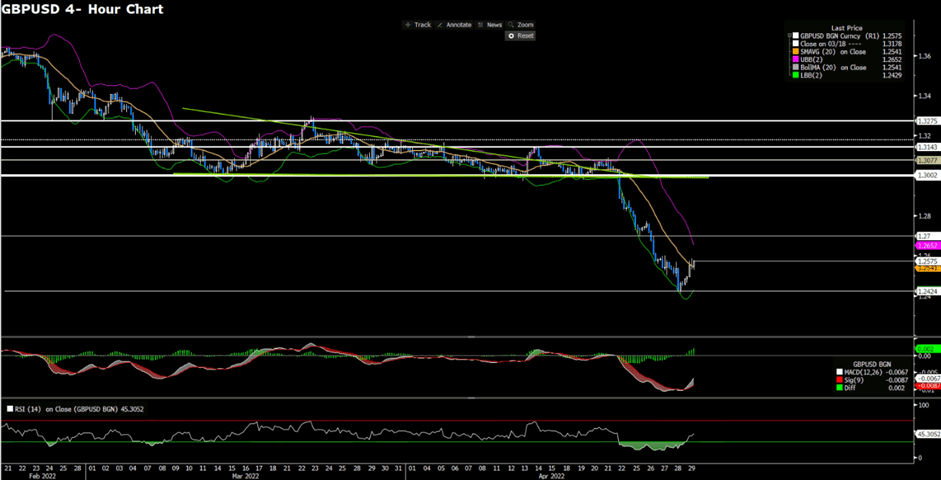
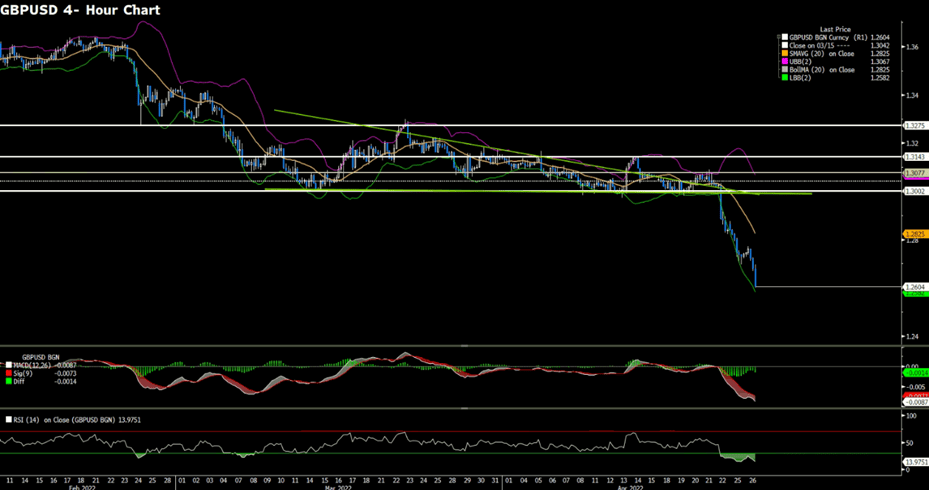
GBPUSD witnessed a rebound after hitting the 1.2400 region. The intraday uptick seems to be boosted by the US PCE inflation data. From the technical perspective, GBPUSD displays a minor pause from the 1.2400 regions after a sheer downside move since the 22nd of April; yet, the outlook remains bearish as the pair continues to fall well below the triangular wedge, suggesting that the context is extremely bearish. On the flip side, to raise the odds of a reversal, GBPUSD needs to at least climb above the 1.3002 level, where the outbreak of the descending wedge is located. At the moment, though the MACD indicator shows some positive move for the pair, the RSI remains at the negative level on the four-hour chart. That being said, the near-term momentum might lend some support to bulls, but the bears are still in control in the longer- timeframe.

Resistance: 1.2700, 1.3002, 1.3077

Support: 1.2424

Economic Data

CurrencyDataTime (GMT + 8)Forecast
EURGerman Manufacturing PMI (Apr)15:5554.1
USDISM Manufacturing PMI (Apr)22:0057.8

U.S. equities closed sharply higher Thursday, led by technology shares as markets continued recovery from steep losses earlier this week. S&P 500 climbed 2.5%, and Dow Jones surged by more than 600 points or 1.8%. The tech-heavy Nasdaq Composite jumped 3.1% to cap trading, marking its best rise since March on the heels of stronger-than-expected earnings from Facebook parent company Meta (FB) that boosted shares up nearly 18%.

Apple Inc. predicted that supply constraints would cost $4 billion to $8 billion in revenue during the current quarter, a warning that sent the shares tumbling and cast a pall on record-setting results that the company just reported.

Covid restrictions, which have swept China in recent weeks, will take a toll on the June quarter, Apple said during a conference call Thursday. The fiscal second quarter’s sales and profit had topped analysts’ estimates, fueled by strong demand for the iPhone and digital services, and the company announced $90 billion in new stock buybacks.

The outlook renewed fears that supply-chain woes will continue to roil the tech industry following a short-lived recovery from pandemic struggles. Companies ranging from Microsoft Corp. to Texas Instruments Inc. have already said that China’s Covid-19 lockdowns will crimp sales and make it harder to produce products like the Xbox. The Xi Jinping administration has embraced a strict Zero Covid policy to stop the pandemic’s spread, reverberating through the world’s supply lines.

Chip shortages and the Ukraine war also are causing disruptions, Chief Executive Officer Tim Cook said during the call. “We are not immune to these challenges, but we have great confidence in our teams, and our products and services — and in our strategy.”

Main Pairs Movement

Despite a shocking decline in the latest GDP release, the greenback advanced across the board on Thursday. The Dollar Index surpassed its 2017 highs to almost hit 104.00, its highest level since December 2002. This was primarily a result of a steep sell-off in the yen that launched USD/JPY to fresh multi-decade highs of at one point above 131.00.

The catalyst for the latest leg lower in the yen, which saw all major G10/JPY pairs surge, not just USD/JPY, was Thursday’s dovish BoJ policy announcement. As expected, the bank doubled down on its intent to stick with its ultra-dovish policies of negative interest rates and yield curve control for the foreseeable future given continued pessimism about its ability to meet its long-term inflation remit.

Elsewhere, most other major G10 currencies also continued to depreciate versus the rampant US dollar. The Euro pair dropped a further 0.5% and briefly dipped under 1.0500 for the first time since March 2017, GBP/USD dropped a further 0.6% to the mid-1.2400s and AUD/USD fell another 0.4% to probe 0.7100. NZD/USD dropped another 0.8% to fresh lows in July 2020 under 0.6500. Expectations for the BoE and RBA to both lift interest rates by 25 and 15 bps each next week have done little to stem the recent slide as both of these hikes pale in comparison to the 50 bps move expected from the Fed not only next week’s meeting but also the next few.

Technical Analysis

USDJPY (4-Hour Chart)

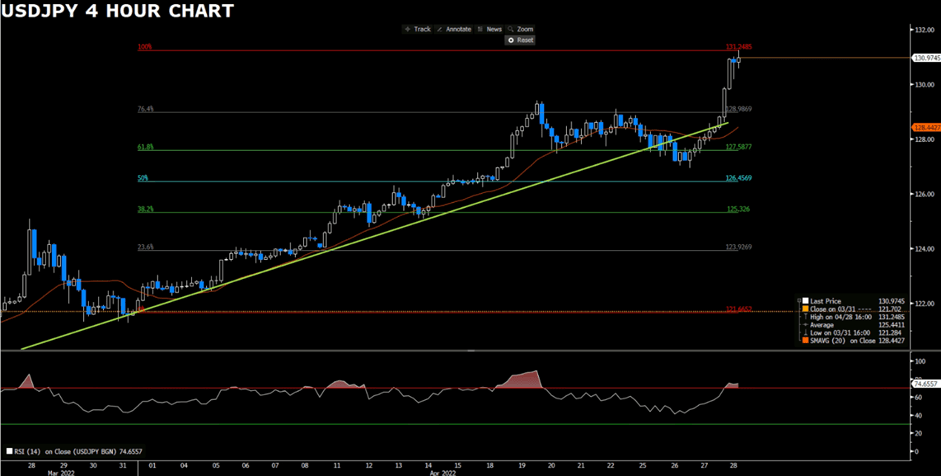
USDJPY hits 131.00 for the first time in two decades as the Fed- BOJ monetary policy divergence widens. On Thursday, the Bank of Japan continues to keep the key rates unchanged though it doubles down on bond buying. From the technical perspective, USDJPY stays in a strong bid tone on the four-hour chart following the breakout of the resistance level of 128.98. Failure to defend the cap level results in attracting more buying interests. At the time of writing, USDJPY is attempting to break the next obstacle, 131.24, in two decades; however, as the RSI indicator has reached near the 80 mark, the upside momentum might need to cool down a bit before continuing to head upward. To the downside, USDJPY needs to slide below 127.58 in order to become downside.

Resistance:  131.24

Support:  128.98, 127.58, 126.45

XAUUSD (4-Hour Chart)

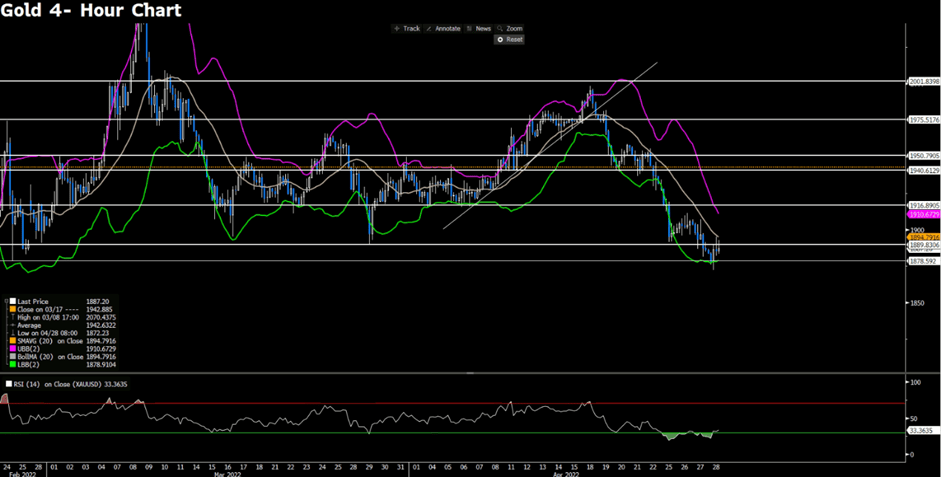
The bright metal fails to recover, consolidating around $1885, though US GDP figures shock with a contraction. However, weak US economic data seem to unlikely change that fact the Fed is going to hike interest rates by 50 bps in May and remains in an aggressive stance later this year. Technically speaking, gold faces a barricade at nearly $1990. In order to gain some follow-through buying, gold needs to climb above $1990, where the midline of Bollinger Band, suggests a reverse from bearish to bullish in the near- term. At the time of writing, bulls seem to lack interest as the RSI still hovers within the negative level, implying that sellers are still in control.

Resistance: 1890, 1916, 1940, 1950

Support: 1878, 1877, 1828

USDCAD (4-Hour Chart)

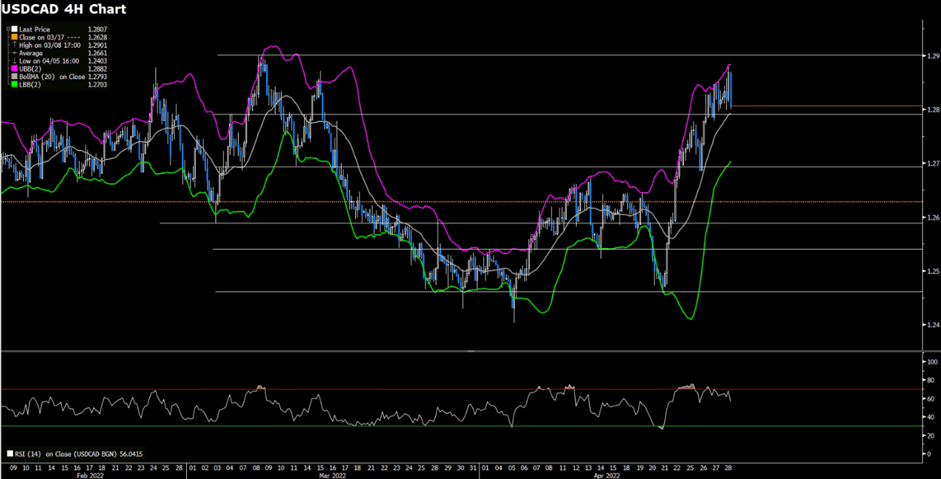
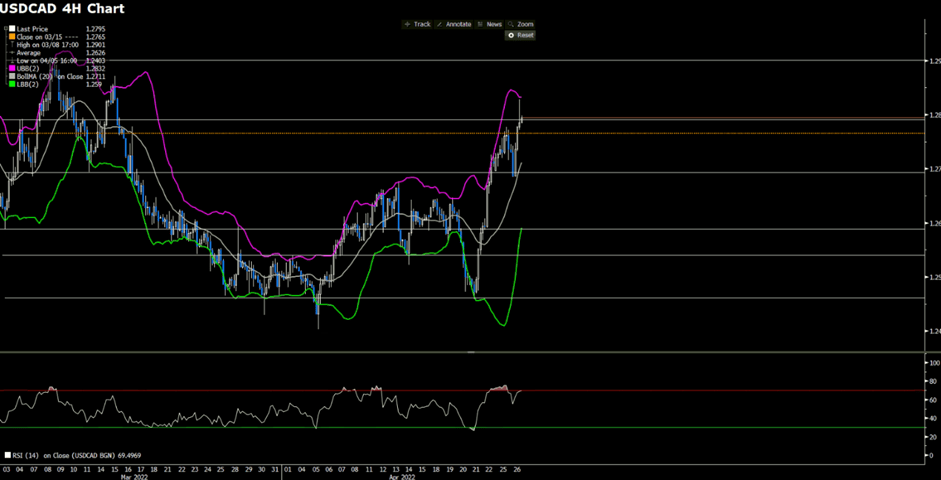
USDCAD eases from multi-week high amid dismal US economic data, showing a contraction in US GDP print. Technically speaking, though USDCAD loses traction after hitting near the 1.2900 level, the downside seems limited. At the time of writing, USDCAD heads south toward the support of 1.27. If the level can defend the bearish momentum, then according to the Elliott Wave point of view, it is expected to see one more upside wave. As the RSI indicator eases from the overbought territory, USDCAD looks to rebound once it hits the support of 1.27. Nonetheless, if the support of 1.27 fails to defend, then it will favor the sellers, attracting some follow-through selling interests.

Resistance: 1.2900

Support: 1.2793, 1.2694, 1.2542

Economic Data

CurrencyDataTime (GMT + 8)Forecast
CNYCaixin Manufacturing PMI(Apr)09:4550
EURGerman GDP(QoQ)(Q1)16:000.1%
EURCPI(YoY)(Apr)17:007.5%
RUBInterest Rate Decision (Apr)18:3015%
CADGDP(MoM)(Apr)20:300.8%

VT Markets Notification of Server Upgrade

Dear Client,

As part of our commitment to provide the best reliability and service to our clients, the trading hours of certain products will be adjusted as follows due to the maintenance.

Available trading hours:

2022/04/30 18:00 – 24:00 (Server time)
2022/05/01 00:00 – 24:00 (Server time)

Please be reminded that the following aspects might be affected during this maintenance period:

1. The functions of client portal operations might be disabled during this period.

2. There might be a gap between the original price and the price after maintenance. Pending orders, Stop Loss, and Take Profit settings within the gap will be filled at the market price after maintenance activity ends.

3. The quotations of products will be paused. Clients may not be able to open new positions or close the held positions.

No action is required by our client. Your service will be back online after the maintenance is completed.

Thank you for your patience and understanding about this important initiative.

If you’d like more information, please don’t hesitate to contact [email protected]

VT Markets The Adjustment Of Weekly Dividend Notification

Dear Client,

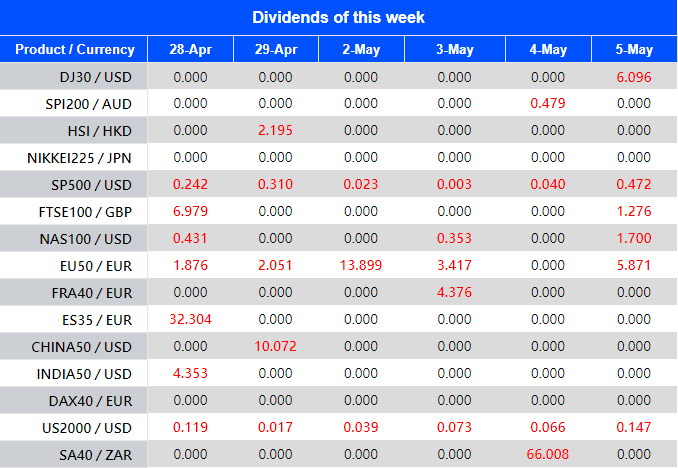
Warmly reminds you that the component stocks in the stock index spot generate dividends. When dividends are distributed, VT Markets will make dividends and deductions for the clients who hold the trading products after the close of the day before the ex-dividend date.

Indices dividends will not be paid/charged as an inclusion along with the swap component. It will be executed separately through a balance statement directly to your trading account, the comment for which will be in the following format “Div & Product Name & Net Volume ”.

Please note the specific adjustments as follows:

Note: The above data is for reference only, the actual execution date may be changed, please refer to the MT4/MT5 software for details.

If you’d like more information, please don’t hesitate to contact [email protected].

VT Markets Notification of trading adjustment in holiday

Dear Client,

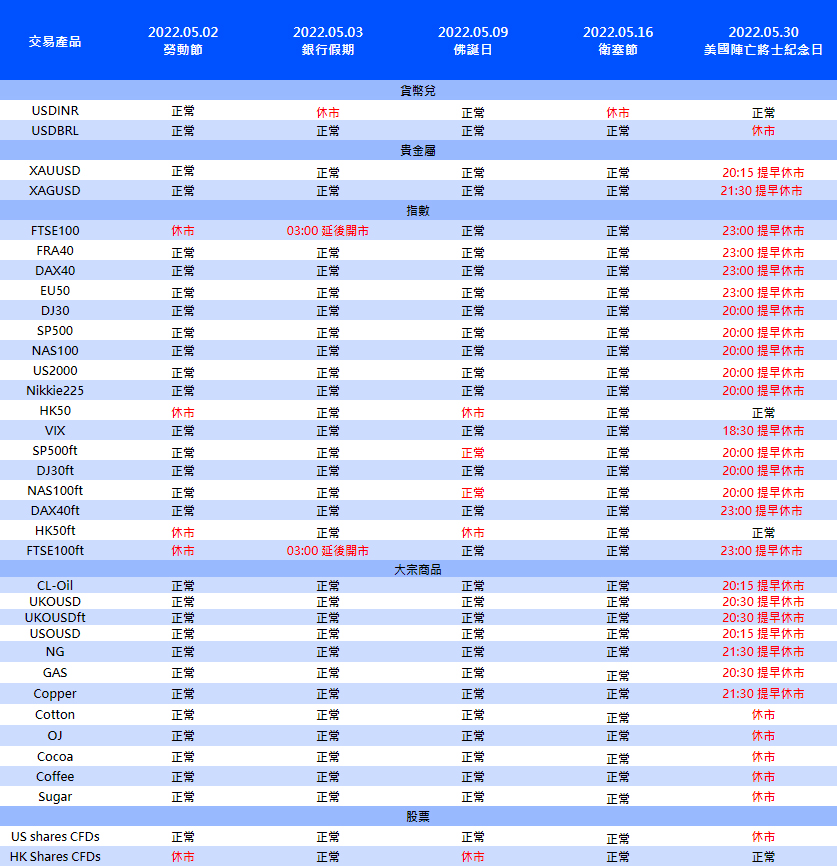
Please note the adjustment on the following products due to the international holiday in May:

The above time is MT4/5 server time. The trading time of other products is not affected. The above data may be subject to change. Please refer to the actual time on MT4/5.

If you have any questions, our team will be happy to answer your questions. Please mail to [email protected] or contact the service online.

U.S. stocks climbed Wednesday afternoon, recovering some of their losses after major stock indexes fell, as worries about inflation and global growth added to further volatility in risky assets. The S&P 500, Dow Jones, and Nasdaq rose about 1 % during the session. On Tuesday, the S&P 500 fell 2.8 percent, the biggest drop in seven weeks, with technology shares especially slammed. The Nasdaq Composite Index dropped 4 percent to 12,490.74, its lowest level since December 2020. The S&P 500 is heading for a monthly decline of 7.8%, with only three trading days left in April.

Facebook’s main social network added more users than projected in the first quarter, potentially staving off concerns that the company is losing momentum as a new generation flocked to younger sites like TikTok.

Revenue for the period jumped 6.6% to $27.9 billion and would have been higher if not for the war in Ukraine, the company said. The stock had dropped almost 50% this year as investors became increasingly worried that Meta’s main business and profit engine — advertising in its social media feeds — was losing steam.

Still, many of Meta’s challenges remain. Tik-Tok, owned by China’s Byte Dance Ltd., is providing serious competition for young users’ attention. At the same time, changes to data-collection rules on Apple Inc.’s iPhones have hindered Meta’s ability to serve users’ targeted ads. Last quarter, Meta executives said the privacy changes would reduce the company’s 2022 sales by $10 billion. Advertisers have also been spending less due to issues with supply chains, inflation, and the ongoing war in Ukraine, Meta executives said.

Main Pairs Movement

The U.S. dollar returned to the top of the G10 daily performance chart, meanwhile, the trade-weighted U.S. dollar index (DXY) hit a new 5-year high. The DXY rebounded to 103.00 for the first time since January 2017, peaking near 103.30 before falling back and stabilizing around that figure as U.S. trade closed.

The bank of Japan will announce its latest monetary policy decision and new economic forecasts during the upcoming Asia-Pacific conference, and any dovish sentiment is likely to exacerbate the yen’s latest decline. USD/JPY rallied more than 100 pips, from 127.00 to 128.30.

AUD/USD and USD/CAD were both flat around the 0.7120 and 1.2820 levels respectively, while NZD/USD fell again by 0.3% below 0.6550 and GBP/USD declined again by 0.2% below 1.2550 but support at 1.2500. The pound’s better performance may be due to a series of recently released data on the U.K. economy and government borrowing that has sparked new concerns about the country’s economic outlook and the prospect of tighter Bank of England policy. mIn terms of other underperforming G10 currencies, the EUR/CHF depreciated 0.8% and 0.7% against the dollar.

Technical Analysis

USDJPY (4-Hour Chart)

After two consecutive days of decline, USDJPY regains traction on Wednesday, boosted by a combination of factors, including the Fed- BoJ monetary policy divergence. Technically speaking, USDJPY turns into its bid tone through the mid-European session on Wednesday after hitting a one-week low and the support level at 127.48. The bullish pullback brings USDJPY back to the positive territory, above the ascending trend-line. The upside momentum is expected to keep on if USDJPY is able to finish above the trendline by the end of the day; then, as the RSI has not yet reached the overbought territory, USDJPY has room to extend further north toward 129.40, the next hurdle.

Resistance:  129.40

Support:  127.48, 126.30, 125.34

XAUUSD (4-Hour Chart)

Gold confronts a steeper decline after the breakout of the psychological support of $1900. The precious metal plunges hard as investors seem to weigh an aggressive US tightening cycle over the tension between Russia and Ukraine. From the technical perspective, though XAUUSD was attempting to bounce back toward the $1900 mark, the RSI indicator on the four-hour chart keeps pointing lower within the negative level, suggesting that any recovery attempts are likely to remain shallow. Furthermore, failure to rebound leads XAUUSD to trade further south, contesting the immediate support at $1889. On the flip side, bulls need to climb above $1916 to regain positive traction in the near- term.

Resistance: 1916, 1940, 1950

Support: 1889, 1877, 1828

GBPUSD (4-Hour Chart)

GBPUSD continues to plunge toward the psychological support of 1.2500 as the risk sentiment is providing a boost to the safe-haven US dollar. From the technical aspect, the downside seems to see no limit since last Friday after slipping below the old support of 1.2973. GBPUSD remains deeply bearish as the MACD is heavily located in the negative territory. Now, the support at 1.2500 acts as an important defended line; failure to defend the territory would vigorously strengthen the downside momentum. Further price action eyes on BoE Governor’s speech on Thursday.

Resistance: 1.2600, 1.2674, 1.2700

Support: 1.2500

Economic Data

CurrencyDataTime (GMT + 8)Forecast
AUDRetail Sales (MoM) (Mar)09:301.0%
JPYBOJ Monetary Policy StatementTentativeN/A
GBPBoE Gov Bailey Speaks17:00N/A
USDGDP (QoQ) (Q1)20:301.1%
USDInitial Jobless Claims20:30180K

Wall Street benchmark indices plunged on Tuesday, speeding up April’s sell-off on US equities as market participants weighed a flurry of corporate reports against inflationary pressures and worries over recession risks. S&P 500 closed the day by 2.8% lower, while Dow Jones slid around 800 points, resuming its losing streak after slightly rebounded on Monday. The tech-heavy Nasdaq Composite nosedived nearly 4%, being its third-biggest drop of the year and marking its lowest close since December 2020.

Russia will cut off the gas to Poland and Bulgaria on Wednesday in a major escalation in the standoff between Moscow and Europe over energy supplies and the war in Ukraine.

Moscow is making good on a threat to halt gas flows to countries that refuse President Vladimir Putin’s new demand to pay for the fuel in rubles. The European Union has rejected the move in principle but now payment deadlines are starting to fall due, governments across Europe need to decide whether to accept Putin’s terms or lose crucial supplies — and face the prospect of energy rationing.

European gas prices surged as much as 17% as traders calculated the risk of other European countries being hit next.

“This is a turning point that has been accelerated by Russia today,” said Piotr Naimski, Poland’s top official for strategic energy infrastructure. The threat of cutoffs has been looming for weeks, but there was an indication last week that the EU was suggesting a potential way out of the standoff. The move against bloc members Poland and Bulgaria probably makes some kind of compromise less likely. It also removes from the EU’s toolkit the option of sanctioning Russian gas.

The focus now turns to other European capitals, particularly Germany, which is heavily dependent on Russian gas. There was no immediate reaction from Berlin.

Main Pairs Movement

Forex trading continues to be dominated by risk-off funds. Recently, China’s blockade risk, the ongoing Russia-Ukraine war, deteriorating global growth prospects and aggressive monetary tightening by many major central banks have all weighed on market sentiment.

USD/JPY started to pull back from last week’s high above 129.00 to around 127.00 and EUR/JPY hit 135.00 in two weeks. Meanwhile, GBP/JPY extended its three-day decline from last week’s highs above 168.00 to nearly 5.0%. The US Dollar Index (DXY) hit a new high at 102.30, driven by declines in the Euro and the British Pound, the two worst performers among the major G10 currencies.

The other major G10 currencies such as AUD, NZD, and CAD all outperformed GBP, each falling around 0.6% against the USD on the day, with losses cushioned by higher energy prices due to geopolitical tensions.  AUD/USD pair dropped to an intraday low around 0.7130 and NZD/USD fell under 0.66, back to the 11-week low area.

Technical Analysis

USDJPY (4-Hour Chart)

USDJPY edges lower for the second successive day, dropping to a weekly low on Tuesday. The risk-off mood seems to benefit the JPY and favor bearish traders for USDJPY at the moment; however, the divergent monetary policies between the Fed and the BOJ should limit losses. From the technical perspective, the near-term outlook of USDJPY looks bearish, given the overnight breakthrough and an ascending trend line. At the same time, the RSI has not yet reached the oversold territory. Hence, some follow-through selling would set a stage for an extension of the corrective pullback. On the flip side, the level at 127.41 now acts as an immediate resistance ahead of the ascending trend- line and the 60 Simple Moving Average now also acts as a pivotal point for short-term traders.

Resistance:  129.40

Support:  127.41, 126.30, 125.34

USDCAD (4-Hour Chart)

USDCAD rallies from the daily swing low, and shoots above the 1.2800 regions. The US dollar continues to benefit from the bet for a more aggressive monetary policy by the Federal Reserve, boosting the US dollar to the highest level since 2020. Technically speaking, Monday’s downfall was seen as a fresh trigger for bullish traders. The outlook retains its upside momentum following the retreat from the pivotal support near 1.2700. At the time of writing, the acceptance level above the current hurdle at 1.2800 would give USDCAD another support prospect for a further appreciating move; however, the upside momentum might see limitation as the RSI has nearly reached the overbought territory, suggesting a technical correction.

Resistance: 1.2800, 1.2900

Support: 1.2700, 1.2587, 1.2461

GBPUSD (4-Hour Chart)

GBPUSD slumps further south below 1.2700 on Tuesday following the escalating fears over supply-chain issues ramping up global inflation with the lockdown in China. From the technical perspective, GBPUSD has met fresh selling pressure, breaking through the psychological support at 1.2700. At the moment, GBPUSD trades near the 1.2600 level, the lowest level since July 2020. Despite the RSI indicator on the four-hour chart suggesting a potential recovery, the bearish momentum seems to continue taking control. At the moment, GBPUSD needs to clear the static resistance that seems to have formed at 1.2674 in order to take its recover.

Resistance: 1.2674, 1.2700, 1.2800, 1.2730

Support: 1.2600

Economic Data

CurrencyDataTime (GMT + 8)Forecast
AUDCPI(QoQ)(Q1)09:301.7%
EURECB President Lagarde Speaks19:30N/A
USDPending Home Sales(MoM)(Mar)22:00-1.6%
USDCrude Oil Inventories22:302.167M

U.S. equities advanced on Monday, reversing earlier losses in the day amid worries about an escalating COVID outbreak in China added to jitters over U.S. economic growth, not to mention the surging inflation and Fed policy tightening. S&P 500 went up 0.6% to reach 4,296.12. Dow Jones climbed more than 200 points, or 0.7%, to close the day at 34,049.46, and Nasdaq Composite rallied 1.3% to close just above 13,000. U.S. stocks bucked the trend of global equity markets, with the major stock indices in Europe and Asia declining significantly on Monday.

Well-known billionaire Elon Musk agreed to buy Twitter Inc. for $44 billion, using one of the biggest leveraged buyout deals in history to take private a 16-year-old social networking platform that has become a hub of public discourse and a flashpoint in the debate over online free speech.

Investors will receive $54.20 for each Twitter share they own, the company said in a statement Monday. The price is 38% more than the stock’s close on April 1, the last business day before Musk disclosed a significant stake in the company, sparking a share rally.

Musk, one of Twitter’s most-watched users with more than 83 million followers, began amassing a stake of about 9% in January. By March, he had ramped up his criticism of Twitter, alleging that the company’s algorithms are biased and feeds cluttered with automated junk posts. He also suggested Twitter’s user growth was inflated by bots. After rejecting an invitation to join the company’s board, on April 14 he offered to take Twitter private, saying he’d make the platform a bastion of free speech and dropping other hints about the changes he’d make as an owner.

The ideas verged from the practical — say, letting users edit tweets and combating the spread of bots — to the peculiar, such as a proposal to turn the company’s San Francisco headquarters into a homeless shelter.

Main Pairs Movement

Despite an impressive recovery of the US equities, the sentiments in the forex markets on Mo remained risk-off, with traders citing China lockdown concerns as the major driver. Amid a sharp pullback in global bond yields, as traders reassessed global growth prospects amid the rising risk of a wider shutdown of the world’s second-largest economy, the rate-sensitive safe-haven yen was the best performing G10 currency.

USD/JPY now trades around the 127.50 area, more than 1.5% below last week’s multi-decade highs above 129.00. The safe-haven US dollar also benefited as a result of risk-off flows and was the second-best performing major G10 currency, with the Dollar Index (DXY) hitting fresh highs in March 2020 in the upper 101.00s.

On the other hand, GBP/USD at one point plummeted under 1.2700 for the first time since September 2020 and was last seen down 0.7% in the 1.2740s, while EUR/USD dropped a similar percentage just above 1.0700 and also at fresh multi-month lows. Any Euro relief in wake of French President Emmanuel Macron’s re-election was no longer last.

Technical Analysis

USDJPY (4-Hour Chart)

USDJPY witnessed some selling pressure on Monday despite the downside still lacking bearish conviction. The Japanese Yen seems to benefit from the prevalent risk-off mood, driving some safe-haven flow. Technically speaking, on the four-hour chart, USDJPY remains upside as it stays above the bullish trendline. At the time of writing, bulls are trying to defend their ascending trendline and the support level at 127.41 from the intraday decline. As the RSI reading is still far from oversold, a convincing breakthrough of the trendline should pave the way for deeper losses and bring USDJPY toward further south 126.30. On the flip side, if the dollar succeeds to defend the trendline and the support level at 127.41, then it might be able to attract some fresh buying interests.

Resistance:  129.40

Support:  127.41, 126.30, 125.34

AUDUSD (4-Hour Chart)

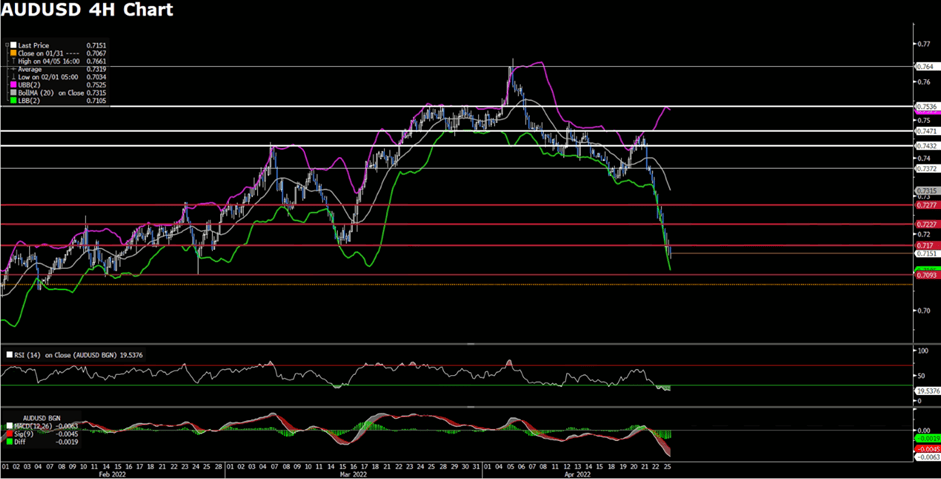
The Australian dollar underperforms amid China’s lockdown from its “zero- Covid” policy. The underperformance of the Aussie drags AUDUSD to the lowest since late February. From the technical perspective,  the outlook of AUDUSD stays bearish, turning more downside, as the pair has traded further south below the descending trendline. At the moment, the downside looks limited before breaking the next support at 0.7093 as the RSI indicator has reached the oversold territory, suggesting any attempted recovery move. However, AUDUSD might need to climb above 0.7277 in order to gain some follow-through buying as beyond the 0.7277 resistance might be able to neglect the negative bias in the near- term.

Resistance: 0.7170, 0.7227, 0.7372

Support: 0.7093

GBPUSD (4-Hour Chart)

GBPUSD crashes through 1.2750, heading toward 1.2700, the psychological support. From the technical aspect, the outlook of GBPUSD stays intensely bearish of the fact it falls below the major psychological support at 1.3000 last week. At the moment, there are no major support levels between 1.2700 and 1.2500 aside from the September 2020 low of 1.2674. The downside of GBPUSD might show some slowdown as it is trading in oversold territory. The market mood, however, needs to turn neutral before GBP sellers decide to book their profits.

Resistance: 1.2800, 1.2730, 1.3002, 1.3077, 1.3143

Support: 1.2700, 1.2674

Economic Data

CurrencyDataTime (GMT + 8)Forecast
USDCore Durable Goods Orders(MoM)(Mar)20:300.6%
USDCB Consumer Confidence(Apr)22:00108
USDNew Home Sales(Mar)22:00765K

U.S. stocks plummeted Friday afternoon to close out another week in the red as investors weighed a bevy of corporate earnings and braced for more aggressive monetary tightening by the Federal Reserve in coming months. S&P 500 plunged 2.8%, marking its second-worst day of the year, while Dow Jones wiped out 980 points in its worst day since October 2020. Nasdaq Composite tumbled 2.6% as well. The losses follow remarks from Fed Chair Jerome Powell at an IMF panel Thursday signaling a 50-basis point rate increase was “on the table” for May when the U.S. central bank holds its next policy-setting meeting. The Fed chair also reiterated that policymakers were committed to “front-end loading” inflation-fighting efforts.

The victory of Emmanuel Macron in France’s presidential election should be a relief for investors worried that a Marine Le Pen win would roil European markets. The euro, French bonds, and shares from the nation’s banks are among the assets that should benefit from Macron’s win for a second term, according to money managers. The euro rose as much as 0.6% against the dollar in early Asia trading, before trimming its advance to about 0.2% as of 7:48 a.m. in Hong Kong.

The risk of a victory by far-right nationalist and eurosceptic Le Pen had been keeping investors on edge, with some predicting European assets could suffer a selloff comparable to the euro crisis or Brexit.

“European investors are partying after the French exit polls: a potential black Monday is definitely averted,” said Fabio Caldato, a partner at Olympia Wealth Management.

Macron won 58.55% of the votes in Sunday’s runoff compared with 41.45% for Le Pen, according to the French Interior Ministry website. The nationalist leader conceded defeat in a speech to her supporters in Paris.

Main Pairs Movement

The US Dollar’s (via the DXY Index) strong run continued through the third week of April, adding another +0.62%. The DXY Index has been positive in 12 of the 16 weeks thus far in 2022, good for a +5.69% YTD. The Euro pair, which spent most of the first four days of the week in positive territory, ended up down by -0.11%. Cable dropped by -1.71%, its worst weekly performance since June 2021. USD/JPY added +1.69%, their seventh consecutive weekly gain.

The narrative behind the US Dollar’s ascent has remained consistent for much of this year: the Federal Reserve is on the verge of a series of significant rate hikes – just look at some of the recent comments by FOMC members – while other major central banks are not. Widening interest rate differentials are propping up the US Dollar, plain and simple.

Commodity-linked currencies also plummeted significantly amid the easing crude oil prices and the broader greenback strength. Aussie dropped the most, down 1.73% Friday. Kiwi slid by 1.46%, and Loonie surged by 1.05%. Gold closed Friday at 1,932.35, down around $20 per troy ounce during the intraday trades. Crude oils gave back all their Thursday’s gains, with WTI trades at $100.40, and Brent at $104.40.

Technical Analysis

USDJPY (4-Hour Chart)

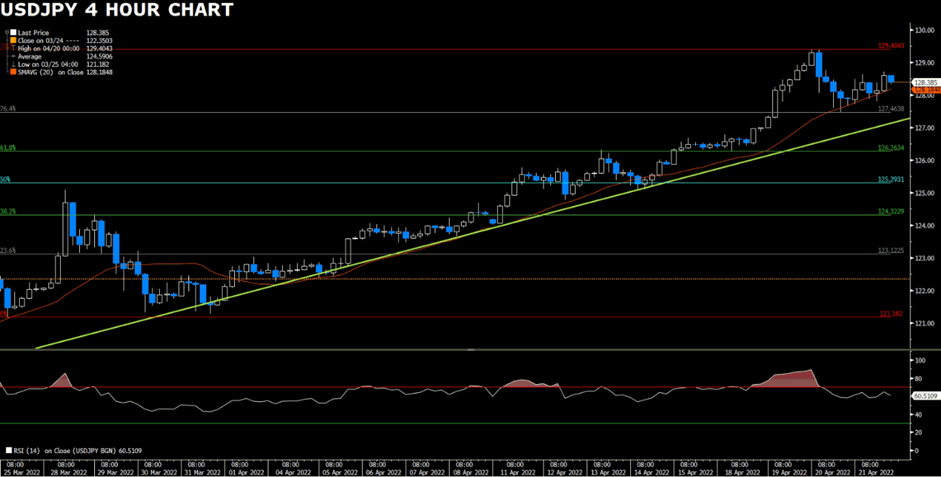
USDJPY posts back-to-back gains heading toward 129 at the time of writing despite falling US Treasury yields and a risk-off market mood. During the US Fed Minutes, Powell added that the US Fed would not count on the supply side healing to help inflation, implying that the Fed is going to focus on the demand side. From the technical perspective, the intraday bias of USDJPY remains aggressively bullish as it continues to trade well above the bullish trendline. At the same time, the pair seems to trade along with the 20 Simple Moving Average, behaving as a support pivot. The RSI indicator steadily hovers within the positive levels, some follow-through buying interests are expected to boost USDJPY toward the next hurdle at 129.4043.

Resistance:  129.40

Support:  127.41, 126.18, 125.18

AUDUSD (4-Hour Chart)

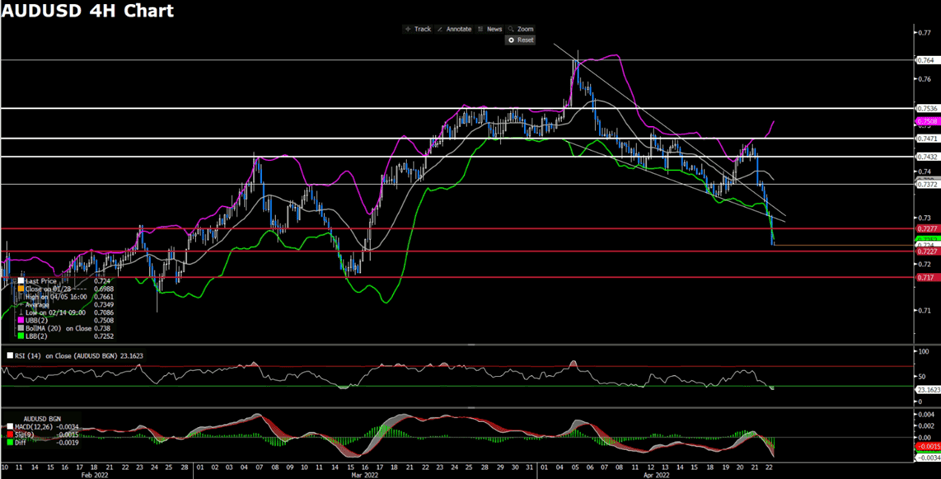
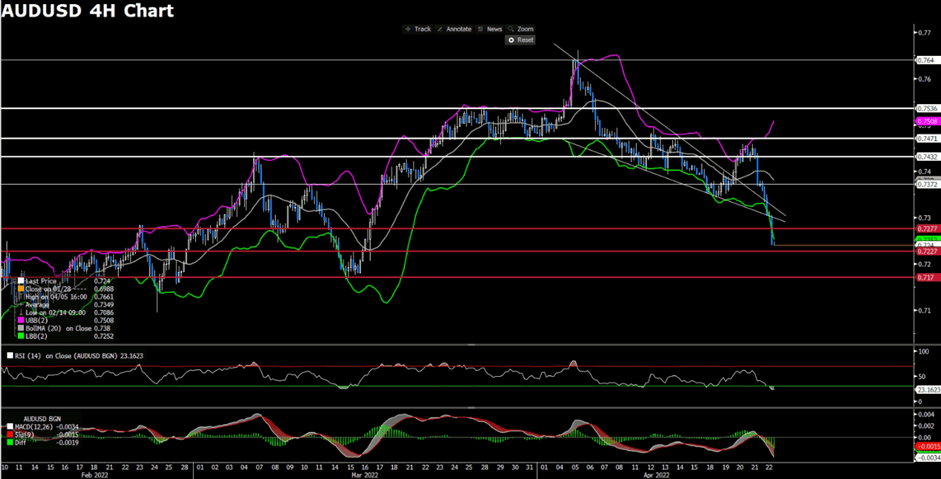
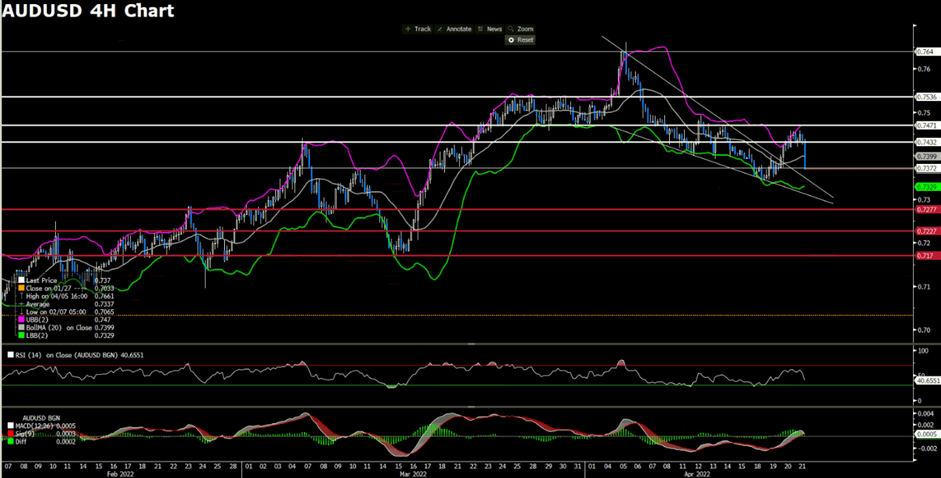
AUDUSD witnessed heavy selling pressure for the second consecutive day on Friday, tumbling to its lowest level since March. From the technical aspect, the bearish outlook is reinforced by the fact that AUDUSD has breached the descending wedge, setting the stage for a further depreciating move toward the next support at 0.7227. The oversold RSI reading seems to not be able to stop the current selling pressure. AUDUSD might need to climb above 0.7372 to regain and attract more buying interest.

Resistance: 0.7372, 0.7432, 0.7471, 0.7536

Support: 0.7277

GBPUSD (4-Hour Chart)

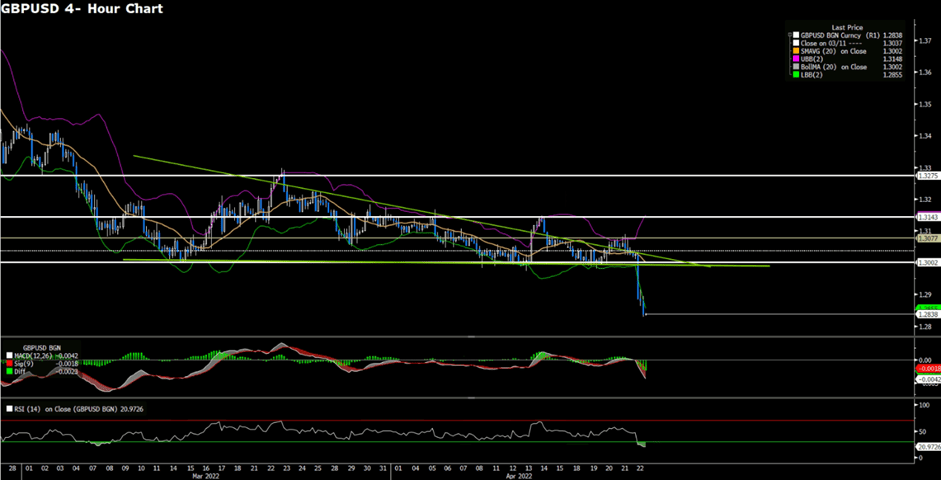
GBPUSD plunges to 18- month-old fresh lows around 1.2820 amid weak UK data and the US Fed’s continuously hawkish comments. Technically speaking, the outlook of GBPUSD on the four-hour chart remains heavily bearish following Friday’s sharp plummet, further breaking the bearish wedge. The RSI indicator fell well below the oversold territory on the four-hour chart; even though the oversold condition might suggest that GBPUSD could stage a pullback correction, buyers are likely to stay on the sidelines until GBPUSD climbs back above 1.3002. On the downside, the next target aims for psychological support at 1.2800, followed by 1.2730, the support level from October 2020.

Resistance: 1.3002, 1.3077, 1.3143

Support: 1.2800, 1.2730

Economic Data

CurrencyDataTime (GMT + 8)Forecast
EURGerman Ifo Business Climate Index (Apr)16:0089.1

U.S. stocks fell Thursday as investors continued to monitor a steady stream of corporate earnings results against a backdrop of elevated inflation and further Fed policy tightening. S&P 500 dropped and erased earlier gains. Dow Jones also turned lower. Nasdaq fell more than 2% and extended Wednesday’s losses when the tech-heavy index was weighed down by a slide in shares of Netflix. Meanwhile, Tesla’s (TSLA) shares rose after the electric vehicle-maker handily exceeded expectations in its fiscal first-quarter results.

After weeks of questions over whether Elon Musk is truly serious about acquiring Twitter Inc., his takeover bid got a lot more real on Thursday. The Tesla Inc. mogul lined up about $25.5 billion in debt financing from Morgan Stanley and other financial institutions, according to a regulatory filing, as well as pledging to contribute an additional $21 billion of his own money through equity financing.

Though details are still scarce on how the billionaire will fund his share of the bid, it was a show-me-the-money moment that signaled Musk isn’t just trolling Twitter with his takeover interest. The move capped a whirlwind 17 days since Musk announced he had acquired a stake of more than 9% in Twitter — becoming its largest shareholder — before turning down a board seat and launching a hostile bid for the company.

Through it all, it’s been hard to tell whether Musk would follow through on his offer. Musk is a prolific tweeter — posting a mix of memes, questions, and barbs — and has vowed to turn Twitter into a bastion for free speech. But a previous claim that he had secured funding to take Tesla private, an episode that drew a lawsuit from the U.S. Securities and Exchange Commission, has cast a shadow over his Twitter bid.

Main Pairs Movement

Risk-off trading conditions, triggered in part by a rise in the US yields amid hawkish Fed rhetoric and saw the safe-haven US dollar outperform, especially against commodity-linked currencies like the Australian, and New Zealand, with respective losses of 1.0% and 1.1%. The US Dollar Index (DXY) reversed an earlier dip below the 100.00 level to rally back into the 100.60s, where it trades with on-the-day gains of about 0.3%.

Fed Chair Jerome Powell, as expected, signaled that 50 bps rate hikes at upcoming meetings were likely and the usually more dovish leaning FOMC member Mary Daly even mentioned the possibility of a 75 bps move. The rate-sensitive euro and sterling plummeted right after Powell’s talks, and USD/CAD rallied from under 1.2500 to the 1.2600 mark, as stronger oil prices failed to offer the loonie respite.

Meanwhile, higher yields in the US (and elsewhere) saw the yen struggle, though albeit perform a little better than its risk-sensitive peers amid safe-haven demand as stocks fell. USD/JPY gained about 0.4% to rally into the 128.30s, with the bulls eyeing a potential retest of earlier multi-decade highs above 129.00 if US yields keep pushing higher and the BoJ keeps reiterating its dovish stance and defending its yield curve control target range.

Technical Analysis

USDJPY (4-Hour Chart)

USDJPY attracts some dip-buying buyers near the 20 Simple Moving Averages on Thursday. The US dollar is back to the bullish move following the hawkish comments from the US Fed. Technically speaking, the overnight sharp corrective pullback creates a parabolic rise for the pair, suggesting to attract more buying interest. The outlook of the USDJPY remains aggressive bullish as it continues trading within the ascending trendline and above the moving average. In the meantime, the RSI remains at the positive levels and has not reached the overbought territory, providing USDJPY room to extend further north.

Resistance:  129.4

Support:  127.41, 126.18, 125.18

AUDUSD (4-Hour Chart)

AUDUSD slides heavily toward 0.7370, erasing most of the gain from this week. From the technical perspective, AUDUSD turns downside and heads toward the next support pivot at 0.7372. The double top formation seems to be a convincing pattern for the pair to break below the support for a further near-term depreciating move. Failure to defend 0.7372 would reinforce by the fact that AUDUSD would trade within the bearish triangular wedge, accelerating the downside momentum toward 0.7277. Moreover, the RSI has not yet reached the oversold territory and currently clings within the negative levels, thus AUDUSD still has room to drop further south. 

Resistance: 0.7432, 0.7471, 0.7536

Support: 0.7372, 0.7277

EURUSD (4-Hour Chart)

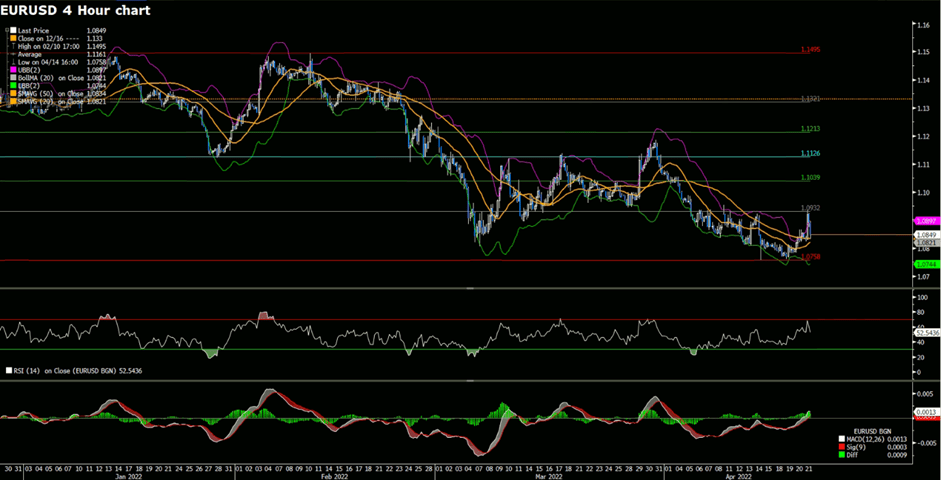
The eurodollar gained strength against the US dollar earlier today as investors welcomed the hawkish comments from the ECB; however, EURUSD accelerates its slump toward 1.8050, erasing most of the gain in the US trading session. From the technical perspective, EURUSD faces a substantial resistance at 1.0932, failing to break through the level. On the four-hour chart, EURUSD retreats and turns lower after the RSI hits near overbought readings, but still holds within the positive levels. Moreover, the pair is still on the track to attracting buying interest as it stays above the 20 and 50 Simple Moving Averages, temporarily limiting the bearish potential of the pair.

Resistance: 1.0932, 1.1039, 1.1126

Support: 1.0758

Economic Data

CurrencyDataTime (GMT + 8)Forecast

GBP

BoE Gov Bailey Speaks   

00:30

N/A

USD

Fed Chair Powell Speaks  

01:00

N/A

EUR

ECB President Lagarde Speaks

01:00

N/A

GBP

Retail Sales (MoM) (Mar)  

14:00

-0.3%

EUR

German Manufacturing PMI (Apr)

15:30

54.5

GBP

Composite PMI (Apr)  

16:30

59.7

GBP

Manufacturing PMI  

16:30

N/A

GBP

Services PMI  

16:30

N/A

CAD

Core Retail Sales (MoM) (Feb)  

20:30

0.1%

EUR

ECB President Lagarde Speaks

21:00

N/A

GBP

BoE Gov Bailey Speaks  

22:30

N/A
Back To Top
server

Hello there 👋

How can I help you?

Chat with our team instantly

Live Chat

Start a live conversation through...

  • Telegram
    hold On hold
  • Coming Soon...

Hello there 👋

How can I help you?

telegram

Scan the QR code with your smartphone to start a chat with us, or click here.

Don’t have the Telegram App or Desktop installed? Use Web Telegram instead.

QR code