Back

According to compiled data, Pakistan’s gold prices dropped, with declines reported in midweek trading sessions

Gold prices in Pakistan fell on Wednesday, based on FXStreet data. Gold was priced at PKR 44,631.11 per gram, down from PKR 44,828.19 on Tuesday. The price per tola dropped to PKR 520,568.50 from PKR 522,867.20 a day earlier. Other listed prices were PKR 446,294.50 for 10 grams and PKR 1,388,184.00 per troy ounce. FXStreet converts international gold prices into Pakistani rupees using the USD/PKR rate and local units. The figures are updated daily at publication time and are for reference, with local market rates able to differ slightly. Central banks are the largest holders of gold. World Gold Council data shows central banks added 1,136 tonnes worth around $70 billion in 2022, the highest annual total since records began. Gold often moves in the opposite direction to the US Dollar and US Treasuries. As a non-yielding asset, it can be affected by interest rates, geopolitical risk, recession fears, and changes in the US Dollar. We see gold’s role as a hedge against currency depreciation and inflation as being severely tested right now. The latest US inflation report for February 2026 showed a stubbornly high 3.1% reading, which should typically support gold. However, this has been overshadowed by the Federal Reserve’s commitment to keeping interest rates elevated, strengthening the US Dollar and creating a headwind for the precious metal. The significant central bank buying we observed back in 2022 has established a new pattern of behavior that provides a solid floor for prices. Looking at the most recent data from the World Gold Council for the fourth quarter of 2025, central banks globally added another 290 tonnes to their reserves. This consistent demand, particularly from emerging economies, suggests that any major price dips are likely to be viewed as buying opportunities by these large institutions. Furthermore, we must watch gold’s inverse relationship with risk assets, which are showing early signs of weakness. Following a period of calm in 2025, stock market volatility has been picking up, with the VIX index recently climbing above 19 for the first time this year. This growing uncertainty in equities could channel more investment into the perceived safety of gold over the next few weeks. Given these conflicting forces, derivative traders should consider strategies that capitalize on potential volatility rather than a specific direction. Implied volatility in gold options has been rising, indicating the market is pricing in a larger-than-usual price swing. This environment makes strategies like long straddles or strangles on gold futures attractive, as they can profit from a significant price move regardless of whether it is up or down. For those with a more cautiously bullish outlook, using call option spreads offers a defined-risk way to position for a potential rally. By purchasing a call at a lower strike price and selling one at a higher strike, traders can limit their upfront cost and maximum loss. This allows for participation in a potential upside break driven by safe-haven flows, while hedging against the persistent strength of the US Dollar.

Start trading now – Click here to create your real VT Markets account

Ahead of central bank events, EUR/USD trades sideways under the 200-hour SMA near 1.1550 during Asia

EUR/USD is moving sideways after rising over the past two days, trading just below the mid-1.1500s. It is holding below the 200-hour SMA at 1.1547 after rebounding from 1.1415–1.1410, its lowest level since August 2025. Markets are waiting for the Federal Reserve decision after its two-day meeting later on Wednesday, and the ECB update on Thursday. Attention is on the future rate path, with concern that a war-driven rise in energy prices could hurt growth and increase inflation pressure. Technicals show the RSI near 62, still positive but not overbought. The MACD line has edged below the signal line near zero, pointing to weaker upward momentum. Resistance is at the 50.0% retracement level of 1.1539, then 1.1569 at the 61.8% level, and the 100-period SMA area near 1.1580. Support is at 1.1509 (38.2%), then 1.1473 (23.6%), with a break below 1.1473 targeting 1.1413, while holding above 1.1569 shifts focus to 1.1612–1.1666. Looking back at late 2025, we saw the EUR/USD get stuck below the 1.1550 level as everyone waited for guidance from the Fed and ECB. This kind of consolidation before major news creates specific opportunities for derivative traders. The key takeaway from that period was the market’s indecision, which signaled that a significant move was coming. In these situations, the primary strategy is to position for a breakout in volatility rather than a specific direction. Traders should consider buying options, such as straddles or strangles, which profit from a large price swing regardless of whether it is up or down. The goal is to own the potential for movement before the central bank announcements release the market’s pent-up energy. The technical levels mentioned were critical triggers for options traders back then. A move above the 1.1569 resistance would have been a clear signal to favor call option strategies, while a break below support at 1.1473 would have favored puts. These levels acted as clear lines in the sand for positioning for the post-announcement trend. Today, on March 18, 2026, we see a different picture with the pair trading much lower, around 1.0830. Recent data shows Eurozone inflation holding stubbornly at 2.6% while the latest US CPI came in at 2.9%, keeping both the ECB and Fed under pressure. This continued policy divergence suggests that even small surprises in upcoming statements could spark significant volatility from current levels. Given that currency market volatility has been relatively compressed in early 2026, options pricing may offer good value for traders anticipating a breakout in the coming weeks. We should be looking at the calendar for the next central bank meetings and key inflation reports as catalysts. The lesson from 2025 is that positioning for the event itself is often more profitable than trying to guess the direction beforehand.

Start trading now – Click here to create your real VT Markets account

FXStreet data shows gold prices in India declined, with the metal trading lower during Wednesday

Gold prices in India fell on Wednesday, based on data compiled by FXStreet. Gold was priced at INR 14,888.97 per gram, down from INR 14,941.65 on Tuesday. The price per tola fell to INR 173,662.40 from INR 174,276.40 a day earlier. Other listed rates were INR 148,890.00 for 10 grams and INR 463,106.90 per troy ounce.

How FXStreet Calculates India Gold Prices

FXStreet derives India gold prices by converting international prices using USD/INR and applying local units. The figures are updated daily at publication time and are for reference, as local prices may vary. Central banks hold the largest gold reserves and were reported to have added 1,136 tonnes worth about $70 billion in 2022, according to the World Gold Council. This was the highest annual total since records began, with emerging economies such as China, India and Turkey increasing reserves. Gold is described as inversely linked to the US Dollar and US Treasuries, and also inversely linked to risk assets. Price moves are linked to geopolitical risk, recession fears, interest rates, and shifts in the US Dollar because gold is priced in dollars (XAU/USD). We’ve seen a minor dip in gold prices today, but this short-term noise is less important than the metal’s role as a safe haven. This slight pullback could be a valuable entry point for traders positioning for the coming weeks. The underlying factors supporting gold remain very strong.

Outlook For Gold And Trading Strategy

The market is anticipating that the U.S. Federal Reserve may begin cutting interest rates later this year as global economic growth shows signs of slowing. Historically, lower interest rates weaken the US dollar, which is typically good for gold. We’ve already seen the Dollar Index fall nearly 2% since the beginning of 2026, creating a favorable environment for the metal. We must also consider the consistent buying from central banks, which provides a solid floor for the price. Looking back from 2025, we saw them buy a record 1,136 tonnes in 2022, and reports from the World Gold Council showed this intense demand continued through 2023 and 2024. This trend of diversifying away from the dollar by official institutions is a powerful long-term signal. With inflation still hovering above the 2% target in many major economies, gold’s appeal as a hedge remains high. Geopolitical uncertainty also continues to drive investors towards safety. For derivative traders, these factors suggest that betting on price increases is the logical path forward. Therefore, buying call options that expire in the next three to six months looks like a sensible strategy. This approach allows traders to benefit from expected price gains while limiting downside risk to the premium paid. A continued weakening of the dollar should be seen as a key indicator to increase these bullish positions. Create your live VT Markets account and start trading now.

Start trading now – Click here to create your real VT Markets account

FXStreet figures show Malaysian gold prices decreased, with data indicating a fall reported midweek in Malaysia

Gold prices in Malaysia fell on Wednesday, based on FXStreet data. Gold was priced at MYR 627.56 per gram, down from MYR 629.52 on Tuesday. The price per tola dropped to MYR 7,319.79 from MYR 7,342.64 a day earlier. Other listed rates were MYR 6,275.64 for 10 grams and MYR 19,519.49 per troy ounce.

Malaysia Gold Price Methodology

FXStreet derives Malaysia’s gold prices from international rates using the USD/MYR exchange rate and local units. Prices are updated daily at the time of publication and are for reference, with local rates able to differ slightly. Central banks hold the most gold and added 1,136 tonnes worth about $70 billion in 2022, according to the World Gold Council. This was the highest annual purchase since records began, with China, India and Turkey among the countries increasing reserves. Gold often moves inversely to the US Dollar and US Treasuries, and can also move opposite to risk assets such as shares. Prices can also react to geopolitical events, recession fears, and changes in interest rates, and are influenced by the US Dollar because gold is priced in dollars (XAU/USD). Given the minor dip in gold prices today, March 18, 2026, we see this not as a sign of weakness but as a temporary fluctuation. The real drivers for gold are tied to expectations for the US economy and Federal Reserve policy. The market is currently pricing in at least two interest rate cuts by the end of this year, a significant shift that supports a bullish outlook for non-yielding assets.

Strategy And Market Outlook

Looking back, we remember the trend from 2025 where central banks continued their aggressive gold purchases, adding over 1,030 tonnes to global reserves according to World Gold Council data. This consistent buying from institutions provides a strong floor under the market, limiting the potential downside of any price corrections. We see this institutional demand as a key stabilizing force that is likely to absorb near-term selling pressure. This environment, marked by slowing economic growth forecasts and sticky inflation around 2.7%, creates uncertainty that is increasing gold’s appeal as a safe-haven asset. Implied volatility on gold options has been creeping up from its 2025 lows, suggesting traders are preparing for a larger price move in the coming months. Therefore, simply holding futures may not be the most capital-efficient strategy. We believe traders should consider purchasing long-dated call options, such as those expiring late in the fourth quarter of 2026, to position for a significant rally when rate cuts become a reality. To offset the premium cost, one could look at selling shorter-term, out-of-the-money puts, capitalizing on the underlying support from central bank buying. This strategy positions for upside while defining risk. Furthermore, gold’s inverse correlation with risk assets is becoming more pronounced. The S&P 500 has struggled to find direction in the first quarter of 2026 amid concerns over corporate earnings in a slowing economy. As capital flows out of equities seeking safety, we anticipate gold will be a primary beneficiary. Create your live VT Markets account and start trading now.

Start trading now – Click here to create your real VT Markets account

AUD/JPY edges higher near 113.00 in Europe, buoyed by RBA hike and hawkishness, targeting 113.50 resistance

AUD/JPY edged up to about 113.00 in early European trade on Wednesday after the Reserve Bank of Australia raised rates and maintained a hawkish stance. The RBA lifted the Official Cash Rate by 25 bps to 4.10% at its March meeting, following a similar move in February and marking the first back-to-back rises since mid-2023. Governor Michele Bullock said prices remained too high, and the board was concerned about second-round effects from higher energy costs linked to the Middle East conflict. Focus now turns to Australia’s February jobs figures due on Thursday, with the Unemployment Rate forecast to hold at 4.1%.

Middle East Risk And Safe Haven Demand

Middle East developments are also being watched for their impact on safe-haven demand. The BBC reported that Iranian security chief Ali Larijani was killed in Israeli air strikes, and Iranian army chief Amir Hatami said Iran would launch a decisive and regrettable retaliation. On the chart, AUD/JPY stays above the 100-day exponential moving average near 106.40, with RSI in the low 60s. Resistance sits at 113.70 and 113.80, with 115.00 next, while support is at 111.40, 110.15–110.35, and 108.70. With the Reserve Bank of Australia hiking rates to 4.10%, we see a clear signal of strength for the Aussie dollar. This is the second consecutive rate increase, reinforcing a hawkish stance not seen since mid-2025. This policy divergence strongly favors the AUD over the Japanese Yen, making long positions in AUD/JPY attractive. The RBA’s worry about inflation is well-founded, given the recent spike in energy costs from the Middle East conflict. We saw a similar situation back in 2022 when the conflict in Eastern Europe pushed WTI crude oil prices above $120 per barrel, showing how quickly geopolitical events can fuel inflation. This history supports the RBA’s decision to act now, which should continue to prop up the Aussie. However, the escalating tension in the Middle East presents a significant risk to this trade. The killing of an Iranian security chief and vows of retaliation are driving safe-haven demand directly into the Japanese Yen. Derivative traders should consider hedging long AUD positions with puts, as a full-blown conflict could quickly unwind recent gains.

Key Catalyst Australia Jobs Data

This week’s Australian employment data is the next major catalyst. An unemployment rate holding at the expected 4.1% would confirm the labor market is resilient enough to handle higher interest rates, giving the RBA more room to hike. This figure remains low compared to historical averages, showing the economy is still on solid footing despite the global pressures we’ve seen build since 2025. From a technical standpoint, the pair’s momentum is strong, suggesting buying call options is a viable strategy. With the price holding firmly above the 100-day average near 106.40 and RSI staying below overbought levels, there appears to be more room to run. A clean break above the 113.80 resistance level could open a path toward the 115.00 psychological mark. For risk management, the 111.40 level serves as an initial floor for the current uptrend. A break below this support might be a signal to tighten stops or reduce long exposure. The most critical level to watch is the 108.70 area, as a drop below this would threaten the entire bullish structure we’ve seen build over recent months. Create your live VT Markets account and start trading now.

Start trading now – Click here to create your real VT Markets account

Dollar Slips as Oil Eases and Risk Appetite Returns

Key Points

  • USDX trades near 99.26, down -0.03%, extending its recent pullback.
  • Easing oil prices have supported risk appetite, weighing on safe-haven demand for the dollar.
  • Markets now focus on Federal Reserve and global central bank meetings for policy direction.

The U.S. dollar softened on Wednesday, giving back some of its recent safe-haven gains as oil prices eased and market sentiment improved ahead of a pivotal week for global central banks.

The US Dollar Index (USDX) is trading near 99.26, down -0.03%, marking a third consecutive session of declines. The move follows a strong rally last week that pushed the dollar to a 10-month high, driven by escalating geopolitical tensions and surging energy prices.

However, with oil prices pausing and pulling back modestly, markets have begun to reintroduce risk exposure, reducing demand for the dollar.

If oil continues to stabilise or decline, the dollar may face further short-term pressure as risk sentiment improves.

Oil Pullback Eases Safe-Haven Demand

The key driver behind the dollar’s recent weakness has been the easing in oil prices. Crude declined after Iraqi and Kurdish authorities agreed to resume exports via Turkey’s Ceyhan port, helping to ease immediate supply concerns.

While Brent crude remains above $100 per barrel, the pause in its upward momentum has been enough to shift market positioning, at least temporarily.

Lower oil prices can reduce inflation fears and ease pressure on global growth, encouraging traders to move away from defensive assets like the U.S. dollar.

If oil resumes its upward trend, safe-haven demand for the dollar could return quickly.

Central Banks Take Centre Stage

Markets are now firmly focused on a series of central bank meetings, starting with the Federal Reserve, followed by the European Central Bank, Bank of England, and Bank of Japan.

All are widely expected to keep interest rates unchanged, but traders will be closely watching for forward guidance, particularly regarding inflation and growth risks stemming from the ongoing Middle East conflict.

The key question for policymakers is whether the energy shock will primarily slow economic activity or lead to more persistent inflation.

A more hawkish tone from central banks could limit further dollar weakness, while a cautious or balanced outlook may support risk assets and weigh on the greenback.

Technical Analysis

The US Dollar Index (USDX) is trading near 99.26, marginally lower on the session (-0.03%), as the recent recovery rally begins to lose momentum just below the psychological 100 level. After rebounding strongly from the 95.33 low, the dollar has entered a phase of consolidation, suggesting the market is reassessing directional conviction.

From a technical standpoint, short-term momentum is starting to soften. The 5-day moving average (99.52) has begun to turn lower, while the 10-day (99.17) sits just beneath current price, acting as near-term support.
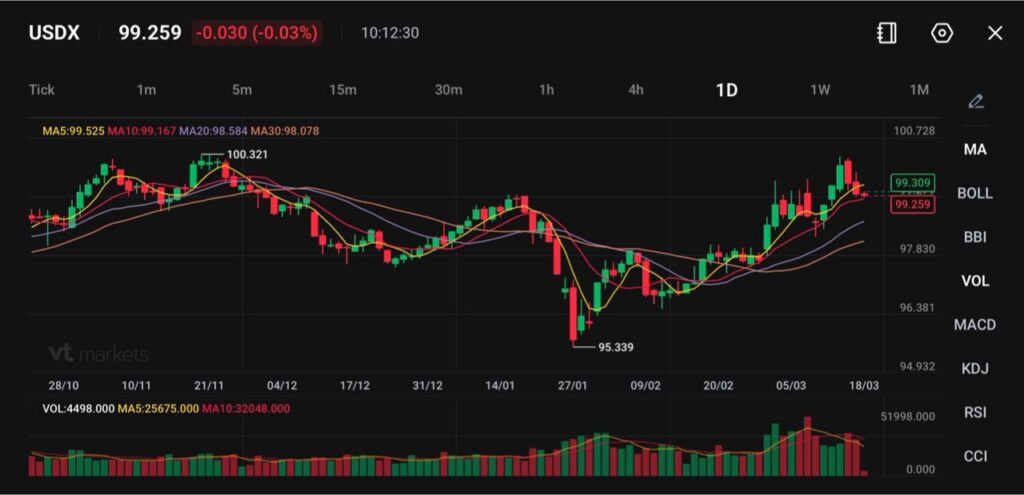
The 20-day (98.58) and 30-day (98.08) remain upward sloping, indicating that the broader recovery structure is still intact despite the current pause.

Immediate support is seen around 99.00–99.10, with a break below this zone potentially exposing downside toward 98.50, where the 20-day average aligns.

On the upside, resistance is firmly positioned at 100.30–100.70, a region that has repeatedly capped bullish attempts and remains a key barrier for further upside continuation.

Overall, the USDX appears to be consolidating below major resistance, with the broader bias still constructive following its recovery from February lows.

However, failure to reclaim the 100 level may lead to further sideways movement or a modest pullback, especially if macro catalysts—such as shifting rate expectations—begin to weigh on dollar strength.

What Traders Should Watch Next

The dollar now sits at a crossroads between geopolitical risk and improving sentiment. Key drivers to monitor include:

  • Movements in oil prices, particularly whether Brent holds above $100
  • Outcomes and guidance from major central bank meetings
  • Developments in the Middle East conflict
  • Currency moves in USDJPY and EURUSD

For now, the dollar’s pullback appears to be a reaction to easing oil prices rather than a full reversal, with broader trends still dependent on how geopolitical and macroeconomic risks evolve.

Learn more about trading Indices on VT Markets today.

FAQs

Why is the US Dollar Falling Today?

The US dollar is weakening because oil prices have eased, reducing safe-haven demand and allowing investors to shift back into risk assets ahead of central bank decisions.

What is Causing USD Weakness Right Now?

A combination of lower oil prices, improved market sentiment, and positioning ahead of central bank meetings is putting short-term pressure on the dollar.

Is the Dollar Still in an Uptrend?

Yes, the broader trend remains supported by geopolitical risks and earlier safe-haven demand. However, the current pullback suggests a short-term correction or consolidation phase.

How Do Oil Prices Affect the US Dollar?

Rising oil prices tend to support the dollar due to its safe-haven status and the U.S. being a net energy exporter. When oil falls, this support weakens, and the dollar can decline.

Why is the Yen Strengthening Against the Dollar?

The yen is gaining as risk sentiment improves and as USDJPY moves away from the 160 level, where markets had expected potential intervention from Japanese authorities.

Why is the Euro Rising Against the Dollar?

The euro is strengthening ahead of the European Central Bank meeting, as traders position for policy guidance and potential shifts in inflation outlook.

What Are Markets Expecting From the Federal Reserve?

Markets widely expect the Federal Reserve to keep interest rates unchanged, but are focused on forward guidance regarding inflation and future rate cuts.

Start trading now – Click here to create your real VT Markets account

Traders keep USD/CAD near 1.3690, staying cautious before Federal Reserve and Bank of Canada decisions later

USD/CAD was little changed at about 1.3690 in Asian trading on Wednesday, after small gains in the prior session. Traders are cautious before policy decisions from the Federal Reserve and the Bank of Canada later in the day. Markets expect the Federal Reserve to keep its benchmark rate unchanged in the 3.50%–3.75% range for March, based on the CME FedWatch Tool. Attention is on Jerome Powell’s guidance, including how higher oil prices could affect the policy outlook amid economic and geopolitical uncertainty.

Bank Of Canada Rate Expectations

For Canada, Rabobank expects the Bank of Canada to hold its overnight rate at 2.25% at the meeting and to keep it there through year-end. This view matches the Bloomberg survey consensus and is fully priced in, even as inflation persists and growth slows, while markets also price a possible rate rise. The pair may stay supported as the Canadian Dollar faces pressure from softer oil, with WTI near $94.00 per barrel. Oil could regain support if tensions around the Strait of Hormuz rise, with the US reporting strikes on Iranian coastal sites, and reports that Israel claimed strikes that killed Ali Larijani and Basij chief Gholamreza Soleimani. We are looking back at the market mood from March 2025, when caution dominated ahead of central bank decisions with USD/CAD hovering near 1.3690. At that time, traders were focused on how oil price surges and geopolitical conflict would shape policy. Both the Federal Reserve and the Bank of Canada were expected to hold rates steady, a familiar pause in a period of uncertainty. Fast forward to today, March 18, 2026, and the landscape has evolved significantly, creating a clear policy divergence. The Fed funds rate is now at 4.75%-5.00% after recent data showed stubbornly high US inflation at 3.4% and another strong jobs report adding 265,000 positions last month. This data supports a stronger US Dollar, as markets are now pricing in less than a 50% chance of a rate cut before the third quarter.

Policy Divergence Trade Implications

Conversely, the Bank of Canada, with its policy rate at 3.50%, faces a different picture. Canada’s latest CPI reading came in at 2.9%, continuing its downward trend and falling within the bank’s target range, while recent housing start figures showed a notable decline. This economic softness suggests the BoC may have to consider easing policy sooner than the Fed, putting downward pressure on the Canadian dollar. The oil market dynamic has also shifted from what we saw in 2025 when WTI was trading near $94 amid tensions in the Strait of Hormuz. Today, WTI crude is trading closer to $85 per barrel after the latest Energy Information Administration (EIA) report showed a surprise build in US inventories, weighing on prices. This relative softness in the oil market removes a key pillar of support for the loonie that was present last year. Given this widening gap in economic performance and monetary policy, derivative traders should consider positions that profit from further USD/CAD strength. Buying USD/CAD call options with expirations in the coming months offers a way to capture potential upside while defining risk. Implied volatility may rise ahead of upcoming central bank meetings, making now a good time to establish such positions. Another strategy is to use bull call spreads on USD/CAD to cheapen the cost of a bullish directional bet. The interest rate differential between the US and Canada, which we see has now widened to over 125 basis points, provides a strong fundamental tailwind for this trade. This carry trade advantage makes holding long USD positions against the CAD increasingly attractive for the medium term. Create your live VT Markets account and start trading now.

Start trading now – Click here to create your real VT Markets account

During the Asian session, NZD/USD inches above the mid-0.5800s, restrained before the FOMC decision

NZD/USD edged up in the Asian session on Wednesday and traded just above the mid-0.5800s. Gains were limited, with little follow-through ahead of the Federal Open Market Committee (FOMC) rate decision. The pair remained below the 200-day Simple Moving Average (SMA). Traders awaited the two-day FOMC outcome due later in the North American session before taking new positions.

Dollar Consolidation In Focus

The US Dollar consolidated after pulling back from its highest level since May 2025. A firmer tone in equity markets reduced demand for safe-haven assets and supported the New Zealand Dollar. Expectations that higher crude oil prices could lift inflation added support to the US Dollar. Reduced expectations for near-term Federal Reserve rate cuts also limited USD declines. Middle East tensions also restrained risk appetite and supported the US Dollar. These developments helped cap NZD/USD gains. On Tuesday, Iranian security official Ali Larijani and Basij commander Gholamreza Soleimani were reported killed in Israeli air strikes. Iran’s army said it would retaliate for Larijani’s death, while the US military said it targeted sites along Iran’s coastline near the Strait of Hormuz, described as a critical energy chokepoint.

Key Levels And Policy Crosscurrents

We are seeing the NZD/USD pair hovering above the mid-0.5800s, but it’s clearly struggling to gain any real traction ahead of the big FOMC decision. The pair remains capped below its 200-day moving average, signaling that traders are hesitant to push it higher without a clear signal from the US Federal Reserve. This indecision suggests that the market is bracing for a significant move. The core issue is the market’s shifting expectation for Fed rate cuts, which is keeping the US Dollar strong. With US CPI inflation data last week coming in at a persistent 3.4% year-over-year, the odds of a rate cut at this meeting have plummeted to just 15% according to the CME FedWatch tool. We saw how similar stubborn inflation readings in late 2025 pushed rate cut expectations further out, and that dynamic is supporting the dollar now. At the same time, geopolitical tensions in the Middle East are providing a floor for the dollar’s value due to its safe-haven status. The recent events involving Israeli strikes on Iranian officials and US military action near the Strait of Hormuz—a chokepoint for nearly 20% of global oil supply—are keeping traders on edge. This backdrop favors holding dollars and limits the appeal of riskier currencies like the Kiwi. Looking back to the volatility we experienced in the second half of 2025, any subtle shift in the Fed’s language caused sharp, multi-day moves in currency pairs. We should expect similar sensitivity today, meaning the current quiet period is likely to end abruptly after the announcement. This suggests that a directional bet placed now is highly speculative. Given this uncertainty, traders could consider options strategies that profit from a spike in volatility, regardless of the direction. Buying straddles or strangles allows a trader to benefit from a large price swing, which is a likely outcome following the Fed’s statement and press conference. This approach hedges against the risk of guessing the direction incorrectly in a news-driven market. However, we must also consider that the Reserve Bank of New Zealand is running its own restrictive policy, holding its cash rate at 5.5% to fight domestic inflation. This provides some underlying support for the Kiwi and could mute the pair’s downside if the Fed’s message is less aggressive than anticipated. This tug-of-war between two hawkish central banks explains the current tight trading range. Create your live VT Markets account and start trading now.

Start trading now – Click here to create your real VT Markets account

Following the RBA’s hawkish rate rise, the Australian dollar lifts AUD/USD near 0.7115 as Fed awaits decision

AUD/USD rose to about 0.7115 in Asian trading on Wednesday. The Australian Dollar gained against the US Dollar after a 25 bps rate rise by the Reserve Bank of Australia (RBA). The RBA lifted the Official Cash Rate by 25 bps to 4.10% from 3.85% at its March meeting. This followed another 25 bps increase in February, making it the second straight rise this year.

Rba Signals Inflation Focus

The RBA said inflation was still too high and noted concerns about second-round effects from higher energy costs linked to the Middle East conflict. The bank also said the latest move did not set a fixed course for future policy. Markets expect the US Federal Reserve to leave rates unchanged at its March meeting on Wednesday. Jerome Powell is set to hold a press conference before his term ends in May. Some analysts think the Fed may not cut rates until October or December 2026 due to geopolitical uncertainty. The Fed decision is due later on Wednesday. We see a clear policy split forming between the Reserve Bank of Australia and the US Federal Reserve. The RBA just pushed its interest rate to 4.10% yesterday to fight inflation, while the Fed is widely expected to stay on hold later today. This widening interest rate difference should continue to support the Australian dollar over the US dollar.

Trading Implications For Audusd

The RBA’s move is understandable, as Australian inflation was still running at 3.8% at the end of 2025, remaining stubbornly above the central bank’s target band. In contrast, the US economy is showing signs of moderation, with the February jobs report indicating a gain of a solid but not inflationary 190,000 positions. This gives the Fed reason to pause and assess the impact of global tensions. For traders, this suggests a bullish stance on the AUD/USD pair in the near term. Buying call options with strike prices around 0.7200 could be a strategy to capitalize on expected upward momentum over the next few weeks. This approach allows traders to define their maximum risk to the premium paid for the option. However, we must consider that implied volatility is currently elevated, with one-month options pricing in around 9.5% of expected movement, making them more expensive. A surprise hawkish tone from the Fed today remains the primary risk that could reverse the pair’s direction. To manage costs and risk, using a bull call spread might be more prudent than buying calls outright. Looking ahead, the uncertainty surrounding the US dollar will persist as Fed Chair Powell’s term ends in May. The market has pushed expectations for the first Fed rate cut out to late 2026, which should provide a floor for the dollar. This suggests the AUD/USD’s climb may be a steady grind higher rather than a sharp rally. Create your live VT Markets account and start trading now.

Start trading now – Click here to create your real VT Markets account

For the session ahead, China’s central bank fixed USD/CNY at 6.8909, previously 6.8961, versus 6.8798 estimate

On Wednesday, the People’s Bank of China (PBoC) set the USD/CNY central rate at 6.8909 for the next trading session. This compared with the previous day’s fix of 6.8961 and a Reuters estimate of 6.8798. The PBoC’s main monetary policy aims are price stability, including exchange rate stability, and supporting economic growth. It also works on financial reforms to open and develop China’s financial market.

Governance And Independence

The PBoC is owned by the state of the People’s Republic of China, so it is not an autonomous body. The Chinese Communist Party Committee Secretary, nominated by the Chairman of the State Council, has strong influence over management, and Pan Gongsheng holds both that role and the governor post. The PBoC uses tools such as a seven-day reverse repo rate, the Medium-term Lending Facility, foreign exchange actions, and the reserve requirement ratio. The Loan Prime Rate is China’s benchmark rate and affects borrowing, mortgages, and savings rates, as well as the Renminbi’s exchange rate. China has 19 private banks, including WeBank and MYbank. In 2014, China allowed domestic lenders funded fully by private capital to operate in the state-led sector. The central bank’s stronger-than-expected fixing for the Yuan today signals an intent to slow its depreciation rather than reverse its course. This action, set against a backdrop of market expectations for a weaker currency, suggests the PBOC is managing a gradual decline. Traders should therefore anticipate continued intervention to prevent any rapid sell-offs in the coming weeks.

Market Implications And Strategy

We see this move in the context of China’s mixed economic data from early 2026, where NBS figures showed retail sales growth slowing to 3.5% year-on-year for the January-February period, creating pressure for monetary easing. This contrasts with more robust export numbers, forcing policymakers into a delicate balancing act. The underlying economic weakness suggests the Yuan will remain under pressure despite these daily fixings. Looking back, the policy divergence with the West that we saw throughout 2025 has become even more pronounced. The US Federal Reserve has maintained a hawkish stance in the first quarter of 2026, holding its benchmark rate steady at 5.50% amid persistent wage inflation data. This widening interest rate differential continues to make holding dollar assets more attractive than yuan-denominated ones. Given the pressure on the currency, we don’t expect the PBOC to cut its main policy rate, the Loan Prime Rate (LPR), in the near term. Instead, it is more likely they will opt for a cut to the Reserve Requirement Ratio (RRR) for banks to inject liquidity without directly weakening the Yuan. This subtle policy move would aim to support the domestic economy while trying to maintain currency stability. For derivative traders, this environment points towards elevated volatility in the USD/CNH pair. The PBOC’s inconsistent and often surprising daily fixes create opportunities for those positioned to profit from sharp, short-term price swings. Strategies that benefit from volatility, such as buying options, should be considered over outright directional bets on the Yuan’s value. Create your live VT Markets account and start trading now.

Start trading now – Click here to create your real VT Markets account

Back To Top
server

Hello there 👋

How can I help you?

Chat with our team instantly

Live Chat

Start a live conversation through...

  • Telegram
    hold On hold
  • Coming Soon...

Hello there 👋

How can I help you?

telegram

Scan the QR code with your smartphone to start a chat with us, or click here.

Don’t have the Telegram App or Desktop installed? Use Web Telegram instead.

QR code

