Daily Market Analysis

Market Focus

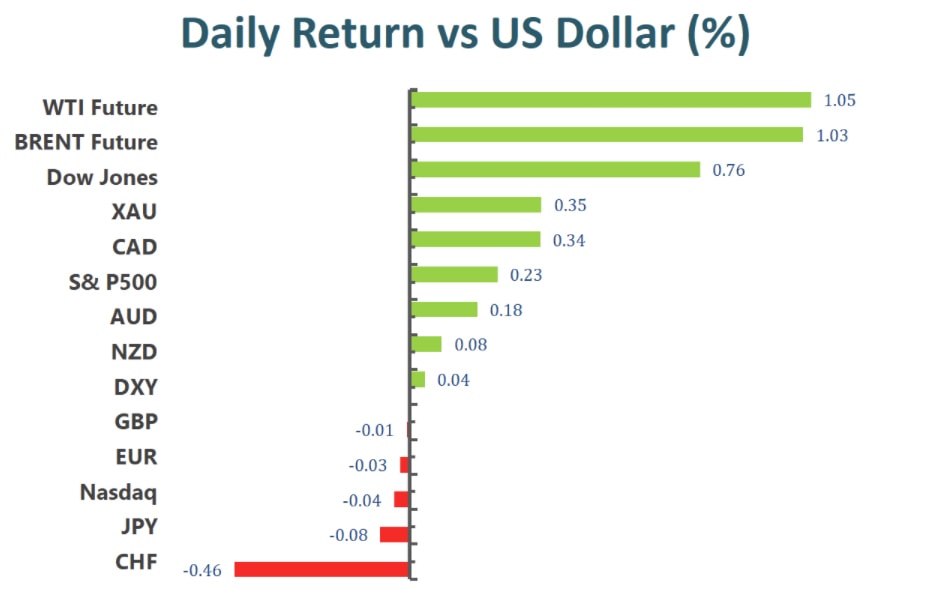
US stock declined on Monday, which was also the biggest fall in about four months. Concerns about China’s real-estate sector and a possible Fed bond tapering caused a plummet in global stock market. However, the S&P 500 index pared some losses in the last hour of trading, as traders started to buy the dip again. The bearish movement witnessed in S&P 500 was an opportunity to buy stocks amid improved global economic recovery.

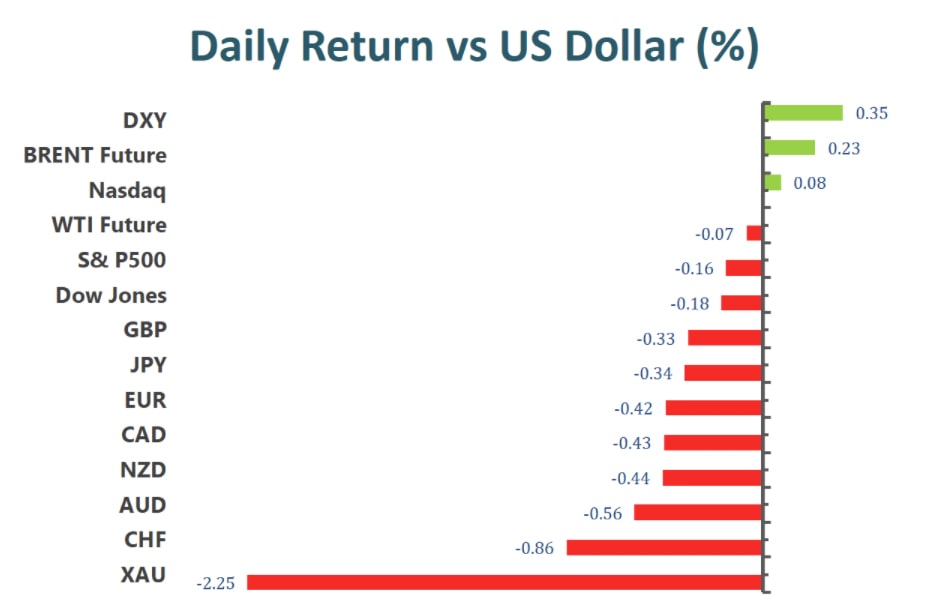
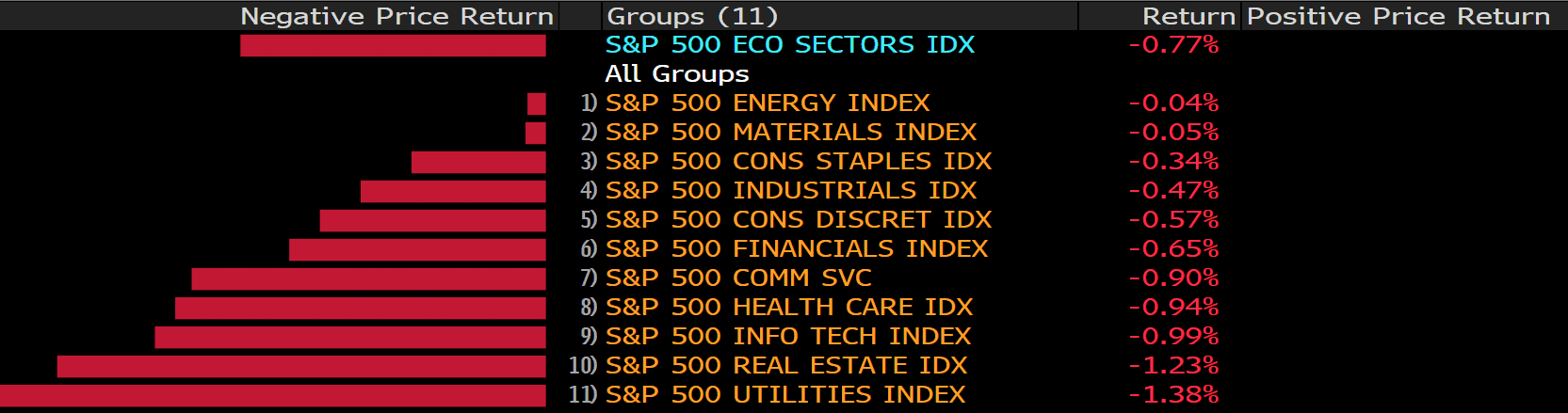
The benchmarks, S&P 500, Dow Jones and Nasdaq both dropped on Monday. S&P 500 was down 1.7% on a daily basis, the index finished in the negative territory for a third day and erased its gains from earlier in the week. The energy, cons discret and financials sectors are the worst performing among all groups, dropped 3.04%, 2.37% and 2.22%, respectively. The Nasdaq fell to its lowest level in about a month.

US dollar and Treasuries both gained before Wednesday’s Fed meeting, as investors expect Fed to give more hints about the timetable of tapering. Strong US Retail Sales data also supported prospects of early Fed tapering, which would eventually be seen to take away the punch bowl for Wall Street.

In Asia, Hong Kong stocks slumped as investors tracked the risk of contagion from the debt crisis at China Evergrande Group. Evergrande executives are working to remedy its business prospects but a messy meltdown at worst or a managed collapse are feared. Therefore, a bailout by Beijing can be hoped as a best scenario for financial markets.
  

Main Pairs Movement:

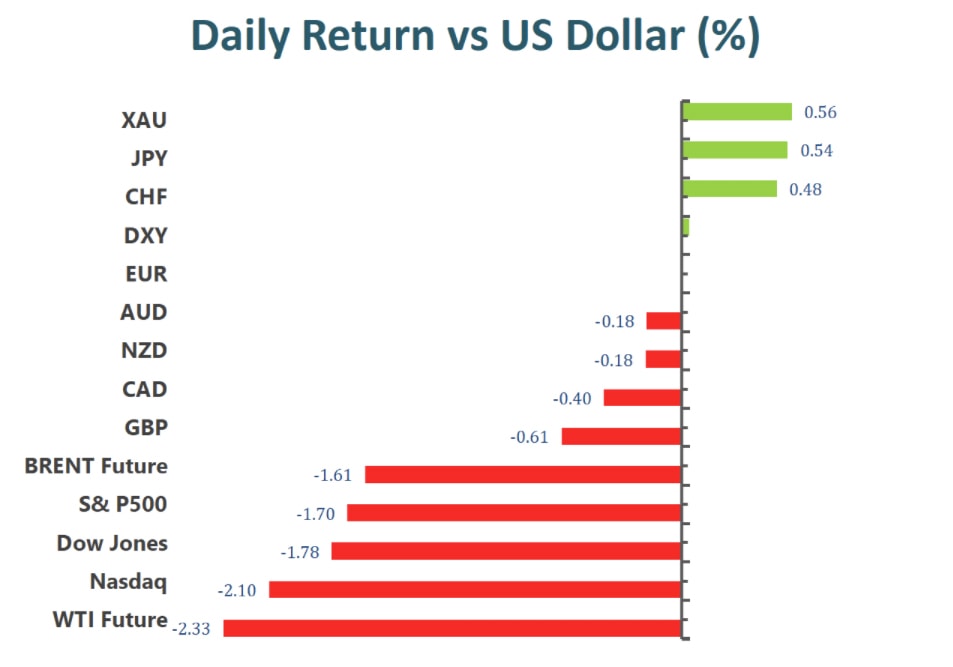
Monday’s trading was marked by a broad market price correction and fears over the possible default of China’s property developer giant, Evergrande Group, which has one of the world’s largest debt burdens for any publicly traded real estate management or development company. Analysts have also pointed out that a price correction was due because of the long bull run that U.S. indices have enjoyed over much of 2021. The Hang Sheng Index dropped 3.3% to its lowest close since October.

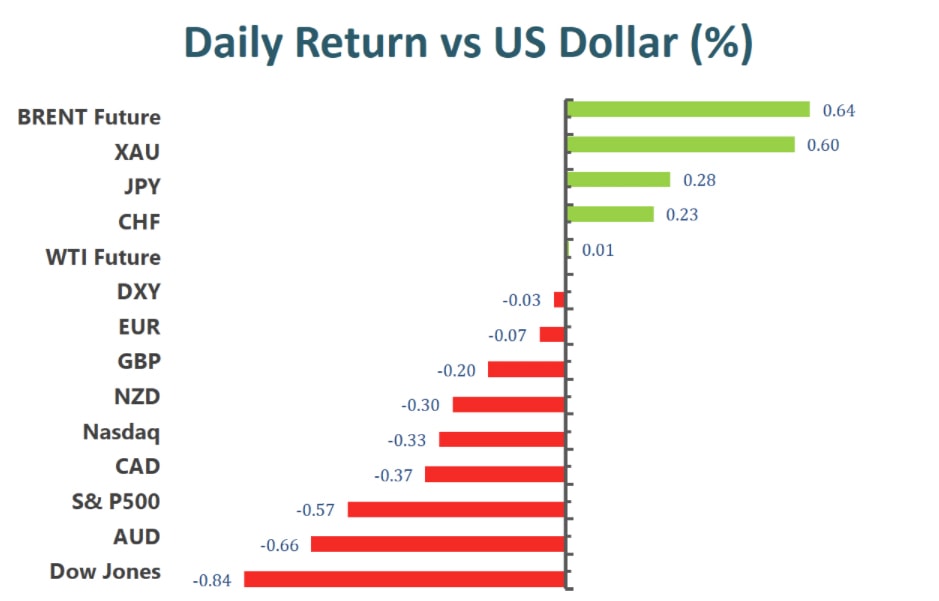
All U.S. dollar based foreign exchange pairs fell as demand for the safe haven dollar increased amid concerns over China’s credit issue. Cable saw strong selling pressure at the beginning of Monday’s trading and is struggling to find support as trading continues through the day. USD/CAD rallied on the back of strong demand in the U.S. dollar. AUD/USD struggled, as well, on the dollar’s rally. Investors will be paying attention to the RBA minutes, which is scheduled to release on the 21st.


Technical Analysis:

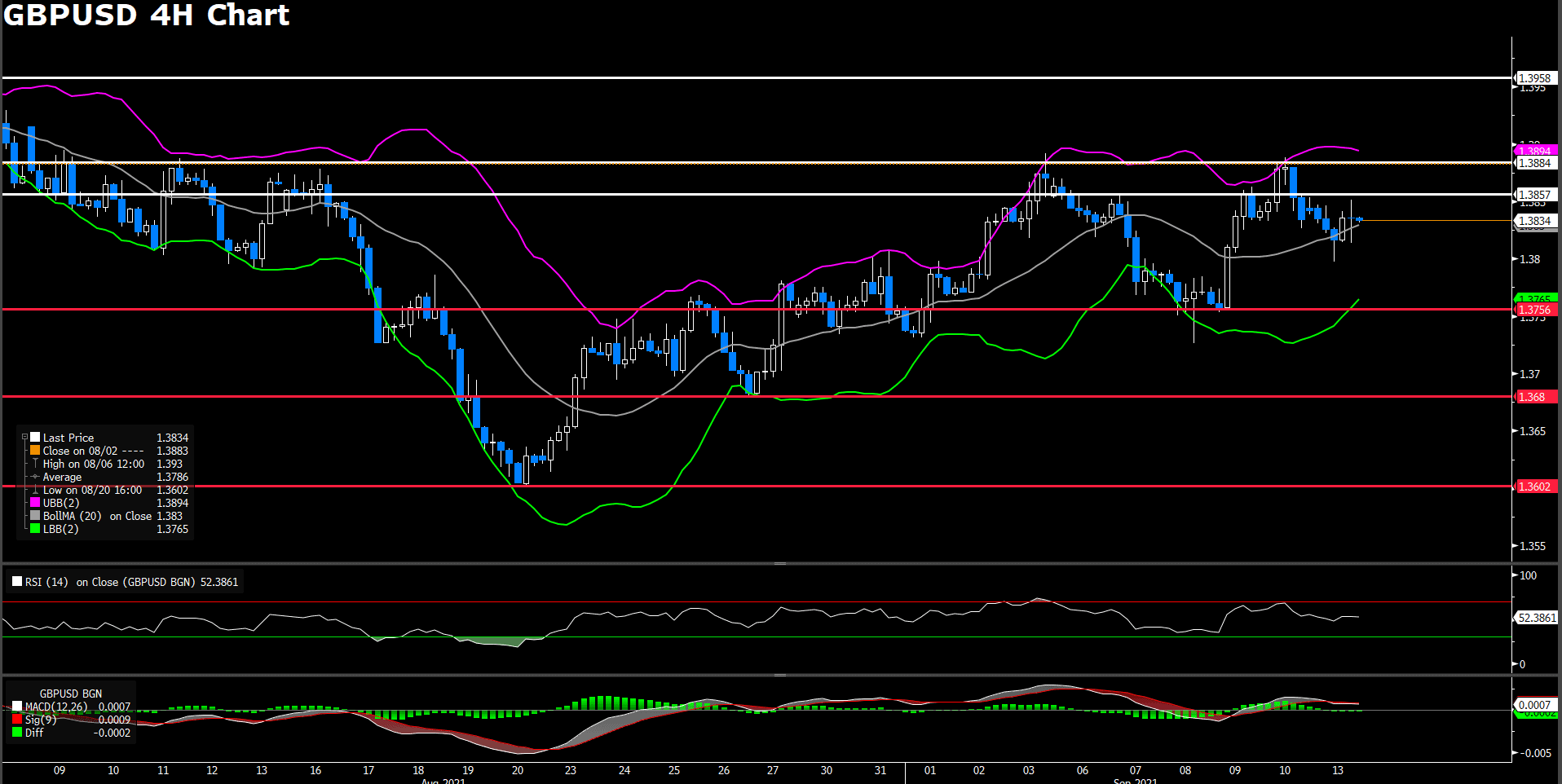
GBPUSD (4-hour Chart)
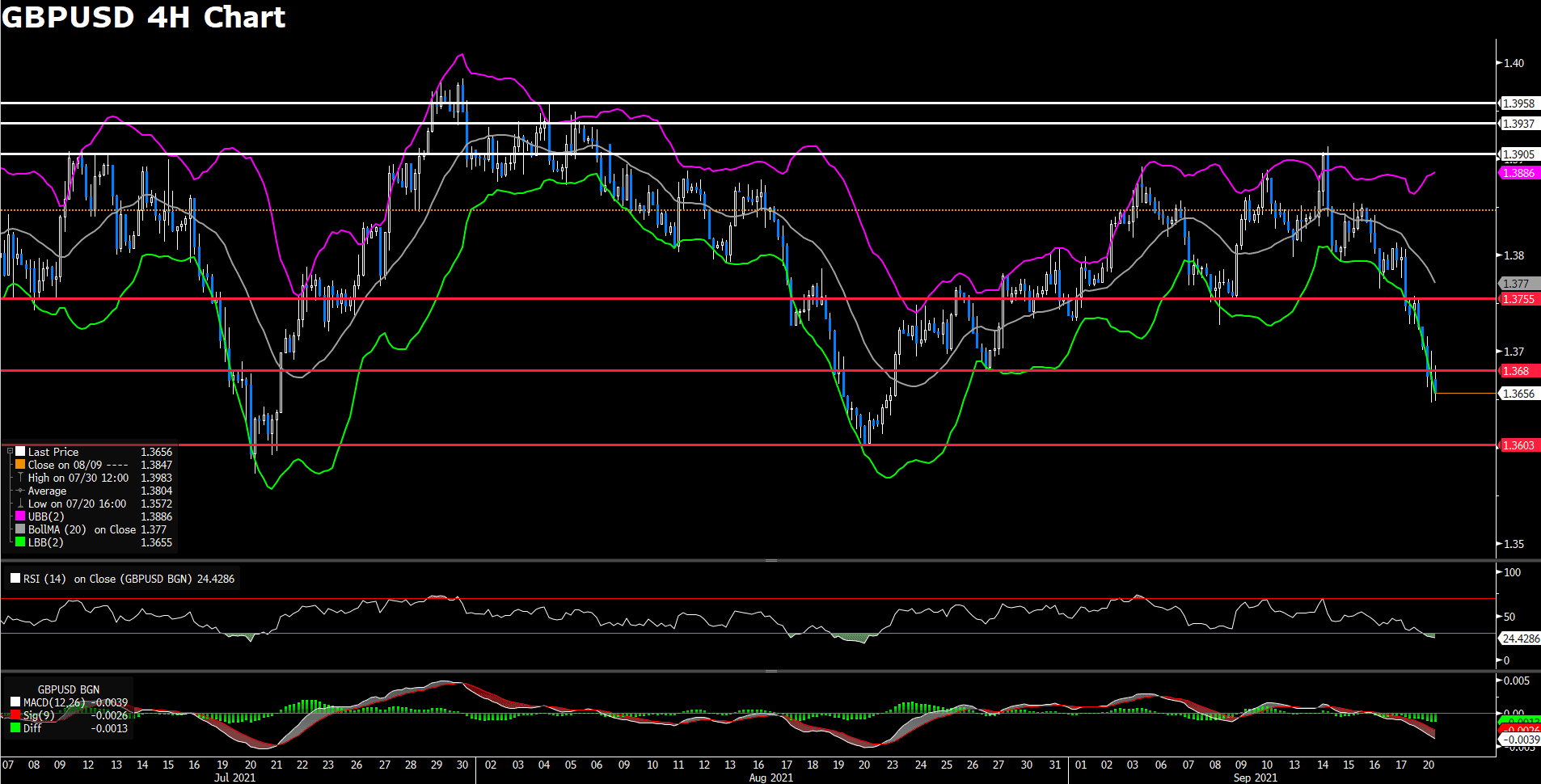
Cable fell sharply on Monday as money flowed to the safe haven asset—the Greenback. After sliding around 0.2% on the previous trading day, Cable began today’s trading even lower. Losing north of 0.6% during the European trading session, GBPUSD was able to find some breathing room around the 1.3669 price level before the American trading session brought the pair to even lower territory. As of writing, Cable is trading at 1.3653, which is lower than our previously estimated support level of 1.3727.

From the technical aspect, Cable is trading at the lower bound of the bollinger bands and is currently trending towards the immediate support level of 1.3603. Cable has failed to defend the previously estimated support level of 1.368. Cable has fell below the 50, 100, and 200 day SMA. RSI for Cable sits at 31.90, suggesting some overselling in the market.

Resistance: 1.381, 1.3849, 1.3905

Support: 1.3603


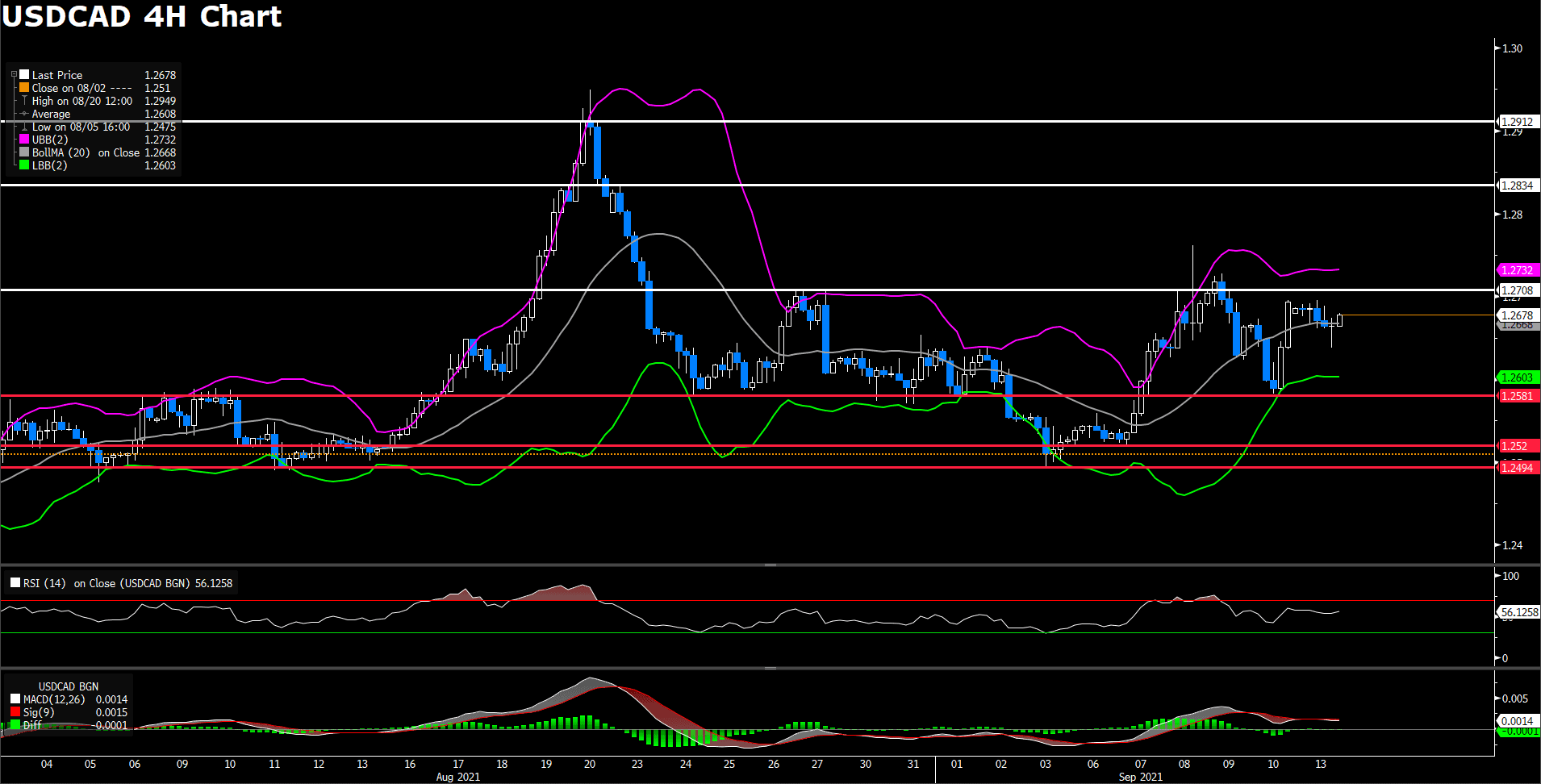
USDCAD (4- Hour Chart)

During the American trading session, USD/CAD climbed to a one-month high of 1.2895. The pair has since settled back down to near the 1.28 price level, which is our previously estimated resistance level for USD/CAD. Rally for the pair was fueled by investors pouring money into the safe haven dollar as concerns over China has boiled over into the foreign exchange market. However, looking ahead into the week, there are significant events that could sway the pair in either direction. On the one hand, the election for the House of Commons is set to take place on Monday; on the other hand, the FED FOMC press conference is set to take place this Wednesday.

From the technical aspect, USD/CAD has broken through the 1.28 resistance level and came close to 1.29 during today’s trading. RSI for the pair sits at 72, as of writing, suggesting some over buying in the market. USD/CAD is trading above the 50, 100, and 200 day SMA and the pair is trading at the upper bound of the bollinger bands.

Resistance: 1.1806, 1.1894, 1.1965

Support: 1.1664


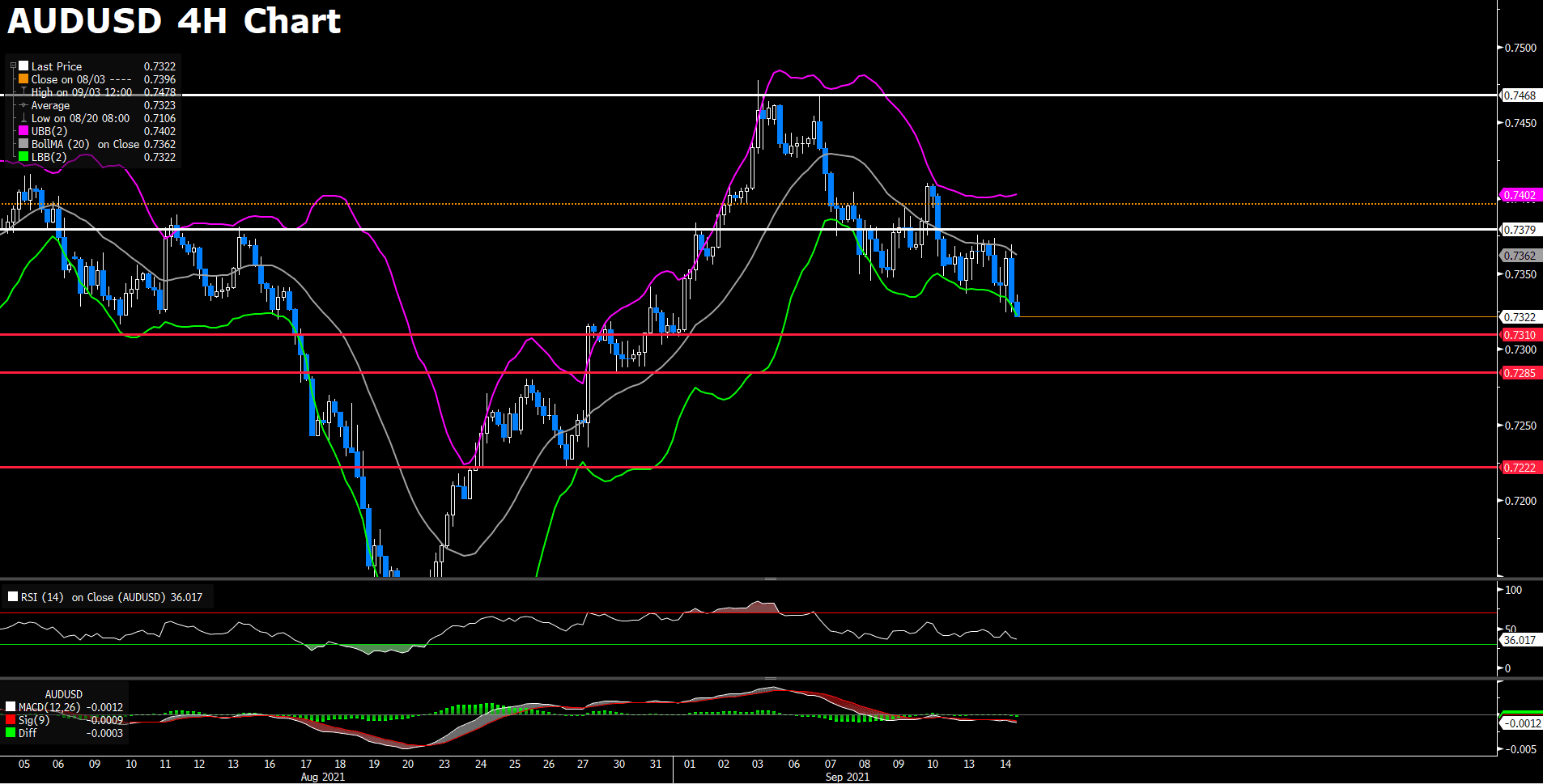
AUDUSD (Daily Chart)
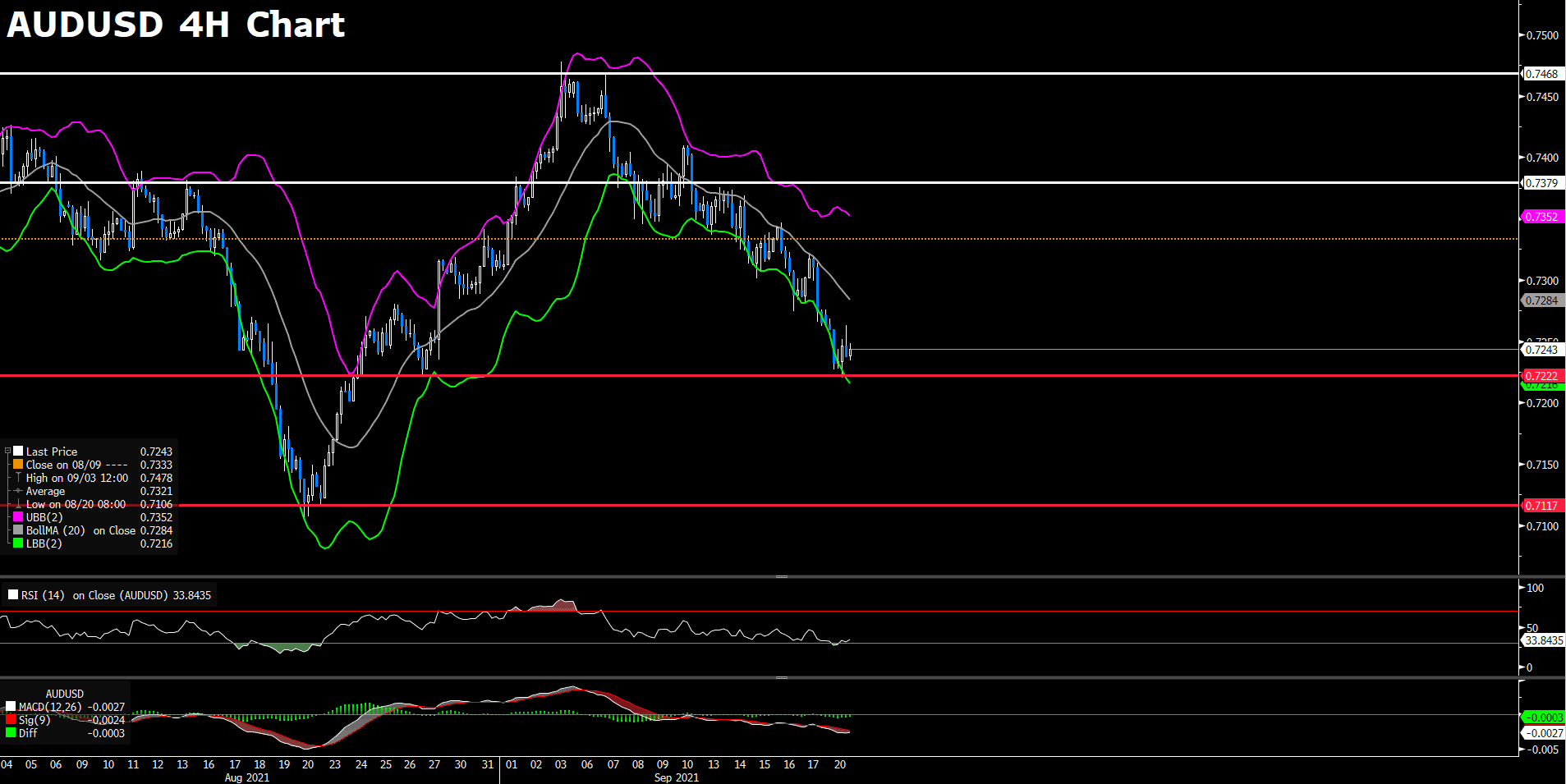
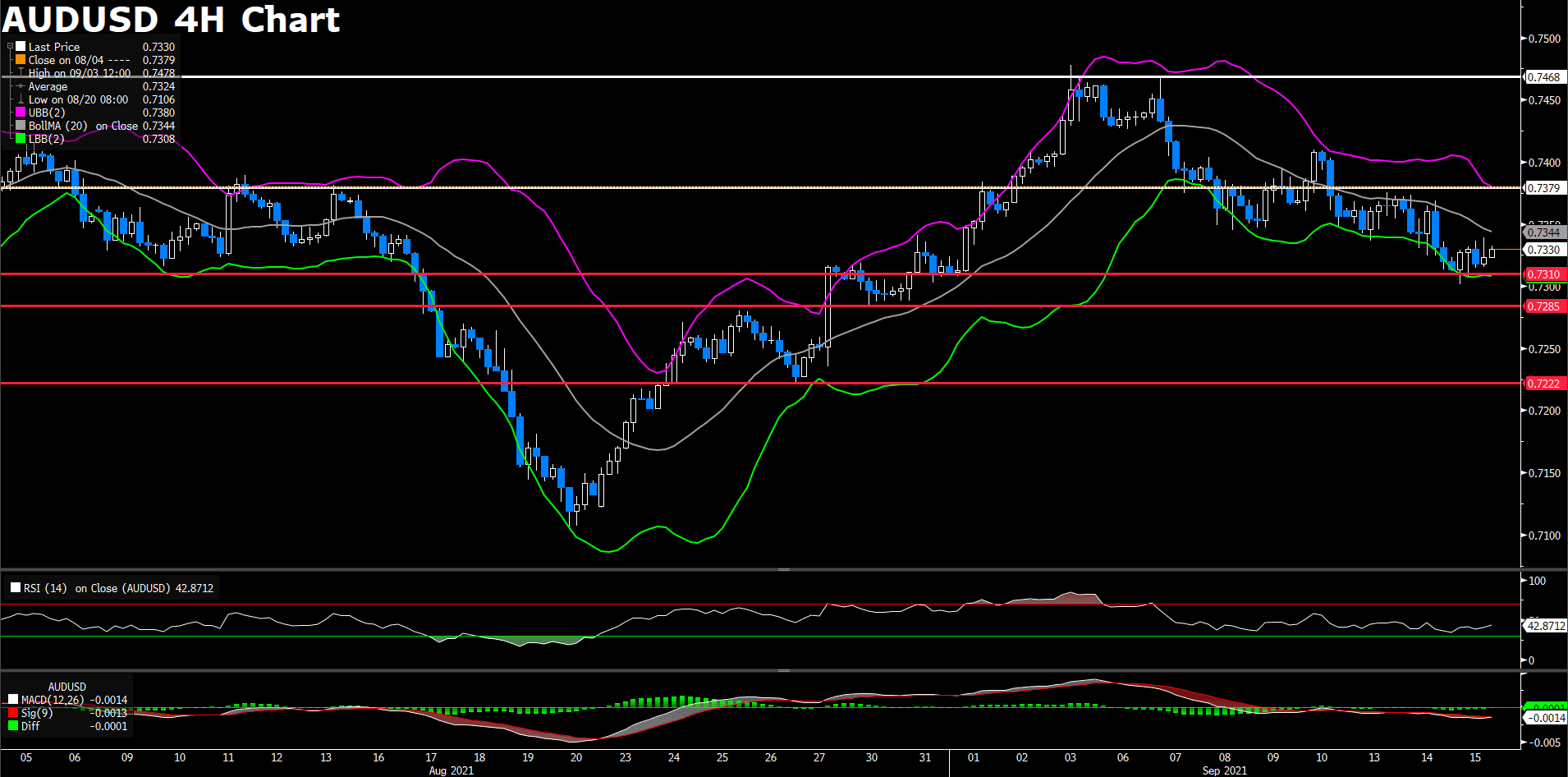
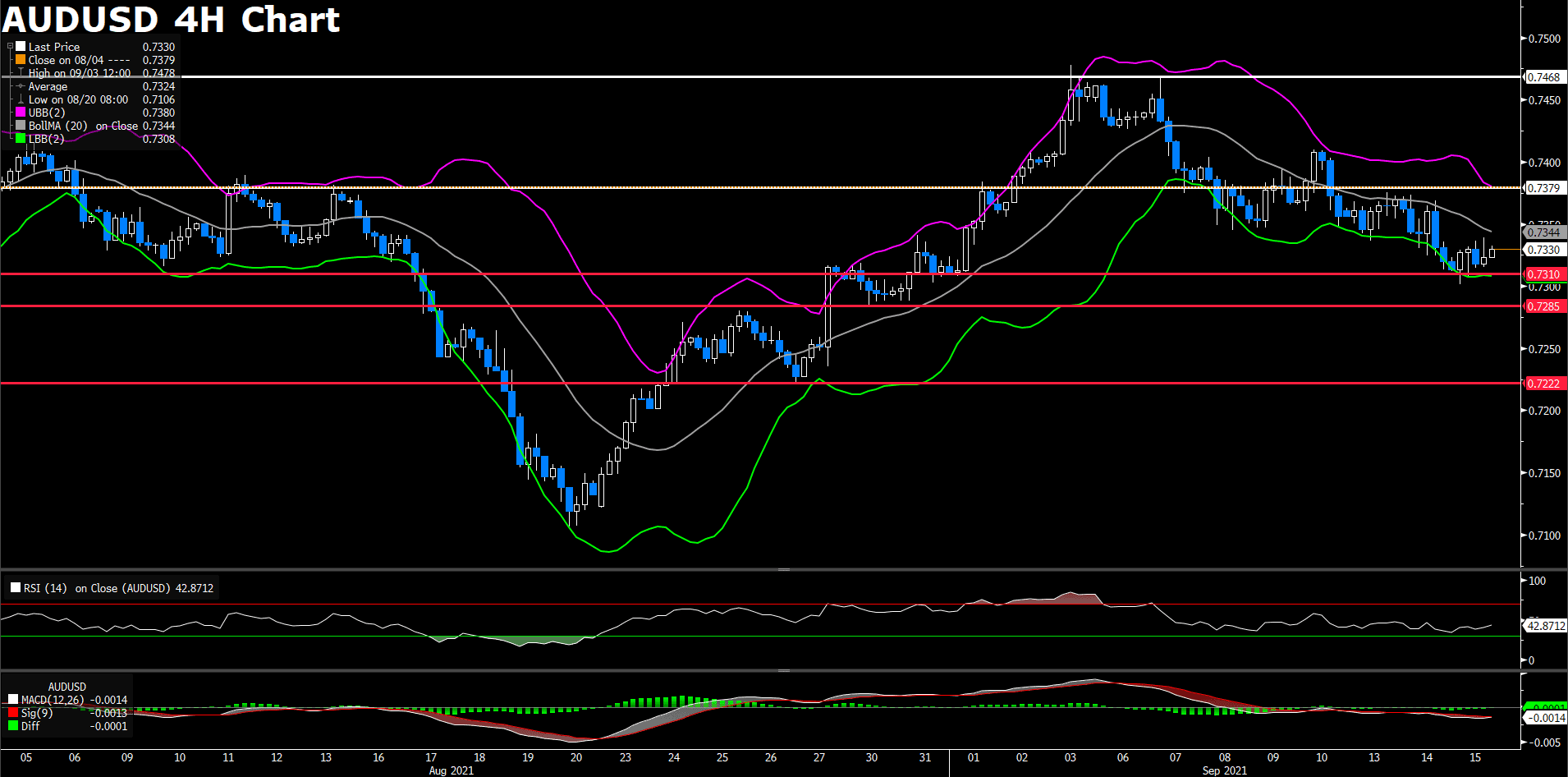
AUD/USD suffered as investors rushed to the safe haven dollar as market sentiment sours. AUD/USD declined, as much as 0.7%, during the early hours of trading. The pair broke through our previously estimated support of 0.7285 and continued trading lower before finding support around our estimated level of support at around 0.7222. The RBA meeting, scheduled for Tuesday, will shed more light on the Australian central bank’s monetary policy direction. Having already scaled back its monthly bond buying measures, the RBA is expected to remain dovish. The credit issue in China could also have spilling over effects on the Aussie dollar, as China is one of the largest exporting country for Australia.

From the technical aspect, AUD/USD has fallen below the 0.7285 support level but has found support around 0.7222; however, if the pair continues to trade lower, the pair will not find support until around the 0.711 price level. RSI for the pair sits at 40.42, indicating a rather neutral buying sentiment. AUD/USD is trading below the 50, 100, and 200 day SMA.

Resistance: 0.7379, 0.7468

Support: 0.7222, 0.7117


Economic Data

Currency

Data

Time (GMT + 8)

Forecast

AUD

RBA Meeting Minutes

09:30

USD

Housing Starts (Aug)

20:30

1.555M

Daily Market Analysis

Market Focus

US stocks declined on Friday, touching the lowest levels in four weeks. Investors now are evaluating the resilience of the global recovery amid concerns about the delta virus and risks from China. On top of that, Friday is the day of quarterly expiration of options and futures, which can create volatility. Oil slipped, while gold advanced.

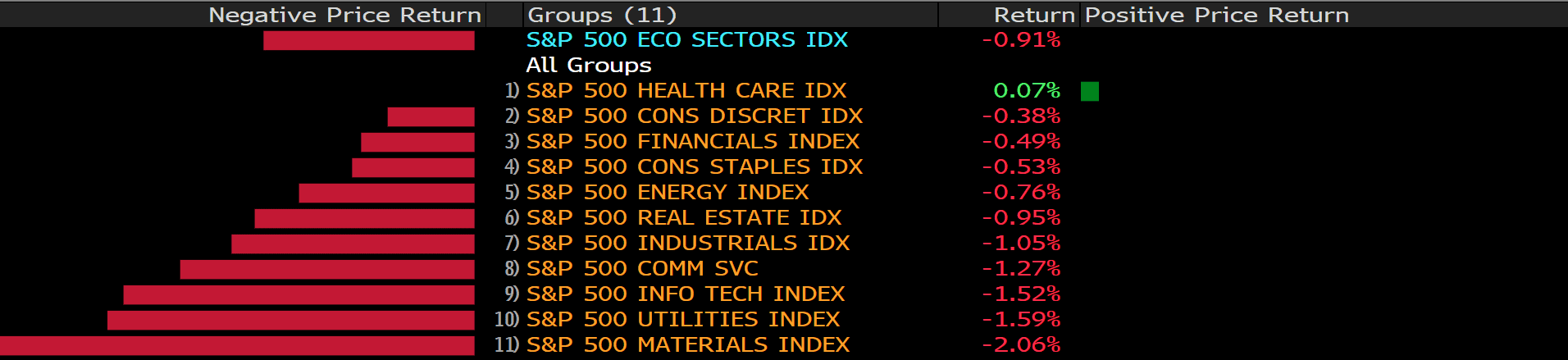
The benchmarks, S&P 500, Dow Jones and NASDAQ both dropped on Friday. S&P 500 was down 0.9% on a daily basis, the index edged lower for a second day and erased its gains from earlier in the week. The material, utilities and technology sectors are the worst performing among all groups, dropped 2.06%, 1.59% and 1.52%, respectively. The NASDAQ, in the same way, finished in positive territory for a third day. Global stock market struggled to maintain optimism in the face of a likely pending change in Fed’s taper plan, slower economic growth and high inflation.

From economic data’s angle, the University of Michigan’s preliminary sentiment index was released on Friday, showing that US consumer sentiment rose slightly but remained close to a decade low. High prices also result in deteriorated buying conditions. The Fed will probably hint at its meeting next week on the timeline of bond tapering and make a formal announcement in November.

In Asia, stock markets were mixed as the debt crisis at China Evergrande Group continued. Casino stocks extended their losses amid tightening regulations in Macau.


Main Pairs Movement:

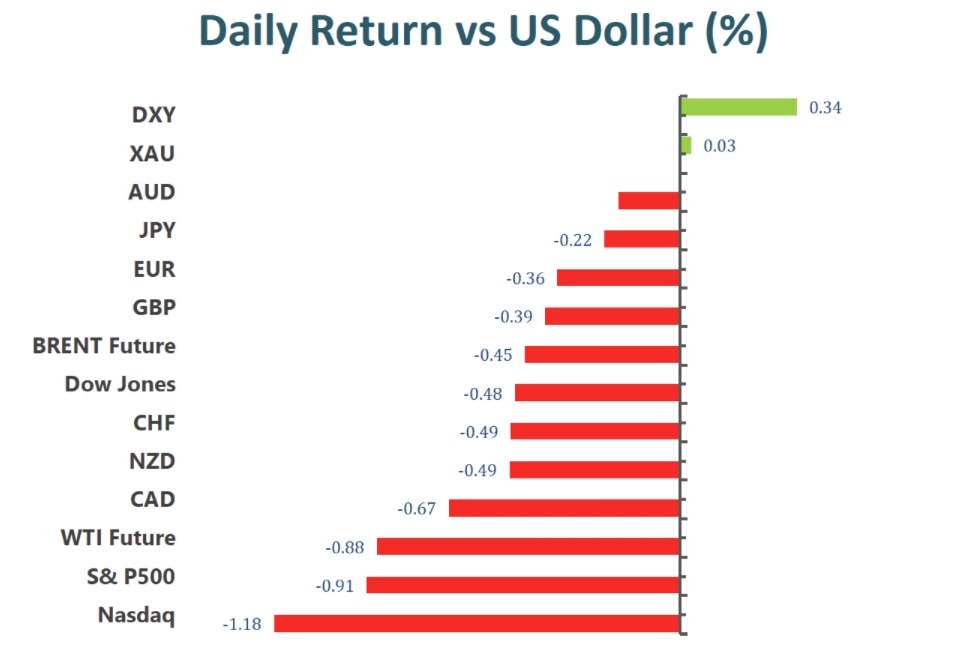
US dollar advanced on Friday, touching the highest level since August 27. The Dollar Index started to gain bullish momentum in the beginning of American session and pushed higher after the U.S. Michigan Consumer Sentiment index released. Consumer confidence in the US improved modestly in September with the Index rising to 71 from 70.3 in August. This reading came in slightly weaker than the market expectation of 72.2. The DXY index rose 0.4% on a daily basis. Market focus now shifts to next week’s FOMC meeting, as investors expect Fed to give more hints about the timeline of bond tapering.

EUR/USD and GBP/USD both declined on Friday amid stronger US dollar across the board, losing 0.33% and 0.38% for the day, respectively. The EUR/USD pair continued its slide, dropping to a fresh monthly low during American trading hours. The Eurozone Core Consumer Price Index (YoY) rose by 1.6%, in line with expectations. Meanwhile, the Core CPI for August (MoM) also edged higher by 0.3%. As for the cable, Bank of England will announce their interest rate decision on September 23.

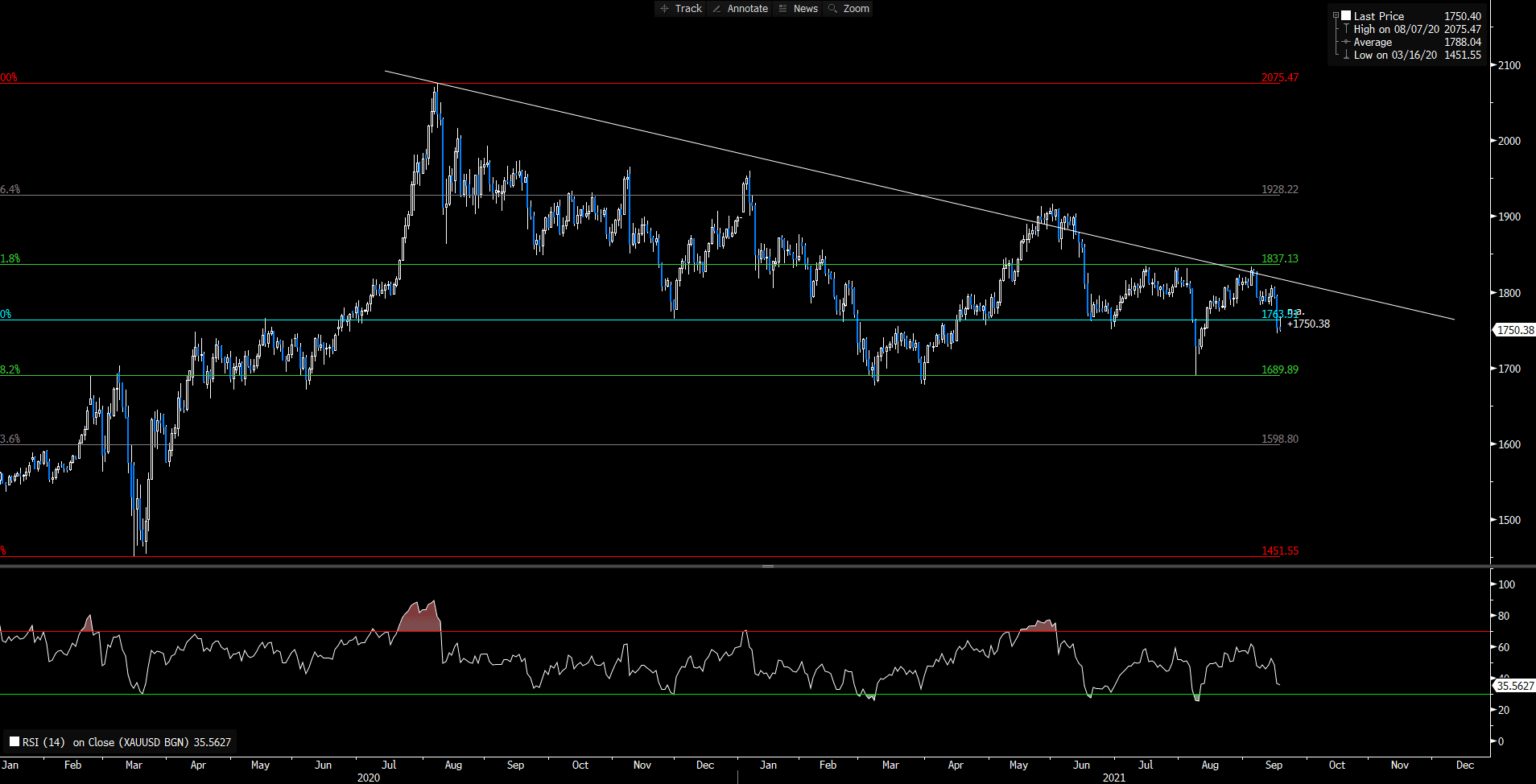
Gold advanced slightly on Friday. After climbing to a daily high during European session, gold lost its traction and dropped below $1,750 amid renewed USD strength. The precious metal posted a 0.05% gain on a daily basis. WTI Crude Oil, on the contrary, dropped more than 0.9% on Friday.


Technical Analysis:

GBPUSD (4-hour Chart)

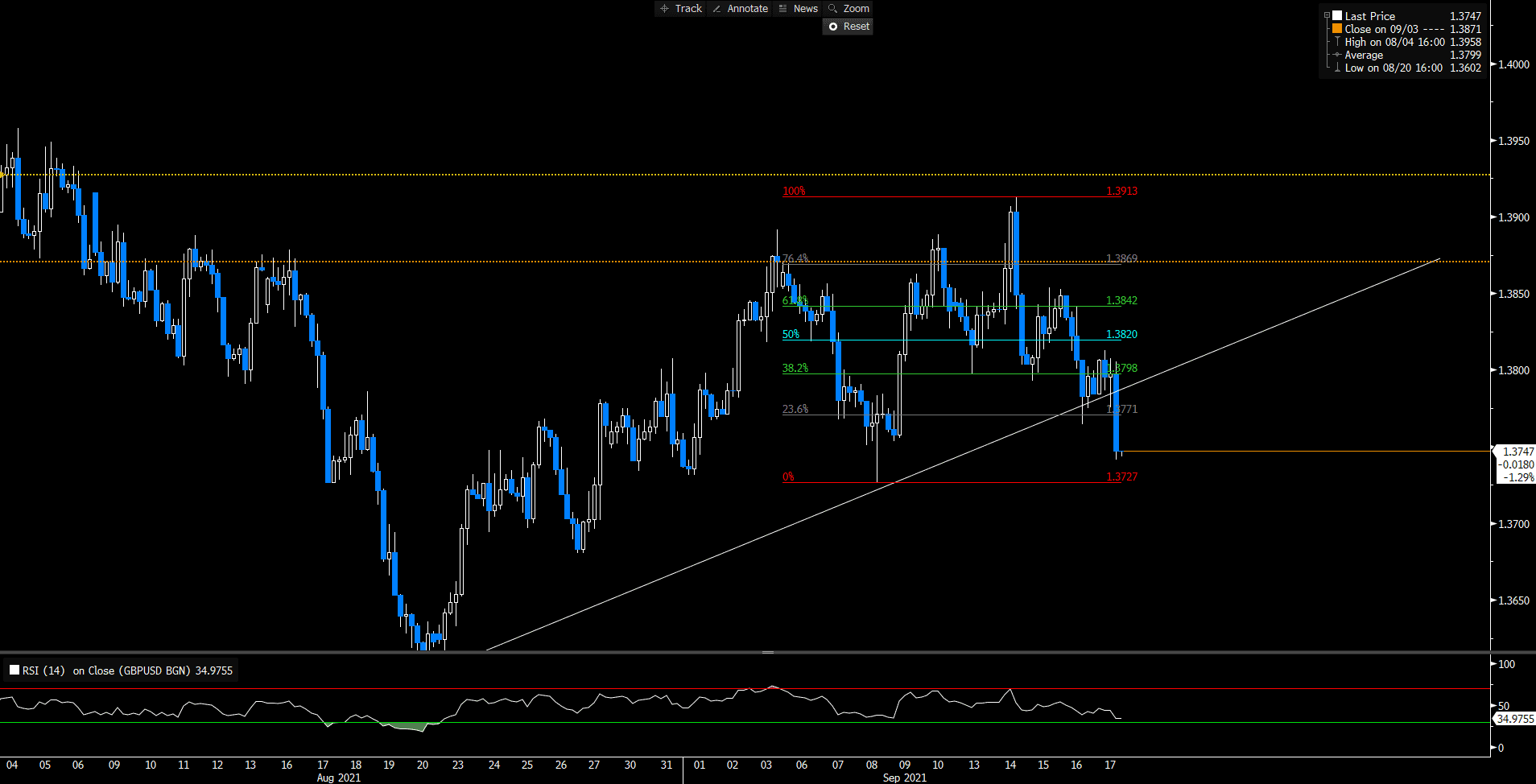
GBPUSD trades under 1.3800 level, on the back foot after UK’s disappointed Retail Sales data, -0.9% in August. From the technical aspect, the intraday bias looks bearish as GBPUSD falls below the ascending trend line, indicating that the upside momentum has been overturned on the four- hour chart. The bearish move is expected to continue as the RSI has not reached the oversold territory, giving more rooms for the pair to extend further south. Bears might continue to head toward the next immediate support level at 1.3727.

Resistance: 1.3771, 1.3798, 1.3820

Support: 1.3727


EURUSD (4- Hour Chart)

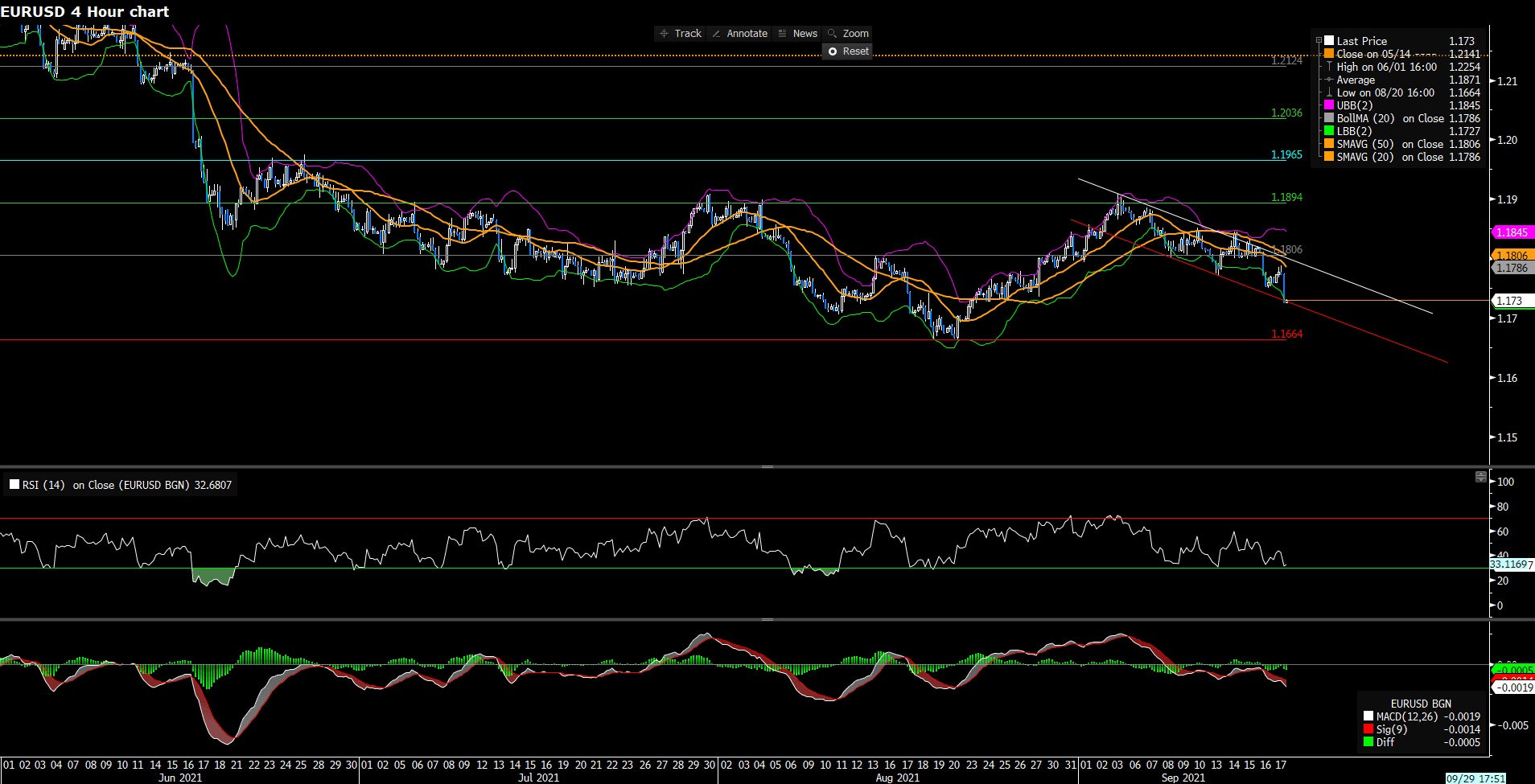
EURUSD trades below 1.1800 level, remaining pressured after the US Consumer Sentiment missed estimates in September. From the technical perspective, EURUSD continues to trade negatively as the pair still trades within the descending channel. At the same time, technicals are pointing lower since the pair fails to climb above the 20 and the 50 SMAs. The RSI on the four- hour chart is above 30, thus outside oversold territory, whilst the MACD is negative, lending supports to bears; that being indicated, EURUSD is still on the downside. Nonetheless, the downside might face some obstacles as the pair has reached the lower bound of Bollinger Band, due for a pullback.

Resistance: 1.1806, 1.1894, 1.1965

Support: 1.1664


XAUUSD (Daily Chart)

From the technical aspect, the price of gold is currently in a descending triangle on the daily chart, with the bottom support line at 1756.90 and the resistance at around $1800. As mentioned earlier, the price of gold formed support near $1753 after a sharp drop on Thursday, and the RSI indicator was in the oversold area. Therefore, the next trend of gold should be able to take a breather with its small rebound. On the other hand, on the 1-hour chart, based on Fibonacci indicators, the short-term resistance is at the level of $1,765.58, and the next resistance is at the level of 1,778.62. All in all, the long term movement for the gold is downside.

Resistance: 1763.51, 1837.13, 1928.22

Support: 1689.89, 1598.80


Economic Data

Currency

Data

Time (GMT + 8)

Forecast

EUR

German PPI (MoM) (Aug)

14:00

0.8%

BRL

BCB Focus Market Readout

19:25

N/A

Daily Market Analysis

Market Focus

US stock declined on Thursday after swinging between gains and losses. Expiration of options and futures will be on Friday, which usually result in high volume and volatility. After seven months of gains, equity market has been choppier mid-way through September, but some market strategists believe that this is actually quite normal from a historical seasonal standpoint.

The benchmarks, S&P 500 and Dow Jones both dropped on Thursday. S&P 500 was down 0.2% on a daily basis, the index edged lower a day after it posted its biggest gain since August on Wednesday. The material and energy sectors are the worst performing among all groups, dropped 1.09% and 1.06%, respectively. The NASDAQ, on the contrary, finished in positive territory for a second day.

On top of that, US Core Retail Sales data was released on Thursday, retail sales rose 0.7% last month, boosted by back-to-school shopping and child tax credit payments. The data unexpectedly increased in August, easing some concerns about a sharp slowdown in economic growth. The news has bolstered investor expectations for next week’s policy meeting and how soon the US central bank will start to taper stimulus. However, the weekly jobless claims increased to 332K, higher than what market had expected. Therefore, market fluctuated as investors digested the impact of mixed economic data. Market focus now shifts to next week’s FOMC meeting.

In Asia, stock market was surrounded by selling pressure, as the debt crisis at China Evergrande Group keep fermenting. Furthermore, casino stocks in Macau extended their losses amid the government’s tightening regulations on casino firms.


Main Pairs Movement:

The U.S. core retail sales figures for August was due earlier today and the news quickly sent shockwaves across foreign exchange markets. August retail sales increase by 1.8%, month over month, excluding car sales. The robust August spending figures went against fears of the Delta variant hampering economic recovery and provides a much-needed boost of confidence in the course of the U.S. economy. Majority consumer spending, in August, shifted from the service industry to furniture, groceries, hardware, and online purchases.

Most currencies dropped against the dollar as demand for the Greenback soared. Cable trended lower and dropped through our previously estimated support level of 1.3801. USD/CAD gained as demand for the dollar soared, but the pair is still consolidating between 1.2589 and 1.268 with no clear down or up trend. AUD/USD, also, fell through our previously estimated support level of 0.731 as the dollar gained strength.


Technical Analysis:

GBPUSD (4-hour Chart)

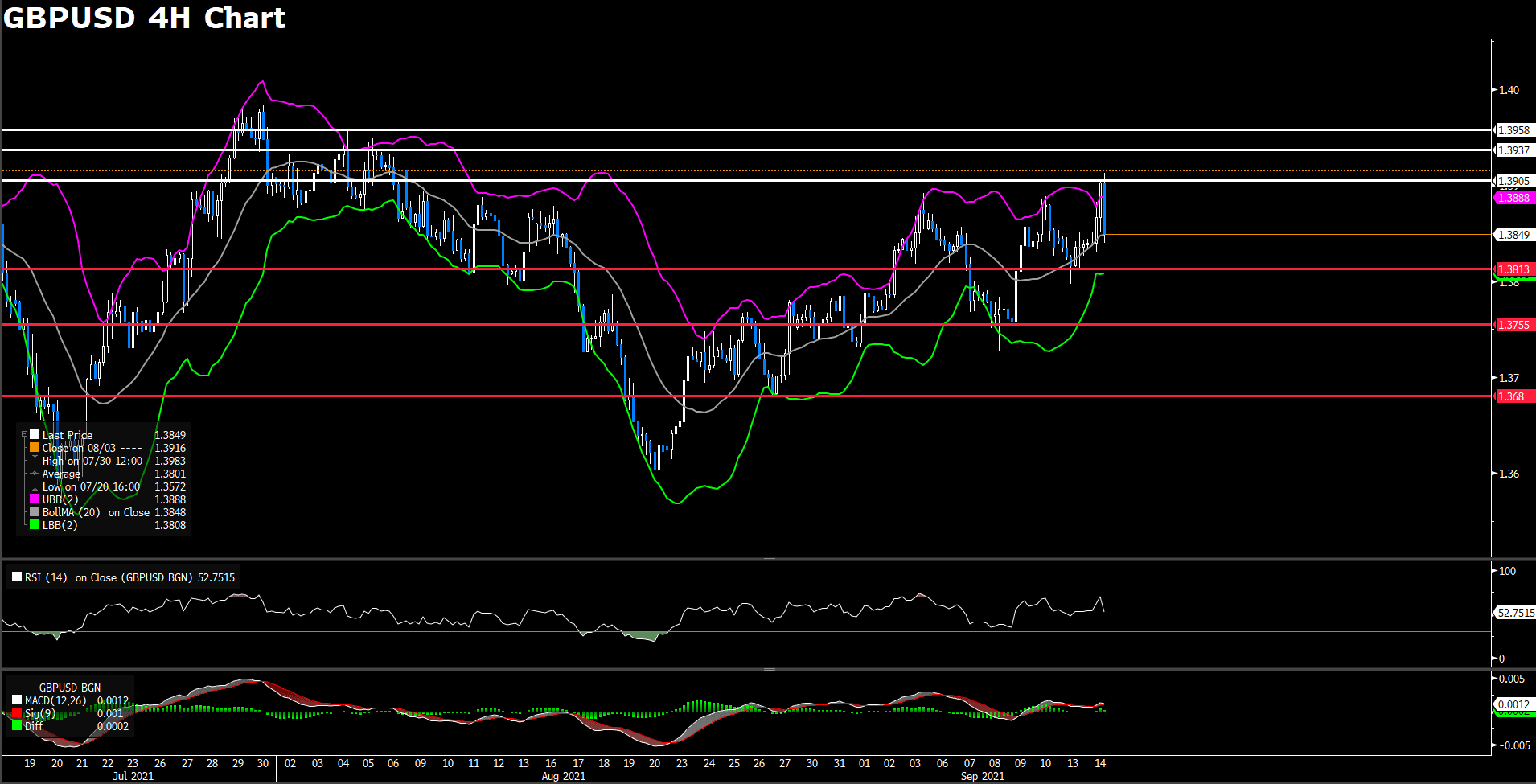
Cable traded higher during the European trading session as the U.K. cabinet reshuffle passed smoothly; however, as the robust U.S. retail figures and American trading hours arrived, the dollar gained strength and started to drag Cable down. Cable tumbled, as much as, 0.53% at the beginning of the American trading session. The strong dollar brought Cable beneath our previously estimated support level of 1.3801 and the pair is trading at 1.378, as of writing. Speculators will be eyeing next week’s FOMC meeting as FED bond tapering is seemingly imminent.

For technical aspect, GBP/USD reversed yesterday’s upward trend amid a resurgent of dollar demand due to healthy August retail sales figures. Cable has broken through our previously estimated support level and is continuing to trend downwards, as of writing. Nearest support for the pair sit at 1.3755; however, the U.K retail sales figures for the month of August are due tomorrow and could provide some upward momentum for bulls and the pound if figures return better than estimated results. RSI is, currently, sitting at 37.74, suggesting some under buying in the market. Cable has broken ground below the 50, 100, and 200 day SMA; furthermore, the pair is edging close to the lower bound of the bollinger bands.

Resistance: 1.3905, 1.3937, 1.3958

Support: 1.3755, 1.368, 1.3604


USDCAD (4- Hour Chart)

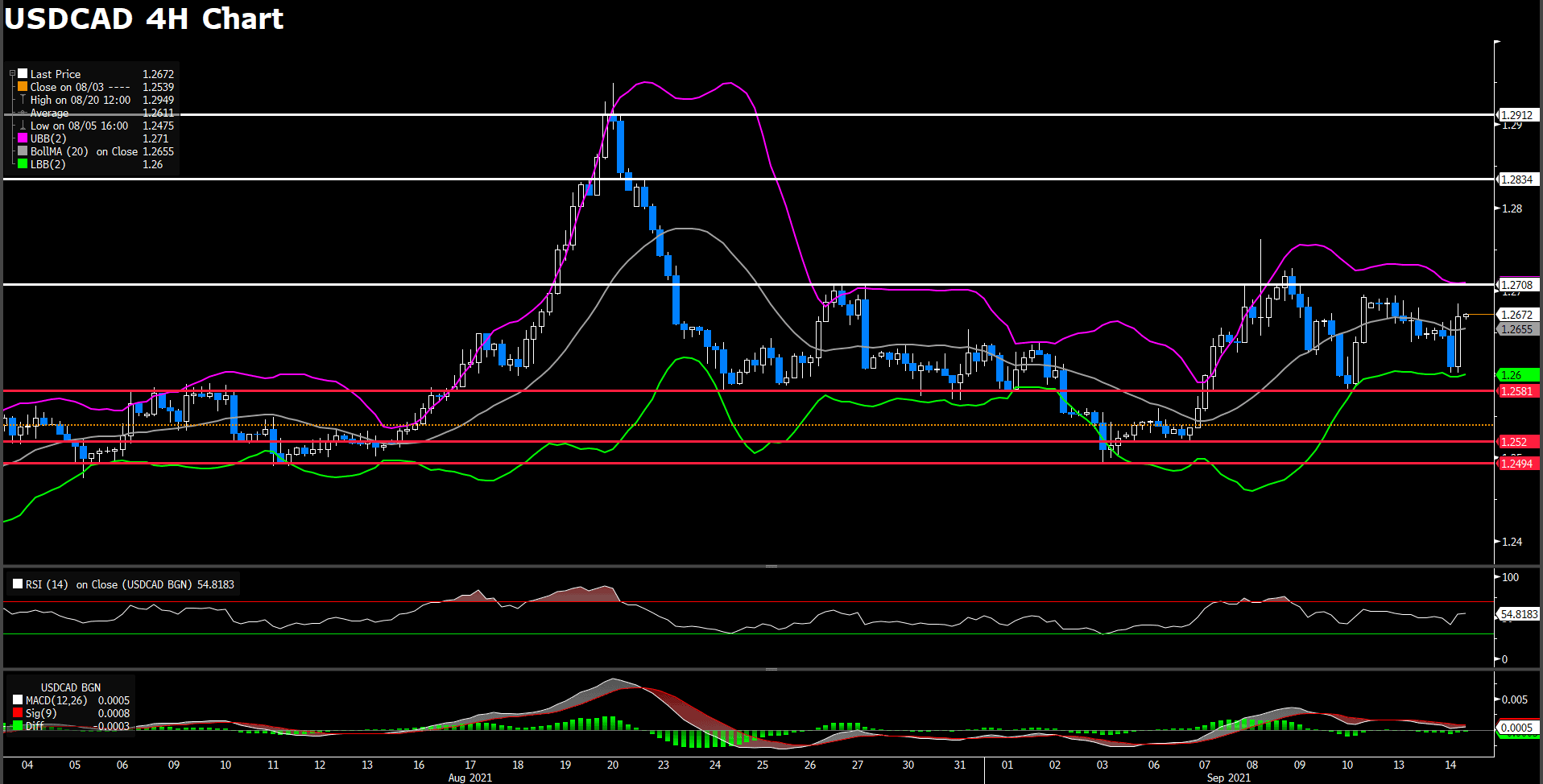
USD/CAD trended downwards at the beginning of the trading day, but quickly recovered from the session low of around 1.26 and gained more than 0.5% once the American trading session began. Strong dollar demand has brought the pair to challenge our estimated resistance level of 1.2708 and help the pair regain all of the lost ground since Monday. Speculators, however, should still be mindful that the loonie is highly dependent on the global export and commodity prices, thus indications of international economic slow down could drag the loonie lower still and propel USD/CAD to higher levels. The Canadian federal election will take place next Monday, and polls are showing a slight favor to Justin Tredeau’s Liberal party.

For technical aspect, USD/CAD is still contained by our previous resistance estimates, but the pair is edging closer to the 1.27 price level. RSI is currently sitting at a marginally over-baught level of 55. USD/CAD has reached the upper bounds of the bollinger bands after today’s dollar rally, and the pair is currently trading above the 50, 100, and 200 day SMA.

Resistance: 1.2708, 1.2834, 1.2912

Support: 1.2589, 1.252, 1.2494


AUDUSD (4- Hour Chart)

The Audtralian Bereau of Statistics revealed that the unemployment rate fell to 4% in August, compared to 4.6% in July; however, the decline in the unemployment rate is attributed to the lowered participation rate in August. Despite a better unemployment rate in August, the lowered participation rate raised concerns and bearish sentiment for the Aussie dollar. AUD/USD began the day trending lower, and, once the U.S. retail sales figures were released, the pair trended even lower and broke through our previously estimated support level of 0.731; however, as of writing, AUD/USD has successfully defended the 0.7285 support level and the pair is beginning to stable around that price level.

For technical aspect, RSI indicates 55.38, suggesting neutral buying sentiment. AUD/USD successfully defended our previously estimated support level of 0.7285, but the pair dropped through the 0.731 support level. Currently, the pair trades at the lower bound of the Bolliner bands, and the pair is trading below the 50, 100, and 200 day SMA.

Resistance: 0.7379, 0.7468

Support: 0.7285, 0.7222, 0.7117


Economic Data

Currency

Data

Time (GMT + 8)

Forecast

USD

TIC Net Long-Term Transactions (Jul)

04:00

GBP

Core Retail Sales (MoM)

14:00

0.8%

GBP

Core Retail Sales (YoY)

14:00

2.5%

GBP

Retail Sales (MoM)

14:00

0.5%

GBP

Retail Sales (YoY)

14:00

2.7%

EUR

Core CPI (YoY) (Aug)

17:00

1.6%

EUR

CPI (MoM) (Aug)

17:00

0.4%

EUR

CPI (YoY) (Aug)

17:00

3.0%


USD

Michigan Consumer

Sentiment (Sep)

22:00

72


VT Markets Notification of Server Upgrade

Dear Client,

As part of our commitment to providing the best reliability and service to our client, we are planning an upgrade in our server on Septembert 18th 2021.

As a result, we will be conduct maintenance according to the schedule below.
Start date and time: 2021-09-18 01:00 GMT+3(Server time)
End date and time: 2021-09-18 16:00 GMT+3(Server time)

The impact can only make client be unable to log in to the MT5 software temporarily, and that won’t affect any order which has been opened.

After the upgrade, clients can login to MT5 software using the server which is shown in the account activation mail.

No action is required by our client. Your services will come back online at the end of the maintenance.

Thank you for your patience and understanding with regard to this important initiative.

If you have any questions, our team will be glad to answer your questions. Please mail to [email protected] or contact the service online.

VT Markets The Adjustment Of Weekly Dividend Notification

Dear Client,

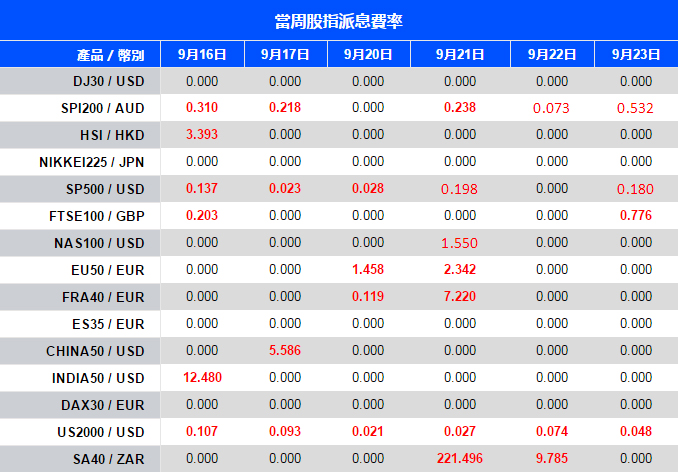
Warmly reminds you that the component stocks in the stock index spot generate dividends. When dividends are distributed, VT Markets will make dividends and deductions for the clients who hold the trading products after the close of the day before the ex-dividend date.

Indices dividends will not be paid/charged as an inclusion along with the swap component. It will be executed separately through a balance statement directly to your trading account, the comment for which will be in the following format “Div & Product Name & Net Volume ” .

Please note the specific adjustments as follows:

Note: The above data is for reference only, the actual execution data may be changed, please refer to the MT4 software for details.

If you’d like more information, please don’t hesitate to contact [email protected].

Daily Market Analysis

Market Focus

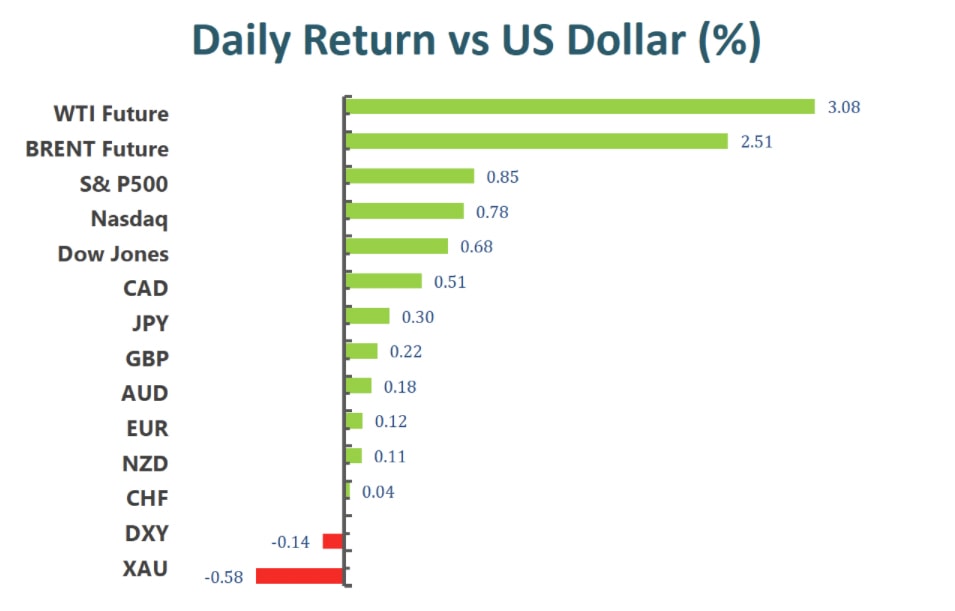
US stock advanced on Wednesday, recording the highest gain in three weeks. The stock market was benefitted from the fact that concerns about a slowdown in economic growth has eased. Crude oil and treasury bond yields both rose. Gold price, on the contrary, declined on Wednesday.

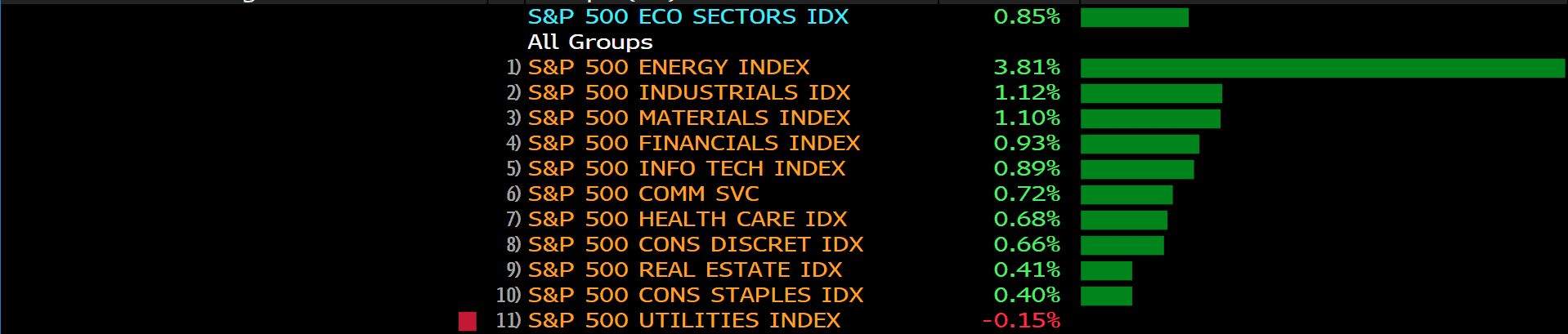
The benchmarks, S&P 500, Dow Jones and the NASDAQ all rose on Wednesday. S&P 500 posted a 0.9% gain on a daily basis, the index was closed in positive territory for only second time in eight trading sessions. The energy and industrial sectors are the best performing among all groups, rose 3.81% and 1.12%, respectively. The energy sector was supported by the bullish momentum witnessed in US crude oil prices, as US inventories run low and storms disrupt US production. Therefore, it’s a rapidly tightening market for crude oil.

On top of that, even though the US CPI data released on Tuesday could be seen as reducing pressure on the Fed to start pulling back on loose monetary policy and meanwhile, increasing the uncertainties about the timeline of bond tapering. Investors are still worried about the rising costs on economic reopening and the impact of the Delta variant around the world.

In Asia, stocks declined after reports showed that China’s economy was damaged in August from rigorous virus controls and tight curbs on property. Casino companies fall on China regulation concern, as Macao plans to strengthen the regulation on casino firms.


Main Pairs Movement:

Lingering effects of a weaker, than expected, U.S. CPI figure are still felt today in foreign exchange markets. Both the U.S. 10-year and 30-year treasury yield fell on Wednesday. The Canadian CPI rose more than 10% in August to 4.1%, compared to 3.7% in July; however, the BOC still remains dovish and believe that inflation should be transitory. The U.K. CPI for August beat estimates and showed a 0.7% growth, month over month.

Cable repaired some of the losses from the previous trading day and is trading at 1.38446, as of writing. Better than estimated CPI data has helped boost the pound. The loonie rose against the dollar as the Canadian CPI also reported better than estimated results. The Aussie, however, fell against the greenback as Covid and inflationary concerns continue to plague any upward movement from the pair AUD/USD.


Technical Analysis:

GBPUSD (4-hour Chart)

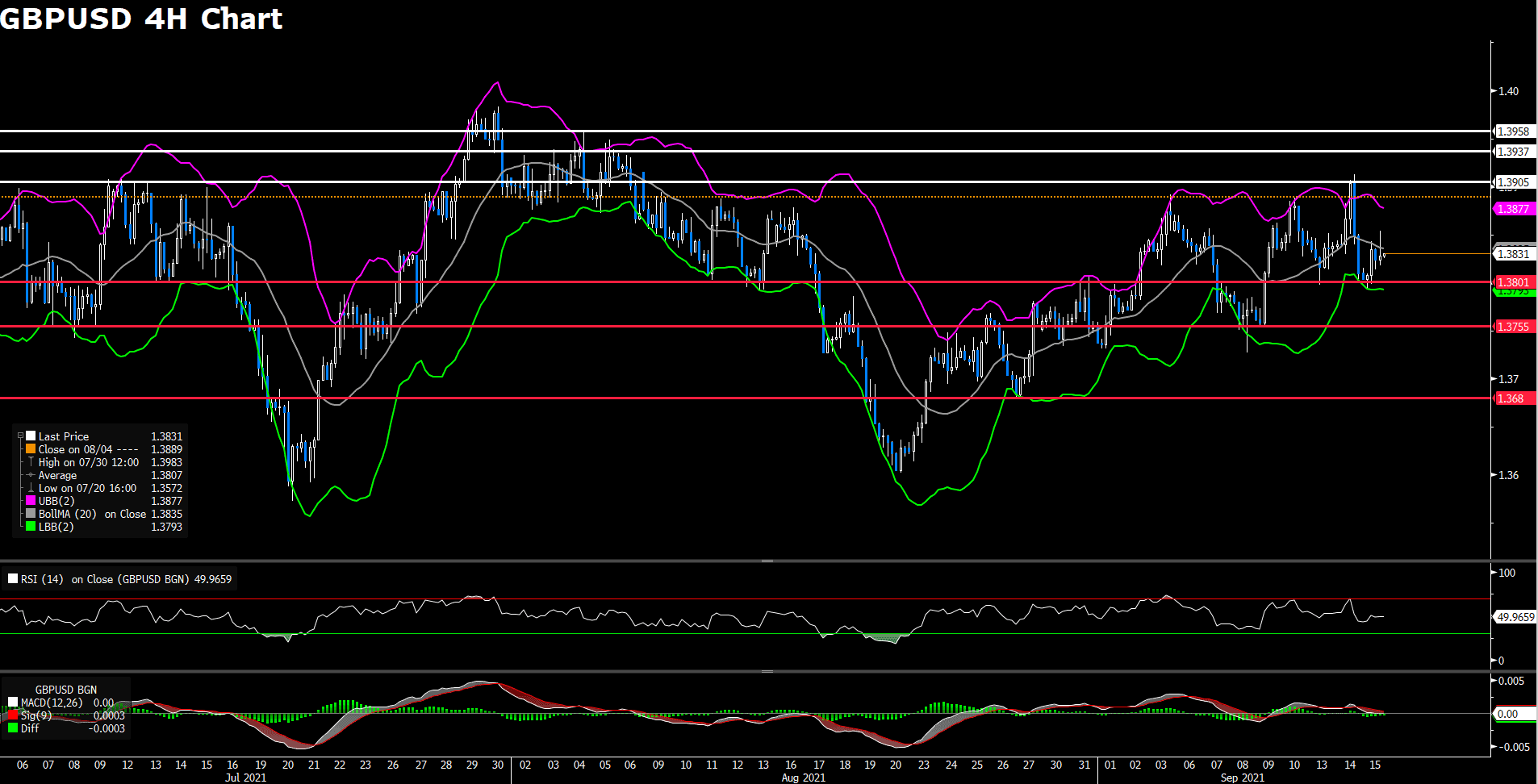
The U.K. CPI for August set the record for the largest ever recorded increase in the CPI National Statictic 12 month inflation series. U.K. core CPI rose to 112.1, compared to 108.8 in August of 2020. The service industry, including restaurants, hotels, recreation and culture, and food and non alchoholic beverages, is the major driver for August price rises. Cable began the day trending lower, but, as U.K CPI data released, the pair quickly gained more than 0.4% to hit the session high of 1.38537. Speculators will be eyeing the BOE policy meeting, which will happen on the 23rd of September.

For technical aspect, GBP/USD reversed yesterday’s downward trend and gained more than 0.2% during the European trading session. Despite falling through our previous support level estimate, Cable found support at the 1.38 price level and was met with resistance at around the 1.383 price level. RSI for the pair sit at 49.7, as of writing. GBP/USD has trended towards the middle of the bollinger bands and is trading above the 50 day SMA.

Resistance: 1.3905, 1.3937, 1.3958

Support: 1.3813, 1.3755, 1.368


USDCAD (4- Hour Chart)

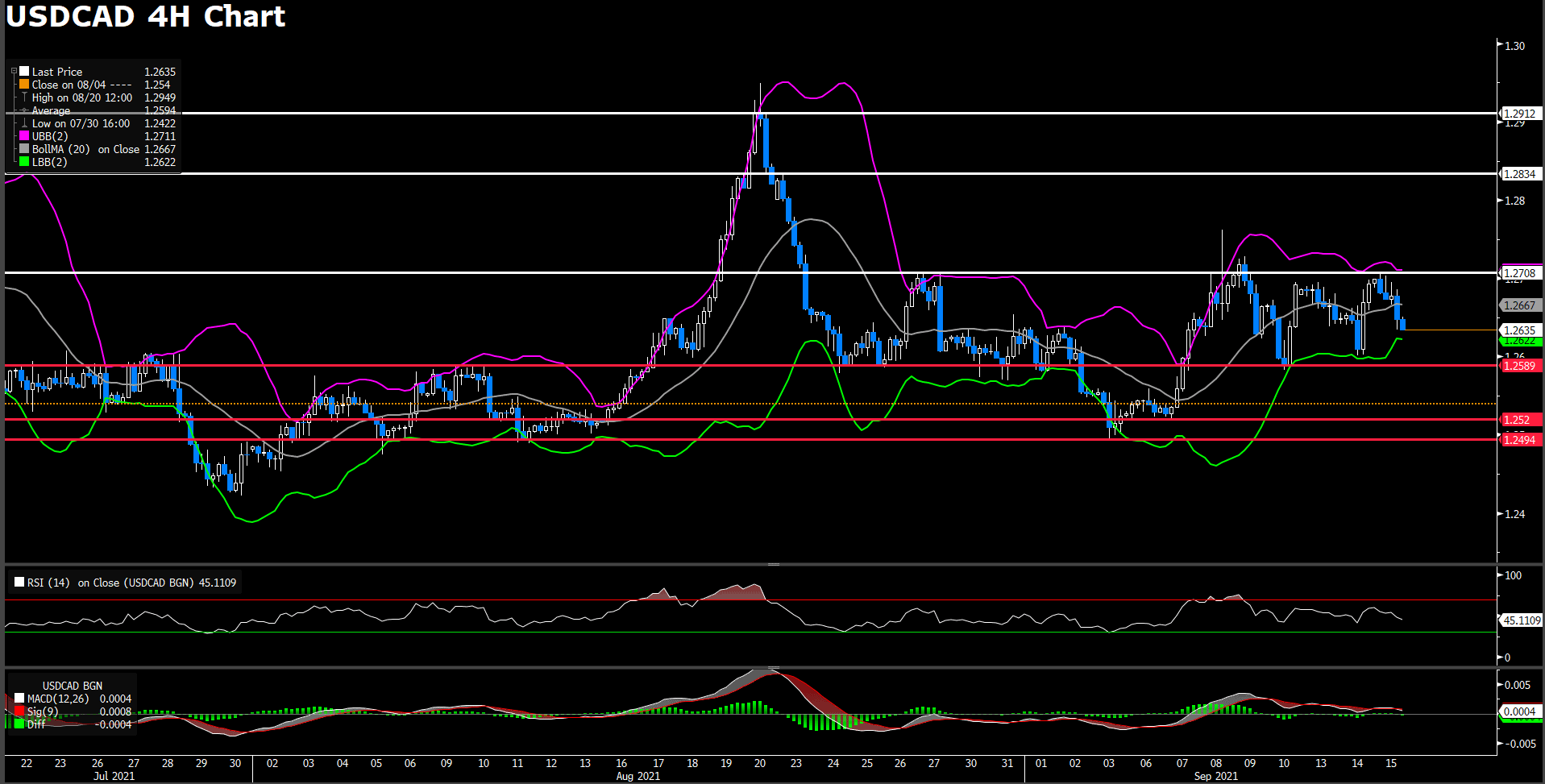
USD/CAD gained during the European trading session, but slipped once the August CPI data released and the American trading session began. Post CPI release, the loonie gained, as much as, 0.4%, and dragged USD/CAD to a session low of around 1.263. The BOC maintains its view that price surges in August remains transitory, but stronger than expected CPI figures will temp BOC to keep forward guidances unchanged, especially in light of poor growth figures. Speculators will be eyeing the housing starts figure, which will be released on Thursday, and the U.S. initial jobless claims report, also releasing on Thursday. The loonie is also riding the strong tailwind fueled by increasing oil prices and commodity prices.

For technical aspect, USD/CAD is still contained by our previous resistance estimates. Strong selling pressure still exists around the 1.2708 price level, evident from the pair’s quick price movement reversal after closing in on that resistance level. RSI sits at 45.55, suggesting some under buying. The pair sits at the lower half of the bollinger bands and is trading below the 50, 100, and 200 day SMA, as of writing.

Resistance: 1.2708, 1.2834, 1.2912

Support: 1.2589, 1.252, 1.2494


AUDUSD (4- Hour Chart)

The Australian unemployment rate will be due tomorrow, with analysts estimating a 4.9% target. The central bank of Australia has committed to tapering plans– reducing bond buying purchasees from 5 billion AUD per week to 4 billion AUD per week, but extending quantitative easing measures into February of 2022. The Delta variant is still a strangling factor on Australia’s economy, as confirmed cases have continued to rise over this month. AUD/USD continued its downward trend as trading began for the day, but was able to gain back some group once the American trading session began.

For technical aspect, RSI indicates 42.2, suggesting weaker buying sentiment. AUD/USD successfully defended our previously estimated support level of 0.731, but the pair met resistance at around 0.7335. Currently, the pair trades at the upper bound of the Bolliner bands, and the pair is trading below the 50, 100, and 200 day SMA.

Resistance: 0.7379, 0.7468

Support: 0.731, 0.7285, 0.7285, 0.7222


Economic Data

Currency

Data

Time (GMT + 8)

Forecast

NZD

GDP (QoQ)

06:45

1.3%

AUD

Unemployment Rate

09:30

4.9%

USD

Initial Jobless Claims

20:30

330K

USD

Philadelphia Fed Manufacturing Index (Sep)

20:30

18.8

Daily Market Analysis

Market Focus

US stock declined after a less-than-expected CPI data was released on Tuesday. The so-called core CPI increased 4.0% in August on a year-on-year basis after advancing 4.3% in July, which offer some validation of views among Fed officials that high inflation will be temporary, meanwhile, increasing uncertainties for the timing of Fed’s bond tapering.

The benchmarks, S&P 500, Dow Jones and the NASDAQ, initially pushed higher following the CPI report, but optimism quickly faded, and the US stock market started facing downward momentum. In conclusion, the influence of the CPI data was overwhelmed by concerns about Delta variant, risks from elevated inflation, slow economic growth and growing chances of a corporate tax rate hike. SP500 posted a 0.6% loss on a daily basis, as the energy and financial sectors are the worst performing group. Dow Jones and the NASDAQ declined 0.8% and 0.3%, respectively.

In Asia, Hong Kong and China’s stock market wavered as investors now focus on the troubles of indebted developer China Evergrande Group. Chinese authorities is facing pressure to find a resolution to a months-long crisis that has intensified obviously in recent days. The company is now dealing with protests by homebuyers, retail investors and employees as it struggles to meet its obligations. Japan’s Nikkei 225 Stock Average, on the contrary, closing at the highest level since 1990.


Main Pairs Movement:

The Bureau of Labor Statistics Core CPI report returned lower than expected price rises in August. The August CPI saw an increase of 0.3%, seasonally adjusted, missing analyst estimates by 4%; these results further validate President Joe Biden and the Fed’s stance that inflation could be temporary and transitory. The energy index increased by 2%, most among all data collected by the BLS, due to the increase of 2.8% in the gasoline index.

Most currency pairs against the U.S. dollar experienced a slight gain at the release of a weaker CPI, but the dollar gained back, and pairs saw a drop. GBP/USD surged at the data release, but would hit its resistance and lose all of its gains during the initial news release. USD/CAD saw a drop during the initial news release, but the dollar quickly repaired loses and successfully defended its support levels. AUD/USD surged at the initial new release, but would go on to drop through our previously estimated support level hours post U.S. CPI release.


Technical Analysis:

 GBPUSD (4-hour Chart)

The GBP/USD pair soared by, as much as, 0.4% to its session high of 1.391 right after the BLS released its August CPI report; however, the pair would soon tumble, as much as, 0.54% to 1.383 over the next two hours.As of writing, the pair has found support at 1.383 and is attempting to repair some losses, but Cable has met resistance at the 1.385 price level and is, once again, trending lower. Despite the sharp loss on Tuesday, the pound is still supported by Governor Andrew Bailey and the BOE’s hawkish stance. Speculators are betting that the BOE would continue its hawkish view and hike interest rates by 15 basis points by May of next year.

For technical aspect, GBP/USD is still confined to its month long upward channel. Since the announcement of the U.S. CPI data, RSI for Cable has dropped and is hovering around 53.4, as of writing. Cable has met new resistance at around the 1.39 price level, but long term resistance for the pair still sits at 1.3958.

Resistance: 1.3905, 1.3937, 1.3958

Support: 1.3813, 1.3755, 1.368


USDCAD (4- Hour Chart)

USD/CAD plunged at the release of the U.S. CPI data. The pair lost, as much as, 0.39% to its session low of 1.2605; however, the pair quickly recovered and was able to gain more than 0.5% and reach its session high of 1.268 over the next two hours, post data release. Bearish signals still exist for the loonie, because manufacturing sales in Canada declined by 1.5% (MoM) in July, wose than the market consensus of 1%.

For technical aspect, RSI indicates 54, suggesting a relatively calm market. The pair currently sits at the middle of the Bollinger Bands and is trading above the 50, 100, and 200 day moving average. Despite the rapid price movements for the pair today, USDCAD is still bound in the 1.26 price range and did not fall through our previous support estimate of 1.2581.

Resistance: 1.2708, 1.2834, 1.2912

Support: 1.2589, 1.252, 1.2494


AUDUSD (4- Hour Chart)

The AUD/USD pair gained 0.4% during the hour of U.S. CPI release but dropped, as much as, 0.61% post U.S. CPI data release; furthermore, the price drop for the pair brought it beneath our previous suppport estimate of 0.7345. AUD remains to be under strong selling pressure in the foreseeable future, due to a dovish central bank, fall in natural resources commodity prices and rising COVID concerns. Despite the Greenback showing weakness due to lower than expected CPI data, the Aussie dollar is still plagued by a dovish central bank stance. On Tuesday, Governer Philip Lowe downplayed the possibility of an, earlier than expected, rate hike.

For technical aspect, RSI indicates 35.2, suggesting weaker buying sentiment. Currently, the pair sits at the lower bound of the Bolliner bands, and the pair is trading below the 50, 100, and 200 day SMA.

Resistance: 0.7379, 0.7468

Support: 0.731, 0.7285, 0.7285, 0.7222


Economic Data

Currency

Data

Time (GMT + 8)

Forecast

GBP

CPI

14:00

2.9%

EUR

French CPI

14:45

CAD

Core CPI MoM (Aug)

20:30

CAD

CPI

20:30

0.1%

VT Markets: The adjustment risk of Constituent stocks in DAX30.

Dear our honorable clients:

VT markets provides major economies’s primary stock index from all over the world for contract transactions, including DAX30 index releases from Deutsche Börse Group.

In order to increase DAX30’s market competitive ability, since 2020 November Deutsche exchange continuing to impose more rigorous membership condition including profit eligibility criteria and financial report.
Recently, they announced a big revolution:

DAX30’s constituent stock will increase 10 more stocks which make blue chip DAX index from 30-40.

What is 【German DAX30 index】?
DAX30 index is combine with 30 biggest market value of international enterprise in German. In some circumstances, it represents Germany economy’s status.

These company are all required to listed in Frankfurt Stock Exchange (FWB), as result it also called (Frankfurt index)

Current constituent stocks of DAX30 are as follow:

German is the biggest economy in Europe, European Central Bank’s headquarters is also at German Frankfurt, DAX30 is as important as FTSE100 and Franch FRA-40 in Securities Index.

In this adjustment, added what kind of constituent stock?
In this adjustment to increase the visionary of Deutsche Börse Group, they add ten well-known companies as follow:

1. Airbus SE
2. Brenntag SE
3. HelloFresh SE
4. Porsche Automobil Holding
5. PUMA SE
6. Qiagen N.V.
7. Sartorius AG Vz
8. Siemens Healthineer AG
9. Symrise AG
10. Zalando SE

Is there any influence on investors in increasing constituent stocks?
1. After the adjustment, you can still hold on to your position.
2. The contract name (DAX30) and the specification in the contract will maintain as usual.

What kind of influence will be if the increased number of the constituent stocks?

1. The increase of the constituent stock means the market movement of diverse and liquidity will be improved.

2. From the influence of stock price: The number of constituent stocks increases can reduce the effect from the sudden individual stock price fluctuates sharply, let the long-term index price trend to steady.

We predict that DAX30 market price will not fluctuate by the increasing number of constituent stock.
However, Investors should pay attention at the investors emotions causes by this adjustment, and market change.

3. From the perspective of the distribution of shares: we can find that in the weekly update of the “Dividend Assignment Adjustment of the Week” data, DAX30 has maintained a value of 0 for a long time.

This is not because DAX30 does not pay dividends, but the dividends distributed by Deutsche Börse DAX30 will be directly reinvested in the stock market.

This is also the biggest difference between DAX30 and other stock indexes.

As result, DAX30 when the constituent stocks pay dividends, the price change of DAX30 will be slightly more severe than other stock indexes.

The increase in constituent stocks is accompanied by an increase in the frequency of dividend assignments, and price changes due to dividends may be more frequent.

Warming tips:
The adjustment will be Monday September 20, if you still hold on to DAX30 position before the market is closed at 4 AM on September 18 Saturday (GMT+8), please make sure that there is sufficient available margin in your account to deal with the market risk that may exist when the market opens on Monday.

If you have any questions, our team will be happy to answer your questions. Please mail to [email protected] or contact the service online.

Daily Market Analysis

Market Focus

US stocks advanced today, ending a five-day slide. Energy group gave a remarkable performance among all. Crude oil prices surged approximately 1.5% on Monday, which leads to a 2.94% gain for energy companies. OPEC Monthly Report released on Monday predicted a stronger demand for its crude oil on a combination of rising fuel consumption and output disruptions elsewhere. Industrial metals also rose, as the price of aluminum reached the highest level in 13 years at $3000 a ton.

Health care companies, on the contrary, are the worst performing group on Monday. Moderna Inc slipped 6.60% on a daily basis, which weighed on the Nasdaq 100 index and kept it in negative territory. On top of that, market sentiment soured over the past few weeks, as investors concerned about the spread of Delta variant around the world will obstruct economic growth. Retail and travel stocks declined.

Market focus now shift to US core CPI data, which is scheduled to be released on Tuesday. Investors will use the reading to assess expectations about the timing of bond tapering and interest rate hikes. The CPI measures price change from the perspective of the consumer. It is a keyway to measure changes in purchasing trends and inflation.

Meanwhile, President Joe Biden’s $3.5 trillion tax-and-spending plan faced challenges. House Democrats on Monday released a package of tax increases that falls short of President Joe Biden’s ambition. The Democratic proposal from the Ways and Means Committee would raise the top corporate tax rate to 26.5% and the top rate on capital gains to 25%, both less than what Biden had proposed. Including a 3.8% Medicare surtax on high earners, the top capital gains rate would be 28.8%.

In Asia, Chinese technology stocks plunged as Beijing officials wants to break up Alipay, the app owned by Ant Group which has more than 1bn users, and create a separate app for the company’s highly profitable loans business.


Main Pairs Movement:

Most USD based currency pairs saw declines on Monday, as the Greenback continues its strong upward momentum. The U.S. Dollar Index (DXY) saw a combined gain of 0.18% since last Friday, and a combined gain of 0.46% over the past week. A slower than expected economic recovery and the imminent release of CPI data this week has provided strong tailwind for the Dollar. As a key inflation signal, the CPI data release, scheduled for the 14th, will provide a clearer outlook to the Fed’s bond tapering schedule.

On Monday, house Democrats have pieced together their initial proposal for a new wave of corporate tax increases over the next few years. The Democrats are aiming for a 26% increase on corporate tax rates, to 26.5% compared to 21% currently, a 3% surtax on individuals earning over 5 million dollars a year, and a newly raised capital gains tax. This new tax bill proposal by the Democrats is their first step to achieving President Joe Biden’s tax agenda that he set during last year’s campaign.

This Tuesday’s scheduled U.S. core CPI release by the BLS will bring substantial volatility to the currency market. Inflationary sentiment will be highly related to this report, and investors will be looking for any clues about the Fed’s bond tapering schedule.


Technical Analysis:

GBPUSD (4-hour Chart)

The GBP/USD pair gained slightly on Monday, crawling back some of the losses on Friday; however, once American trading hours began, Cable saw a steap drop then a rapid recovery but saw resistance at 1.384. The greenback, supported by elevated producer price figures for August, remains bullish, suppressing Cable at its current price level and creating strong resistance at the 1.3895 price level, which has been unsuccesfully tested by Cable three times over the last month. Key CPI statistics are due on Tuesday, and if inflation remains high, the Federal Reserve could move up its bond tapering schedule.

For technical aspect, RSI indicates 51, as of writing, suggesting bullish sentiment. Currently, Cable sits at the center of the bollinger bands with no clear movement direction after hitting the upper band on the 10th.

Resistance: 1.3857, 1.3884, 1.3958

Support: 1.3756, 1.3680, 1.3602


USDCAD (4- Hour Chart)

The USD/CAD pair did not see much price movement during the European trading session, the pair hovered between 1.266 and 1.269; however, once the American trading session began, the pair saw strong selling pressure and dropped as much as 0.29% to the day’s low of 1.266 over the first three hours of trading. The pair recovered towards the end of the American trading session and gained back 0.25% and the pair is trading at 1.267, as of writing. The upward movement of WTI has provided some level of support for the loonie, but the strength of the greenback seems to offset the momentum provided by oil’s price rise.

For technical aspect, RSI indicates 55 figures, suggesting that there is some bullish buying. The pair currently sits at the middle of the Bollinger Bands and is trading above the 50, 100, and 200 day moving average.

Resistance: 1.2708, 1.2834, 1.2912

Support: 1.2581, 1.252, 1.2494


AUDUSD (4- Hour Chart)

The AUD/USD pair began the day dropping 0.13%, but quickly recovered after the American trading session began. The pair met resistance at around the 0.737 price level and has since retraced back to around the 0.735 price level, as of writing. The pair snapped its week long losing streak and has now found some support at the 0.735 prive level. The strong Dollar has supressed the pair’s growth, and this week could lead to more bulling greenback movements as CPI data for August is due this Tuesday. Higher than expected U.S. CPI data could, once again, bring strong downward pressure for AUD/USD.

For technical aspect, RSI indicator 44 figures as of writing, suggesting mild bearish sentiment ahead. Currently, the pair sits in the lower half of the Bolliner bands, while resistance for the pair sits at the middle of the Bollinger bands. As indicated earlier, higher than expected U.S. CPI data would put strong bearing pressure on the pair, thus lower support levels sit at 0.7285 and 0.7222

Resistance: 0.7468, 0.7534

Support: 0.735, 0.7285, 0.7285, 0.7222


Economic Data

Currency

Data

Time (GMT + 8)

Forecast

GBP

Unemployment Rate (July)

14:00

4.6%

CHF

PPI (Aug)

14:30

USD

Core CPI MoM (Aug)

20:30

0.3%

USD

Core CPI YoY (Aug)

20:30

4.2%

USD

CPI MoM (Aug)

20:30

0.4%

CAD

Manufacturing Sales MoM (Jul)

20:30

-1.2%

Daily Market Analysis

Market Focus

U.S. equities notched their biggest weekly decline since mid-June in volatile trading as investors assessed the latest read on the economy after more strategists weighed in with cautious comments on the market.

The S&P 500 fell 0.8%, pushing its loss for the holiday shortened week to 1.7%. Apple Inc. was the biggest decliner in the Dow Jones Industrial Average on Friday, after a court ordered the iPhone maker to make a change to the way it generates money from its App Store. Gold posted its first weekly decline since early August after data on U.S. producer prices rekindled debate over when the Federal Reserve will pull back on stimulus.

Markets have been volatile as the continued spread of Covid-19 has undermined the economic recovery and lifted supply-shock inflation, even as central banks reaffirm an accommodative stance. In the U.S., equities have been whipsawed amid mixed economic data and a lack of clarity on the Fed’s timeline for reducing its asset purchases. On Friday, data showed the producer price index for final demand, a key measure of inflation, increased more than expected last month.

Strategists from almost all the top Wall Street banks have come out this week with a nervous message about the U.S. stock market. The common themes in their analysis include valuations at historical extremes, a near non-stop rally for seven months, an economy that looks soft and the imminent tapering of Fed stimulus.

Apple dropped 3.3%, the most since earl May. A federal judge said Friday that the company must let app developers steer consumers to outside payment methods.

In Europe, the Stoxx 600 fell 0.3%, with telecommunications and utilities underperforming, while miners and technology led the gainers. The European equities benchmark posted a second weekly loss, the first time that’s happened since the end of April, as investors reduced their risk on concern that central bank stimulus measures might get pulled back quickly.


Main Pairs Movement:

Most commodity currencies gained against the dollar after a call between U.S. President Joe Biden and Chinese leader Xi Jinping boosted risk sentiment, despite U.S. stocks fluctuating on growth concerns.

Traders on Friday were also focused on trade tensions with China. The Biden administration is weighing a new investigation into Chinese subsidies after the U.S. president urged China’s Xi Jinping to cooperate on a phone call.

The Canadian dollar touched a session high after the country’s employment report showed job growth beating estimates, rising 90.2K versus the 68.2K forecast; USD/CAD is edging lower to 1.2658, after dropping as much as 0.6%.

EUR/USD edges lower to 1.1816; pair rose as much as 0.2% to 1.1851 earlier end to active week of hedging. Swiss franc and Japanese yen weakened against the dollar Friday; USD/JPY advances 0.2% to 109.93. The pound shrugged off data showing the U.K.’s economic rebound ground to a halt in July, with focus on a hawkish tilt from the Bank of England; GBP/USD gains less than 0.1% to 1.3844


Technical Analysis:

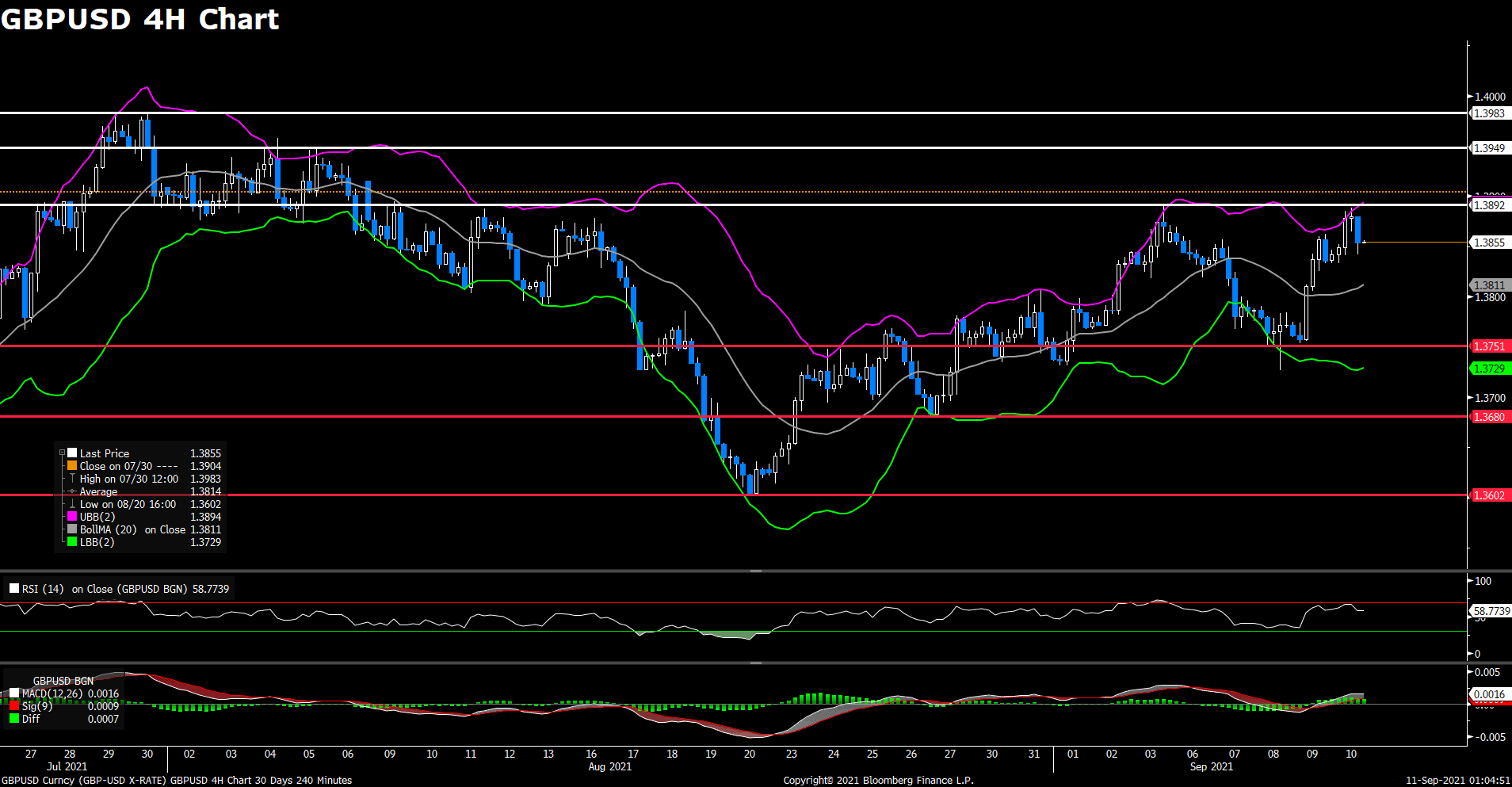
GBPUSD (4-hour Chart)

The GBP/USD pair advanced on Friday, reaching a fresh weekly high around 1.3888 level. But the pair failed to preserve its bullish traction afterwards, retreating back during American trading hours. The cable was last seen trading at 1.3851, rising 0.11% on the day as of writing. The Bank of England Governor Andrew Bailey’s hawkish comments on Wednesday provided some bullish momentum for GBP/USD, he said that half of the MPC members believe the basic conditions for a rate hike had been met.

For technical aspect, RSI indicator 58 figures as of writing, suggesting bull-movement ahead. The MACD also rises above the signal line, which means the pair is likely to experience upward momentum. In conclusion, we think market will be bullish. As for the Bollinger Bands, the price is now sitting between the upper band and the moving average, which also indicates a bull market.

Resistance: 1.3892, 1.3949, 1.3983

Support: 1.3751, 1.3680, 1.3602


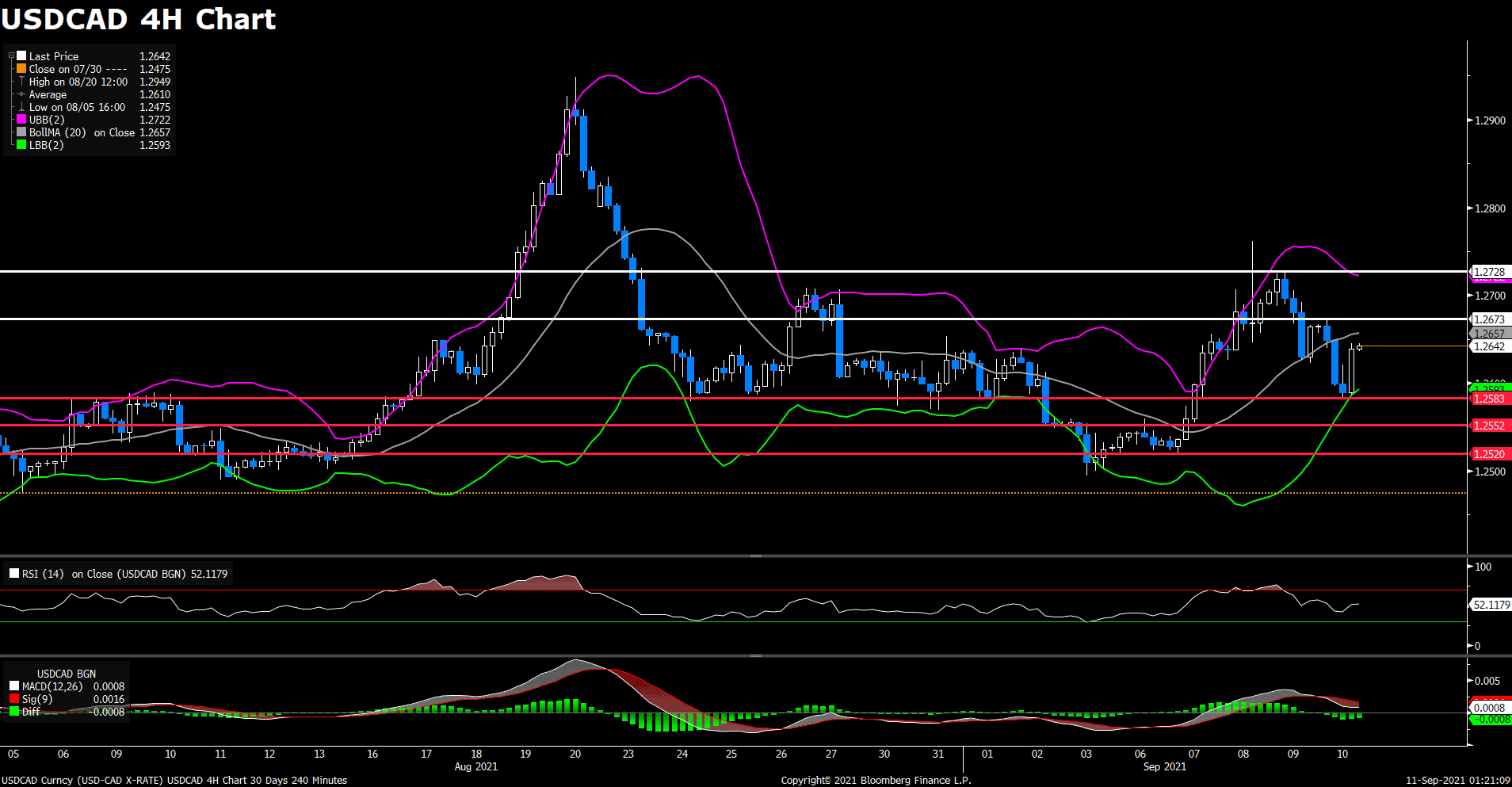
USDCAD (4- Hour Chart)

The USD/CAD pair was surrounded by heavy selling pressure during European trading hours, touching a three-day low on Friday. Fortunately, the pair have rebounded back to 1.264 level after American session began, offsetting half of its losses for the day. The pair is trading at 1.2643 at the time of writing, posting a 0.16% loss on a daily basis. The larger-than-anticipated drop in the unemployment rate in Canada, which down to 7.1% in August, giving a boost for the Canadian dollar. On top of that, crude oil prices surged 2.4% for the day, which also set the bullish tone for the commodity-linked loonie.

For technical aspect, RSI indicator 51 figures as of writing, suggesting that there is no obvious trend now. But the Bollinger Bands shows that the price rises from the lower band and it’s moving toward the SMA line, which indicates a bull market. In conclusion, we think market will be bullish as the pair heads to test the 1.2673 resistance, a break above that level will open the door for additional near-term profits. The next resistance sits at 1.2728.

Resistance: 1.2673, 1.2728

Support: 1.2583, 1.2552, 1.2520


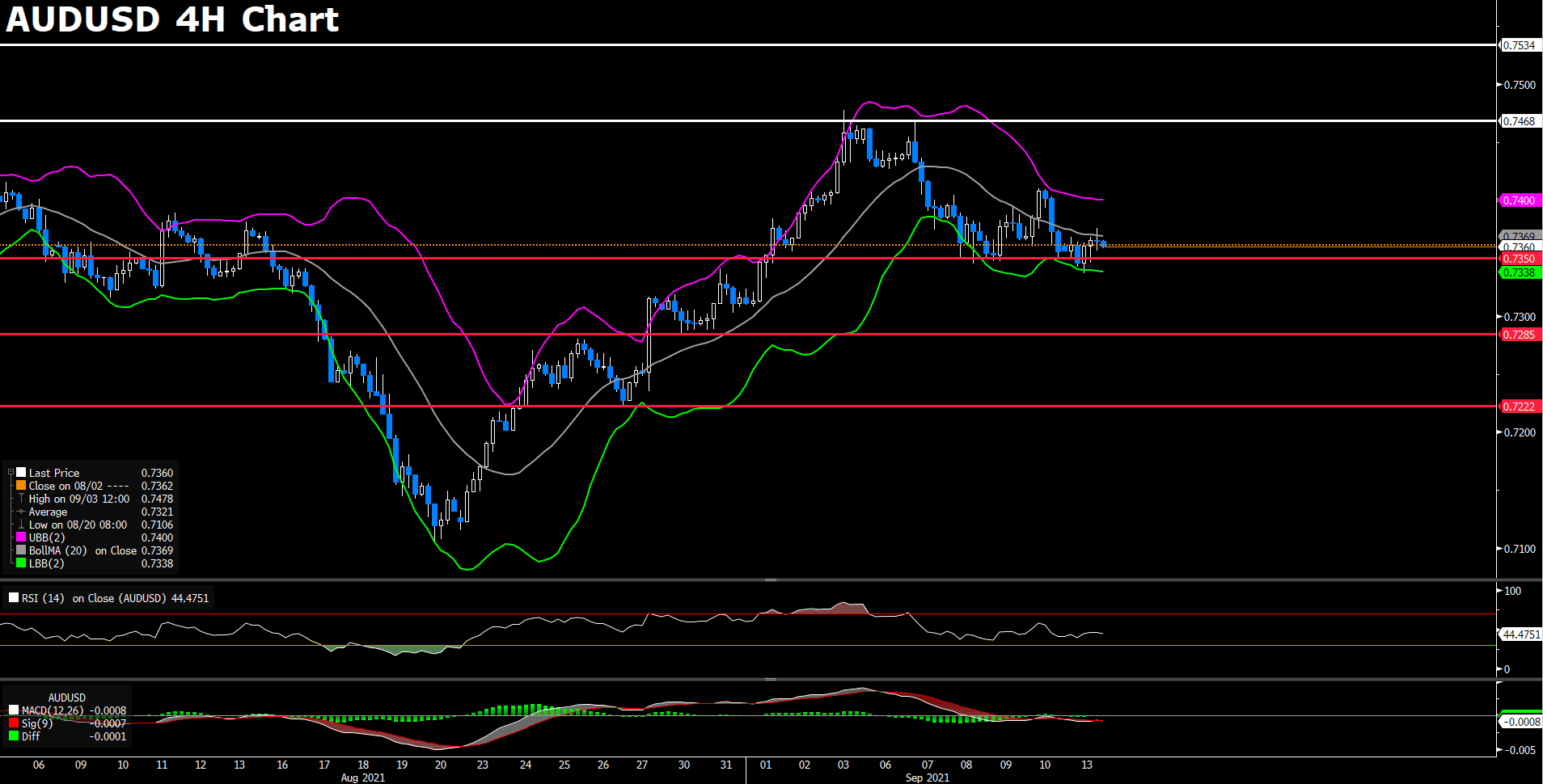
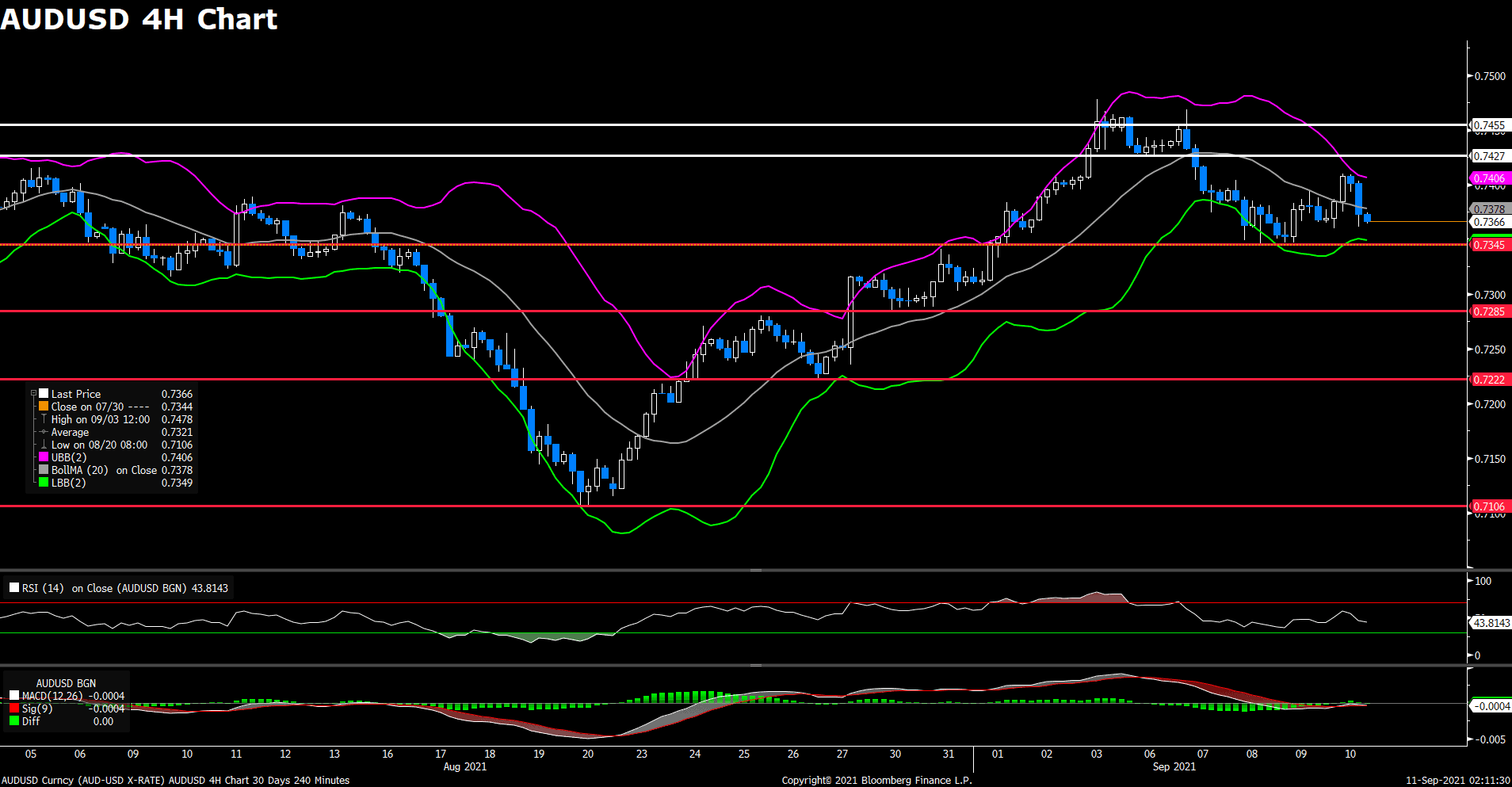
AUDUSD (4- Hour Chart)

The AUD/USD pair gave a remarkable performance in the first half of the day, rising above 0.7405 level. But it’s a whole different story once the American session begins. The pair lost its bullish momentum and dropped sharply, eliminating most of its profits for the day. A rebound witnessed in US dollar weighed on the AUD/USD, as the market mood turns cautious ahead of the weekend. Therefore, the demand of the safe-haven dollar is increasing. At the time of writing, the pair is trading at 0.7365, rising merely 0.01% for the day.

For technical aspect, RSI indicator 43 figures as of writing, suggesting tepid bear-movement ahead. For Bollinger Bands, price is falling from the upper band and crossing below the moving average, as a result, the lower band becomes the loss target. In conclusion, we think market will be bearish as the pair is now heading to test the 0.7345 support.

Resistance: 0.7427, 0.7455

Support: 0.7345, 0.7285, 0.7222, 0.7106


Economic Data

Currency

Data

Time (GMT + 8)

Forecast

OIL

OPEC Monthly Report

19:00

Back To Top
server

Hello there 👋

How can I help you?

Chat with our team instantly

Live Chat

Start a live conversation through...

  • Telegram
    hold On hold
  • Coming Soon...

Hello there 👋

How can I help you?

telegram

Scan the QR code with your smartphone to start a chat with us, or click here.

Don’t have the Telegram App or Desktop installed? Use Web Telegram instead.

QR code