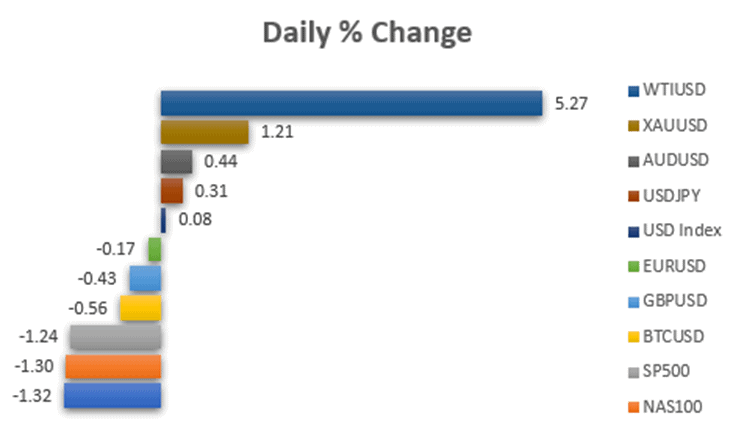
US equities were up on Monday due to the strength of technology and mega caps stocks. The S&P 500 gained 0.78 percent, while the Nasdaq 100 gained 1.54 percent and the Dow Jones Industrial Average gained 0.33 percent.

The US bond market is a source of concern since current conditions are particularly concerning for the long-term growth of the US economy. The 5-year US bond yield is currently slightly higher than the 30-year yield, with the 5-year yield at 2.56 percent and the 30-year yield at 2.55 percent.

However, when compared to rates between 2- and 10- years, the current situation is still better; however, crossing between 5- and 30-year yields can be an early warning of a future recession in the long term.

Rising inflation rates due to high energy prices, supply chain disruptions, and the prospect of an economic downturn due to the conflict in Eastern Europe are the key causes of the inverted yield curve, as well as the Fed’s proactive stance.

The impact of an inverted yield curve may cause investors to stockpile cash again, putting pressure on the US stock market in the future.
Main Pairs Movement

The TSLA jumped as much as 2.38 percent in response to plans to seek shareholder approval for procedures that would allow for another stock split.

AAPL continued to rise until the tenth day, setting a record for the longest period since 2010, with a 1.75 percent gain.

The US dollar (WTI) plummeted as much as 6.68 percent as the virus spread across China, the world’s largest crude oil importer.

Because of the sustained negative feeling toward the yen, the USDJPY rose as much as 1.54 percent.

The biggest performer was BTCUSD, which gained 3.90 percent due to the market’s perception of adverse global economic prospects, particularly in the United States.

Technical Analysis

GBPUSD (4-Hour Chart)

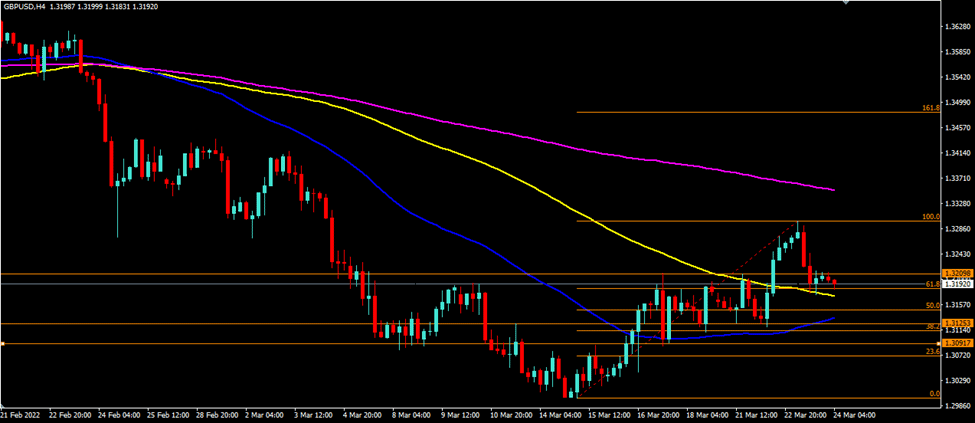
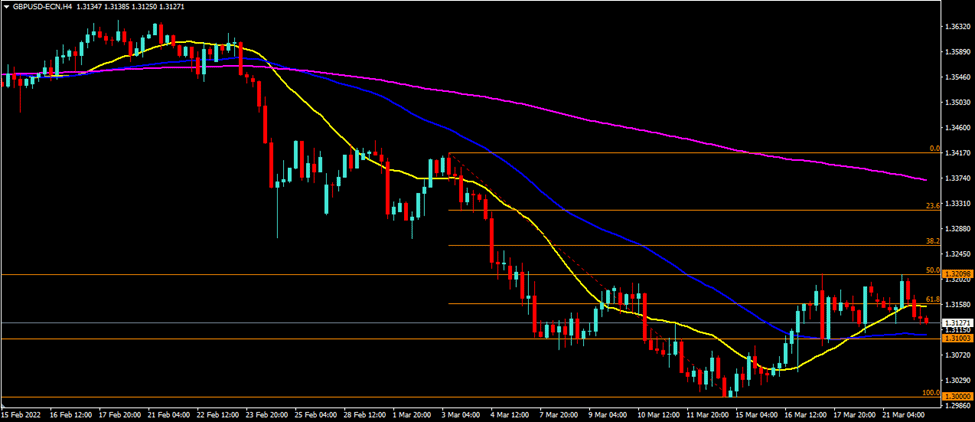
The lowering cable broke through our support region at 1.3125-1.3150 but became somewhat rejected around 1.3080. It is now expected that the cable will move in the range of 1.3080 – 1.3126, with a possible breakout. A breach of the 1.3126 level indicates that the probable resistance is 1.3188, while a break below 1.3080 indicates that the cable is heading to the support area of 1.3000 – 1.3020. The cable is trading below its 50-day, 100-day, and 200-day simple moving averages (SMAs) on the four-hour chart.

Resistance: 1.3126, 1.3188

Support: 1.3080, area (1.3000 – 1.3020)

EURUSD (4-Hour Chart)

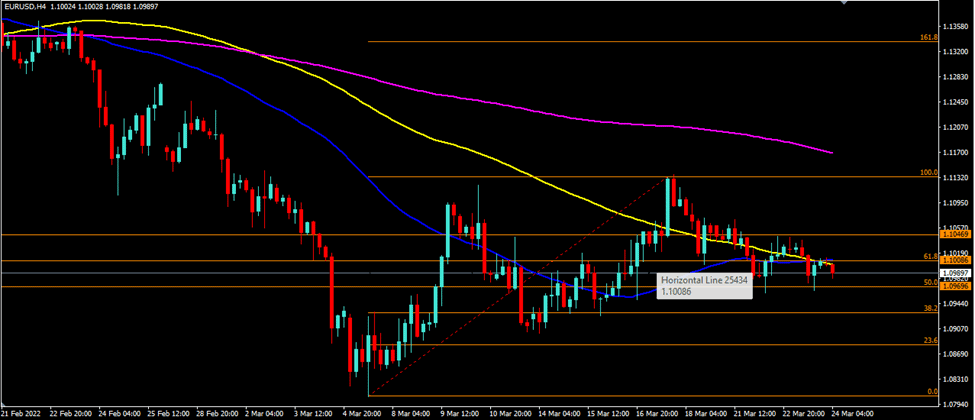
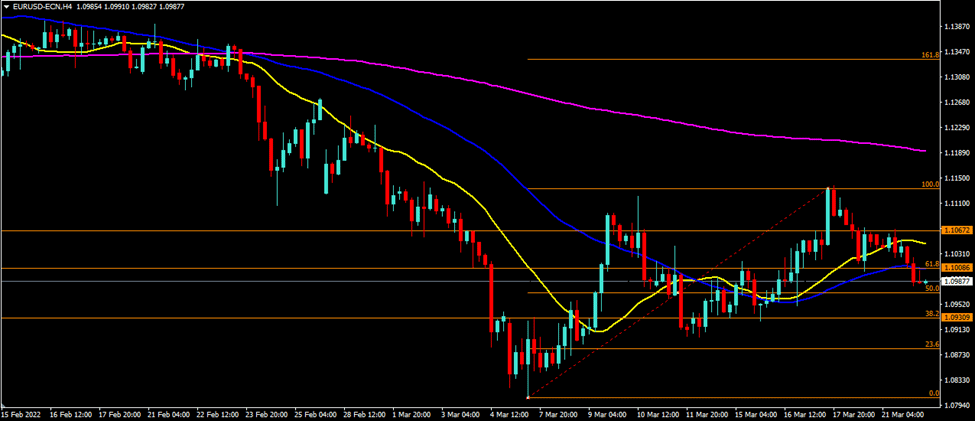
On Monday, the EURUSD was flat, hovering around the 1.0969 level. At the time of writing, the EURUSD is attempting to break through the 100-day Simple Moving Average (SMA). Immediate resistance is still at 1.1008 and 1.1046, while support is at 1.0925 and 1.0899. On the four-hour chart, EURUSD is now trading below its 50-day and 200-day simple moving averages (SMAs) while attempting to break above the 100-day SMA.

Resistance: 1.1008. 1.1046

Support: 1.0925, 1.0899

XAUUSD (4-Hour Chart)

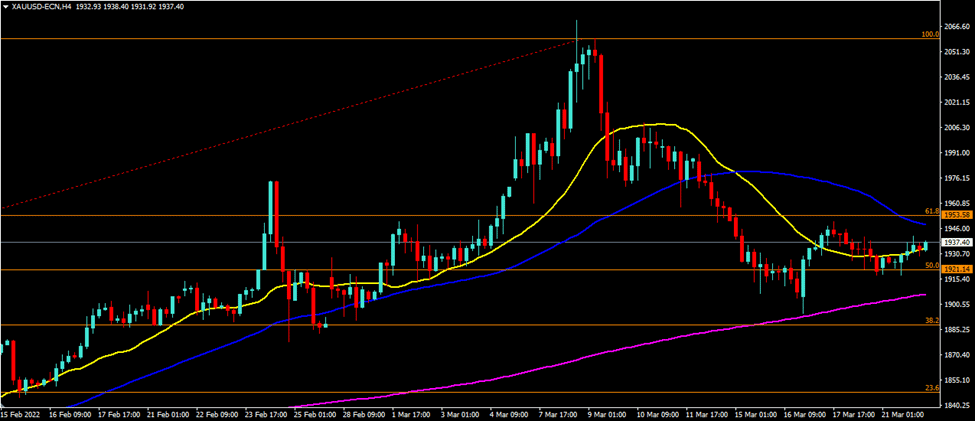
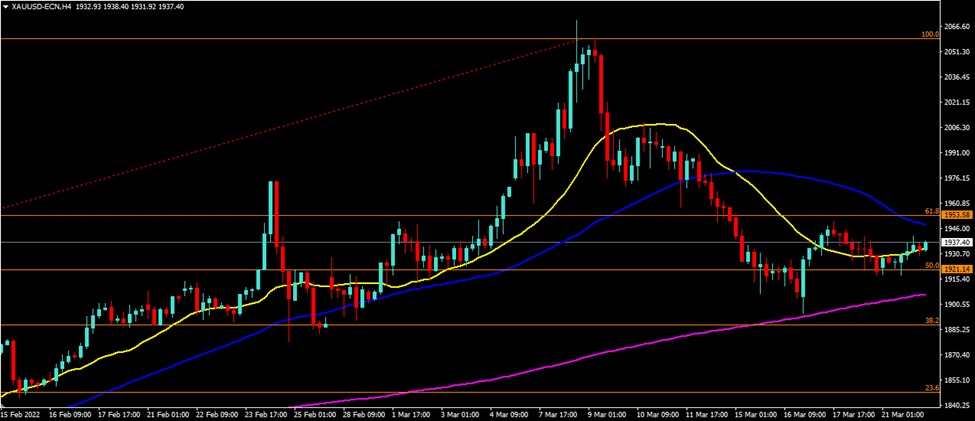
XAUUSD fell more on Monday, approaching our support level of $1921. Currently, the level of $1921 can sustain the weakening of the XAUUSD, but more weakness is still possible given the state of the crisis between Russia and Ukraine, which has begun to diminish. XAUUSD is projected to trade in a range of $1921 to $1936 for the foreseeable future until one of the levels is breached. If it breaks above $1936, the next resistance levels are at $1948 and $1964, while a breach below $1921 will continue to support levels of $1910 and $1893. On the four-hour chart, XAUUSD is now trading below its 50-day and 100-day simple moving averages but slightly above its 200-day SMA.

Resistance: area $1936, $1948, $1964

Support: $1921, $1910, $1893

U.S. equities were mixed on Friday but ended generally higher following a string of up and down days on Wall Street as investors pondered the route forward for interest rates and fresh sanctions against Russia. The Dow Jones Industrial Average finished the day 0.30 percent higher; the S&P 500 finished 0.44 percent higher, and the Nasdaq Composite finished the day -0.09 percent lower.

Source: DW

Even while negotiations between the two countries are still ongoing, Ukrainian troops continue to oppose. This situation undoubtedly causes commodity prices to rise more, particularly oil prices, which remain above $100 per barrel. High global oil costs cause worldwide inflation rates to rise further, weighing on the economic progress of every country on the planet.

The yield on 10-year US bonds has reached 2.4 percent, while the yield on 5-year bonds has reached 2.5 percent, indicating that market participants’ views on long-term uncertainty are beginning to emerge. The Inverted Yield Curve is an indicator of a coming economic recession, as market players are beginning to mistrust the long-term payment of government bonds due to the war in Ukraine, rising oil costs, and the Fed’s aggressive stance of raising interest rates this year.

Furthermore, the threat of a recession has prompted many investors to convert their financial instrument holdings into cash and cryptocurrencies such as bitcoin.

Main Pairs Movement

We can notice some market activity based on MT4 from VT Markets over the last week.

The US Dollar was up 8.44 percent, Bitcoin was up 7.97 percent, and Apple stock was up 6.28 percent.

Meanwhile, the USDJPY increased by 2.57 percent, and the XAUUSD increased by up to 1.85 percent.

The SP500 was up 1.72 percent and the NAS100 was up 2.31 percent on the US Index.

Technical Analysis

GBPUSD (4-Hour Chart)

The cable remains pretty solid; our resistance level of 1.3209 has not been broken, but upward momentum is weakening as we approach our next resistance area of 1.3269 – 1.3300. The cable is presently approaching our support areas of 1.3125 and 1.3150. On the four-hour chart, the cable is trading below its 50- and 200-day simple moving averages (SMAs), but above its 100-day SMA.

Resistance: 1.3209, area 1.3269 – 1.3300

Support: 1.3125-1.3150

EURUSD (4-Hour Chart)

The EURUSD is unable to hold above our resistance level of 1.1008 and is falling back below it, breaking below 1.0969, which we can mark as our nearest resistance. The nearest support levels for the EURUSD are around 1.0925 and 1.0899. On the four-hour chart, EURUSD is currently trading below its 50-day, 100-day, and 200-day simple moving averages (SMAs).

Resistance: 1.0969, 1.1008

Support: 1.0925, 1.0899

XAUUSD (4-Hour Chart)

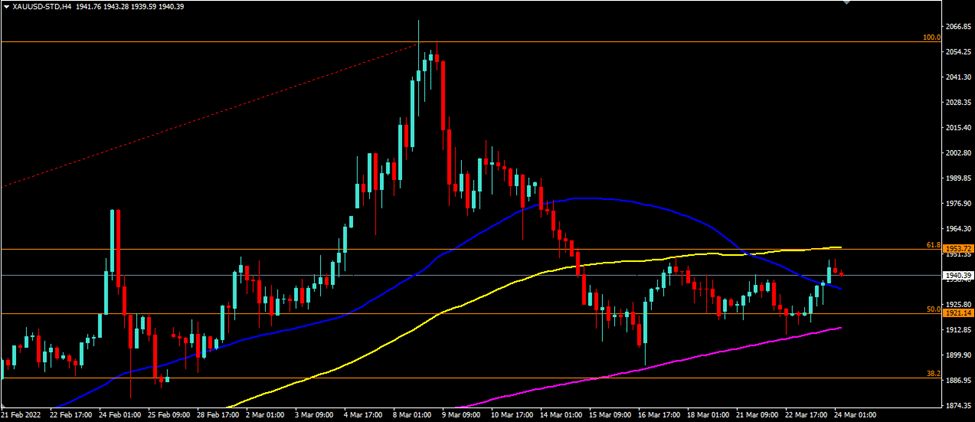
XAUUSD fell down below our 61.8 Fibonacci level of $1953 per ounce, as well as our resistance level of $1948 per ounce. For today, we can choose $1948 – $1953 per ounce as our nearest resistance level, with the next resistance levels at $1974 and $2000 per ounce. In the meantime, our support levels will be set at $1921 per ounce. On the four-hour chart, XAUUSD is now trading above its 50-day and 200-day SMAs but below its 100-day SMA.

Resistance: area $1948 – $1953, $1974, $2000

Support: $1921

VT Markets Notification of Server Upgrade

Dear Client:

As part of our commitment to provide the best reliability and service to our clients, the trading hours of certain products will be adjusted as follows due to the maintenance.

Available trading hours:

2022/03/26 18:00 – 24:00 (Server time)
2022/03/27 00:00 – 24:00 (Server time)

Please note that 24 trading hours will take effect from the 26th of March 2022 onwards.
Please be reminded that the following aspects might be affected during this maintenance period:

1. The functions of client portal operations might be disabled during this period.

2. There might be a gap between the original price and the price after maintenance. Pending orders, Stop Loss, and Take Profit settings within the gap will be filled at the market price after maintenance activity ends.

3. The quotations of products will be paused. Clients may not be able to open new positions or close the held positions.

No action is required by our client. Your service will be back online after the maintenance is completed.

Thank you for your patience and understanding about this important initiative.

If you’d like more information, please don’t hesitate to contact [email protected].

US equities ended higher following a decline the previous day, and the market views this as an opportunity to re-enter the market. Additionally, the market is awaiting the outcome of President Joe Biden’s NATO and G7 summit visits. The Dow Jones Industrial Average concluded the day 1.11 percent higher; the S&P 500 ended the day 1.50 percent higher, and the Nasdaq Composite ended the day 2.08 percent higher.

NATO and G7 leaders met in Brussels to discuss beefing up NATO military forces in Ukraine’s border county, humanitarian assistance, and escalating penalties against Russia’s leadership.

This uncertainty undoubtedly prompts the most hawkish ECB board members to contemplate extending the QE program beyond the summer if the EU economies enter a recession.

Due to the region’s reliance on Russia for oil and natural gas, oil prices in the region have increased due to supply problems. After the summit, the availability of oil and natural gas may worsen further as the Russian government compels payment in rubles for these commodities.

Main Pairs Movement

NVIDIA shares rose 7.18 percent to their highest level since mid-January, while INTEL rose 5.70 percent, helping to boost the S&P500 and Nasdaq.

Meanwhile, AAPL increased marginally to 1.18 percent, marking the company’s eighth straight day of advances, and bringing the stock to its March high.

Following Wednesday’s significant increase, oil prices fell as much as 2.79 percent as the Russian government mandated that these commodities be paid in rubles.

Meanwhile, the Forex Market has been reasonably stable, although it still reacts when US Jobless Claims fall below 200K.

Technical Analysis

GBPUSD (4-Hour Chart)

The cable continues to be relatively stable; our resistance level of 1.3209 has not been broken, however, upward momentum continues towards the next resistance area of 1.3269 – 1.3300. The cable’s current support ranges between 1.3125 and 1.3150. On the four-hour chart, the cable is trading above its 50- and 100-day SMAs but below its 200-day SMA.

Resistance: 1.3209, 1.3269

Support: 1.3125-1.3150

EURUSD (4-Hour Chart)

The EURUSD has just broken our resistance level of 1.1008 and moving towards our next resistance area of 1.1046 – 1.1070, while the nearest support level is at the broken resistance at 1.1008 and 1.0969. EURUSD is currently trading above its 100-day SMA, trying to move above 50-days SMA but below its 200-day SMA.

below its 50-day, 100-day, and 200-day SMAs on the four-hour chart.

Resistance: 1.1046-1.1070

Support: 1.1008, 1.0969

XAUUSD (4-Hour Chart)

XAUUSD broke our 61.8 Fibonacci level at $1953 per ounce and chasing higher with the uncertainty of global geopolitical conditions. Our next resistance will be at $1974 and $2000 per ounce. Meanwhile, our support levels will be at $1948 and $1921 per ounce. XAUUSD is currently trading above its 50-day, 100-day, and 200-day SMAs on the four-hour chart.

Resistance: $1974, $2000

Support: $1948, $1921

VT Markets The Adjustment Of Weekly Dividend Notification

Dear Client:

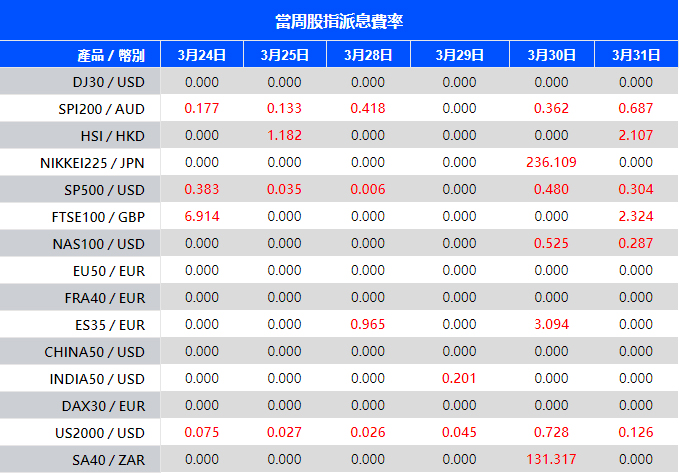
<pWarmly reminds you that the component stocks in the stock index spot generate dividends. When dividends are distributed, VT Markets will make dividends and deductions for the clients who hold the trading products after the close of the day before the ex-dividend date.

Indices dividends will not be paid/charged as an inclusion along with the swap component. It will be executed separately through a balance statement directly to your trading account, the comment for which will be in the following format “Div & Product Name & Net Volume ”.

Please note the specific adjustments as follows:

Note: The above data is for reference only, the actual execution date may be changed, please refer to the MT4/MT5 software for details.

If you’d like more information, please don’t hesitate to contact [email protected].

On Wednesday, US stock markets finished down as tensions between Russia and Ukraine remained unchanged, and US President Joe Biden was en route to Brussels for the NATO and G7 summits, highlighting the possibility of NATO forces being increased surrounding Ukraine. The Dow Jones Industrial Average finished 1.32 percent lower, the S&P 500 finished 1.24 percent lower, and the Nasdaq Composite finished 1.30 percent lower.

Since Russia’s initial strike on Ukraine in February, over 140,000 NATO troops have been deployed, 100,000 of which are US forces. Troops are dispersed throughout Ukraine’s neighboring nations, including Poland, Slovakia, Hungary, and Romania. At least 140 warships and 130 aircraft are stationed in this alliance, ready to battle if a NATO country is attacked or if Russia begins to utilize biological or chemical weapons. This situation will most probably result in a conflict that escalates in Eastern Europe, having a direct effect on Europe’s and the United States’ capital markets.

With the Russia-Ukraine conflict intensifying, it will exacerbate future disruptions in the supply of energy and raw materials, causing global inflation to continue to rise and persist for an extended period. A recession indicator appeared in the form of the 10-year US bond yields passing the two-year yield. This condition very likely implies that long-term economic growth will be riskier and that the local and global economies would stagnate, posing a threat to the global economy.

World gold prices began to gradually edge out of the bearish zone and exhibit turnaround characteristics. The current rising in international gold prices is a result of the deteriorating situation in the Ukraine-Russia war, which has lasted more than a month.

It is worth noting that Russia began a military campaign against Ukraine on February 24 and there has been no sign of peace between the two nations in the month afterward. The most recent development in the Ukraine-Russia confrontation is NATO’s backing for Ukraine by stationing extra troops on its border. This, of course, has the potential to re-ignite tensions between the two belligerent nations.

On the other side of the COVID-19 pandemic, a new virus strain, Omicron Subvariant BA.2, has been claimed to have infected over 250,000 people in Germany in just one day last week. This exacerbates the pandemic situation and creates an opportunity for safe-haven assets such as gold to strengthen once more this week.

Main Pairs Movement

On Wednesday, WTI gained moreover 5% as Russia threatened to upset the natural gas market.

Gold edged higher on Wednesday, finishing at $1948, owing to the uncertainty surrounding US President Biden’s talks with NATO, as well as the fact that US inflation continued to spiral out of control as the Ukraine issue intensified.

On Wednesday, higher energy costs continued to dominate currency market fluctuations, with the Australian dollar gaining and the yen weakening. The Australian dollar increased to its highest level since December 2015 against the Japanese yen and has gained 8% so far in March.

Technical Analysis

GBPUSD (4-Hour Chart)

Cable has broken over our previously anticipated resistance level of 1.3209 on the technical side, although upward momentum appears to be waning and back below the resistance level. Cable is currently trading above its 50-day and 100-day SMAs but below its 200-day SMA on the four-hour chart.

Resistance: 1.3209

Support: 1.3125

EURUSD (4-Hour Chart)

On a technical level, the EURUSD has successfully defended our previously anticipated resistance level at 1.1008, while the nearest support level is at 1.0969 (50% Fibonacci levels). EURUSD is currently trading below its 50-day, 100-day, and 200-day SMAs on the four-hour chart.

Resistance: 1.1008, 1.1046

Support: 1.0969

XAUUSD (4-Hour Chart)

On a technical level, our previously anticipated resistance level of $1953 per ounce remains untested. On the other hand, the XAUUSD’s near-term support has been tested and the price bounces back from the $1921 per ounce level. XAUUSD is currently trading below its 100-day SMA but above its 50-day and 200-day SMAs on the four-hour chart.

Resistance: 1953

Support: 1921

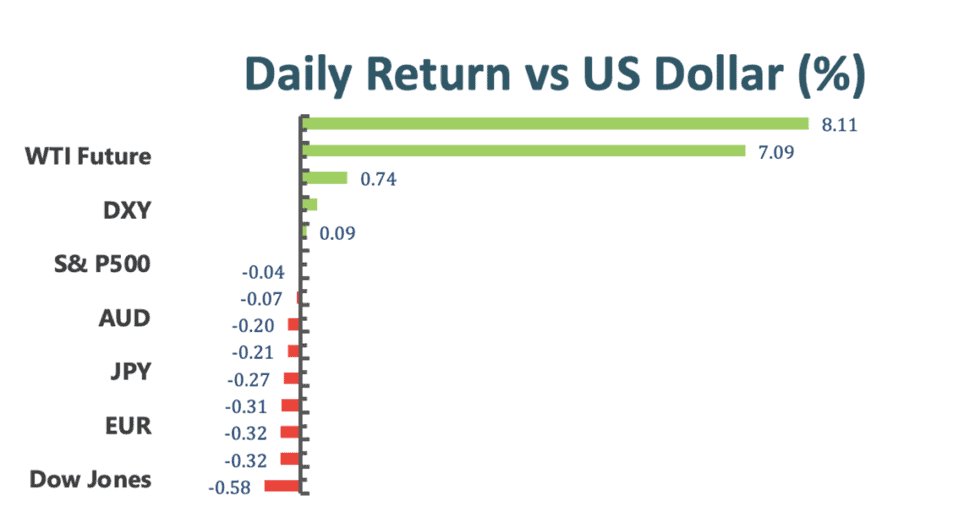
On Monday, the US stock market moved marginally lower following Federal Reserve Chairman Jerome Powell’s warning about increasing inflation and the possibility of a half-point rate hike in May. The Dow Jones Industrial Average finished 0.58 percent lower, while the S&P 500 was practically flat, down 0.04 percent. The Nasdaq Composite finished the day down 0.4 percent.

Fed Chair Jerome Powell underlined on Monday that the Fed will continue to fight the rate of inflation in the United States. Powell will not alter his liquidity withdrawal approach, despite market participants’ doubts that rapid interest rate hikes will result in a halt in US GDP. Powell’s assertiveness repressed the US stock market, resulting in another 0.6 percent decline in the Dow Jones index.

The decrease in Wall Street’s capital market is, of course, plagued by the Fed’s determination to hike interest rates six times this year and the Fed’s balance sheet reduction, which now stands at $9 trillion US Dollars. The hike in interest rates and the subsequent shrinkage of the Fed’s balance sheet, which will begin at the Fed’s May 4 meeting, undoubtedly signals that Powell will drain liquidity aggressively in the future, resulting in a deterioration of the US capital market.

Additionally, the accident of a Boeing 737 owned by China Eastern Airlines in the Chinese highlands weighed on Boeing’s shares, adding to the market’s woes yesterday. Boeing stock dropped as much as 3.5 percent, according to reports.

The XAUUSD pair’s negative movement may continue this week, owing to the US Dollar currency index’s ongoing gain following last week’s FOMC meeting. The Fed’s program of raising interest rates from 0.25 percent to 0.50 percent was the primary driver in the market’s decision to hold the US Dollar. The US central bank is expected to hike interest rates at least three times this year, but it is conceivable for the Fed to raise rates more depending on the direction of US inflation, which is presently at 7.9 percent. The US central bank’s policies continued to strengthen the US dollar and reduce global gold prices this week.

Main Pairs Movement

The Japanese yen fell to a six-year low versus the US dollar in response to the Federal Reserve’s aggressive monetary policy. USDJPY closed 0.27 percent higher at 119.47 on Monday. Simultaneously, the Bank of Japan maintained its easing stance, maintaining its interest rates and asset purchase program constant.

WTI gained more than 7% on Monday as the EU considered penalties against Russia’s oil industry following an attack on Saudi Arabian infrastructure by Houthi rebels who professed support for Russia’s invasion. The EU has begun discussing joining the US in an oil embargo because of the move.

Gold edged higher on Monday, settling at $1936 because of the uncertainty surrounding the US President Biden-NATO discussions. Meanwhile, the market has moved its emphasis to the Russia-Ukraine war. Separately, gold gained some momentum following word that the anticipated call between Joe Biden and Xi Jinping failed to produce any significant results.

EURUSD fell 0.32 percent, to 1.10152, to begin the week, as the US dollar strengthened in response to Jerome Powell’s aggressive tone.

Technical Analysis

GBPUSD (4-Hour Chart)

Cable began the week with a gain as demand for the dollar continues to wane. The Bank of England’s most recent interest rate boost provided an adequate upward impetus for the British Pound. The UK’s CPI and PMI statistics are slated for publication on Wednesday and Thursday, respectively; the US’ initial jobless claims and core durable goods data are scheduled for release on Thursday.

Cable has broken over our previously anticipated resistance level of 1.3185 on the technical side, although upward momentum appears to be waning. Cable is currently trading above its 50-day SMA but below its 100- and 200-day SMAs on the four-hour chart.

Resistance: 1.3208

Support: 1.3100, 1.3000

EURUSD (4-Hour Chart)

The euro-dollar pair has maintained the higher price trend we predicted. However, with no end in sight to the Ukraine-Russia war and no sign of progress in the most recent peace talks, market investors should be cautious of probable short-term trend reversals. Fed Chairman Jerome Powell stated during his scheduled address during the US session that inflation was running faster than expected and that the central bank would not rule out a 50-basis point rate hike.

On a technical level, the EURUSD has successfully defended our previously anticipated support level at 1.0893, while the immediate resistance level at 1.1127 remains untested. As of this writing, the pair’s RSI stands at 40.07. EURUSD is currently trading below its 50-day, 100-day, and 200-day SMAs on the four-hour chart.

Resistance: 1.1008, 1.1067

Support: 1.0930

XAUUSD (4-Hour Chart)

Gold began the week trading higher relative to the previous week’s closing. With the Kremlin and Kyiv refusing to back down, market participants will continue to monitor the growing scenario while using gold as a hedge against geopolitical tensions. Recent interest rate hikes by central banks throughout the world have also aided the precious metals boom. Recently, the Russian army used hypersonic weapons capable of carrying nuclear warheads to demolish tactical positions. This move has alerted worldwide defense ministries, as such weapons have not been used since the outbreak of the Ukraine-Russia war.

On a technical level, our previously anticipated support level of $1918 per ounce remains in place. On the other hand, the XAUUSD’s near-term resistance barrier has established near the $1940 per ounce price level. XAUUSD is currently trading below its 50-day and 100-day SMAs but above its 200-day SMAs on the four-hour chart.

Resistance: 1953

Support: 1921

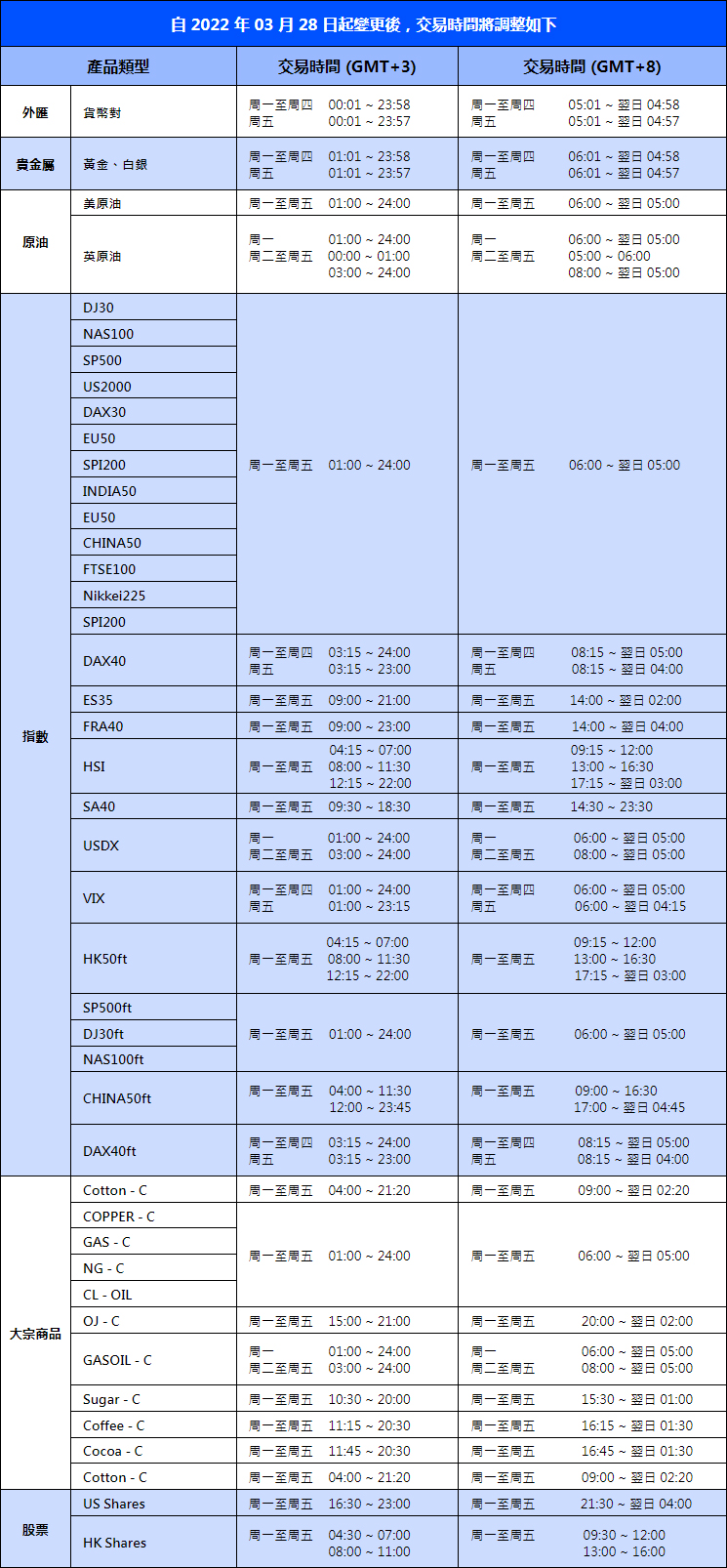
VT Markets The adjustment of EU DST

Dear Client,

With Standard time commencing in the EU on March 28th. Please consider below carefully:

The trading sessions of some products on MT4/MT5 will be changed as follows.
Please find the table below for more information.

If you’d like more information, please don’t hesitate to contact [email protected].

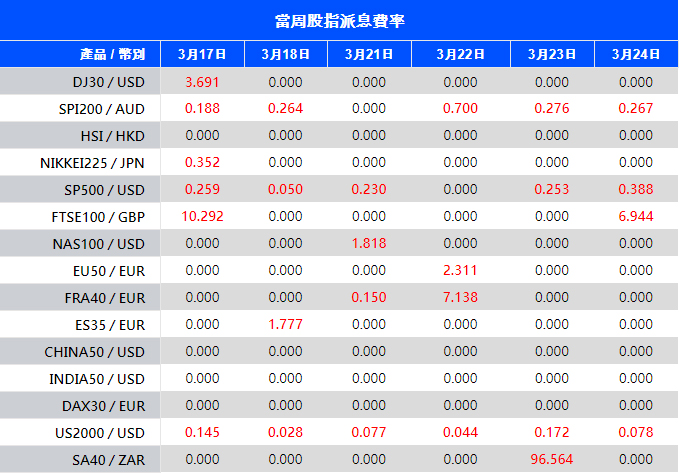
VT Markets The Adjustment Of Weekly Dividend Notification

Dear Client,

Warmly reminds you that the component stocks in the stock index spot generate dividends. When dividends are distributed, VT Markets will make dividends and deductions for the clients who hold the trading products after the close of the day before the ex-dividend date.

Indices dividends will not be paid/charged as an inclusion along with the swap component. It will be executed separately through a balance statement directly to your trading account, the comment for which will be in the following format “Div & Product Name & Net Volume ”.

Please note the specific adjustments as follows:

Note: The above data is for reference only, the actual execution data may be changed, please refer to the MT4/MT5 software for details.

If you’d like more information, please don’t hesitate to contact [email protected].

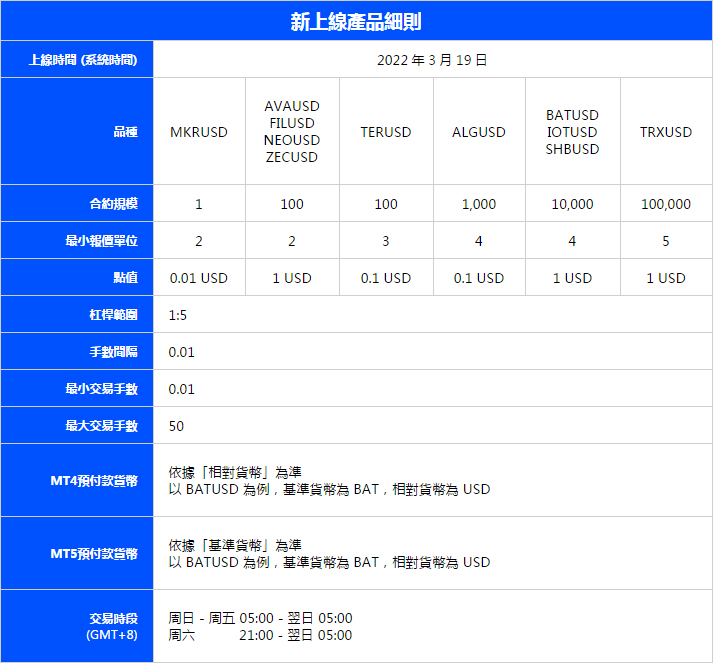
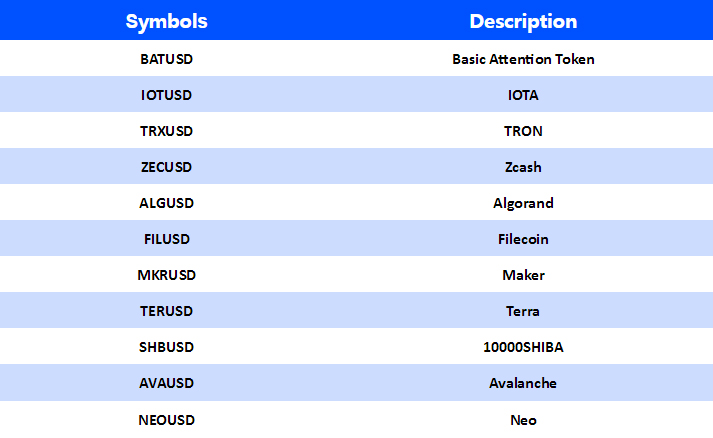
VT Markets New Product launch

Dear Client,

To provide our clients with a wealth of trading options, VT Markets will launch a new product on March 19th, 2022.

The specifications of the new products as shown in the table below.

The above data is for reference only, please refer to the MT4/MT5 software for specific data.

Please contact [email protected] if you would like more information regarding to this.

Back To Top
server

Hello there 👋

How can I help you?

Chat with our team instantly

Live Chat

Start a live conversation through...

  • Telegram
    hold On hold
  • Coming Soon...

Hello there 👋

How can I help you?

telegram

Scan the QR code with your smartphone to start a chat with us, or click here.

Don’t have the Telegram App or Desktop installed? Use Web Telegram instead.

QR code