
Lesson 4: What exactly are a pip and a pipette?

Pips and pipettes are terms commonly used by traders. Here’s what they mean.

What is a pip?

PIP stands for Percentage In Point. It is a way to measure how much a currency pair has changed in value.

We used to say a pip was the slightest change in the price of currency pairs, but then a new term came into use called a pipette.

To avoid confusion, Pip is the abbreviation for the fourth decimal place in a currency pair’s quote price (except the JPY pair).

Let’s have a look at an example.

Assuming the EURUSD goes from 1.1500 to 1.1520, how many pips are generated?

To figure how many pips the movement of EURUSD is, you only see the difference, which is 20 pips. As we said, the Pip is the fourth decimal place. In this example, the difference is 20 pips.

Consider another currency pair, GBPUSD, as an example. Consider another example in a different currency, the GBPUSD.

GBPUSD is trading at 1.3160, down from 1.3200. Thus, in this example, we may refer to GBPUSD as being down 40 pips. It is important to note that not all currency pairs have four decimal digits.

USDJPY

Because the currency pair versus the Japanese Yen (JPY) only has two decimal, we refer to the Pip as the second decimal place.

Consider the following example:

USDJPY is trading at 128.50 and has risen to 128.65, implying a 15 pip gain. GBPJPY’s move from 167.45 to 167.00 is a 45-pip loss. After we’ve figured out what PIP is, we’ll try to figure out what Pipette is.
What is a pipette?

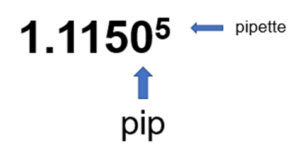
After years of using only four decimal (two for the JPY Pair), the fifth decimal, Pipette, was introduced. Most brokers use the fifth decimal (except for JPY using three decimals); however, this Pipette is usually shown with a smaller number. Pipettes are most commonly referred to as fractional pips, or 1/10 the worth of a pip.

I know it sounds weird, but Pipette isn’t used very often in everyday language. However, consider the following example: EURUSD trades between 1.11505 and 1.11513. Thus, the EURUSD increased by eight pipettes, but because most traders were unconcerned about the change below one Pip, traders typically prefer to refer to it as 0.8 pips.

The following example is GPUSD decreasing from 1.32507 to 1.32403. Then, we can see that the GBPUSD decreased by 204 pipettes or 20.4 pips.

USDJPY with third decimals

Following that, let us consider an example with the JPY pair.

The GBPJPY increased from 167,503 to 167,758. Thus, GBPJPY increased by 255 pipettes or 25.5 pips. Easier to follow, right?

Therefore, bear this in mind. A pip is a unit of measurement of a currency pair’s value change; it is the fourth decimal place for most currency pairs except for the JPY, which is the second decimal place.

One Pipette, also known as fractional pips, is 1/10 of a pip, the fifth decimal point for most currency pairs but the third decimal point for JPY pairs.

Lesson 3: Understanding the currency pairs

The US Dollar is the most frequently traded currency in the world. As a result, most currencies are quoted against it. However, different types of currency pairs are used when referring to Forex trading, each of which is split into groups depending on the amount of trading activity and liquidity. These are known as majors, minors (or crosses), and exotic pairs.

Major currency pairs

The most traded currency pairs in the world are called the majors. They are generally the most liquid and attractive to all types of Forex traders. The EURUSD is the most traded pair, representing nearly 30% of all daily Forex trades on the entire Forex market.

Currencies not classed as major currencies but are normally traded against a major currency are called minor currencies and crosses.

PAIRCURRENCIES COUNTRIES
EURUSDEuro/US DollarEurozone/United States
GBPUSDBritish Pound/US DollarUnited Kingdom/United States
USDJPYUS Dollar/Japanese YenUnited States/Japan
USDCHFUS Dollar/Swiss FrancUnited States/Switzerland
USDCADUS Dollar/Canadian DollarUnited States/Canada
AUDUSDAustralian Dollar/US DollarAustralia/United States
NZDUSDNew Zealand Dollar/US DollarNew Zealand/United States

Minor currency pairs and crosses

Currency pairs that do not contain the US Dollar are known as ‘crosses’. A currency pair involving a major non-US Dollar currency would also be known as a ‘minor currency pair’.

The most common crosses are pairs derived from the three major non-US Dollar currencies – Euro, Great British Pound, and Japanese Yen. For example, pairs that involve the euro are called ‘euro crosses’. Below is a list of Euro, Pound, Yen, and other crosses.

EURO CROSSES

EURGBPEuro/British Pound
EURCHFEuro/Swiss Franc
EURAUDEuro/Australian Dollar
EURCADEuro/Canadian Dollar

GBP CROSSES

GBPAUDBritish Pound/Australian Dollar
GBPCADBritish Pound/Canadian Dollar
GBPCHFBritish Pound/Swiss Franc
GBPNZDBritish Pound/New Zealand Dollar

YEN CROSSES

GBPJPYBritish Pound/Japanese Yen
EURJPYEuro/Japanese Yen
CHFJPYSwiss Franc/Japanese Yen
CADJPYCanadian Dollar/Japanese Yen
AUDJPYAustralian Dollar/Japanese Yen
NZDJPYNew Zealand Dollar/Japanese Yen

OTHER CROSSES

AUDCADAustralian Dollar/Canadian Dollar
AUDNZDAustralian Dollar/New Zealand Dollar
AUDCHFAustralian Dollar/Swiss Franc
CADCHFCanadian Dollar/Swiss Franc
NZDCADNew Zealand Dollar/Canadian Dollar
NZDCHFNew Zealand Dollar/Swiss Franc

Exotic currency pairs

Trading exotic pairs offer exposure to a wide range of developing and emerging market economies across Asia, the Middle East, and Africa. In general, exotic pairs are not traded as often as majors or crosses, which means they are not very liquid markets and lack consistent market activity.

There are often pros and cons associated with trading exotic currency pairs. Because they are not so widely traded, they can often be subject to higher trading fees; however, when the market moves, they can be subject to wild price fluctuations (suitable for the more experienced trader).

Below is a list of some of the main currency pairs referred to when talking about exotic pairs.

PAIRCURRENCIESCOUNTRIES
USDSEKUS Dollar/Swedish KronaUnited States/Sweden
USDNOKUS Dollar/Norwegian KroneUnited States/Norway
USDTRY                US Dollar/Turkish Lira                     United States/Turkey
USDMXNUS Dollar/Mexican PesoUnited States/Mexico
USDZARUS Dollar/South African RandUnited States/South Africa
USDPLN US Dollar/Polish ZlotyUnited States/Poland
USDSGDUS Dollar/Singapore DollarUnited States/Singapore

Nicknames

In Forex, many currency pairs (especially the majors) have particular nicknames which are commonly used in the market. Many even have an exciting story about why they were nicknamed that in the first place. For example, the FX pair GBPUSD is called ‘cable’.

This dates back to the 19th century when a communications cable ran across the Atlantic Ocean floor to get the exchange rate between the US Dollar and the British Pound.

In some cases, the currency by itself is known by a different name. For example, the US Dollar is often referred to as the ‘greenback’, while you may hear the British Pound referred to as ‘sterling’.

Below is a list of the most popular currency pair nicknames.

CURRENCY PAIR NICKNAME

GBPUSDCable
EURUSDFiber
EURGBPChunnel
USDCADLoonie
AUDUSDAussie
NZDUSDKiwi
GBPJPYGuppy
EURJPYYuppy
USDCHF Swissy

Currency codes

Currencies are often abbreviated to a three-letter currency code. The first two letters symbolize the country’s name, while the third is the country’s currency.

Let’s look at a few examples.

GBP – ‘GB’ stands for Great Britain, while the ‘P’ stands for Pound

USD – ‘US’ stands for the United States, the ‘D’ stands for Dollar

JPY – ‘JP’ stands for Japan, the ‘Y’ stands for Yen

In trading, you will hear a lot about ‘pips’ and ‘spreads’. Learn about pips in Forex and how different factors can influence spreads.

Lesson 2: Why should you trade in the forex?

(In comparison to other markets)

The forex market is the world’s largest, and it offers numerous advantages that attract traders. The following are some of the primary reasons to give forex trading a try.

Unparalleled liquidity

The foreign exchange market is highly liquid, which is another way of saying that other traders are always available to engage. However, why is liquidity so critical?

Assume you’re attempting to sell a Nokia phone manufactured in 2000. If you placed an ad on eBay asking for $1,000, you’re unlikely to receive an offer — and if you do, it’s likely to be for a few hundred dollars (at most) a month later. Essentially, there aren’t many buyers and vendors for that goods.

However, if you were to sell the current iPhone at the price you purchased, you would almost certainly receive multiple offers, most of which would be close to your asking price. This is simply due to the market’s high volume of buyers and sellers. This is a technique for proving enough liquidity.

Volatility

Another reason it is pretty popular is due to the volatility of the FX market. This is related to currency fluctuations, which are determined by the real economy of various countries. Because economic outlooks are constantly changing – due to factors such as recent news and events – the accompanying currency’s value will fluctuate. These movements provide traders with an opportunity to benefit from forex deals.

24-5

The currency market is open twenty-four hours a day, five days a week. This 24-hour trading provides traders in various world regions with numerous changes, depending on which markets are available at particular times. For instance, when trading sessions overlap – as they do during the few hours that the US and European markets are open concurrently – there can be more trading activity, resulting in new chances. The markets’ 24/5 nature also provides traders with flexibility – for example, even if you’re locked in the office all day, you may still conduct a few trades over lunch or while relaxing at home in the evening.

Trading with leverage

One of the beautiful aspects of forex is that it allows for leveraged trading. This indicates that you can use a small amount of capital to undertake a higher-value trade. In effect, leveraged trading will enable you to stretch your money further.

For instance, leverage of 1:100 means that a $1 investment may purchase $100 worth of “forex.” While leverage has the potential to help you earn more money more rapidly, it also has the potential to cause you to lose more money. Therefore, whenever you trade with leverage, proceed with prudence and trade only what you can afford to lose.

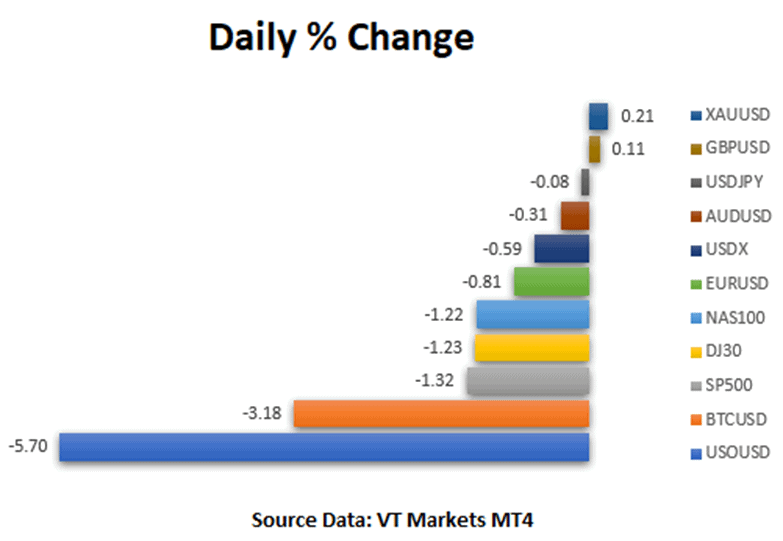
Although this month was a favorable month for US equity, quarterly it decreased mostly owing to the FED’s threat to reduce inflation and affected by conflict situations in Ukraine. According to MT4 VT Markets data, the SP500 was down 1.32 percent daily and down 5 percent quarterly, the NAS100 was down 1.22 percent and down 9.08 percent quarterly, and the DJ30 was down 1.23 percent and down 4.58 percent quarterly.

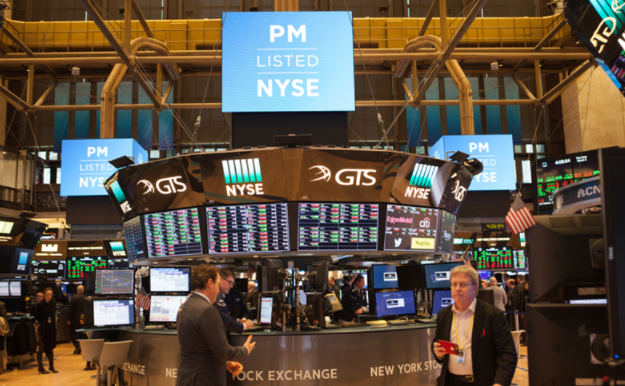
Source: Shutterstock

Today’s US jobs report will be the market’s focus, as it is one of the statistics that will support a judgment on whether the FED is likely to hike interest rates by 50 basis points in May, to combat increasing inflation. The consumer price index (CPI) reached 7.9 percent, the highest level in 40 years. The FED’s Core PCE statistics jumped to 5.4 percent, significantly over the central bank’s target of 2 percent. Several US central bank governors, including Fed Chair Jerome Powell, have signaled in recent weeks that they are open to the possibility of a 0.5 percent rate hike, so the non-farm employment change data is critical to monitor.

Source: Forex Factory

Many analysts anticipate a 492K gain this month (estimate from forex factory), which is a significant increase but still falls short of last month’s 678K. The unemployment rate is expected to fall to 3.7 percent from 3.8 percent, while average hourly earnings are expected to rise 0.4 percent from 0.0 percent last month.

Main Pairs Movement

Several technology companies continued to fall; AAPL fell 1.04 percent to $175.95, INTEL fell 2.56 percent to $50, NVIDIA fell 0.65 percent to $275.73, and TSLA fell 0.69 percent to $1086. 29

USOUSD (WTI Texas) momentarily dipped below $100, or as much as 5.70 percent, as a result of US President Joe Biden’s directive to unleash US oil reserves and push drillers to raise output.

The USDX (USD Index) plummeted as high as 0.59 percent, signaling that the USD is weakening. However, due to concerns about the conflict in Ukraine, the EURUSD plummeted as much as 0.81 percent on Thursday. Aside from that, there hasn’t been much movement in Major Currencies. The GBP gained ground against the EUR, causing the EURGBP currency pair to fall 0.85 percent.

BTCUSD (Bitcoin) declined 3.18 percent as the market anticipates the release of US jobs data today.

Technical Analysis

GBPUSD (4-Hour Chart)

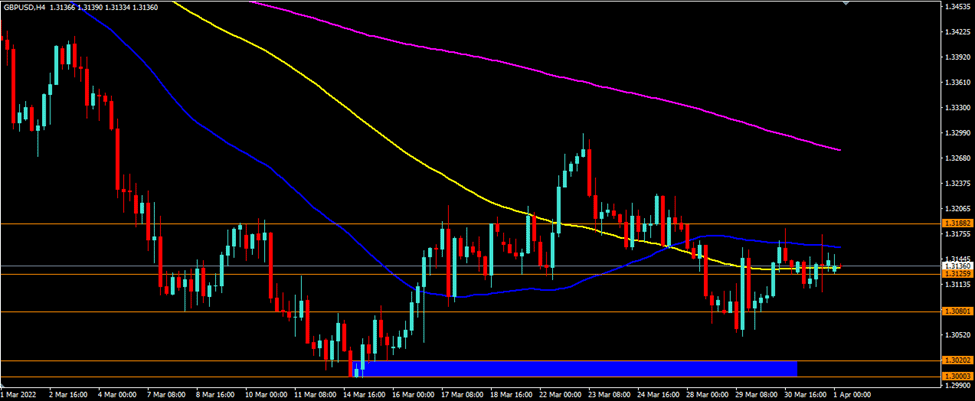
Yesterday, GBPUSD gained ground in the early European session before closing with a gain of only 14.1 pips, or 0.11 percent. GBPUSD is currently trading above the 1.3126 level and is moving pretty flat in anticipation of today’s labor report. Today’s support is around 1.3080, while the resistance is at 1.3188. GBPUSD is trading below its 50-day and 200-day simple moving averages (SMAs) and is hovering around its 100-day SMA on the four-hour chart.

Resistance: 1.3188

Support: 1.3080

EURUSD (4-Hour Chart)

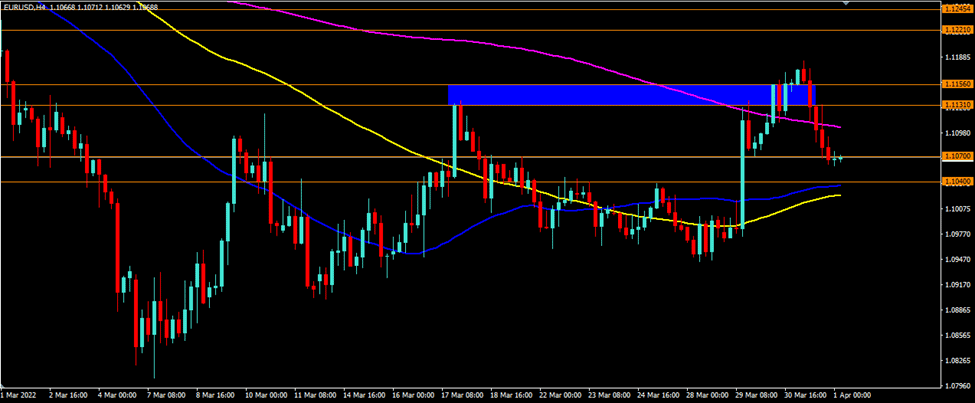
After two days of gains, the EURUSD fell to the previous support level of 1.1070 and subsequently to 1.1040. The resistance levels are 1.1131 and 1.1156. On the four-hour chart, EURUSD is trading above its 50-day and 100-day SMAs but below its 200-day SMA (SMAs).

Resistance: 1.1131. 1.1156

Support: 1.1070, 1.1040

XAUUSD (4-Hour Chart)

The XAUUSD rose somewhat on Thursday, although the market is still waiting for a major move from US jobs data. XAUUSD briefly tested our resistance level of $1948 and is now trading slightly above the $1936 level. Our resistance level is still $1948, with the next one at $1964, and support levels at $1921 and $1910. XAUUSD is now trading below its 100-day simple moving average but above its 50-day and 200-day SMAs on the four-hour chart.

Resistance: $1948, $1964

Support: $1921, $1910

Lesson 1: What does “forex” mean?

Forex – often spelled FX – is an abbreviation for “Foreign Exchange.” Fundamentally, it is similar to a stock exchange in that it is a market where one can exchange multiple currencies worldwide. According to a 2019 triennial report from the Bank for International Settlements (a global bank for national central banks), the daily trading volume for Forex reached $6.6 trillion in April 2019.

What Is the Forex Market?

The foreign exchange market is where currencies are traded. Currencies are important because they allow us to purchase goods and services locally and across borders. International currencies need to be exchanged to conduct foreign trade and business.

If you are living in the United States and want to buy cheese from France, then you or the company from which you buy the cheese must pay the French for the cheese in euros (EUR). The US importer would have to exchange the equivalent value of US dollars (USD) for euros.

You’re travelling from Australia to the United States in our scenario. You have AUD 1,000 to spend on your trip and thus visit a currency exchange to convert your Australian dollars to US dollars.

Assume the exchange rate was 1 AUD to 0.7 USD. This means that for each AUD you hand over to the currency broker, you will receive 0.7 USD in exchange. Given that you have 1,000 Australian dollars, you would obtain US$700 in this exchange.

Unfortunately, some things came up before your scheduled flight to New York, and you couldn’t go. As a result, you cancel your vacation and return to the currency dealer to exchange your US$700 for Australian dollars. To your amazement, the dealer hands you AUD 1,100 – a sum greater than the AU$1000 you had paid.

Consider the possibility that the currency broker made an error. Let us re-examine.

In this case, you made a profit of AUD 100. You originally spent AUD 1,000 to purchase US$700, but now you’re paying the same US$700 and receiving AUD 1,100 in return. That is a brief overview of Forex trading; it is not only about exchanging one currency for another but also about attempting to benefit from it.

In this instance, we profited since the US Dollar rose against the Australian Dollar while we held it. This enabled us to convert our original US$700 for more Australian Dollars than we had previously.

One unique aspect of this international market is that there is no central marketplace for foreign exchange. Instead, currency trading is conducted electronically over the counter (OTC), meaning that all transactions occur via computer networks among traders worldwide rather than on one centralized exchange.

The market is open 24 hours a day, five and a half days a week, and currencies are traded worldwide in the major financial centres of Frankfurt, Hong Kong, London, New York, Paris, Singapore, Sydney, Tokyo, and Zurich—across almost every time zone.

This means that the forex market begins anew when the US trading day ends in Tokyo and Hong Kong. The forex market can be highly active anytime, with price quotes changing constantly.

A Brief History of Forex

In its most basic sense, the forex market has been around for centuries. People have always exchanged or bartered goods and currencies to purchase goods and services. However, as we understand it today, the forex market is a relatively modern invention.

After the Bretton Woods accord began to collapse in 1971, more currencies were allowed to float freely against one another. The values of individual currencies vary based on demand and circulation and are monitored by foreign exchange trading services.

Commercial and investment banks conduct most of the trading in forex markets on behalf of their clients. Still, there are also speculative opportunities for trading one currency against another for professional and individual investors.

There are two distinct features of currencies as an asset class:

  • You can earn the interest rate differential between two currencies.
  • You can profit from changes in the exchange rate.

An investor can profit from the difference between two interest rates in two different economies by buying the currency with the higher interest rate and shorting the currency with the lower interest rate. Before the 2008 financial crisis, shorting the Japanese yen (JPY) and buying British pounds (GBP) was expected because the interest rate differential was huge. This strategy is sometimes referred to as a carry trade.

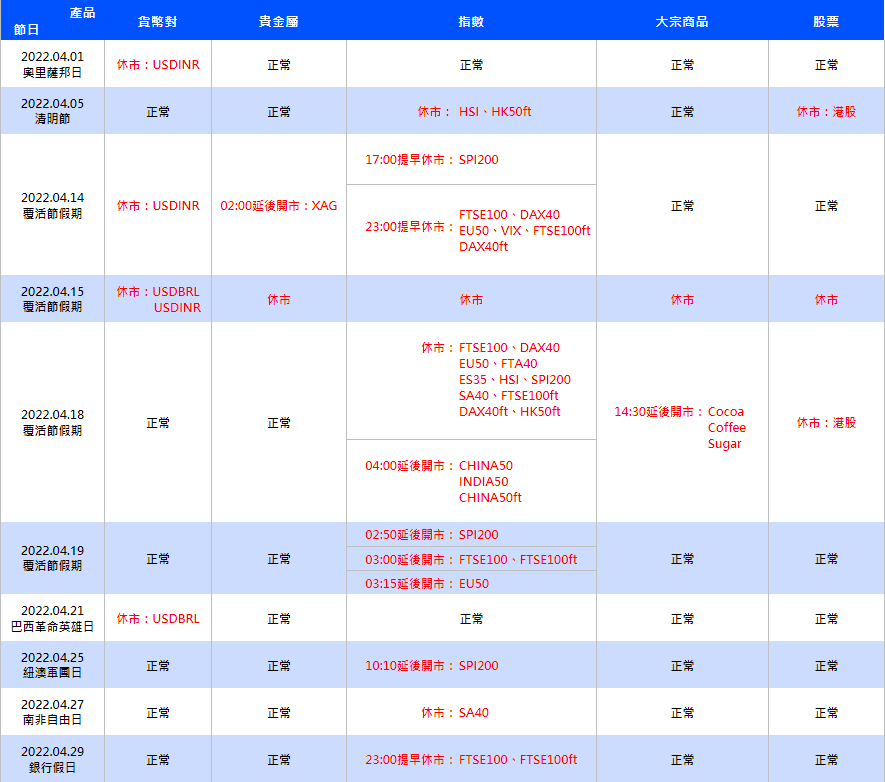
VT Markets Notification of trading adjustment in holiday

Dear Client,

Please note the adjustment on the following products due to the international holiday in April:

The above time is MT4/5 server time. The trading time of other products is not affected. The above data may be subject to change. Please refer to the actual time on MT4/5.

If you have any questions, our team will be happy to answer your questions. Please mail to [email protected] or contact the service online.

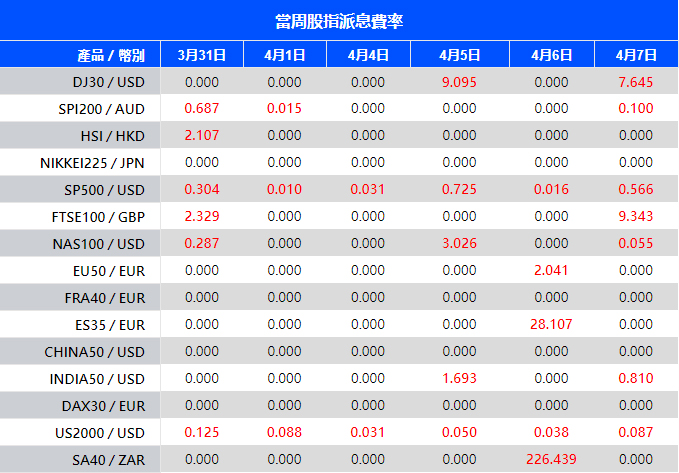
VT Markets The Adjustment Of Weekly Dividend Notification

Dear Client:

Warmly reminds you that the component stocks in the stock index spot generate dividends. When dividends are distributed, VT Markets will make dividends and deductions for the clients who hold the trading products after the close of the day before the ex-dividend date.

Indices dividends will not be paid/charged as an inclusion along with the swap component. It will be executed separately through a balance statement directly to your trading account, the comment for which will be in the following format “Div & Product Name & Net Volume ”.

Please note the specific adjustments as follows:

Note: The above data is for reference only, the actual execution date may be changed, please refer to the MT4/MT5 software for details.

If you’d like more information, please don’t hesitate to contact [email protected].

US Equity move lower on Wednesday after some days of increases. This is due to the market’s continued focus on the outcome of the meeting between Russia and Ukraine, as well as mixed data from the United States. The SP500 was down 0.42 percent, the NAS100 was down 0.79 percent, and the DJ30 was down 0.08 percent, according to MT4 VT Markets data.

Economic growth appears to be stable in the United States in 2021, as last night’s Final GDP statistics showed 6.9 percent growth, indicating that the Federal Reserve may continue to raise interest rates aggressively this year.

Source: Shutterstock

Several analysts believe that a rapid withdrawal of liquidity will impair domestic and global economic growth in the future, as seen by the inverted yield curve that has occurred since the beginning of this month.

Aside from the Fed’s policies, the capital market was also burdened by high inflation rates produced by rapid money circulation and skyrocketing global oil prices. The next market players will await US job data and inflation figures, which will affirm the US economy’s current strength.

The softening of Russia’s invasion of Ukraine does not indicate that the battle between the two nations has ended, resulting in continued high oil and natural gas prices. This scenario was compounded by Germany’s policy of barring energy imports from Russia, putting more strain on Europe’s economic growth. Due to the scarcity of fuel, both oil and gas, in the European Union zone, inflation rates can rise, posing a risk of a recession on the continent.

Main Pairs Movement

Several technology companies fell after gaining momentum for a few days; AAPL declined 0.82 percent to $177.07 after advancing for 11 consecutive days.

Meanwhile, INTEL and NVIDIA also declined significantly. INTEL lost 1.46 percent to $51.32, while NVIDIA sank 2.33 percent to $276.19.

USOUSD (WTI Texas) finished higher at $106.45, up 2.26 percent, as prospects for a resolution to the Ukraine conflict dwindled.

The USD’s weakness versus several major currencies was triggered by the revelation of data that was not supportive of the USD. This resulted in a 0.65 percent increase in the EURUSD and a 0.82 percent decline in the USDJPY.

Technical Analysis

GBPUSD (4-Hour Chart)

On Wednesday, the GBPUSD rose further, breaking past the resistance level at 1.3126 and approaching the next resistance level at 1.3188. GBPUSD is now attempting to trade within a broader range of 1.3080 to 1.3188. On the four-hour chart, GBPUSD is trading below its 50-day and 200-day simple moving averages (SMAs) and slightly above its 100-day SMA.

Resistance: 1.3188

Support: 1.3080

EURUSD (4-Hour Chart)

EURUSD strengthened more and broke through our Resistance levels with 1.1221 and 1.1245 are the following resistance levels. In terms of support, we see that previous resistance levels 1.1131 and 1.1156 revert to become the support levels. EURUSD is trading above its 50-day, 100-day, and 200-day simple moving averages on the four-hour chart (SMAs).

Resistance: 1.1221. 1.1245

Support: 1.1131, 1.1156

XAUUSD (4-Hour Chart)

XAUUSD gained up to 0.70 percent following a break of our resistance level at $1936. Currently, XAUUSD is awaiting the release of US labor statistics and updates on the condition of the Russia-Ukraine conflict. At the moment, the movement is seen between $1921 and $1936, with the possibility of breaking through the barrier at $1936. If it breaches $1936, the next resistance levels will be $1948 and $1964, while if it breaches $1921, the next support levels will be $1910 and $1893. On the four-hour chart, XAUUSD is presently trading below its 50- and 100-day simple moving averages, and while it is currently above them, it appears to be attempting to break below its 200-day SMA.

Resistance: $1936, $1948, $1964

Support: $1921, $1910, $1893

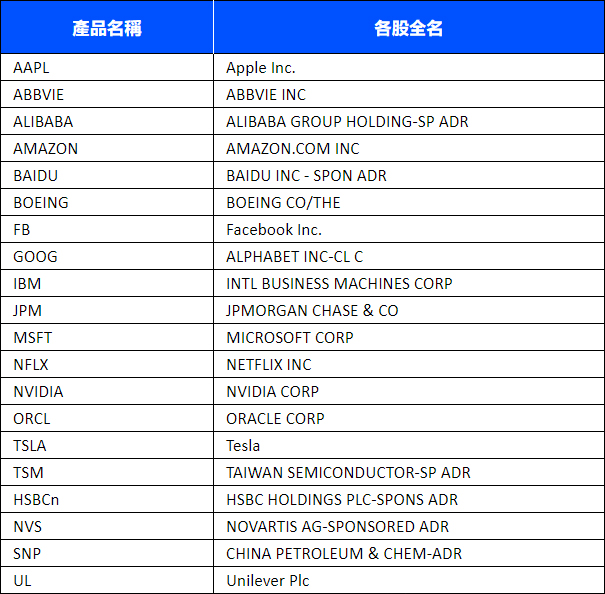
VT Markets Notification of US stock trading conditions optimization

Dear clients:

VT Markets continues to optimize the trading environment and expand our global business. We are honoured to announce that the trading fees for some popular US stock products have been optimized recently.

All VT Markets clients can trade the 20 U.S. stock contracts listed in the table below on the preferential terms of 0 commission from March 28th.

Note: The above data is for reference only, the actual execution date may be changed, please refer to the MT4/MT5 software for details.

If you’d like more information, please don’t hesitate to contact [email protected] or contact us via the official website live chat.

On Tuesday, US equity markets climbed significantly as a result of Russia’s determination to engage in talks with Ukraine and begin reducing troop operations surrounding the city of Kyiv. The S&P 500 index increased by 1.13 percent, the Nasdaq 100 increased by 1.62 percent, and the Dow Jones Industrial Average increased by 0.90 percent.

On the other hand, market players continue to be concerned about the potential of recession, owing to the higher short-term US bond yields relative to long-term US bond yields. While the 2-year yield on US Treasuries is technically equal to the 10-year yield, the intersection of the 5-year yield curve has exceeded the 10-year or even 30-year yield, as it did in 2006, precipitating the Great Recession in 2008.

This existence will undoubtedly weaken the US Dollar index in the future, but it will rebound again as a result of the Fed’s aggressive monetary policy this year. Commodity prices are beginning to fall as the Russian invasion of Ukraine subsides, putting pressure on the Australian dollar soon.

Main Pairs Movement

AAPL increased 1.23 percent to close at $178.76 for the 11th consecutive day.

TSLA closed somewhat lower on the day following a very large surge at the session’s start, but it still prints extremely high at $1098.64.

INTEL also increased following Monday’s flat performance, closing at $52.23, up 0.40 percent.

USOUSD (WTI Texas) concluded higher than its opening price and gained as much as 1.65%, following a period of lower movement and a brief dip below $100.

The USD’s weakness versus several major currencies resulted in the strongest strengthening of the EURUSD, which increased by 0.97 percent, and the weakest USDJPY.

Technical Analysis

GBPUSD (4-Hour Chart)

GBPUSD temporarily climbed on Tuesday before closing with only a modest increase over the opening price. Had broken through the resistance level of 1.3125 and the support level of 1.3080, however, the price of GBPUSD is currently trading above the 1.3080 support level. GBPUSD continues to trade in a range of 1.3080 – 1.3125, with a probable breakout. If it breaks through 1.3125, the next target for GBPUSD will be 1.3188. Concerning the lower level, if GBPUSD falls below 1.3080, a move to the support range between 1.3000 and 1.3020 is possible. On the four-hour chart, GBPUSD is trading below its 50-day, 100-day, and 200-day simple moving averages (SMAs).

Resistance: 1.3126, 1.3188

Support: 1.3080, area (1.3000 – 1.3020)

EURUSD (4-Hour Chart)

EURUSD was the major currency pair that gained the most in the majors after breaking through our resistance levels. EURUSD is currently stalled at the 200-day simple moving average, with immediate resistance located between 1.1131 and 1.1156. While 1.1070 and 1.1040 serve as support levels. EURUSD is currently trading above its 50-day and 100-day simple moving averages (SMAs) on the four-hour chart while attempting to break above the 200-day SMA.

Resistance: 1.1131. 1.1156

Support: 1.1070, 1.1040

XAUUSD (4-Hour Chart)

Yesterday, XAUUSD plummeted to our lowest support level of $1893 but was able to end the day back up to $1919. Today’s movement in XAUUSD appears to be a little weaker, with the pair attempting to breach the support levels once more. Currently, the range is $1910 – $1936, with some resistance at $1921. $1948 and $1964 remain resistance levels, while $1893 is the next support level. XAUUSD is currently trading below its 50-day, 100-day, and 200-day simple moving averages on the four-hour chart.

Resistance: $1936, $1948, $1964

Support: $1910, $1893

Back To Top
server

Hello there 👋

How can I help you?

Chat with our team instantly

Live Chat

Start a live conversation through...

  • Telegram
    hold On hold
  • Coming Soon...

Hello there 👋

How can I help you?

telegram

Scan the QR code with your smartphone to start a chat with us, or click here.

Don’t have the Telegram App or Desktop installed? Use Web Telegram instead.

QR code