The United States Redbook Index (YoY) rose to 7.6% on April 3. It was 6.9% in the previous reading.
The recent Redbook data from April 3rd shows a significant jump in consumer spending, rising to a robust 7.6% year-over-year. This signals that the consumer remains unexpectedly strong, which could easily fuel inflationary pressures. Consequently, we must reconsider the Federal Reserve’s likely path for the remainder of 2026.
Rates Higher For Longer
This strong spending likely means the market will price out any near-term rate cuts, especially with the March CPI report coming in hotter than expected at 3.4% last month. We should be looking at options on SOFR futures, positioning for the “higher for longer” narrative to gain more traction. Short-term Treasury futures may also face significant downward pressure in the coming weeks.
For equity indices, this creates a scenario where good economic news could become bad news for valuations. The threat of a more hawkish Fed is a major headwind, much like what we saw after the surprise jobs report in the autumn of 2025, which caused a sharp market pullback. We could see increased choppiness, making strategies on the VIX that bet on a rise in volatility look attractive.
We believe the most direct trades are in sector-specific derivatives, especially since March retail sales also beat expectations last week, growing by 0.9%. Call options on consumer discretionary ETFs appear favorable for a short-term momentum play. Conversely, we should consider put options on rate-sensitive sectors like utilities and REITs, as they will almost certainly underperform if bond yields continue their upward trend.
US durable goods orders fell 1.4%, or $4.4 billion, to $315.5 billion in February, according to the US Census Bureau. This followed a 0.5% fall in January and was worse than the expected 0.5% decline.
Excluding transportation, new orders rose 0.8%. Excluding defence, new orders fell 1.2%.
Durable Goods Detail
Transportation equipment fell by $6.1 billion, or 5.4%, to $106.1 billion. This category has declined in four of the last five months.
The data had little effect on the US dollar at the time reported. The US Dollar Index was slightly lower on the day at 99.92.
We recall looking at the durable goods report from February 2025, which showed a significant 1.4% headline decline. That drop was almost entirely due to transportation orders, which masked some underlying strength in other business investment. It was an early warning signal about weakness in big-ticket manufacturing.
Looking at the situation today, the most recent data for February 2026 shows a similar, though less dramatic, pattern of industrial softness. New orders for non-defense capital goods excluding aircraft, a key proxy for business spending, have been flat for two consecutive quarters. This suggests corporate caution is becoming entrenched, much like the trend that began in early 2025.
Market And Policy Implications
This manufacturing slowdown is happening while the latest Consumer Price Index (CPI) report showed core inflation remaining sticky at 3.1%. This dynamic puts the Federal Reserve in a difficult position, unable to cut interest rates to support industry without risking a resurgence in inflation. Consequently, futures markets are now pricing in only one potential rate cut for the remainder of 2026.
For traders, this points toward a strategy of buying volatility, especially within the industrial sector. Purchasing straddles or strangles on major industrial ETFs allows a position to profit whether the sector breaks sharply lower on recession fears or rips higher on a surprise stimulus. The current tension between slow growth and hawkish monetary policy makes a period of calm unlikely.
Given the specific and continued weakness in transportation, bearish derivative plays on aerospace and heavy machinery manufacturers should be considered. We see value in buying put options on companies that have a high backlog but are facing order cancellations, a trend we saw beginning last year. This provides a targeted way to short the most vulnerable part of the economy without betting against the entire market.
The Reserve Bank of New Zealand is expected to keep the Official Cash Rate unchanged at 2.25% for a second consecutive meeting. Governor Anna Breman is set to update the Bank’s inflation and growth projections, despite there being no new Monetary Policy Statement.
In a speech on 24 March, Breman indicated economic growth in 2026 may be weaker than forecast in the February Monetary Policy Statement. She also said the Bank would look through a short-term disruption and a temporary rise in petrol prices.
Policy Constraints And Inflation Pressures
Policy options are constrained even with spare capacity in the economy because headline inflation is slightly above the 1% to 3% target range. Most core inflation measures are above the target mid-point, and swaps markets price nearly 100bps of OCR rises over the next 12 months.
A prolonged energy shock and weaker terms of trade may keep the New Zealand dollar under pressure against most major currencies. The article notes increased stagflation risk.
The article was produced with the assistance of an artificial intelligence tool and reviewed by an editor.
Looking back at the analysis from 2025, we can see the warnings about stagflation were accurate, as the market’s pricing of nearly 100 basis points in hikes has now materialized. The Official Cash Rate currently stands at 3.25%, a direct result of the tightening path the Reserve Bank of New Zealand was forced to take. This history shows us the RBNZ has followed through on its inflation-fighting mandate despite signs of economic weakness.
Trading Implications For Rates And FX
The core problem of high inflation and low growth, as flagged last year, persists today. The latest Q1 2026 data shows headline inflation remains sticky at 3.5%, still stubbornly above the 1-3% target band. Meanwhile, GDP growth for the final quarter of 2025 came in flat at 0.0%, confirming the economic slowdown Governor Breman warned about.
For interest rate traders, this environment suggests the RBNZ has very little room to move. The central bank is unlikely to cut rates with inflation this high, but further hikes could severely damage the economy. This points toward using options strategies that profit from range-bound interest rates, such as selling straddles on short-term interest rate futures.
The New Zealand dollar continues to perform defensively, just as we anticipated due to the prolonged energy shock and weak terms of trade. New Zealand’s terms of trade fell another 1.2% in the last quarter of 2025, and with the NZD/USD now hovering near 0.5900, the currency’s weakness is well-established. This makes the NZD an attractive currency to borrow against in carry trade strategies.
Given this backdrop, traders should consider positioning for continued NZD underperformance against major currencies. Buying put options on the NZD/USD offers a clear way to hedge against or profit from further declines. Alternatively, selling out-of-the-money call options could be a strategy to generate income, based on the view that any significant currency strength is improbable in the coming weeks.
US durable goods orders excluding transportation rose 0.8% in February. This was above the 0.5% forecast.
The recent report showing durable goods orders growing at 0.8% against a 0.5% forecast indicates a surprisingly robust business investment climate. This underlying economic strength challenges the narrative that the economy is cooling enough for imminent rate cuts. We need to adjust our strategies based on the idea that the Federal Reserve may remain patient for longer than the market expects.
Implications For Fed Policy
This complicates the Federal Reserve’s path, especially as the latest inflation data from March 2026 showed CPI is still hovering at 3.1%, well above the 2% target. In response, Fed funds futures are now pricing in only a 40% probability of a rate cut by the June meeting, a sharp drop from the 75% chance priced in just one month ago. Traders should consider positions that benefit from a “higher for longer” interest rate environment, such as puts on Treasury bond ETFs.
For equity markets, this strength in business spending is bullish for industrial and technology sectors, which could provide a tailwind for the S&P 500 and Nasdaq 100. We are looking at this as an opportunity to open or add to long positions through call options on major indices. This continues the trend we saw where strong corporate earnings in Q4 2025 pushed markets to new highs despite hawkish Fed commentary.
We remember how in mid-2025, a similar string of strong economic data caused a prolonged period of choppy, sideways trading before the market eventually broke to the upside. That experience taught us that while the immediate reaction might be uncertain due to interest rate fears, underlying economic health is ultimately supportive of equities. We could see a repeat of that pattern, with short-term volatility giving way to a new upward leg.
This renewed uncertainty about the Fed’s timeline could cause market volatility to pick up from its current lows. The VIX has been trading near the 14 level, but this kind of data surprise could easily push it back toward the 17-18 range in the coming weeks. This suggests it may be a good time to buy some cheap protection or structure trades, like bull put spreads, that benefit from a rise in implied volatility.
In currency markets, this report further strengthens the case for the US dollar. We have already seen the Dollar Index (DXY) climb to a three-month high of 105.20 on the back of resilient economic figures. This trend will likely continue, putting downward pressure on pairs like the EUR/USD, which is already testing key support levels we saw in February.
US durable goods orders excluding defence fell by 1.2% in February. This followed a 0.5% rise in the previous period.
Looking back, the decline in durable goods orders to -1.2% in February 2025 was an early warning of the economic cooling we experienced for the rest of that year. That data point signaled a pullback in business investment that extended well into the autumn. This trend confirmed that the high-interest-rate environment was finally taking a significant toll on capital expenditures.
Manufacturing Weakness Confirmed
This weakness was validated as the ISM Manufacturing PMI remained in contraction territory, below 50, for the subsequent ten months. For instance, we saw the index hover around 47 for much of late 2025, confirming the manufacturing sector’s persistent softness. This broad-based slowdown showed that the February 2025 number was not an anomaly but the start of a clear trend.
Throughout the second half of 2025, this economic uncertainty kept implied volatility elevated, making hedging strategies more expensive. We saw the VIX, the market’s fear gauge, average around 19 during that period, with several spikes above 22 during earnings seasons. This environment rewarded traders who were long volatility or had structured defensive positions using options.
The Federal Reserve was constrained by core inflation that remained stubbornly above 3% for most of 2025, forcing it to maintain a restrictive policy stance. This backdrop suppressed risk appetite and favored trades that benefited from high borrowing costs and low economic growth. Short-dated interest rate futures consistently priced out any significant rate cuts for the near term.
Now, however, we are seeing signs of a potential shift as the most recent March 2026 ISM manufacturing index just printed at 50.3, the first expansionary reading in over a year. This suggests we should consider gradually rotating out of purely defensive positions that have worked for the past year. It may be time to cautiously sell some of the expensive downside puts and begin building positions in call spreads on cyclical sectors.
Positioning For A Turn
Given this nascent sign of recovery, we should also monitor options on interest rate futures closely. If upcoming data like retail sales and employment confirm this economic bottoming process, the market will have to reprice the path of future Fed policy. This could create an opportunity to position for a steeper yield curve before the recovery narrative is fully embraced by the wider market.
US durable goods orders excluding transport rose by 0.8% in February. The forecast was 0.5%.
This stronger-than-expected data on business investment suggests the economy has more underlying momentum than previously thought. This report, combined with the March non-farm payrolls that showed a robust addition of 295,000 jobs, challenges the narrative for imminent Federal Reserve rate cuts. We believe the market will now have to reconsider the timing and magnitude of any easing cycle previously anticipated for the summer.
Rates Higher For Longer
Given this, we see opportunities in interest rate derivatives that bet on rates staying higher for longer. The odds of a June rate cut have likely diminished, making selling June or September 2026 SOFR futures an attractive position. This play is based on the expectation that the Fed will signal a more patient, data-dependent stance in its upcoming communications.
For equity indices, the news is a double-edged sword, likely creating volatility. While strong business spending is good for corporate earnings, the threat of delayed rate cuts could pressure valuations, particularly in the tech sector. Therefore, we are considering buying put spreads on the Nasdaq 100 index as a hedge against a market pullback driven by interest rate fears.
This economic strength should also translate to a stronger U.S. dollar. After the recent core CPI data showed inflation remaining sticky at 3.1%, the case for dollar-denominated assets improves relative to other currencies. We are looking at buying call options on the U.S. Dollar Index (DXY) to capitalize on a potential move higher, especially against the Euro.
This situation reminds us of the environment back in 2024, when persistently strong economic figures repeatedly forced the market to push back its rate cut expectations. With the VIX, a measure of market volatility, having recently traded at a low of 14, options premiums are relatively cheap. Buying some form of portfolio protection now seems prudent before the market fully digests this shift.
US durable goods orders excluding defence fell by 1.2% in February. This compares with a 0.5% rise in the previous period.
The February report showing a 1.2% drop in durable goods orders, excluding defense, confirms the economic cooling we have been watching for. This reversal from the slight growth seen in January suggests businesses are now pulling back on major investments. This is a clear signal that the higher interest rates from 2025 are finally starting to impact corporate spending plans.
Signs Of Economic Cooling
This weak business spending data, combined with recent online reports showing a dip in consumer confidence indices for March, paints a picture of a slowing economy. The March jobs report, released last Friday, also supported this by showing a moderation in wage growth to its slowest pace in over a year. We see this as a consistent trend of economic deceleration heading into the second quarter.
As a result, the probability of the Federal Reserve raising interest rates again in its May meeting has fallen dramatically. Current market pricing derived from Fed funds futures now indicates a greater than 60% chance that the Fed will hold rates steady, a sharp turnaround from the hawkish sentiment we saw late last year. This pivot in expectations is the most critical factor for our strategy in the coming weeks.
For equity derivatives, we should consider hedging against a potential market downturn, as slowing growth could impact corporate earnings. Buying put options on broad market indices like the S&P 500 or on cyclical sector ETFs offers a way to protect portfolios. With the VIX, a measure of expected market volatility, having recently climbed from 14 to 18, the cost of this insurance is rising, suggesting we should act soon.
In the interest rate markets, this data reinforces the view that bond yields may have peaked. We could use options on Treasury note futures to position for falling interest rates as the market begins to anticipate eventual rate cuts later this year. Looking back at similar economic slowdowns, like the one in 2019, defensive government bonds tended to perform well as investors sought safety.
This outlook also has implications for currency markets, as a less aggressive Federal Reserve typically weakens the U.S. dollar. We could explore strategies that benefit from a declining dollar, such as buying call options on the euro or Japanese yen. The U.S. Dollar Index (DXY) has already fallen 2% over the last three weeks, and this fundamental data provides a strong reason for that weakness to persist.
US durable goods orders fell by 1.4% in February. This was below the forecast of -0.5%.
The result shows a weaker reading than expected for the month. It compares the actual change (-1.4%) with the forecast (-0.5%).
The February durable goods orders miss is a significant red flag for the economy’s health. This negative surprise, at -1.4%, points to weakening business investment and manufacturing activity. We should therefore position for increased defensive posturing in the markets over the coming weeks.
We are considering buying puts on broad market indices like the S&P 500 (SPY) and specifically on the industrial sector ETF (XLI) to hedge against a potential downturn. This view is strengthened by the latest Industrial Production Index data, which showed a 0.6% contraction last month, confirming the slowdown in manufacturing. This creates a compelling case for downside protection through May expirations.
This weak data also changes the outlook for interest rates, making a Federal Reserve rate cut more likely than a hike. We anticipate yields on government bonds will fall, so we are looking at call options on Treasury bond ETFs like TLT. Looking back, we saw a similar situation in the third quarter of 2025, when a string of poor manufacturing reports preceded a fall in bond yields.
Heightened economic uncertainty often leads to a spike in market volatility. The CBOE Volatility Index (VIX) is currently trading near a relatively low level of 16, making volatility derivatives an inexpensive way to hedge. We see value in purchasing VIX call options as a direct bet on rising market fear.
This durable goods report is not an isolated piece of information, as it aligns with the recent decline in the Consumer Confidence Index to 97.5. This combination of weak business spending and shaky consumer sentiment reinforces our cautious stance. We will be monitoring upcoming employment data closely for further confirmation of this cooling trend.
Deutsche Bank’s Henry Allen says US and European equities have fallen less than during past oil shock periods, with markets appearing to price in a short conflict, firm macro data and still-dovish central banks. The S&P 500 and Europe’s STOXX 600 are 5–6% below their record highs.
US data cited include the March jobs report, the first covering the period since the strikes began on 28 February. It showed nonfarm payrolls rising by +178k, the strongest in 15 months, while unemployment edged down to 4.3%.
The note refers to earlier episodes when oil shocks coincided with equity drawdowns and later recoveries. Examples include 1979–80, when Paul Volcker raised rates aggressively and a US recession occurred in early 1980, and 1990–91.
It also references 2022, when global central banks raised rates aggressively during a bear market. That period was followed by a recovery in 2023, with the S&P 500 reaching a new record by early 2024.
The article states it was created with the help of an Artificial Intelligence tool and reviewed by an editor.
We are seeing that risk assets are holding up much better than they did during historical oil shocks. Looking back to the events of early 2025, the S&P 500’s drawdown was surprisingly shallow, with the index staying only 5-6% below its record highs. This pattern of resilience suggests that selling out-of-the-money puts to collect premium could be a viable strategy during any minor pullbacks in the coming weeks.
This market confidence seems rooted in strong economic fundamentals, which have continued into this year. The latest jobs report for March 2026 showed the economy added a solid 215,000 nonfarm payrolls, keeping the unemployment rate low at 3.8%. This underlying economic strength tends to dampen volatility, which could make shorting VIX futures profitable if the market remains steady.
We have seen this playbook before, even following more significant downturns. For instance, after the aggressive central bank rate hikes of 2022 led to a bear market, the S&P 500 staged a powerful recovery throughout 2023 and into early 2024. This history supports using any dips as opportunities to establish defined-risk bullish positions, such as buying call spreads, to capture a potential rebound.
A key factor is that central banks do not appear poised for aggressive tightening like they were in 1980 or 2022. Recent statements from the Federal Reserve indicate a continued pause on interest rates, especially with core inflation now trending just below 3%. This backdrop limits the probability of a sharp, unexpected market shock, providing a favorable environment for strategies that profit from range-bound or slowly appreciating markets.
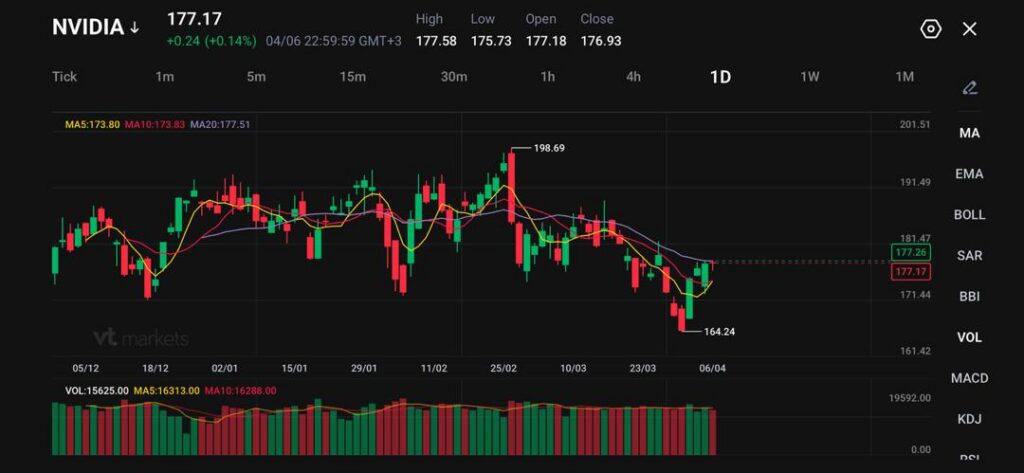
NVIDIA trades at 177.17, up 0.24 (+0.14%), while the wider market heads into earnings season with leadership still concentrated in technology and financials.
S&P 500 profits are forecast to rise 14.4% year on year to just under $609 billion, with Information Technology expected to grow more than 46% to $182.8 billion.
Financial sector earnings are expected to rise 18% to around $98.5 billion, helped by capital markets activity and trading volatility.
The earnings story going into first-quarter reporting still runs through the same two groups that carried much of the market before the war shock. S&P 500 profits are forecast to rise about 14.4% from a year earlier to just under $609 billion, and the largest contribution is still coming from technology.
Information Technology alone is expected to generate $182.8 billion in earnings, up more than 46% from last year and roughly 30% of the full S&P 500 total. When Communication Services is added, that share rises to 40%. Adding Consumer Discretionary pushes it to 47%.
That concentration matters for NVIDIA because it keeps the stock at the centre of the earnings trade even after months of consolidation. Traders were hoping the market would broaden enough to reduce its dependence on mega-cap technology. The forecast says that it has not happened yet. The market still needs tech to deliver.
NVIDIA Still Sits Inside the Main Profit Engine
NVIDIA remains one of the biggest symbols of that setup. The sector backdrop is still strong, and NVIDIA’s own operating momentum has remained well ahead of the index. The company reported quarterly revenue of $68.1 billion, up 73% year on year, while Data Centre revenue reached $62.3 billion, up 75%. Full-year revenue came in at $215.9 billion, up 65%.
For the current quarter, NVIDIA guided to about $78 billion, plus or minus 2%, above the analyst estimate of $72.6 billion at the time.
The issue is no longer whether NVIDIA can grow. The market is asking how much of that growth is already priced in, how durable margins remain, and whether management can keep justifying the scale of AI capex across the ecosystem. That is why commentary matters as much as the headline numbers.
Banks Are the Other Major Leg of the Trade
The other source of earnings support is financials. Sector profits are expected to rise 18% to about $98.5 billion, with deal flow, trading activity, and fundraising all supporting the numbers. Several large transactions and higher volatility in stock and bond markets have improved the near-term revenue backdrop for the big banks.
BlackRock has added to bearish positions on German bonds, betting that a “pretty large inflation uptick” across Europe will push borrowing costs back above the 15-year highs reached last week https://t.co/dAmtNqxKjY
That creates an important read-through for NVIDIA and the rest of the large-cap tech. If banks deliver solid numbers and management teams sound constructive, traders may become more willing to re-enter cyclical growth trades. If financials beat but warn on the broader economy, the market may keep rewarding earnings resilience while still limiting valuation expansion.
War Risk Has Not Broken the Earnings Base
The most constructive part of the setup is that forward earnings estimates have continued moving higher even while the market has pulled back. That combination is rare. It suggests analysts still see companies protecting margins and preserving operating leverage even with oil prices high and sentiment weaker.
Romania is set to leave European Union’s highest interest rates steady as the surge in oil prices will likely fuel inflation that’s already running at close to double digits https://t.co/V2z8P5N5Og
The market has already started to re-rate some of that risk. NVIDIA’s valuation multiple has compressed sharply. A recent market review showed NVIDIA’s price-to-earnings ratio had fallen to its lowest level in about seven years, even as analysts still expected NVIDIA’s current fiscal-year earnings growth to run above 70%, compared with about 19% for the S&P 500 overall.
That does not remove risk. It does mean the stock is no longer trading with the same stretched premium it carried at earlier peaks.
Technical Analysis
NVIDIA is trading near 177.17, attempting a modest rebound after the recent decline that saw price fall to the 164.24 low. Price action shows a short-term recovery forming, with buyers stepping in after the sell-off, but the broader structure still reflects weakness following the rejection from the 198.69 high.
The current move higher appears corrective, with price now testing a key near-term resistance zone.
From a technical standpoint, the trend remains neutral to slightly bearish. Price is hovering around the short-term moving averages, with the 5-day (173.80) providing immediate support, while the 10-day (173.83) and 20-day (177.51) are flattening and acting as overhead resistance. This compression suggests the market is in a transition phase, where momentum is stabilising but has yet to confirm a bullish reversal.
Key levels to watch:
Support: 173.80 → 171.40 → 164.20
Resistance: 177.50 → 181.50 → 190.00
The immediate focus is on the 177.50–178.00 zone, which aligns with the 20-day average and recent rejection levels. A sustained break above this area could extend the recovery toward 181.50, where stronger resistance is likely to emerge.
On the downside, 173.80 is acting as near-term support. A break below this level could see price revisit 171.40, with further weakness exposing the 164.20 low.
Overall, NVIDIA is attempting to stabilise after a corrective pullback, but the broader structure still lacks strong bullish confirmation.
Unless price can reclaim and hold above 177.50–181.50, the move higher is likely to remain corrective within a wider consolidation phase.
What Traders Should Watch Next
The next move depends less on whether tech can post strong numbers and more on what management says about the second half. Traders already know technology and banks are driving the first-half earnings story.
They want to hear whether AI demand is still broadening, whether margins can absorb the oil shock, and whether executives think war-related disruption remains temporary.
For NVIDIA specifically, the cleanest path higher needs two things together: steady AI demand and a market willing to reward that demand with a higher multiple again.
If earnings season confirms both, the stock can start pushing through the 177.5 zone and build toward the upper end of the recent range. If guidance turns more cautious, the recovery may stall even if the headline numbers still look strong.
Create a live VT Markets account today to access our platform features, including market insights and educational content.
Trader Questions
Why is Nvidia So Important to This Earnings Season?
Nvidia sits inside the part of the market driving the biggest share of profit growth. Technology is expected to generate $182.8 billion in earnings, up more than 46% from last year, which keeps Nvidia at the centre of the reporting season story.
Why Are Investors Still Focused on Tech and Banks?
Those two groups are carrying most of the earnings growth. S&P 500 profits are forecast to rise 14.4% to just under $609 billion, while financial earnings are expected to rise 18% to about $98.5 billion.
What Does This Mean for Nvidia Stock Specifically?
It means Nvidia still has to deliver more than strong numbers. Investors will also want clear guidance on AI demand, margins, capex durability, and how management sees the second half.
Why Does Guidance Matter More Than the Headline Beat?
The market already expects strong growth from mega-cap tech. The bigger question is whether that growth can stay strong if oil prices remain high, financial conditions stay tight, or corporate spending becomes more selective.
Is Nvidia Still Growing Fast Enough to Justify Attention?
Yes. The latest figures cited in the article showed quarterly revenue at $68.1 billion, up 73% year on year, with data centre revenue at $62.3 billion, up 75%. Full-year revenue reached $215.9 billion, up 65%.
Start trading now – Click here to create your real VT Markets account
Written on April 7, 2026 at 10:17 am, by josephine