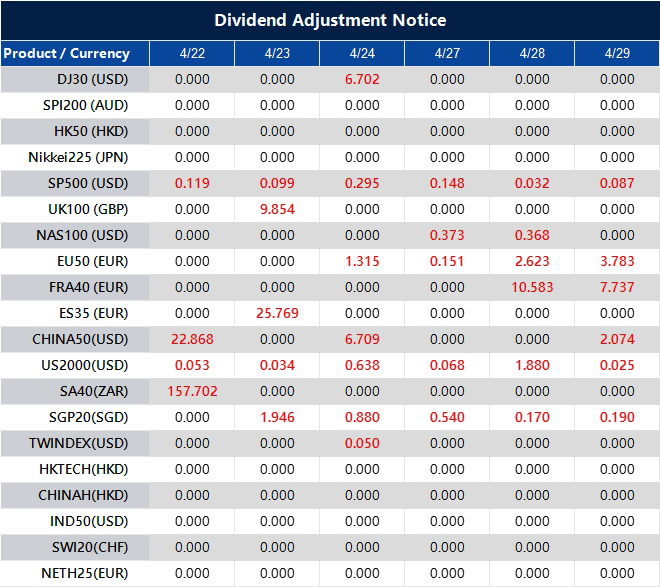
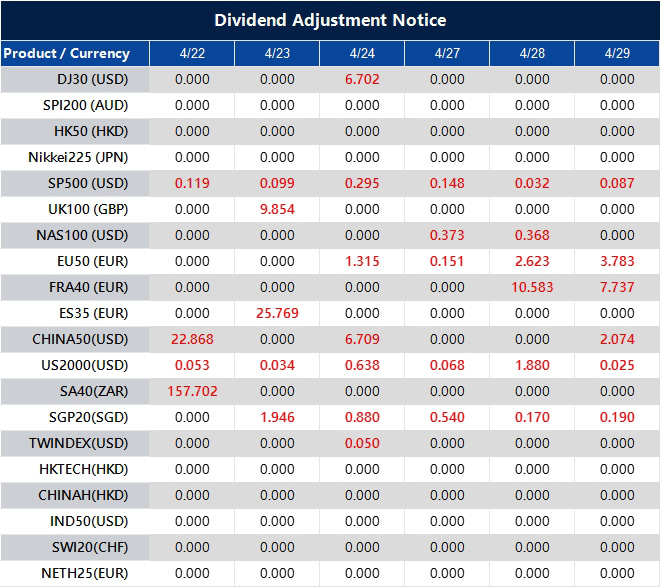
Dividend Adjustment Notice – Apr 22 ,2026

Dear Client,

Please note that the dividends of the following products will be adjusted accordingly. Index dividends will be executed separately through a balance statement directly to your trading account, and the comment will be in the following format “Div & Product Name & Net Volume”.

Please refer to the table below for more details:

Dividend Adjustment Notice

The above data is for reference only, please refer to the MT4/MT5 software for specific data.

If you’d like more information, please don’t hesitate to contact [email protected].

In March, the UK’s core annual CPI was 3.1%, falling short of the 3.2% forecast

The United Kingdom’s core Consumer Price Index rose by 3.1% year on year in March. This was below the 3.2% figure expected.

The March core inflation figure coming in below expectations at 3.1% is a significant dovish signal for us. This suggests that underlying price pressures in the UK economy are easing faster than the market anticipated. This data point directly increases the probability of an earlier interest rate cut from the Bank of England.

We should anticipate that interest rate derivatives will react strongly to this news. Traders should consider positions that will profit from falling UK interest rates, such as going long on Short Sterling or SONIA futures contracts. Gilt yields are also likely to fall, meaning long positions in Gilt futures should become more favorable.

For currency markets, this makes the pound less attractive. The prospect of lower rates reduces the return on holding sterling-denominated assets. We expect to see weakness in GBP/USD and GBP/EUR, so strategies that short the pound could be advantageous in the coming weeks.

This environment is generally positive for UK equities, as lower borrowing costs can boost corporate earnings and investor sentiment. We might see strength in the domestically-focused FTSE 250 index. Traders could look at buying call options or futures on UK indices to capitalize on this potential upside.

This single data point is amplified by other recent statistics, such as UK retail sales which posted a 0.3% decline last month, suggesting consumer demand is softening. In response, market pricing has already shifted, with overnight index swaps now implying a 70% chance of a rate cut by the Bank of England’s August meeting, up from 45% just last week.

We remember how sticky inflation was through 2024 and 2025, which kept the Bank on a hawkish path longer than many expected. This new, softer data challenges that narrative and suggests the turning point may be arriving sooner than officials have guided. This is a very different environment from the aggressive rate-hiking cycle we saw just a couple of years ago.

UK output producer prices rose 0.9% month-on-month, undershooting forecasts of 1% for March data release

The United Kingdom Producer Price Index (Output), month on month and not seasonally adjusted, rose by 0.9% in March. The market expectation was 1%.

The March reading was 0.1 percentage points lower than forecast. This indicates a slightly slower monthly rise in output producer prices than expected.

The March producer price output figure coming in at 0.9% instead of the expected 1% signals that factory gate inflation is cooling slightly faster than anticipated. This suggests that the pipeline pressures pushing up consumer prices might be weakening. We must now consider that the Bank of England may have less incentive to maintain its hawkish stance in its upcoming meetings.

Given this data, we should anticipate a slight dovish repricing in the UK interest rate markets. Looking back at how markets reacted to the inflation peaks of 2025, even small signs of easing led to significant shifts in rate expectations. Derivative traders could consider positioning through SONIA futures, anticipating that the forward curve will flatten as the probability of further rate hikes diminishes.

This outlook implies potential weakness for the British Pound, which has recently found support from higher rate expectations. With GBP/USD trading near 1.27, a level not consistently held since last year, this PPI miss could trigger a pullback. We see an opportunity in buying short-dated puts on GBP, targeting a move back towards the 1.2550 support level in the coming weeks.

Conversely, this environment could be supportive for UK equities, particularly the FTSE 100 index. Lower inflation and interest rate expectations reduce borrowing costs and can boost corporate earnings sentiment. We believe that buying call options on the FTSE 100, which has shown resilience by holding above 8,000 points, offers a good risk-reward profile for a potential rally.

This single data point, however, must be viewed with caution until we see the broader picture. The upcoming Consumer Price Index (CPI) report will be critical to either confirm or contradict this disinflationary signal from producers. A corresponding miss in the CPI data would give us greater conviction to increase our positions based on a more dovish central bank outlook.

The UK’s monthly non-seasonally adjusted input Producer Price Index rose 4.4%, beating the 2.8% forecast

The UK Producer Price Index (input, month-on-month, not seasonally adjusted) rose by 4.4% in March. The market expectation was 2.8%.

The March reading was 1.6 percentage points higher than expected. This indicates faster growth in input prices than forecasts suggested.

The release refers to input costs faced by UK producers. It reports the change from the previous month on a non-seasonally adjusted basis.

The March input PPI reading of 4.4% is a significant surprise and points to persistent inflationary pressures at the factory gate. This data challenges the view that costs were moderating after the volatility we saw throughout 2025. We should position for the Bank of England to delay any planned interest rate cuts and possibly adopt a more hawkish tone.

Consequently, we see value in selling Sterling Overnight Index Average (SONIA) futures contracts for the third and fourth quarters. This position anticipates that the market will have to price out the probability of rate cuts later this year. The swap market has already reacted, now pricing less than a 50% chance of a rate cut by year-end, a sharp drop from the 80% chance priced in just last week.

The prospect of higher-for-longer UK interest rates should provide a strong tailwind for the pound. We are looking at buying call options on GBP/USD, targeting a move above the 1.2900 level. This is supported by recent data from the U.S. Commodity Futures Trading Commission, which shows speculative net-long positions on sterling have been building for three consecutive weeks.

For UK equities, this development is a headwind, as higher borrowing costs could squeeze corporate margins and dampen consumer spending. We recommend considering buying put options on the FTSE 100 index as a hedge against a potential market pullback. Looking back at 2025, we saw how rate-sensitive sectors reacted negatively to similar inflation surprises, with the FTSE 250 falling over 3% in a single week on one occasion.

In the fixed-income space, we expect UK government bond (gilt) yields to continue their upward trend. Selling long-dated gilt futures is the most direct way to express this view. The 10-year gilt yield has already jumped 12 basis points to 4.38% on this news, and we see potential for it to re-test the highs from last quarter.

In March, the UK’s annual Retail Price Index rose to 4.1%, exceeding forecasts of 3.9%

The UK Retail Price Index (RPI) rose by 4.1% year on year in March. This was above the expectation of 3.9%.

The March figure was 0.2 percentage points higher than forecast. It indicates annual RPI inflation remained above the predicted rate.

This higher-than-expected inflation figure suggests that price pressures in the UK economy are more persistent than we anticipated. The Bank of England will likely view this as a reason to delay any potential interest rate cuts that were being priced in for the summer. We should therefore adjust our rate expectations to be more hawkish for the remainder of 2026.

This data point does not stand alone, making it more significant for our strategy. Recent statistics show UK wage growth remained elevated at 5.6% in the three months to February 2026, fuelling the kind of services inflation that the Bank is most concerned about. This confirms the underlying inflationary heat is not fading as quickly as hoped.

For interest rate traders, this means we should anticipate a sell-off in UK government bonds, pushing yields higher. We are seeing the forward curve for SONIA futures reprice, with the market now indicating less than a 50% chance of a rate cut by September, down from over 80% just last month. Positions that benefit from higher short-term rates, or paying fixed on interest rate swaps, now look more attractive.

This situation feels very similar to the pattern we observed back in 2024, when sticky inflation repeatedly forced the market to push back its timeline for BoE rate cuts. In that period, sterling gained against currencies whose central banks were more dovish. History suggests a similar playbook could unfold now, where being too early on easing expectations proves to be a costly mistake.

In the foreign exchange markets, this supports a stronger British Pound. Higher interest rate expectations make holding sterling more attractive for international investors, a factor that has already pushed the GBP/USD exchange rate up by 0.5% to 1.2850 in overnight trading. We should consider buying call options on sterling to capitalise on potential further upside against the dollar and the euro.

For equities, this outlook presents a headwind, as higher borrowing costs can squeeze corporate profits and dampen economic activity. We should consider hedging our exposure to UK stocks, as the FTSE 100 has historically underperformed during periods of rising rate expectations. Buying put options on the FTSE 100 index could serve as a useful portfolio protection strategy in the coming weeks.

VT Markets Brings Together Top Southeast Asia Partners to Create Impact Beyond Charts at Bangkok’s Baan Nokkamin Foundation

22 April, Bangkok, Thailand – Ahead of the VT Markets APAC Gala 2026: Future in Motion, the VT Markets team, along with regional partners and clients across Thailand, Vietnam, Malaysia, Indonesia, Myanmar, and Philippines dedicated their morning to the Baan Nokkamin Foundation to deliver essential supplies and community support.

Established in 1989 and officially registered and authorised by Thailand’s Ministry of Interior, the Baan Nokkamin Foundation is a dedicated organisation providing a safe haven for orphans, underprivileged children, the elderly, and those recovering from addiction. The organisation is dedicated to fostering self-reliance and emotional strength, providing the resources necessary for residents to transition into independent, successful lives.

During the visit, the VT Markets team and their regional partners spent time to organise and distribute comprehensive care packages tailored to the foundation’s immediate needs. This initiative allowed VT Markets’ key stakeholders to join the brand in a direct, hands-on contribution to the local community. The donations included:

  • Pantry Staples: Large quantities of rice, instant noodles, canned sardines, soy sauce, fish sauce, cooking oil, and sugar.
  • Daily Nutrition: Milk cartons and assorted snack packs.
  • School Supplies: A variety of stationery and tools to support their educational needs.

“True leadership is measured by the lives we touch,” said Dandelyn Koh, Head of Global Marketing at VT Markets. “Our visit to Baan Nokkamin, joined by our most valued IB partners and VIP clients, reminded us that while our business footprint is global, our deepest responsibility is to the local communities where we operate. Providing these essentials is a small gesture of our long-term commitment to Thailand.”

This initiative marks a significant chapter in VT Markets’ ongoing and growing Corporate Social Responsibility (CSR) efforts. As the firm continues to expand its presence across the Asia-Pacific region, it remains dedicated to scaling its social impact, ensuring that its global growth consistently translates into meaningful support for the communities it serves.

AUD/JPY trades near 114.05, buoyed by RBA hawkishness, staying bullish above the 100-day EMA

AUD/JPY rose to about 114.05 in early European trade on Wednesday, with the Australian Dollar gaining on a hawkish tone from the Reserve Bank of Australia. The Japanese Yen may strengthen if risk conditions worsen, which can weigh on the pair.

US President Donald Trump said on Tuesday he is extending the ceasefire with Iran at Pakistan’s request while waiting for a “unified proposal” from Tehran, as the US military keeps a blockade of Iranian ports. Markets are watching US-Iran peace talks, and a longer conflict could lift the safe-haven Yen.

On the daily chart, the pair remains above the 20-day simple moving average and the 100-day exponential moving average. Price is near the upper Bollinger Band, and the Relative Strength Index is 68.62, just below overbought.

Resistance is near the upper Bollinger Band at 115.35. Support sits around the Bollinger middle band at 111.90, then near the 100-day EMA at 108.55 and the lower Bollinger Band at 108.45.

The Yen is shaped by Japan’s economic performance, Bank of Japan policy, yield gaps with US bonds, and market risk tone. The BoJ used ultra-loose policy from 2013 to 2024, then began a gradual unwind in 2024, which has helped narrow the bond-yield gap.

Given the Reserve Bank of Australia’s hawkish outlook, we see the Australian dollar maintaining its strength in the near term. With Australia’s most recent quarterly inflation data for Q1 2026 coming in at 3.8%, slightly above expectations, the case for holding long AUD positions remains compelling. This policy divergence with the Bank of Japan continues to be the primary driver for the AUD/JPY cross.

For the coming weeks, we believe using call options to gain upside exposure is a sound strategy, especially with the clear bullish momentum on the daily chart. However, with the Relative Strength Index nearing overbought levels at 68.62, it is prudent to set take-profit targets around the 115.35 resistance level. Traders might also consider selling higher-strike calls to create a spread, which can offset the cost of the initial position.

The gradual policy normalization from the Bank of Japan, which began back in 2024, remains a key risk factor that could strengthen the yen unexpectedly. Therefore, we are layering in protective put options with strike prices below the initial support level of 111.90. This provides a safety net against any sudden shifts in sentiment or a surprisingly firm statement from the BoJ.

The ceasefire between the US and Iran is currently suppressing the yen’s safe-haven appeal, which is favorable for this pair. Any sign of these peace talks faltering could cause a rapid reversal as capital flows back into the yen. We are holding a small number of cheap, out-of-the-money JPY call options as a low-cost hedge against such a geopolitical event.

We remember how this pair reacted during the global growth scares in the third quarter of 2025, when it dropped sharply as investors sought the yen’s stability. While the environment is different now, the US-Japan 10-year bond yield spread has also narrowed by 10 basis points over the last month, slightly eroding the carry trade appeal that was so strong last year. This historical behavior reinforces our decision to remain hedged against downside risk.

According to compiled data, gold prices in Saudi Arabia have risen, reflecting an upward move in bullion

Gold prices in Saudi Arabia rose on Wednesday, based on FXStreet data. Gold was priced at SAR 573.16 per gram, up from SAR 569.16 on Tuesday.

The price per tola increased to SAR 6,685.21 from SAR 6,638.56 a day earlier. Other listed prices were SAR 5,731.56 for 10 grams and SAR 17,827.23 per troy ounce.

FXStreet derives Saudi gold prices by converting international prices using the USD/SAR rate and local units. The figures are updated daily at publication time and are for reference, as local prices may vary.

Central banks hold the largest gold reserves and added 1,136 tonnes worth about $70 billion in 2022, according to the World Gold Council. This was the highest annual purchase since records began, with China, India and Turkey increasing reserves.

Gold often moves opposite to the US Dollar and US Treasuries, and can also move against risk assets. Gold prices may also react to geopolitical events, recession fears, and changes in interest rates.

Gold’s recent price increase reflects a wider market shift towards caution. After the aggressive interest rate hikes we witnessed throughout 2025 to tame inflation, recent economic data from the first quarter of 2026 is pointing towards a significant slowdown. This growing fear of a recession is prompting a flight to safe-haven assets.

The US Federal Reserve is a key factor, having held its benchmark rate at 6.0% since December 2025. Derivative markets now indicate a 70% probability of a rate cut before the end of this year, as March inflation figures remained stubbornly high at 4.2%. As expectations for lower rates grow, non-yielding gold becomes a more attractive asset to hold.

Central bank activity continues to provide a strong floor for the gold price. We saw them add more than 950 tonnes to their reserves in 2025, the third consecutive year of historically strong buying, as they diversify away from the US dollar. This persistent demand from official sources helps absorb any temporary dips in the market.

For derivative traders, this suggests a bullish outlook for the coming weeks. Implied volatility in gold options has ticked up to its highest level this year, showing the market is anticipating larger price movements. Therefore, strategies like buying call options or setting up bull call spreads could be effective ways to capitalize on the expected upward trend.

FXStreet-compiled data shows gold prices in the Philippines increased, with today’s figures confirming an upward move

Gold prices in the Philippines rose on Wednesday, based on FXStreet data. Gold was priced at PHP 9,193.66 per gram, up from PHP 9,127.89 on Tuesday.

Gold increased to PHP 107,232.70 per tola from PHP 106,465.90 a day earlier.

Philippine Gold Rate Snapshot

The listed rates were PHP 91,936.62 for 10 grams and PHP 285,956.00 per troy ounce.

FXStreet converts international gold prices into Philippine pesos using the USD/PHP rate and local units. Prices are updated daily at the time of publication and are provided as a reference, as local market rates may vary slightly.

Central banks are the largest holders of gold. They added 1,136 tonnes worth about $70 billion to reserves in 2022, according to the World Gold Council, the highest annual total on record.

Gold often moves in the opposite direction to the US Dollar and US Treasuries, and it can also move against risk assets such as equities. Its price may react to geopolitical events, recession concerns, interest rates, and shifts in the US Dollar because gold is priced in dollars (XAU/USD).

Market Implications For Traders

The recent rise in gold prices, now over 285,000 PHP per troy ounce, shows the strong momentum we are currently witnessing. This isn’t just a local trend; it reflects a global environment where the metal is trading at historically high levels. For traders, this signifies a market with high energy but also one that could be prone to sharp reversals.

We should pay close attention to the unwavering demand from central banks, which has been a primary driver of this rally. After seeing them add over 1,037 tonnes in 2023 and another 1,000+ tonnes throughout 2025, their activity continues to provide a strong floor for prices. This sustained buying suggests any significant dips in the coming weeks will likely be viewed as buying opportunities by major institutions.

The outlook for interest rates remains a key source of volatility, which is critical for options pricing. After the rate cuts we saw through last year, the recent March 2026 US inflation report came in hotter than expected, creating uncertainty around the Federal Reserve’s next move. This indecision fuels gold’s appeal as a store of value when the future path of monetary policy is unclear.

Gold’s traditional inverse relationship with the US Dollar is also in play, though geopolitical tensions have made gold a preferred safe haven in its own right. We’ve seen this asset decouple from its typical correlations during periods of instability, acting more as a barometer of global fear. This backdrop means headline risk from international conflicts could trigger sudden upward spikes.

Given the high price and implied volatility, traders should consider strategies that define risk. Bull call spreads offer a way to capitalize on further upside with a capped maximum loss, making them suitable for this environment. For those anticipating a correction from these elevated levels or wanting to hedge, buying puts provides straightforward downside protection.

Create your live VT Markets account and start trading now.

Data show gold prices increased in the United Arab Emirates, with UAE rates rising according to compiled figures

Gold prices in the United Arab Emirates rose on Wednesday, based on FXStreet data. Gold reached AED 561.43 per gram, up from AED 557.34 on Tuesday.

Per tola, gold rose to AED 6,548.30 from AED 6,500.67 a day earlier. FXStreet also lists AED 5,614.17 for 10 grams and AED 17,462.26 per troy ounce.

Uae Gold Price Conversion Method

FXStreet converts international prices into AED using the USD/AED rate and local units. Prices are updated daily at the time of publication and are for reference, as local rates may vary slightly.

Central banks are the largest holders of gold and use it to diversify reserves. They added 1,136 tonnes worth about $70 billion in 2022, the highest annual total since records began.

Gold often moves opposite to the US Dollar and US Treasuries, and can also move against risk assets such as shares. As gold pays no yield, lower interest rates can support prices, while higher rates can weigh on them.

We are seeing gold prices rise, reflecting its status as a safe-haven asset during turbulent times. This movement is a signal to watch for broader market instability. The current environment suggests traders are seeking to hedge against both inflation and potential currency weakness.

Central Bank Buying Supports Gold

The trend of central banks buying gold, which we saw surge back in 2022, is providing strong underlying support for the market. The World Gold Council’s latest figures for the first quarter of 2026 show central banks added a net 290 tonnes to reserves, the strongest first quarter on record. This sustained institutional demand, particularly from emerging economies, creates a solid price floor.

We must also consider the actions of the U.S. Federal Reserve, as gold is a non-yielding asset. After the series of rate cuts we experienced in 2025, the March 2026 inflation figure came in slightly hot at 3.1%, causing the market to question if more cuts are coming. This uncertainty over interest rates makes holding gold more attractive compared to assets whose returns could stagnate.

The inverse relationship between gold and the U.S. dollar remains a critical factor. The U.S. Dollar Index (DXY) has softened to around the 103.5 level, down from its highs last autumn in 2025. This weaker dollar makes gold cheaper for holders of other currencies, which can directly fuel demand and push prices higher.

For traders using derivatives, the combination of geopolitical tension and interest rate ambiguity points toward increased volatility in the coming weeks. This suggests strategies that benefit from price swings could be advantageous. Many will likely be positioning through call options to capture upside potential while limiting downside risk.

Create your live VT Markets account and start trading now.

Back To Top
server

Hello there 👋

How can I help you?

Chat with our team instantly

Live Chat

Start a live conversation through...
  • Telegram
    hold On hold
  • Coming Soon...

Hello there 👋

How can I help you?

telegram

Scan the QR code with your smartphone to start a chat with us, or click here.

Don’t have the Telegram App or Desktop installed? Use Web Telegram instead.

QR code