Back

During Asian trading, USD/JPY fell near 159.35 as Trump’s extended Iran ceasefire weakened the dollar versus yen

USD/JPY eased to about 159.35 in Asian trade on Thursday, with the US Dollar softer against the Japanese Yen. The preliminary S&P Global PMI data are due later on Thursday.

US President Donald Trump said on Tuesday he is extending the ceasefire with Iran while awaiting a “unified proposal” from Tehran. Iran said it would not reopen the Strait of Hormuz despite a US naval blockade, and the White House said Iran’s claim of seizing two ships there was not seen as a ceasefire breach.

Lebanon is set to seek a one-month extension of its truce with Israel in meetings in Washington on Thursday. Lebanon–Israel talks on 14 April were the first in decades, and the US later announced a 10-day truce that is due to end on Sunday.

Bank of Japan Governor Kazuo Ueda did not point to an April rate rise, citing economic uncertainty from a “negative supply shock” linked to the war. Markets broadly expect the BoJ to keep rates unchanged until at least June 2026.

According to Reuters, markets are pricing a 72%–77% chance of a rate rise in May. They also imply close to a 99% chance of a rise by June.

We see the USD/JPY pair easing to 159.35 due to the Iran ceasefire extension, which reduces safe-haven demand for the dollar. However, this dip might be a temporary reaction in what remains a larger uptrend. This provides a potentially interesting entry point for those betting on continued dollar strength.

Continued tensions, like Iran’s stance on the Strait of Hormuz and the fragile Lebanon-Israel truce, mean we should expect sudden price swings. We saw similar spikes in currency volatility in late 2023 when Mideast conflicts intensified, pushing the Cboe Volatility Index (VIX) above 20. This environment suggests that using options to trade on or hedge against sharp, unexpected moves could be a prudent strategy.

The key driver remains the massive interest rate gap between the US and Japan. With the market pricing in a 99% chance of a US Federal Reserve hike by June while the Bank of Japan waits, the differential could widen past 5.5 percentage points. Historically, a gap this wide has consistently fueled a stronger dollar against the yen, creating a powerful incentive for carry trades.

Implied volatility for USD/JPY options will likely stay elevated above the 10-12% range we saw for much of last year due to these geopolitical risks. Thursday’s US S&P Global PMI data will be the next key test for the US economy’s strength. A strong reading would reinforce the Federal Reserve’s hawkish stance and likely send the pair higher.

Given the strong underlying support from central bank policy, selling out-of-the-money puts on USD/JPY for the coming weeks looks attractive. This strategy allows us to collect premium by betting that the pair will not fall significantly below current levels. The rate differential acts as a strong floor against any major JPY strength, making sharp sell-offs less likely to last.

We should remember the lessons from the 2022-2024 period, where geopolitical scares caused temporary dips but the overwhelming policy divergence ultimately drove the pair much higher. Interventions by Japanese authorities back in 2022 near the 151 level only provided better entry points for long-term buyers. We could be seeing a similar pattern developing now as the pair approaches the 160 mark.


Amid a continued US blockade, Iran attacked three Hormuz Strait ships, escorting two into Iranian waters

Iran fired on three ships in the Strait of Hormuz, and escorted two of them into Iranian waters, the Wall Street Journal reported on Wednesday. The incidents came a day after US President Donald Trump extended a ceasefire while maintaining an American blockade of Iranian ports.

Iranian media said the Islamic Revolutionary Guard Corps was taking the two ships to Iran. White House press secretary Karoline Leavitt said the seizures did not breach the ceasefire terms.

West Texas Intermediate crude was up 0.35% on the day at $92.25 at the time of writing.

We remember well the tensions from last year when Iran seized those ships in the Strait of Hormuz. That event in 2025 pushed WTI crude to over $92, creating significant market jitters that are still fresh in our minds. Today, the market’s memory of that volatility is shaping current trading strategies.

Currently, oil transit through the strait has stabilized, with recent data from the Energy Information Administration showing flows at nearly 21 million barrels per day, close to pre-crisis levels. However, diplomatic channels remain fragile, and any perceived breakdown could instantly reintroduce a risk premium into the market. This creates a deceptive calm for those watching energy prices, which are holding steady around $85 per barrel today.

Given this backdrop, we see implied volatility in oil options as unusually low, with the CBOE Crude Oil Volatility Index (OVX) hovering near 32, a sharp contrast to the peaks above 50 seen in 2025. This suggests that buying options, such as long straddles on WTI futures, could be a cost-effective way to position for a potential shock in the coming weeks. We learned from the supply disruptions of the past that the market can reprice geopolitical risk almost overnight.

Another approach is to focus on the spread between Brent and WTI crude, which is currently tight at just over $3.50 per barrel. Historically, any flare-up in the Strait of Hormuz disproportionately affects Brent, causing this spread to widen significantly, as it did in 2019 when it blew out past $7.00. We believe establishing long positions in the Brent-WTI spread offers a targeted way to trade on renewed Middle East tension.

WTI crude remains supported above $92, easing from Asian highs near $95.85 as Middle East tensions persist

WTI rose for a third day, reaching about $95.80–$95.85 in Asia, a one-and-a-half-week high. It later slipped but stayed just above $92.00, up nearly 0.30% on the day.

A temporary extension of the US-Iran ceasefire did not remove concerns about continued conflict. Tension around the Strait of Hormuz kept worries about disruption to the shipping route.

US President Donald Trump said on Tuesday that the US Navy blockade of Iranian ports will continue. Iran’s semi-official Tasnim news agency reported that Iran’s Revolutionary Guards Navy seized two vessels, and that at least three container ships were hit by gunfire in the Strait on Wednesday.

Prices also found support after a surprise draw in US crude stockpiles. An intraday jump was linked to false reports of an attack on Tehran, and the move later eased.

With WTI crude holding strong around $88, we see a familiar pattern emerging. Tensions are again high in the Red Sea, while the latest EIA report showed a surprise inventory draw of 3.1 million barrels last week. This tight supply backdrop mirrors situations we’ve navigated before.

We are reminded of the Strait of Hormuz tensions back in 2025, when similar disruptions pushed prices firmly above the $92 mark. The market is once again pricing in a significant geopolitical risk premium, suggesting the path of least resistance is upwards. The fundamental picture, supported by OPEC+ maintaining production cuts through the second quarter, supports a bullish stance for oil.

For those looking to capitalize on this, buying out-of-the-money call options for June 2026 delivery appears prudent. A move towards the $95 strike price offers considerable upside if these supply fears continue to mount. This strategy allows for participation in a rally while strictly defining the risk to the premium paid.

However, we also remember how quickly prices retreated on rumors during the 2025 spike, creating significant volatility. With implied volatility currently elevated, selling cash-secured puts below the current market, perhaps at the $82 or $80 level, could be a way to collect rich premiums. This benefits traders if prices move up, sideways, or even fall slightly.

NZD/USD trades near 0.5910, extending four-day uplift as easing Iran tensions weaken the safe-haven US Dollar

NZD/USD stayed firmer for a fourth day, trading near 0.5910 in Asian hours on Thursday. It held around 0.5900 as the US Dollar weakened amid lower demand for safe-haven assets after a US-Iran ceasefire extension.

US President Donald Trump said on Tuesday the US would extend the ceasefire with Iran at Pakistan’s request. The decision was linked to waiting for a unified proposal from Tehran, which reduced concern about renewed conflict that had pushed energy prices higher.

Tensions remained elevated because Iran kept control of the Strait of Hormuz, restricting passage and targeting vessels. Iranian parliament speaker and chief negotiator Mohammad Bagher Ghalibaf said reopening the strait would be “impossible” while the US and Israel continue ceasefire violations, including a US naval blockade.

In New Zealand, the Labour Party said it would support the India–New Zealand free trade deal. This gave National and ACT enough votes to pass it through Parliament.

Moody’s changed New Zealand’s outlook from stable to negative, citing global economic and political uncertainty. Fitch Ratings made a similar downgrade in March.

Looking back at the situation in 2025, we saw a brief relief rally in the NZD/USD towards 0.5900, driven by a temporary de-escalation between the US and Iran. This risk-on mood, however, was built on a fragile foundation, as ongoing tensions in the Strait of Hormuz capped any significant upward momentum. That underlying geopolitical risk never truly disappeared, reminding us how quickly sentiment can reverse.

Today, the interest rate differential provides a more solid base for the Kiwi, with the Reserve Bank of New Zealand’s Official Cash Rate at 5.0% against the US Federal Reserve’s 4.75%. While New Zealand’s Q1 inflation has eased to 3.5%, it remains above the RBNZ’s target, justifying its hawkish stance for now. This contrasts with the narrative in 2025, which was dominated by negative outlooks from ratings agencies like Moody’s and Fitch.

The persistent geopolitical uncertainty we observed last year highlights the value of owning volatility. Just as we saw implied volatility in currency pairs spike during the 2022 Ukraine conflict, any flare-up in global hotspots can easily overshadow domestic monetary policy. Purchasing long-dated NZD/USD straddles could be an effective strategy to profit from a significant price move, regardless of the direction.

Given New Zealand’s reliance on commodity exports, we must also watch for economic headwinds. Recent Global Dairy Trade auctions have shown a 2.5% decline in whole milk powder prices, which could pressure the NZD downwards. For those with existing long positions, buying put options with a strike price below the 0.6000 level offers a defined-risk way to hedge against a potential downturn.

The positive carry between the NZD and USD still presents an opportunity, but it requires careful risk management. Using options, such as a bull call spread, allows traders to take a moderately bullish position on the pair to capture potential upside. This strategy has the benefit of a capped, pre-defined maximum loss should the trade move against us.

PBOC fixed USD/CNY at 6.8650, above prior 6.8635 and Reuters’ 6.8294 estimate for upcoming trading session

The People’s Bank of China (PBOC) set the USD/CNY central rate for Thursday at 6.8650. This compared with the prior day’s fix of 6.8635 and a Reuters estimate of 6.8294.

The PBOC’s main monetary policy aims are price stability, including exchange rate stability, and supporting economic growth. It also works on financial reforms such as opening and developing financial markets.

The PBOC is state-owned, so it is not an autonomous body. The Chinese Communist Party Committee Secretary, nominated by the Chairman of the State Council, has strong influence over management and direction, and Pan Gongsheng holds both that post and the governor role.

The PBOC uses several policy tools, including a seven-day Reverse Repo Rate, a Medium-term Lending Facility, foreign exchange intervention, and the Reserve Requirement Ratio. The Loan Prime Rate is China’s benchmark rate and affects borrowing, mortgages, savings rates, and the Renminbi exchange rate.

China has 19 private banks, which make up a small share of the system. The largest are digital lenders WeBank and MYbank, backed by Tencent and Ant Group, and rules since 2014 have allowed privately funded domestic lenders to operate.

The central bank’s daily fixing of the yuan is a key signal for us. Today’s rate of 6.8650, notably weaker than the market’s expectation of 6.8294, suggests an official preference for a softer currency. This deliberate move indicates that we should anticipate further controlled depreciation in the weeks ahead.

This policy direction aligns with recent economic data, as China’s Q1 2026 GDP growth came in slightly below target at 4.8%. Furthermore, export figures for March 2026 showed a year-on-year contraction of 1.5%, putting pressure on authorities to support the manufacturing sector. A weaker yuan makes Chinese goods cheaper for foreign buyers, providing a direct boost to exporters.

Looking back, we saw similar policy leanings throughout 2025 as authorities grappled with a sluggish property market and weak domestic consumption. The stimulus measures enacted last year provided a floor for the economy but did not ignite strong growth. This context reinforces the view that policymakers are now using currency as a primary tool to achieve their economic targets.

Given the PBoC’s mandate to support growth, we should be prepared for them to use their other policy instruments to guide the economy. This could include another cut to the Reserve Requirement Ratio (RRR) for banks to encourage more lending. An adjustment to the Loan Prime Rate (LPR) is also on the table if economic momentum continues to falter.

For derivative traders, this environment favors strategies that profit from a rising USD/CNY. Buying USD call options or CNH put options offers a direct way to position for yuan weakness. The growing gap between the daily fix and market estimates also points towards rising currency volatility, making long-volatility positions potentially profitable.

However, we must remember the PBoC’s goal is stability, not a disorderly decline. This suggests the yuan’s depreciation will be gradual and managed within a tight band. Therefore, constructing call spreads on USD/CNY could be a prudent strategy to capitalize on a limited upward move while managing premium costs.

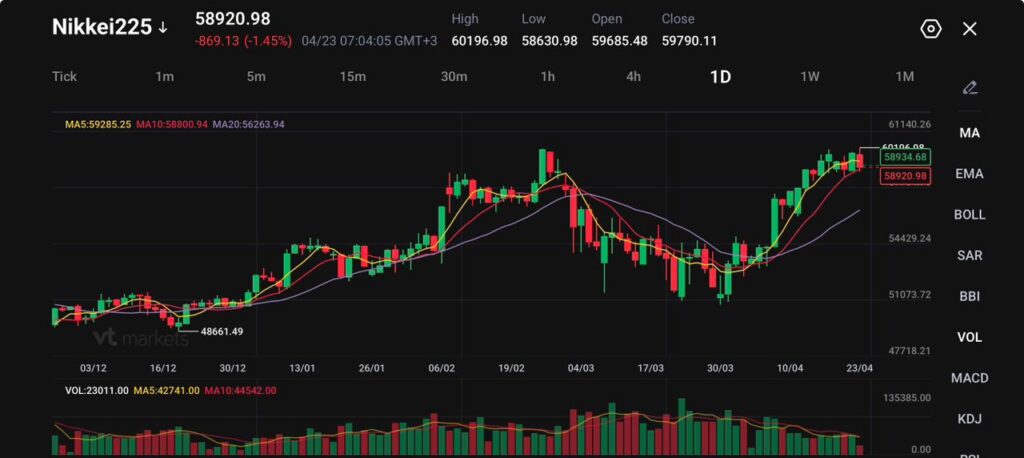
Nikkei 225 Pulls Back as Oil Tests AI-Led Rally

Key Points

  • Nikkei 225 fell 869.13 points or 1.45% to 58,920.98, after touching a high of 60,196.98.
  • Brent crude held above $100, last cited at $102.45 after a 3.5% jump in the prior session and a further 0.5% rise.
  • Wall Street still provided a strong lead, with the S&P 500 up 1%, the Dow up 0.81%, and the Nasdaq up 1.6% to a record close.

Asian equities pushed to fresh highs as traders leaned on a strong start to the US earnings season and another record finish on Wall Street. Japan briefly traded above 60,000 for the first time, South Korea’s Kospi hit a record high, and Taiwan’s main index also touched an all-time peak.

MSCI’s broadest index of Asia-Pacific shares outside Japan rose about 1% to a record before some of that momentum cooled.

That backdrop tells us the market still wants to own growth and technology exposure. Traders have been willing to look through geopolitical tension as long as company earnings keep landing well and oil shocks do not yet look large enough to choke global demand. Futures later turned softer, which fits the idea that markets are still bullish, but less carefree than they looked at the highs.

For the Nikkei 225, that means the rally remains fundamentally supported, but the margin for error is thinner. If oil keeps climbing and starts to pressure margins, transport costs, and inflation expectations more directly, traders may rotate out of the most extended parts of the move.

Wall Street Earnings Are Still Doing The Heavy Lifting

The US lead remained supportive. On Wednesday, the S&P 500 rose 1%, the Dow Jones Industrial Average added 0.81%, and the Nasdaq Composite advanced 1.6% to a record close. After the bell, Tesla also helped sentiment by posting a surprise positive first-quarter free cash flow of $1.44 billion, compared with market expectations for a $1.43 billion deficit. Revenue came in at $22.39 billion, although that still slightly missed forecasts.

The Nikkei has been moving in step with the global AI and semiconductor trade. Taiwan Semiconductor Manufacturing rose 3.2% and Samsung Electronics gained 2.6%, which helped keep chip and AI-linked risk appetite alive across the region.

The cautious read here is that earnings are still winning the short-term argument, but only just. If US results stay strong, dip buyers may keep stepping into Asian equities. If earnings momentum starts to narrow while oil stays firm, the Nikkei could lose one of its main pillars of support.

Technical Analysis

Nikkei 225 is trading near 58,921, pulling back after a strong rally that pushed price toward the 60,100–60,200 resistance zone. The recent move higher from the late-March lows remains intact, but momentum is starting to cool as the index meets overhead supply.

From a technical standpoint, the bias remains cautiously bullish but showing early signs of exhaustion. Price is still holding above the 20-day moving average (56,263), which continues to slope upward and supports the broader recovery structure. However, the 5-day (59,285) has started to roll over, and the 10-day (58,801) is now acting as immediate support, indicating short-term consolidation.

Key levels to watch:

  • Support: 58,800 → 56,200 → 54,400
  • Resistance: 60,100 → 61,100 → 62,500

The index is currently consolidating just below the 60,100 resistance level, where recent upside attempts have stalled. A clean break above this zone could extend the rally toward 61,100, with further upside potential if bullish momentum resumes.

On the downside, 58,800 is acting as immediate support. A break below this level could trigger a pullback toward the 56,200 area, though this would likely remain corrective as long as the broader higher-low structure holds.

Overall, the Nikkei 225 is holding onto its recovery gains but losing short-term momentum near resistance. The near-term focus is on whether buyers can reclaim 60,100, or if the index pulls back to retest support before attempting another leg higher.

What Traders Should Watch Next

The next move will likely depend on whether earnings or energy wins the macro tug-of-war. If Wall Street keeps posting clean earnings beats and oil steadies rather than surges, the Nikkei can still rebuild toward the 60,000 area and challenge the 60,196.98 high again.

For now, the Nikkei still looks like a market in an uptrend that has run into a real macro speed bump. Traders should watch whether buyers defend the moving average cluster quickly, or whether oil finally forces a more meaningful rethink of how much good news is already priced in.

Learn more about trading Indices on VT Markets today.

Trader Questions

Why did the Nikkei 225 fall after hitting record highs?

The Nikkei 225 dropped 869.13 points or 1.45% to 58,920.98 after briefly reaching 60,196.98. The pullback reflects profit-taking near record levels and growing caution as oil prices above $100 raise inflation concerns.

Are Asian equities still in an uptrend?

Yes, the broader trend remains supported. MSCI’s Asia-Pacific index rose about 1% to a record, while the Nikkei still holds above key moving averages like the MA10 at 58,800.94 and MA20 at 56,263.94.

How are US markets influencing the Nikkei?

Wall Street continues to provide a strong lead. The S&P 500 rose 1%, the Dow gained 0.81%, and the Nasdaq climbed 1.6% to a record close, supporting global risk sentiment and AI-linked stocks.

What role are oil prices playing in the current market?

Brent crude staying above $100, last at $102.45 after a 3.5% surge and an additional 0.5% rise, is lifting inflation expectations. This creates pressure on equities if energy costs begin to impact growth and margins.

What levels should traders watch for the Nikkei 225?

Traders are watching the 58,800–59,285 range, which aligns with the MA10 and MA5. Holding above this zone keeps the uptrend intact, while a break lower could shift focus toward the mid-57,000s and the MA20 at 56,263.94.

Start trading now – Click here to create your real VT Markets account

South Korea’s year-on-year GDP grew 3.6% in the first quarter, beating forecasts of 2.7%

South Korea’s gross domestic product grew by 3.6% year on year in the first quarter.

This was above the market expectation of 2.7% for the same period.

The stronger-than-expected GDP growth fundamentally alters our short-term view on South Korean monetary policy. We had been pricing in a potential interest rate cut by the third quarter, but this robust data makes that scenario less likely. The Bank of Korea will now have to reconsider its path given this clear economic strength.

We are now looking at interest rate swaps that price out any BOK rate cuts for the remainder of 2026. After the BOK held its policy rate at 3.50% for all of 2025 to stamp out inflation, this growth surprise suggests they have no reason to ease policy yet. We see value in positions that bet on rates staying higher for longer than previously anticipated.

For currency traders, this reinforces a bullish stance on the South Korean Won, especially against currencies where central banks are more dovish. With the USD/KRW pair already down to around 1,310 this year from over 1,350, we expect call options on the Won to become more popular. This data widens the policy divergence between a firm BOK and a Federal Reserve that is still signaling a potential summer rate cut.

On the equity front, the initial reaction for the KOSPI index could be positive due to strong economic fundamentals. However, traders should be cautious, as the prospect of delayed rate cuts could cap valuation multiples, especially for growth-sensitive tech stocks. We will be watching KOSPI 200 futures for signs of a breakout, but also considering put options to hedge against any rate-related jitters.

MUFG’s Lloyd Chan says elevated geopolitical risks persist, yet REER valuations imply the rupiah is undervalued versus USD

Geopolitical risks remain elevated, while valuation measures such as the real effective exchange rate (REER) indicate the rupiah is undervalued against the US dollar. The outlook described is for near-term rupiah stabilisation rather than a disorderly fall.

Policy intervention is reported to have reduced foreign exchange volatility and slowed the pace of USD/IDR gains. Indonesia’s sovereign credit default swap (CDS) spreads have also narrowed.

USD/IDR is described as having entered overbought territory. This is presented as reducing the appeal of further US dollar gains at current levels.

The base case forecast keeps USD/IDR at 17,000 by end-Q2. A gradual improvement in rupiah performance is expected in later quarters as policy support and financial flows strengthen.

We’ve seen geopolitical risks keep pressure on the rupiah, but valuation metrics now show it is meaningfully undervalued against the US dollar. Bank Indonesia’s active policy has successfully slowed the dollar’s advance, helping to calm foreign exchange volatility. This is supported by Indonesia’s March 2026 inflation rate, which came in at a manageable 2.9%, giving the central bank flexibility.

The recent rally has pushed the USD/IDR pair into overbought territory, which reduces the appeal of betting on more dollar gains at these levels. Technical indicators suggest the upward momentum is likely exhausted after the pair tested the 16,900 level last week. For traders, this signals that the path of least resistance may no longer be upwards.

Our base case is for the rupiah to stabilize in the near term, avoiding the kind of disorderly depreciation we saw during previous global shocks, like the one in 2025. This outlook makes selling out-of-the-money USD/IDR call options an attractive strategy for the coming weeks. A trader could look at strike prices above the 17,000 mark for contracts expiring towards the end of the second quarter.

Confidence in Indonesia’s fundamentals is also improving, as seen in the sovereign credit default swap spreads, which have narrowed by 8 basis points this month. Furthermore, preliminary data shows a return of foreign capital, with net inflows of nearly $600 million into the local bond market in the first half of April. This gradual improvement in flows should provide a floor for the rupiah and support its performance later this year.

GBP/USD hovers around 1.35 as traders await UK PMIs and retail sales amid choppy, uncertain trading

GBP/USD ended Wednesday near 1.3510 after trading between 1.3540 in London and 1.3490 later on. The pair has stayed within a 65-pip range, with long wicks on candles showing mixed direction.

UK CPI rose 0.7% month-on-month in March versus 0.6% expected, and annual CPI moved up to 3.3% year-on-year. Core CPI eased to 3.1% year-on-year versus 3.2% expected.

Thursday UK flash PMIs are forecast at 49.9 for Manufacturing and 49.8 for Composite, and GfK Consumer Confidence is seen at -25 versus -21. Friday UK Retail Sales are forecast at 0.2% month-on-month after -0.4% in February.

US data on Thursday include flash PMIs, with Services expected near 50 and Manufacturing near 52.5, plus Initial Jobless Claims seen at 212K versus 207K. Friday University of Michigan one-year inflation expectations are projected at 4.8%.

On the 15-minute chart, GBP/USD was 1.3506, below the day’s open at 1.3517, with Stochastic RSI near 40. On the daily chart, it was 1.3501, above the 50-day EMA at 1.3427 and 200-day EMA at 1.3357, with Stochastic RSI near 87.

We can see how the market was coiled with uncertainty back in 2025, with GBP/USD pinned near 1.35 amid conflicting signals. That period’s data showed the classic conflict for the Bank of England: stubbornly high headline inflation against a backdrop of weakening economic activity. This indecision created the choppy, two-way price action described.

The fears of a UK slowdown we saw in the 2025 forecasts were realized, as Q4 2025 GDP contracted by 0.2%, confirming a technical recession. Current data from the Office for National Statistics shows UK inflation has since eased to 2.8%, but the Bank of England has kept rates steady at 5.0% due to persistent wage growth above 4%. This has kept the pound under pressure as the market weighs the risk of a policy mistake.

On the other side of the Atlantic, the dollar’s strength was underpinned by the Strait of Hormuz closure throughout much of 2025, a situation that has since been resolved through diplomatic channels in early 2026. This has shifted focus back to monetary policy divergence, where the Federal Reserve remains more hawkish than the Bank of England, citing core services inflation that is still running above 3.5% as of March 2026. This divergence has been a key factor in pushing GBP/USD from those 1.35 highs down to its current trading range around 1.2950.

Given this backdrop, we should anticipate continued policy divergence to drive currency movements. This suggests that buying long-dated GBP/USD put options could be a prudent way to hedge against further sterling weakness if the UK economy continues to underperform. Volatility is likely to increase around central bank meetings, making straddles or strangles a viable strategy for traders expecting a breakout but unsure of the direction.

The interest rate differential between the US and the UK has widened over the past year, making carry trades more attractive. Traders could consider using forward contracts to short GBP/USD, capturing the positive carry from holding dollars over pounds. However, we must be mindful that any surprise hawkish shift from the Bank of England could quickly unwind these positions.

USD/JPY stabilises near 159.50 as traders await Japan’s CPI and US PMIs, signalling indecision

USD/JPY was steady on Wednesday near 159.50 after Tuesday’s move to 159.64. It has traded between 159.10 and 159.60, with small candles showing limited direction.

Japan’s March trade balance showed a ¥667 billion surplus versus a ¥1,106 billion consensus. Imports rose 10.9% year on year against a 7.1% forecast, while exports grew 11.7% year on year.

Crude oil prices have remained high, raising Japan’s energy import costs and weighing on the yen. Upcoming risk sentiment may shift if tensions around the US-Iran situation ease.

In the US, Thursday includes Initial Jobless Claims (consensus 212K; prior 207K) and preliminary April S&P Global PMIs. Services are forecast near 50 and Manufacturing near 52.5.

Japan’s CPI is also due Thursday, with core CPI (excluding fresh food) expected at 1.8% year on year versus 1.6% previously. Friday brings University of Michigan data, with one-year inflation expectations seen at 4.8%.

On charts, USD/JPY was at 159.48; the 15-minute view shows consolidation and Stochastic RSI near 30. On the daily chart, price is above the 50 EMA (158.25) and 200 EMA (154.93), with Stochastic RSI near 31.9.

The wide interest rate gap between the US and Japan remains the core reason for the dollar’s strength against the yen. We’ve seen this theme dominate since the Bank of Japan ended its negative interest rate policy back in March 2024, as their single small hike was dwarfed by a U.S. Federal Reserve that has kept rates elevated. The current pause near 159.50 shows that the market is waiting for a new catalyst before pushing higher or reversing course.

For those betting the uptrend continues, buying out-of-the-money call options for May or June 2026 offers a way to profit from a move higher with defined risk. A strike price around 160.50 would be a logical target, anticipating a breakout above the recent consolidation. This view is supported by the price holding firmly above key long-term moving averages, suggesting the broader bullish structure is still in place.

However, we must consider the risk of a sudden yen strengthening, especially with Japan’s upcoming inflation report. A surprisingly high CPI figure could fuel speculation of another BoJ rate hike, a scenario that has more weight now than it did before the policy shift we saw two years ago. Purchasing put options with a strike price below the 158.25 support level could serve as a valuable hedge against such a downturn.

Given the tight trading range and major economic data scheduled for release, a volatility strategy may be the most prudent approach. Buying both a call and a put option for the coming weeks allows a trader to profit from a significant price move in either direction. This is especially relevant as the upcoming U.S. PMI and Japanese CPI figures have the potential to break the current market indecision.

Back To Top
server

Hello there 👋

How can I help you?

Chat with our team instantly

Live Chat

Start a live conversation through...

  • Telegram
    hold On hold
  • Coming Soon...

Hello there 👋

How can I help you?

telegram

Scan the QR code with your smartphone to start a chat with us, or click here.

Don’t have the Telegram App or Desktop installed? Use Web Telegram instead.

QR code