
Back

In April, France’s manufacturing business climate reached 100, surpassing forecasts of 99 without fail

France’s manufacturing business climate index rose to 100 in April. This was above expectations of 99.

A reading of 100 matches the long-term average level. The April result indicates a move up from below-average conditions.

The French manufacturing climate hitting 100 is a sign of stabilization, meeting the long-term average after a prolonged period of uncertainty. While the beat over expectations is small, it supports the recovery narrative we’ve watched build since the difficult second half of 2025. This suggests a solid footing for French industrial equities, making short-dated call options on the CAC 40 index an attractive play for modest upside.

This stability is a welcome change from the contracting PMI figures we saw throughout much of 2025, which kept implied volatility high on French stocks. With the index now anchored at its historical norm, we expect a gradual dampening of volatility in the weeks ahead. Selling out-of-the-money put spreads on key industrial names could be a prudent way to collect premium, capitalizing on this newfound market confidence.

This data subtly complicates the picture for the European Central Bank, whose members have been hinting at potential rate adjustments later this year. Steady economic indicators, like the 0.5% growth in industrial production we saw across the Eurozone in the last quarter of 2025, reduce the urgency for intervention. This may lend slight strength to the Euro, suggesting cautious positioning in EUR/USD call options.

However, we must remember this is just a single data point and the beat was marginal, signaling a return to normal rather than a significant boom. Given that France’s own industrial output only recently clawed its way back to positive territory last year, overly aggressive bullish bets are not warranted. This environment may be better for income-generating strategies, like covered calls on existing industrial stock positions.
Amid US-Iran tensions, the New Zealand dollar falls versus the stronger US dollar, trading within 0.5870–0.5930 range

The New Zealand Dollar fell moderately against a stronger US Dollar on Thursday as rising US–Iran tensions lowered risk appetite. NZD/USD stayed within a recent range, capped below 0.5930 and supported above about 0.5870.

New Zealand consumer inflation data earlier this week showed price pressures remain above the Reserve Bank of New Zealand’s target rate, which offered some support to the NZD. Trading stayed cautious amid the Middle East situation, keeping the pair in a narrow band.

The broader setup from early April lows remained in place, but momentum weakened and 4-hour indicators turned lower, focusing attention on support near 0.5870. The RSI slipped to just below 50 and the MACD histogram moved slightly negative.

A break below 0.5860–0.5870 could shift price towards the April 13 low near 0.5800, with early April lows just under 0.5700 next. On the upside, a move above 0.5930 (April 17 and 22 highs) could target 0.5965 (March 10 high) and late-February highs near 0.6000.

The technical analysis section was produced with help from an AI tool.

We recall the situation back in April 2025, where the NZD/USD was stuck between 0.5870 and 0.5930 due to geopolitical stress and sticky New Zealand inflation. That period showed us how risk appetite can cap gains even when domestic data looks supportive for the kiwi. This historical range provides a useful baseline for understanding potential pullbacks.

Fast forward to today, April 23, 2026, the pair is trading significantly higher, near 0.6150. New Zealand’s latest Q1 2026 inflation data came in at 3.8%, which is still above the Reserve Bank of New Zealand’s target but shows a clear cooling trend from the highs we saw over a year ago. The RBNZ has held its cash rate at 5.5%, but the market is now pricing in the possibility of cuts before the end of the year, which could cap the kiwi’s strength.

On the other side of the pair, recent US inflation for March 2026 was unexpectedly firm at 3.1%, making the Federal Reserve hesitant to signal any rate cuts. This policy divergence, where the RBNZ looks set to ease before the Fed, is creating underlying strength for the US dollar. We see this as the primary headwind preventing the NZD/USD from breaking out to new highs.

For derivative traders, this suggests a strategy based on range-bound trading with a bearish tilt. Implied volatility in NZD/USD options is currently low, making it relatively cheap to buy puts for downside protection below the 0.6100 support level. Selling call options with strike prices above the recent high of 0.6220 could be a viable strategy to collect premium, assuming the policy divergence continues to cap the pair’s upside.

The key levels to watch in the coming weeks are the 0.6100 support area and resistance around 0.6220. A decisive break below 0.6100, driven by hawkish Fed commentary or new geopolitical risk, could trigger a move back towards the 0.6000 psychological level. Traders should be prepared for this potential shift as the market digests the competing inflation and central bank narratives.

UOB strategists expect GBP/USD to consolidate, with largely flat momentum, trading between 1.3475 and 1.3530

UOB strategists Quek Ser Leang and Lee Sue Ann report that GBP/USD momentum indicators remain mostly flat. They expect intraday consolidation within 1.3475 to 1.3530.

They noted that GBP previously traded in a tight 1.3493 to 1.3534 range and closed at 1.3501, down 0.03%. An earlier view had set an expected daily range of 1.3465 to 1.3535.

For the 1–3 week outlook, they say earlier upward momentum has faded. They keep a broader trading band of 1.3400 to 1.3600, with no new directional bias.

The piece states it was produced using an Artificial Intelligence tool and checked by an editor.

For the coming weeks, we see that the upward momentum in GBP/USD has faded away. The pair is expected to be stuck in a range, likely trading between 1.3400 and 1.3600. This suggests that traders should avoid betting on a strong directional breakout.

This sideways market is ideal for strategies that profit from a lack of movement, such as selling options. Traders could consider selling call options with strike prices at or above 1.3600 and selling put options near the 1.3400 level. The goal is to collect the premium as time passes and the options expire worthless, assuming the pair stays within this band.

The economic data supports this view of a market in balance. Last week’s UK inflation data showed core CPI holding at a stubborn 3.1%, which keeps the Bank of England from cutting rates, but slowing manufacturing PMI figures prevent them from hiking either. This creates a holding pattern for the pound, much like the one we saw for parts of 2025.

On the other side of the pair, recent US retail sales figures came in softer than anticipated, which has reduced expectations for any near-term rate hikes from the Federal Reserve. With both central banks seemingly on pause, there isn’t a strong catalyst to push the currency pair decisively in one direction. We can see this reflected in the market directly.

Implied volatility for one-month GBP/USD options has fallen to around 6.8%, a sharp contrast to the double-digit volatility we experienced during the market shifts in late 2025. This low volatility environment confirms market expectation for consolidation. It makes buying options less attractive, as big price swings are needed to make a profit.

Therefore, strategies that require a strong trend, like buying outright calls or puts, are less likely to succeed in the immediate future. The risk is that the position loses value each day due to time decay while the currency pair goes nowhere. It appears more prudent to focus on the established range for now.

Neptune Insurance’s Q1 revenue stayed at $37.8 million year-on-year, while EPS rose to $0.09

Neptune Insurance Holdings Inc. reported revenue of $37.8 million for the quarter ended March 2026, unchanged from a year earlier. Earnings per share were $0.09, compared with $0.00 a year ago.

Revenue was 3.05% above the Zacks Consensus Estimate of $36.68 million. EPS matched the consensus estimate of $0.09.

Policies in force at period end were 295 thousand, versus an average analyst estimate of 285.59 thousand. Premium in force at period end was 389 million, compared with an average estimate of 374.23 million.

The average number of employees was 59.9 thousand, versus an average estimate of 63 thousand. Revenue per employee was $2.8 billion, compared with an average estimate of $2.63 billion.

Fee income was $8.76 million, compared with an average estimate of $8.66 million. Commission income was $29.03 million, versus an average estimate of $28.02 million.

We are seeing Neptune Insurance report what looks like a quiet quarter with revenue unchanged from last year. Earnings per share landed exactly where analysts predicted, which usually keeps a stock stable. The key, however, is the underlying strength shown by beating estimates on both the number of policies and the total premium value in force.

This growth in the customer base is happening as the company becomes more efficient, using fewer employees than projected to generate higher revenue per person. Looking back, we saw this trend build throughout 2025 as a “hard market” environment allowed insurers to increase premiums. Recent data confirms this, with the U.S. Bureau of Labor Statistics showing property and casualty insurance rates up another 6.4% in the first quarter of 2026 alone.

We should also consider the broader economic environment for their investment income. The Federal Reserve’s minutes from the March 2026 meeting suggest interest rates will hold steady around 4.5%, a level that continues to benefit the returns on insurers’ large investment portfolios. This provides a stable source of income on top of the growing premium base.

With the earnings announcement now behind us, we can expect the stock’s implied volatility to decrease in the coming weeks. This suggests that strategies like selling cash-secured puts could be attractive. Such a position benefits from both the drop in volatility and the fundamental floor provided by the company’s solid operational performance.

Danske Bank says April flash Eurozone PMIs guide the ECB; manufacturing dips below 50, services stay 50.2

Euro area April flash PMIs are due ahead of the next European Central Bank meeting. Manufacturing PMI is expected to fall from 51.6 to 49.6, while Services PMI is expected to stay at 50.2.

The expected manufacturing drop is linked to higher energy prices. March’s rise in the headline index was largely tied to longer delivery times, which could again affect the headline reading in April.

Uncertainty around the PMI measures is described as unusually high, so readings may be harder to interpret than normal. Price components and the output sub-component are set to be watched closely.

Markets started the session weaker amid news about a stand-off over the Strait of Hormuz. Asian equities fell, US Treasuries rose by a couple of basis points, and EUR/USD moved back below 1.1700.

We remember this time last year, in April 2025, when significant concerns over energy prices were expected to push the manufacturing PMI into contraction territory. The market was also digesting geopolitical risk from the Strait of Hormuz, which sent the EUR/USD pair sliding below 1.1700. This created a clear playbook for trading Euro weakness.

Now, looking at the fresh April 2026 flash PMI data, we see a familiar pattern of industrial weakness, with the manufacturing index coming in at 49.9, still just below the crucial 50 mark. However, the services sector is showing more resilience this time around, posting a reading of 52.1 and suggesting a continued divergence in the Eurozone economy. This two-speed reality complicates the outlook for the European Central Bank.

The ECB is caught between this sluggish manufacturing output and core inflation that remains sticky, with the latest reading for March 2026 holding at 2.9%. This makes a near-term interest rate cut less certain and increases the importance of the ECB’s forward guidance in the coming weeks. We believe this uncertainty will keep a lid on any significant Euro strength.

Given the EUR/USD is currently hovering around 1.0720, a full ten cents lower than this time in 2025, bearish strategies remain attractive. Traders should consider buying puts or establishing put spreads on the EUR/USD, targeting moves lower on any signs that the ECB is prioritizing growth over its inflation fight. The persistent manufacturing weakness provides a strong fundamental reason for this view.

Volatility in European energy markets, specifically natural gas prices, continues to be a major factor weighing on industrial sentiment. While prices are off their highs, they remain structurally elevated, recently trading around €35 per MWh on the TTF hub. This sustained pressure on manufacturing suggests that options protecting against further Euro declines or a spike in market volatility are prudent hedges.

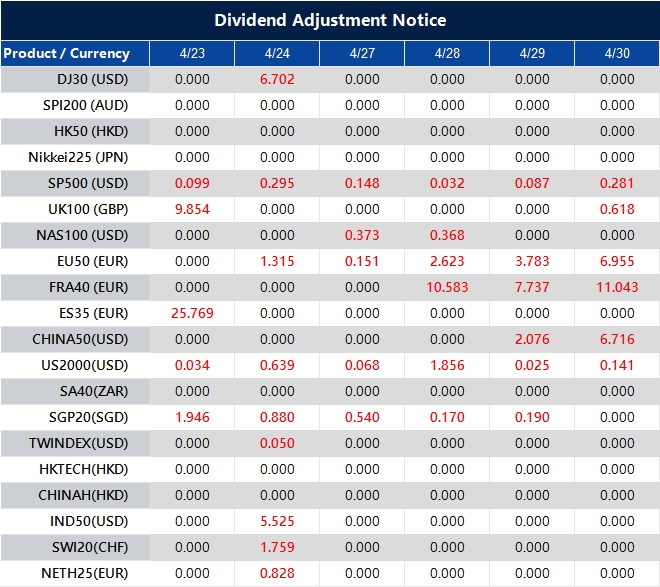
Dividend Adjustment Notice – Apr 23 ,2026

Dear Client,

Please note that the dividends of the following products will be adjusted accordingly. Index dividends will be executed separately through a balance statement directly to your trading account, and the comment will be in the following format “Div & Product Name & Net Volume”.

Please refer to the table below for more details:

Dividend Adjustment Notice

The above data is for reference only, please refer to the MT4/MT5 software for specific data.

If you’d like more information, please don’t hesitate to contact [email protected].

In April, India’s HSBC Manufacturing PMI rose to 55.9, up from 53.9 previously, indicating stronger growth

India’s HSBC Manufacturing PMI rose to 55.9 in April from 53.9 in March. A reading above 50 indicates expansion in manufacturing activity.

The April figure points to faster growth than the previous month. The change marks an increase of 2.0 points.

This new manufacturing data suggests the Indian economy is expanding faster than we thought. A PMI reading of 55.9 is a strong bullish signal, indicating robust demand and production. In the coming weeks, we should anticipate positive momentum in equity markets.

We should consider increasing our long positions on Nifty 50 futures and buying call options. Historically, strong PMI prints like this have often preceded market upturns, as seen in the post-pandemic rally of the early 2020s. With India’s GDP forecast recently revised to 6.8% for the next fiscal year, this data supports a view of continued corporate earnings growth.

This economic strength should also attract more foreign investment, putting upward pressure on the Indian Rupee. Foreign portfolio investors have already poured over $5 billion into Indian equities this quarter, a trend this data will likely accelerate. Therefore, shorting USD/INR futures or buying Rupee call options appears to be a sensible strategy.

The strong economic signal may temporarily lower implied volatility as market direction seems clearer. This could present a cost-effective opportunity to build long option positions on manufacturing and industrial stocks. We should act before the market fully prices in this stronger growth outlook.

However, we must also watch for inflation, as this strong growth could lead to price pressures. With core CPI inflation already hovering at 5.2%, the Reserve Bank of India will be paying close attention. Looking back at the swift rate hike cycle in 2025, we know the central bank isn’t afraid to act if the economy overheats.

India’s HSBC Composite PMI climbed from 57 to 58.3 in April, indicating stronger overall business activity

India’s HSBC Composite PMI rose to 58.3 in April, up from 57 in the previous month.

The increase shows a faster expansion in combined activity across services and manufacturing during April.

This flash PMI data for April shows an acceleration in India’s economic expansion. The reading indicates broad-based growth across both manufacturing and services, suggesting strong underlying business conditions. This reinforces a bullish outlook on Indian equities for the coming weeks.

The positive sentiment is already reflected in the market, with the Nifty 50 recently crossing the 28,500 mark and foreign portfolio investors (FPIs) being net buyers of over $2 billion in Indian equities so far this month. We should expect this trend to continue as strong economic data attracts more capital. This suggests that long positions on the index are favourable.

Derivative traders should consider buying Nifty 50 futures or out-of-the-money call options for the May expiry to capitalise on this upward momentum. Selling put options or initiating bull put spreads could also be a viable strategy to collect premium, given the strong support for the market. These strategies are based on the expectation that the index will continue its upward trend or, at a minimum, not experience a significant decline.

However, we must watch inflation, as the March CPI reading came in at 4.8%, still above the Reserve Bank of India’s target. The RBI held the repo rate at 6.5% in its early April meeting, signaling that they are not yet ready to ease policy. This persistent hawkish stance could place a cap on how quickly equities can rally.

This strong reading builds on the momentum we saw through the second half of 2025, where the economy showed remarkable resilience despite global headwinds. The consistent expansion suggests that corporate earnings for the quarter just ended are likely to be robust. This provides a fundamental basis for the current market optimism.

The data also points towards a strengthening Indian Rupee, as strong growth and high interest rates attract foreign inflows. We could see the USD/INR pair test lower levels, making selling USD/INR futures a potential currency play. Meanwhile, the India VIX has fallen to near 11, indicating low expected volatility and making strategies that benefit from a stable market, such as selling strangles, more attractive.

FXStreet data shows gold prices in the Philippines declined, with values dropping during Thursday trading sessions

Gold prices in the Philippines fell on Thursday, based on FXStreet figures. Gold was priced at PHP 9,140.53 per gram, down from PHP 9,210.80 on Wednesday.

Gold also slipped to PHP 106,613.40 per tola from PHP 107,433.00 a day earlier. Other listed prices were PHP 91,402.31 for 10 grams and PHP 284,302.50 per troy ounce.

FXStreet converts global gold prices into Philippine pesos using the USD/PHP rate and local units. The figures are updated daily using market rates at the time of publication, and are for reference as local prices may vary.

Central banks are the largest holders of gold. In 2022, they added 1,136 tonnes worth about $70 billion, the highest annual purchase on record, according to the World Gold Council.

Gold often moves in the opposite direction to the US Dollar and US Treasuries, and can also move against risk assets. Prices can change with geopolitical events, recession fears, interest rates, and shifts in the US Dollar, since gold is priced in dollars.

We are seeing a minor dip in the gold price today, April 23, 2026, but this short-term noise should not distract from the larger picture. For traders, this is not a signal to sell, but rather a moment to assess the underlying market strength. The key drivers for gold remain bullish, and this small pullback is insignificant in the broader context.

The most important factor is interest rate policy, as gold is a yield-less asset. We remember the aggressive U.S. Federal Reserve rate hikes that peaked at 5.5% back in 2023, but the current environment is very different with expectations of further easing. This general trend toward lower interest rates reduces the appeal of holding cash and bonds, making gold more attractive.

We must also consider the persistent demand from central banks, which provides a strong floor for the price. Looking back, we saw them add over 1,000 tonnes to their reserves in both 2022 and 2023, a trend that continued through 2024 and 2025. This institutional buying from emerging economies is a powerful force that limits how far prices can fall.

The U.S. Dollar, which is inversely correlated with gold, is also a key consideration. While the Dollar Index has been hovering near the 104 level, the prospect of more interest rate cuts in the U.S. than in other major economies could weaken it. A falling dollar typically pushes the price of gold higher.

Given these factors, any price weakness in the coming weeks should be viewed as a buying opportunity. We believe traders should look to establish long positions, perhaps using call options to capture potential upside while defining their risk. Betting against gold in this macroeconomic environment appears to be the more dangerous trade.

Singapore’s annual consumer inflation rose to 1.8% in March, accelerating from the prior 1.2% reading

Singapore’s Consumer Price Index (CPI) rose 1.8% year on year in March, up from 1.2% in the previous month.

This means consumer prices increased faster in March than they did in the month before.

This jump in inflation to 1.8% is significant for us. It shifts the conversation towards the Monetary Authority of Singapore (MAS) potentially tightening its policy sooner than expected. The increase from 1.2% shows that price pressures are building up again.

We should anticipate the Singapore dollar strengthening against its trading partners. This means looking at currency derivatives, such as buying SGD call options against the US dollar, as the market begins to price in a steeper slope for the S$NEER policy band. Recent market data already shows the USD/SGD 3-month forward points ticking lower, indicating growing expectations of a stronger Sing dollar.

This outlook also points toward higher domestic interest rates. We should position for the Singapore Overnight Rate Average (SORA) to climb from its current plateau around 3.7%. Using interest rate swaps to pay a fixed rate or buying SORA futures could be an effective strategy in the coming weeks.

We remember how in mid-2025, inflation fears subsided, leading the MAS to maintain a neutral stance through two consecutive policy meetings. That period of stability now appears to be ending based on this new data. This is a clear signal that the economic environment is changing from what we saw last year.

For equity markets, rising interest rate expectations could create headwinds for the Straits Times Index (STI). Companies sensitive to borrowing costs, particularly in the real estate sector, may face pressure. We should consider buying put options on the STI or specific property stocks to hedge against a potential market downturn.

Back To Top
server

Hello there 👋

How can I help you?

Chat with our team instantly

Live Chat

Start a live conversation through...

  • Telegram
    hold On hold
  • Coming Soon...

Hello there 👋

How can I help you?

telegram

Scan the QR code with your smartphone to start a chat with us, or click here.

Don’t have the Telegram App or Desktop installed? Use Web Telegram instead.

QR code


