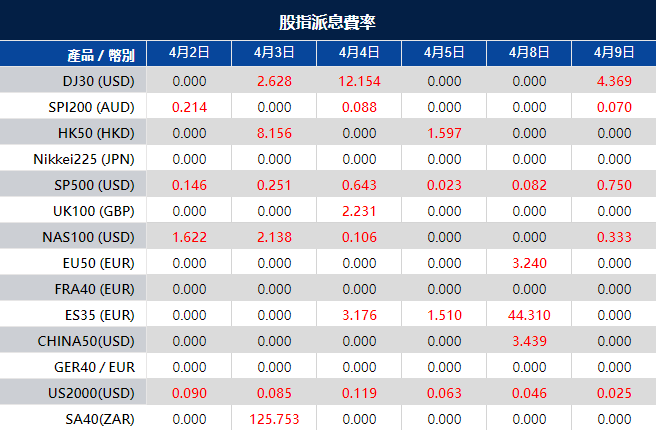
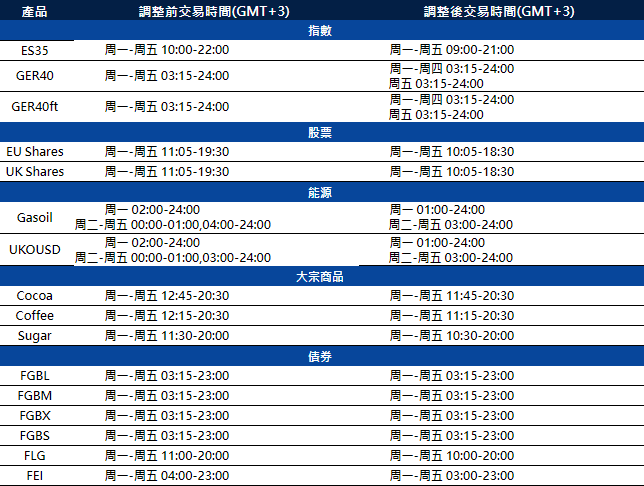
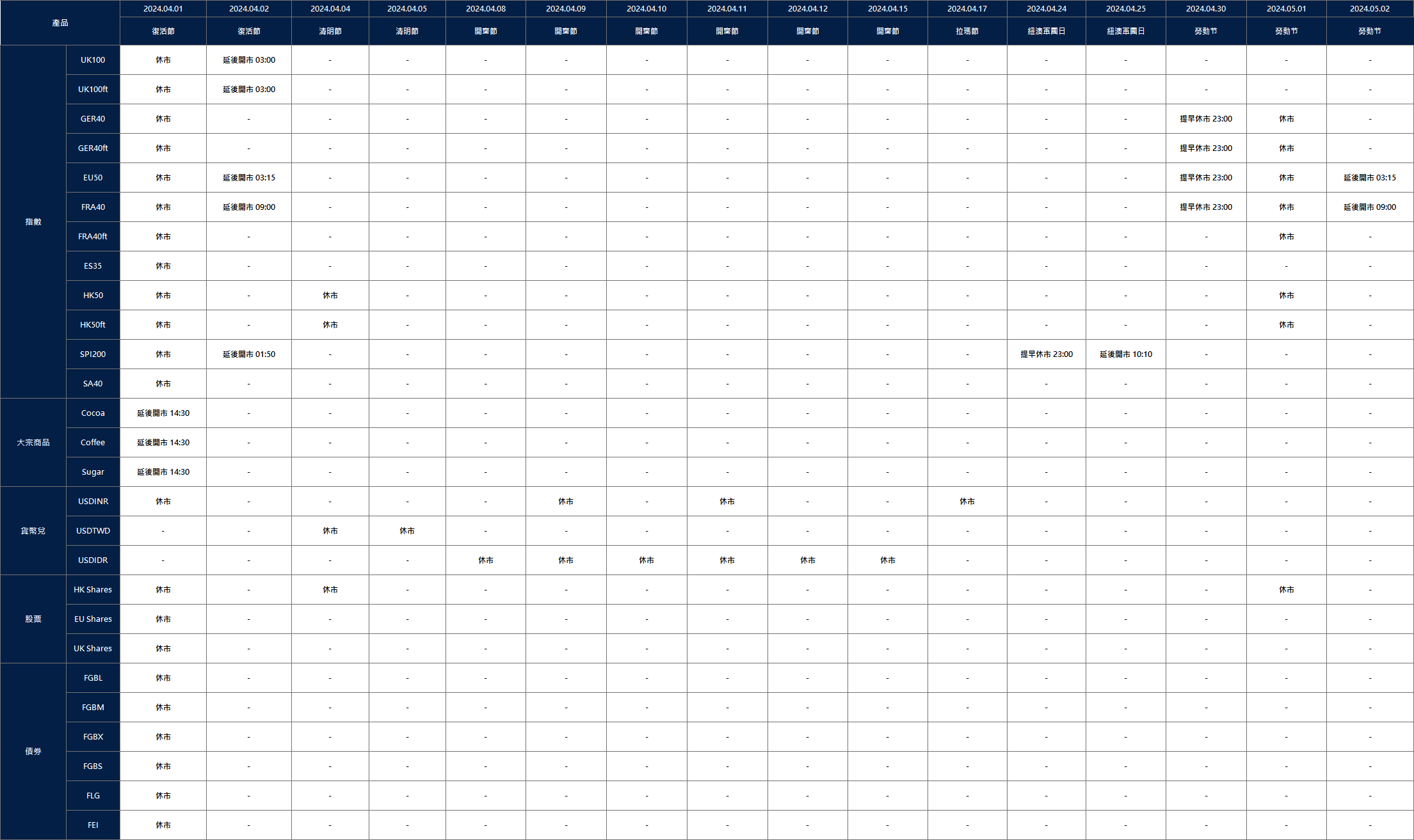
Please note that the dividends of the following products will be adjusted accordingly. Index dividends will be executed separately through a balance statement directly to your trading account, and the comment will be in the following format “Div & Product Name & Net Volume ”.
Please refer to the table below for more details:
The above data is for reference only, please refer to the MT4/MT5 software for specific data.
If you’d like more information, please don’t hesitate to contact [email protected].
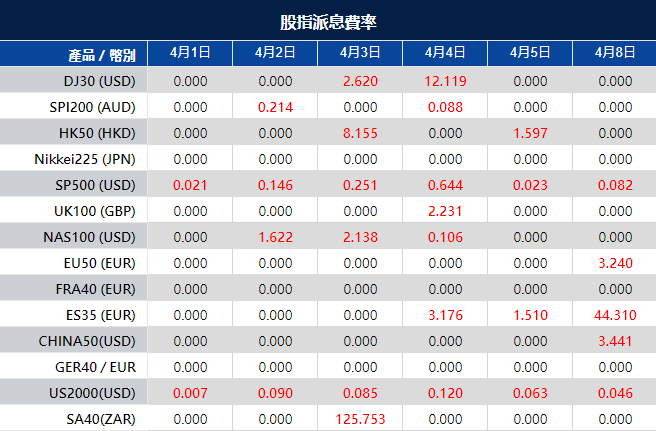
Please note that the dividends of the following products will be adjusted accordingly. Index dividends will be executed separately through a balance statement directly to your trading account, and the comment will be in the following format “Div & Product Name & Net Volume ”.
Please refer to the table below for more details:
The above data is for reference only, please refer to the MT4/MT5 software for specific data.
If you’d like more information, please don’t hesitate to contact [email protected].
As the world’s economies continue to navigate the post-pandemic landscape, key indicators from the United States, Switzerland, and Canada offer insights into the ongoing recovery and challenges faced by various sectors. The upcoming weeks are set to deliver pivotal data on services sector performance, inflation rates, and employment changes that will shed light on the economic direction of these countries. Below, we delve into the specifics of each report and what analysts are anticipating.
U.S. ISM Services PMI Takes a Slight Dip
In the United States, the Institute for Supply Management (ISM) Services Purchasing Managers’ Index (PMI) saw a slight decline to 52.6 in February 2024, down from a four-month peak of 53.4 in January. This metric is crucial as it reflects the health of the services sector, which constitutes a significant portion of the U.S. economy. The anticipated PMI for March, set to be unveiled on 2 April 2024, is expected to hold steady at 52.6, signaling continued expansion in the services sector, albeit at a tempered pace.
Switzerland’s Inflation Rate on the Rise
Moving to Europe, Switzerland reported an uptick in its inflation rate to 0.6% in February 2024, a significant jump from the 0.2% recorded in the preceding month. This increase was primarily driven by higher costs for housing rentals and air transport. Analysts are closely watching the Swiss economy and forecast a further inflation rise of 0.3% for March 2024, with the official figures scheduled for release on 4 April 2024. This gradual increase in inflation could signal a strengthening consumer demand and economic activity in the country.
Canadian Employment Figures Show Growth
In Canada, the employment landscape showed positive momentum with the addition of 40.7K jobs in February 2024, an improvement over the 37.3K jobs added in January. However, the unemployment rate edged higher to 5.8% in February, up from 5.7% the month before. The focus now turns to the March 2024 employment report, expected on 5 April 2024. Analysts predict a more modest job growth of 25K, with unemployment anticipated to tick slightly higher to 5.9%. These figures suggest that while the job market remains robust, it faces headwinds that could moderate growth.
U.S. Job Market Shows Resilience Amidst Challenges
Lastly, the U.S. job market continued to demonstrate resilience with the economy adding 275K jobs in February 2024, surpassing the revised figure of 229K in January. Despite this strong job growth, the unemployment rate increased to 3.9%, the highest level since January 2022. Looking ahead to March 2024, analysts are forecasting the addition of 200K jobs, with the unemployment rate expected to remain steady at 3.9%. The upcoming jobs report, due on 5 April 2024, will be crucial in assessing whether the U.S. labor market can sustain its momentum amidst economic uncertainties.
As these economic indicators unfold, they will provide valuable insights into the health and trajectory of the global economy. Stakeholders, from policymakers to investors, will be watching closely to gauge the effectiveness of current economic policies and to strategize for the future amidst a landscape of ongoing challenges and opportunities.
Have you ever noticed that some traders seem to know where the market will move before it happens? They’re probably using a method called “trading based on news.” Think of it as being like a money detective, always searching for the newest information in the finance world.
Imagine this: You find out a company you’re interested in has just reported great earnings, earlier than everyone else. You buy shares in that company. Then, as more people hear the news and start buying, the price goes up, and you’ve made a clever investment before the crowd.
In this guide, we’re going to look at how trading on news works, why it’s important, and how it helps you make better decisions in the market. Let’s get started!
Understanding market news
Keeping up with market news is like having a secret advantage when you trade. Here’s a brief overview of the types of news that can really shake up the markets:
Economic indicators: Watch for important figures like the gross domestic product (GDP) and unemployment rates. These can tell you a lot about the economy’s health and affect how people feel about the market.
Company earnings: How much profit a company makes can really change its stock price. Good news can boost it, while bad news can drop it.
World events: Things like elections or trade disputes can change how markets behave. Knowing what these events might do can help you make smarter trading choices.
Central bank news: Central banks control a lot of financial policies and rates. Their announcements can move markets quickly.
Checking news source trustworthiness
With so much news around, it’s key to know what’s true and what’s not. Here are some ways to make sure your news is reliable:
Choose well-known sources that report accurately and without bias.
Compare stories from different places to make sure they match up.
Be wary of dramatic headlines or rumors on social media.
Look at the history and expertise of the source in financial news.
Understanding how news affects different assets
Different news affects different assets in different ways. For example, rising oil prices might be good for energy companies but bad for airlines. Knowing which assets will be affected by which news helps you make better trading decisions.
When news comes out, try to predict if it will make prices go up or down. Also, think about whether its effect will be quick and sudden or slow and lasting.
Fear and Greed Index sentiment analysis toll source: CNN
Sentiment analysis tools are like magic balls for traders, giving insights into the market’s mood. By understanding the market sentiment, you can guess better how prices might change with the news.
How to trade with news
Trading on news isn’t just about following stories—it’s also about controlling your emotions. Here’s how to trade well with news:
Picking the right time to buy or sell
Timing is crucial in trading, especially with news. Act fast, but don’t let fear or greed push you into hasty decisions. Stick to your plan, knowing when to get in and out.
Choosing the right things to trade
Different news affects different financial items differently. Pick the ones that match your trading style and risk level. Think about how liquid (easy to buy and sell) and volatile (how much prices change) they are to make informed choices.
Thinking about market changes and risk
News can suddenly change how risky or stable the market is. Keep these changes in mind when you trade, and be ready to adjust your plans. Stay flexible and don’t risk too much.
Being patient and disciplined
Good trading takes patience and control. Stay calm, even when it’s tempting to act quickly, and don’t make decisions on a whim. Accept that losses are part of trading and use them to learn and improve.
Developing a news trading strategy source: Canva
Making a news trading strategy
Building a good news trading strategy means combining foresight, analysis, and flexibility. Here’s how to start:
Personal trading plan: This plan is your guide. Make it fit your risk level, financial goals, and trading style. Set clear rules for when to enter or exit a trade, how to manage risk, and when to take profits to keep your trading consistent.
Adding news analysis: Mix traditional and technical analysis with news analysis for a well-rounded strategy. Understand how news affects market feelings and prices, and use this in your trading.
Testing strategies: Test your strategy with past data before using it for real. This helps you see how it might do in different market conditions and make it better. Look at how it does with news events to make sure it’s strong and reliable.
Always be ready to change: Markets keep changing, so your strategy should too. Be willing to update your approach as things evolve. Regularly check how you’re doing, look at your trading plan, and adjust as needed to stay on top.
In the end, trading with news is a powerful way to take advantage of market movements caused by the latest information. By adding news analysis to your personalized trading plans, you can move through the market with more certainty. With the right approach, anyone can use news to make well-informed decisions and reach their financial goals in the constantly changing trading world.
Euro Market Sentiment Overview: Market sentiment analysis for EUR/USD, EUR/GBP, EUR/JPY.
Popularity in Trading: Trading can appear as a popularity contest; discerning traders find value in contrarian approaches.
IG Client Sentiment as a Contrarian Indicator: This tool provides insights into market sentiment, helping to identify potential opportunities to go against the mainstream trend.
Sentiment Analysis for EUR/USD:
Retail traders are significantly bullish on EUR/USD, with 60.78% taking long positions.
The long-to-short ratio stands at 1.55 to 1.
There’s been a notable increase in long positions (up 3.99% from yesterday and 35.69% from last week), while short positions have seen a significant decrease.
Contrarian Interpretation: The strong bullish sentiment on EUR/USD may indicate a contrarian signal for a potential decline in the near term.
Combining Strategies for Trading: Contrarian indicators are most effective when used as part of a comprehensive strategy that includes technical and fundamental analysis.
Top of Form
STOCK MARKET:
S&P 500 Record High: Closed the first quarter of 2024 with a record, marking its best performance since 2019.
Market Performance: The S&P 500 and Dow Jones both increased by more than 0.1%, while the Nasdaq slipped by 0.1%.
Consistent Growth: All three major stock averages have risen for five consecutive months.
Quarterly Closure: With markets closing for Good Friday, Thursday was the final trading day of the quarter.
Broadening Rally: Initially driven by megacap stocks, the market rally is now expanding more broadly.
Wall Street Targets: Firms are raising their year-end price targets for the S&P 500 due to its strong performance.
Economic Growth Data: Fourth quarter GDP growth was revised up to 3.4% from 3.2%.
Employment Figures: Initial jobless claims were slightly below estimates at 210,000 for the last week.
Upcoming Key Data: Investors are awaiting the PCE price index, the Federal Reserve’s favored measure of inflation.
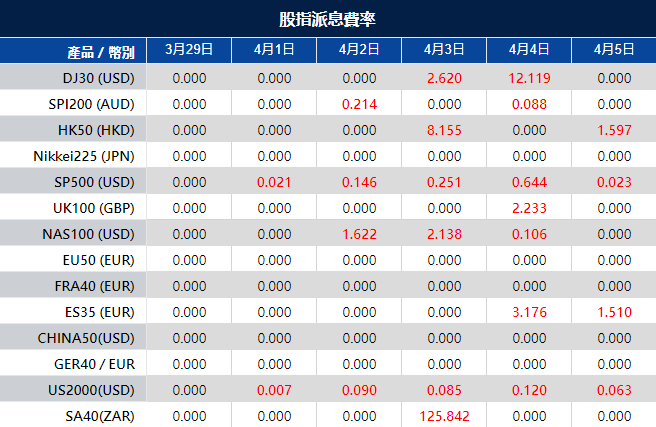
Please note that the dividends of the following products will be adjusted accordingly. Index dividends will be executed separately through a balance statement directly to your trading account, and the comment will be in the following format “Div & Product Name & Net Volume ”.
Please refer to the table below for more details:
The above data is for reference only, please refer to the MT4/MT5 software for specific data.
If you’d like more information, please don’t hesitate to contact [email protected].
Affected by international holidays, the trading hours of some VT Markets products will be adjusted. Please check the following link for the remaining affected products:
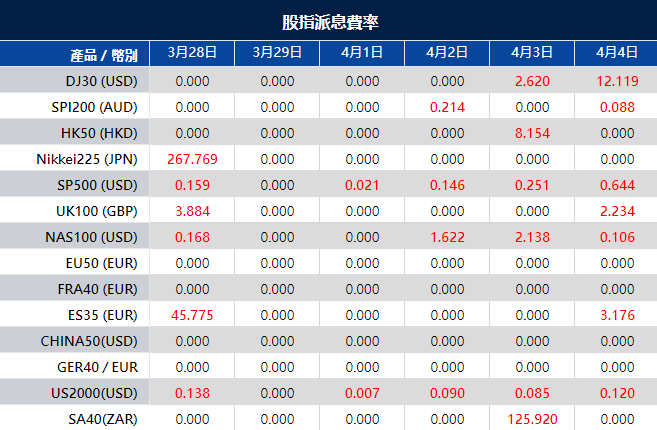
Please note that the dividends of the following products will be adjusted accordingly. Index dividends will be executed separately through a balance statement directly to your trading account, and the comment will be in the following format “Div & Product Name & Net Volume ”.
Please refer to the table below for more details:
The above data is for reference only, please refer to the MT4/MT5 software for specific data.
If you’d like more information, please don’t hesitate to contact [email protected].
Wednesday witnessed a significant uptick in the S&P 500 and Dow Jones, marking a promising close to the first quarter with the best performance since 2019. All sectors of the S&P 500 saw gains, led by utilities, real estate, and industrials, amidst broad market optimism and strategic quarter-end rebalancing. The stock market’s positive trajectory is buoyed by expectations of a soft landing for the U.S. economy and adjusted interest rate cut forecasts. Meanwhile, in the currency market, the dollar index edged up slightly, with USD/JPY experiencing a minor dip amid speculation of Japanese intervention to support the yen. The currency landscape remains cautious, with upcoming U.S. economic data and central bank policy adjustments in focus, especially regarding rate cuts by the Fed and the ECB. Investors and traders are keenly awaiting further indicators, including jobless claims, GDP, and consumer sentiment, to gauge the economic outlook as the second quarter approaches.
Stock market updates
The S&P 500 saw a significant rise on Wednesday, marking a new record high as it continues its journey toward the best first quarter since 2019. The index rose by 0.86%, closing at 5,248.49, while the Dow Jones Industrial Average saw a substantial gain, advancing 477.75 points or 1.22% to close at 39,760.08. The Nasdaq Composite also enjoyed gains, rising by 0.51% to close at 16,399.52. This uplift in the stock market ended a three-day losing streak for both the S&P 500 and the Dow Jones, highlighting a robust broad rally across the market.
In terms of sector performance, all 11 sectors of the S&P 500 experienced gains, with utilities leading the charge with an impressive jump of nearly 2.8%. This was closely followed by real estate and industrials, which advanced 2.4% and 1.6% respectively. This widespread rally underscores the market’s positive sentiment, driven by a strategic rebalance toward the end of the quarter. According to Art Hogan, chief market strategist with B. Riley Wealth, this shift indicates a growing enthusiasm for equities, spurred by quarter-end rebalancing and an overall positive outlook for the stock market as we approach the end of the first quarter.
Looking ahead, the major stock indexes are set to conclude the first quarter on a strong note, with the S&P 500 aiming for a 10% gain, which would be its best first-quarter performance since 2019. The Dow and Nasdaq are also on track for substantial quarterly gains. Additionally, the anticipation of a soft landing for the US economy and adjusted expectations for interest rate cuts contribute to a positive market outlook. Investors are now looking forward to upcoming data on jobless claims, GDP, and consumer sentiment, which will provide further insight into the economic landscape as we move into the second quarter.
Currency market updates
The dollar index experienced a slight increase as the market consolidated gains from the previous week, with traders awaiting further U.S. economic data and navigating quarter-end rebalancing. This period of anticipation comes ahead of the upcoming holiday market closures. Despite a broader increase, the USD/JPY pair saw a minor decline, reflecting market reactions to potential Japanese intervention to support the yen and prevent further decline, contrasting with the aggressive yen support seen in October 2022 following the Fed’s rate hiking cycle commencement.
In currency movements, the USD/JPY dynamics were influenced by speculation around the Federal Reserve’s future rate cuts, with traders eyeing crucial economic data releases for further direction. Meanwhile, the EUR/USD pair dropped slightly amid fluctuations in yield spreads between bunds and Treasuries, indicating a cautious market sentiment towards rate cuts by major central banks. Market pricing shows a significant anticipation of rate adjustments by the ECB and the Fed within the year, highlighting the nuanced interplay between monetary policy expectations and currency valuations.
The British pound found some stability, managing to stay above a recent low, supported by steady yields spreads between Gilts and Treasuries. This steadiness is amidst a broader market focus on upcoming U.S. economic indicators and a keen interest in Federal Reserve Governor Christopher Waller’s speech for insights into the central bank’s rate strategy. As the market approaches the holiday weekend, with key economic data on the horizon, currency traders are closely monitoring shifts in monetary policy outlooks and their potential impact on currency markets.
Picks of the Day Analysis
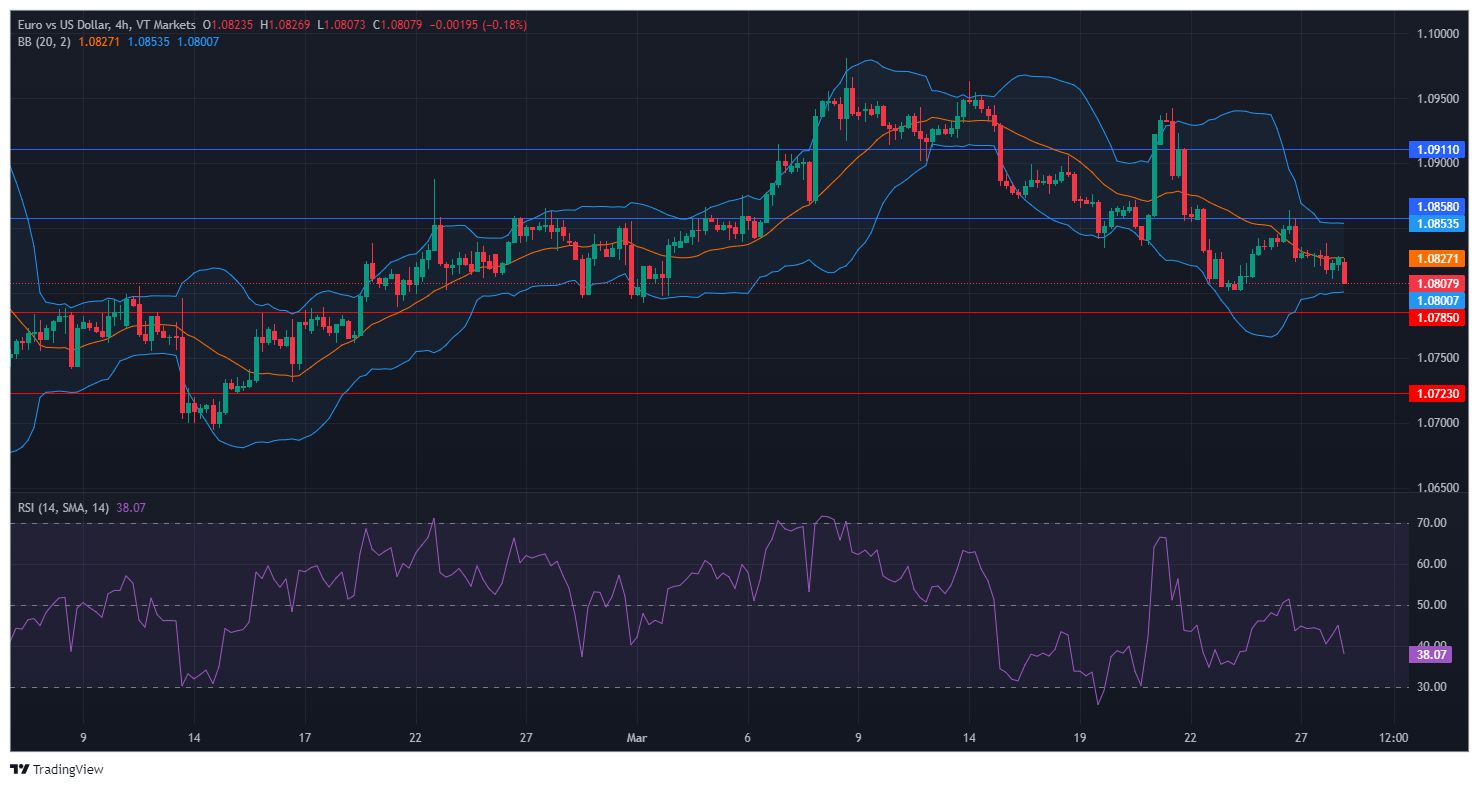
EUR/USD (4 Hours)
EUR/USD outlook influenced by ECB and Fed’s potential easing cycles
The EUR/USD pair witnessed a slight decline as the US Dollar gained modestly, influenced by expectations of divergent monetary policy strategies between the Federal Reserve (Fed) and the European Central Bank (ECB). Both central banks are anticipated to initiate easing cycles possibly in June, albeit at potentially different paces. ECB’s consideration for a rate cut is supported by moderating wage growth in the eurozone, suggesting a cautious approach towards easing. Meanwhile, the probability of a Fed rate cut in June slightly decreased. Despite these developments, the broader economic outlook hints at a stronger Dollar in the medium term, especially as both banks move towards easing, potentially driving EUR/USD towards its year-to-date low and beyond.
On Wednesday, the EUR/USD moved lower, able to reach near the lower band of the Bollinger Bands. Currently, the price is moving slightly above the lower band, suggesting a potential slight downward movement to reach the lower band. Notably, the Relative Strength Index (RSI) maintains its position at 38, signaling a bearish outlook for this currency pair.