Global Equities Rise; Gold Prices Decline

As fears of an escalation in the Middle East subside, investors are shifting away from safe-haven assets, resulting in a boost to global equities. The MSCI global stock index (EURONEXT:IACWI) saw an increase of 6.01 points or 0.81%, reaching 749.29. Wall Street mirrored this positive sentiment, with the Dow Jones Industrial Average (DJI) climbing by 253.58 points or 0.67% to 38,239.98, the S&P 500 (SPX) advancing 43.37 points or 0.87% to 5,010.60, and the Nasdaq Composite (IXIC) rising by 169.30 points or 1.11% to 15,451.31.

Gold, Bonds Prices Under Pressure

Conversely, spot gold fell sharply by 2.59% to $2,328.65 an ounce, marking its most considerable one-day drop since June 2022. U.S. gold futures also saw a decrease of 2.8%, settling at $2,346.4. In the bond market, yields, which move inversely to prices, were generally trending towards multi-month highs. The U.S. 10-year Treasury note yield slightly decreased by 0.2 basis points to 4.613%, whereas the 30-year bond yield edged up by 0.6 basis points to 4.7168%.

Earnings Season and Market Sentiment

With over 150 companies from the S&P 500 and 173 companies from the STOXX 600 scheduled to report first-quarter results, investor focus is sharply on earnings. Notably, eyes are on major U.S. tech giants like Microsoft and Alphabet, especially following Nvidia’s 10% plunge on Friday.

In commodities, the FTSE-100 in London, heavy with resource stocks, rose 1.62% nearing record highs as tin and nickel prices reached multi-month peaks. Additionally, Portuguese stocks surged over 3% led by oil company Galp Energia, which soared about 20% after optimistic reports about a significant oil field off Namibia.

Shifts in Currency and Oil Markets

The dollar index slightly gained by 0.03% at 106.13, reflecting a steady position amid global uncertainties. In the oil sector, both Brent and West Texas Intermediate crude saw modest declines, each dropping by 29 cents to $87.00 and $82.85 a barrel, respectively, as market focus returned to fundamental supply and demand dynamics.

Interest rate expectations are also affecting market movements, particularly in the U.S., where traders are speculating about potential rate cuts by the Federal Reserve, possibly as early as July, with a more likely scenario in September. This anticipation is echoed in the movements of the two-year Treasury note yield, which rose slightly by 0.2 basis points to 4.9713%.

Start trading now – Click here to open a live account.
No Calm in Storm? Oil Prices Rise Even as Middle East Tensions Remain Under Status Quo

Geopolitical Concerns Drive Oil Price Increase in Asian Trading

Oil prices witnessed an increase in Asian trading on Tuesday, reflecting a reversal from the downturn observed in the previous session. This change underscores the market’s ongoing vigilance concerning geopolitical developments in the Middle East. Specifically, Brent crude futures saw a rise of 39 cents, reaching $87.39 a barrel, and West Texas Intermediate crude also gained 40 cents, priced at $82.30 a barrel, as of 0033 GMT.

This uptick was followed by despite a decline caused by easing tensions on Monday, where both benchmarks fell by 29 cents. This decline was influenced by perceptions that the recent intensification of tensions between Israel and Iran had minimal immediate effects on the oil supply dynamics from the region. Despite this, the lingering uncertainties continue to foster a cautious market sentiment, emphasizing the potential for continued volatility.

U.S. Sanctions on Iran’s Oil Sector Heighten Global Supply Concerns

A critical aspect contributing to this volatility is the U.S. decision to expand sanctions on Iran’s oil sector. This move encompasses penalties not just on Iran but also on any foreign entities like ports, vessels, and refineries that facilitate the processing or transportation of Iranian crude. This development hints at a broader enforcement landscape which could disrupt some supply lines or alter trade routes, potentially exerting upward pressure on prices if significant disruptions occur.

Geopolitical Trends Signal Potential Challenges for Oil Prices

The ongoing geopolitical narrative, while having eased momentarily in terms of direct market impact, maintains a trend that has been escalating since last October. Analysts from Barclays have expressed concerns over these developments, suggesting that while the immediate threat to oil markets may have subsided, the persistent elevation in geopolitical risk poses an underlying threat to stability.

Their forecast for Brent crude remains around $90 a barrel for the year, acknowledging that risks are tilted towards the higher end of the spectrum.In the immediate term, market participants are also focusing on the anticipated data regarding U.S. crude oil and refined product inventories. Expectations lean towards an increase in crude inventories and a decline in refined product stockpiles. Such trends typically suggest a slowing demand for end products, which could counterbalance any upward price pressures from geopolitical tensions.

Start trading now — click here to create your live VT Markets account.

London Stock Market Recovers as Middle East Tensions Ease

On Monday, the FTSE 100 increased by 1.1%, and the FTSE 250 saw a rise of 0.8%, reflecting a positive shift in investor sentiment after last week’s downturn. This uptick marks the most significant monthly gain for both indexes, highlighting a rebound as concerns about the Middle East conflicts wane.

As tensions de-escalate, investors seem more willing to take on risk, moving away from safer, low-yield investments. Historical patterns suggest that such rebounds could be sustainable if geopolitical stability continues.

Energy Sector Shows Resilience

Conversely, the energy sector experienced a 0.7% increase despite a drop in oil prices over 1%. This resilience in the face of falling oil prices might suggest underlying strength or optimism in the sector’s outlook, perhaps due to diversification efforts or adaptive business strategies.

Easing Gold Prices

The precious metals sector faced a decline of 1.2%. This dip came as gold prices fell, a reaction possibly tied to decreased demand for safe-haven assets as tensions in the Middle East appeared to ease.

Tyman Buyout Deal

In individual stock news, Tyman experienced a surge, climbing 29% following news of a successful buyout deal worth $976 million with Quanex Building Products. This deal not only propelled Tyman but also lent momentum to the broader construction sector, which overall advanced nearly 3%.

This move could be part of a bigger trend, and could indicate a renewed strengthening in the sector, possibly leading to increased investor confidence in construction and related industries.

Economic Indicators to Watch Out For

The market’s focus will likely shift towards upcoming economic data, with the UK PMI scheduled for release on Tuesday and the U.S. personal consumption expenditure price index due on Friday. These indicators will provide further insight into the economic landscape and could influence the Bank of England‘s monetary policy decisions, particularly any discussions around rate cuts.

Start trading now — click here to create your live VT Markets account.

APR 22: Watch Out for This Week’s US GDP and PCE Data

As we gear up for the release of key economic data from the United States, including Q1 GDP and March Core PCE figures, the financial markets are poised on the edge of their seats. These statistics are critical as they not only shed light on the current economic standing of the U.S. but also have the potential to steer the Federal Reserve’s upcoming decisions on inflation and interest rates.

Economic Data and Currency Impact

In this case, the EUR/USD, USD/JPY, and GBP/USD pairs are especially reactive to U.S. economic forecasts. Any variation from expected GDP and PCE outcomes could lead to volatility in these currency pairs. Historically, unexpected figures in GDP or Core PCE have led to sharp movements in the forex market. For example, a stronger than anticipated economic report tends to bolster the USD against its counterparts.

Easing of Conflict in Middle East

We have already seen how tensions in the Middle East affect the markets.

There appears to be a temporary calm in Middle Eastern tensions, which might contribute to market stability in the short term. If this stabilization persists, it could bolster investor confidence, influencing global market fundamentals positively.

Tech Earnings Season

In the corporate arena, the continued flow of Q1 earnings reports from tech giants like Tesla, Meta, Alphabet, Amazon, and Microsoft will likely play a crucial role in shaping market sentiment. Strong earnings from these firms can uplift the economic outlook, while any disappointments could dampen the mood considerably.

Bank of Japan’s Policy

The Bank of Japan’s upcoming policy decision is also on the radar. Changes in the BoJ’s rate decisions could affect the Japanese yen and ripple through global markets. A dovish stance by the BoJ might weaken the yen but could boost stock prices as cheaper financing becomes more accessible.

Federal Reserve’s Forecasting

In the U.S., the Federal Reserve’s current forecasting methods are under scrutiny. The Fed’s recent revision of growth projections upwards by 0.7 percentage points for 2024 and the acknowledgment of persistent inflation indicate a potential shift away from previously anticipated interest rate cuts. Former Fed Chair Ben Bernanke advocates for a scenario analysis approach, which could provide a more dynamic and comprehensive framework for predicting and communicating potential economic scenarios. This method may decrease market volatility by offering a clearer projection of future economic conditions and policy directions.

Historically, the implementation of such analytical improvements by central banks, as seen in the late 1990s under Greenspan’s Fed, helped in enhancing public understanding and market stability during economic transitions.

Start trading now — click here to create your live VT Markets account.

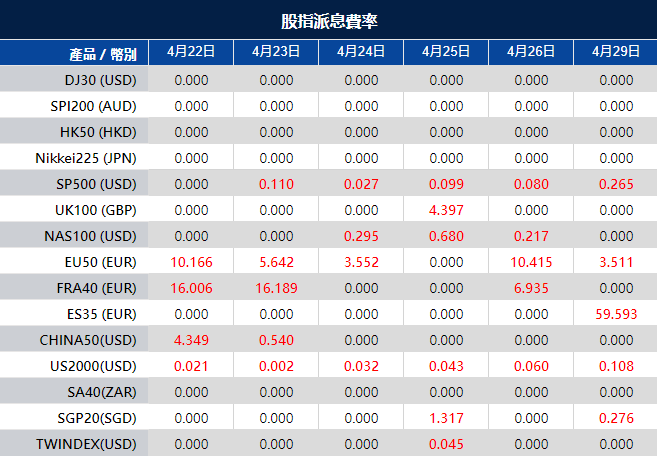
Dividend Adjustment Notice – April 22, 2024

Dear Client,

Please note that the dividends of the following products will be adjusted accordingly. Index dividends will be executed separately through a balance statement directly to your trading account, and the comment will be in the following format “Div & Product Name & Net Volume ”.

Please refer to the table below for more details:

The above data is for reference only, please refer to the MT4/MT5 software for specific data.

If you’d like more information, please don’t hesitate to contact [email protected].

Why South Korea’s Stock Market is Pumping

In today’s market roundup, South Korean shares experienced an uplift, notably the KOSPI, which climbed 16.20 points, a 0.63% increase, settling at 2608.06 at 0100 GMT. This rise comes as the finance minister reaffirms the government’s commitment to its corporate reform agenda, dubbed the “Corporate Value-up Programme.”

Government Commitment and Investor Sentiment

Finance Minister Choi Sang-mok’s assurances come at a crucial time, as investors express concerns about the momentum of these reforms following the ruling party’s recent electoral setback. These reforms are aimed at enhancing corporate efficiency and market competitiveness, with specific guidelines expected to be released next month.

The market’s reaction was mixed but generally positive in sectors expected to benefit from the government’s focus on reform. Auto and financial stocks saw appreciable gains with Hyundai Motor and Kia Corp rising 3.62% and 2.63%, respectively. The Finance-major Index and the Securities-minor Index also enjoyed increases of 3.59% and 2.30%.

Tech Underperformance

Conversely, the technology sector faced a downturn, with major chipmakers like Samsung Electronics and SK Hynix recording declines of 1.55% and 3.06%, following a 4.1% drop in the Philadelphia Semiconductor Index. This sector’s volatility reflects broader global tech concerns rather than domestic issues alone.

Currency and Bond Markets

Moreover, the South Korean won edged slightly lower by 0.07% against the dollar, with the onshore settlement standing at 1383.1 per dollar. In the debt market, June futures on three-year treasury bonds saw a slight decrease, while the yields on three-year and ten-year Korean treasury bonds increased, indicating a shift in investor sentiment towards bonds.

The performance of South Korean exports saw an 11.1% increase during the first 20 days of April compared to last year. This indicates resilient export activities, which are crucial for the country’s economic health. Foreign investment trends showed a net sell-off, with foreigners offloading shares worth approximately $109.38 million.

Start trading now — click here to create your live VT Markets account.

MARKETS TODAY: Gold Prices Dip Due to Rising U.S. Treasury Yields

ICYMI: Market summary for today, 22 April 2024

Gold prices experienced a downturn today, with spot gold dropping by 0.3% to $2,381.36 per ounce early in the GMT morning. Concurrently, U.S. gold futures saw a decline of 0.7%, reaching $2,395.80 per ounce.

These movements are set against a backdrop of increasing U.S. Treasury yields, which edged up to 4.6475%, thereby diminishing the attractiveness of non-yielding bullion to investors.

Impact of U.S. Treasury Yields on Gold

The upward movement in the benchmark 10-year U.S. Treasury yields exemplifies the inverse relationship typically seen between yields and gold prices. Historically, as yields rise, the opportunity cost of holding non-yielding assets like gold increases, leading investors to shift towards yield-bearing assets.

This dynamic is further complicated by persistent inflation and higher-for-longer interest rates, noted as substantial risks to financial stability by the Federal Reserve.

Amidst these economic parameters, geopolitical tensions continue to influence market sentiments. The ongoing conflict in the Middle East keeps investors on edge, potentially increasing gold’s appeal as a safe-haven asset despite the current price decline.

Inflation Concerns and Interest Rate Projections

Comments from Chicago Federal Reserve President Austan Goolsbee indicate that progress on reducing inflation has stalled, suggesting a continued environment of high interest rates.

This situation supports a scenario where gold might not rebound significantly in the short term due to the extended period of elevated rates diminishing its appeal.

Outlook for Other Precious Metals

The broader precious metals market shows mixed signals. Silver, after a significant 26% rise in the recent two months, dropped by 0.6% to $28.48 per ounce, indicating potential for a technical correction despite the momentum.

Platinum dipped slightly by 0.1% to $930.72, whereas palladium remained stable at $1,026.44. The overall robust demand outlook from China and lingering macroeconomic uncertainties suggest that metals like copper and gold might see further gains, though this trajectory could be volatile in light of ongoing economic and geopolitical factors.

Start trading now — click here to create your live VT Markets account.

Wheat Prices Rise Due to Geopolitical Tensions

Chicago Wheat Futures Continue Upward Trajectory

Today, April 22 – Chicago wheat futures witnessed an upward movement, marking a nearly 1% increase, influenced by short-covering and ongoing geopolitical tensions in the Middle East. This rise is part of a continuing trend, with wheat prices now rising for three consecutive sessions. Corn and soybeans also experienced marginal gains, indicating a broader pattern of cautious optimism in the grains market.

Detailed Breakdown of Grain Market Fundamentals

The most-active wheat contract on the Chicago Board of Trade (CBOT) increased by 0.8%, reaching $5.71 a bushel. This follows a 2.5% surge on Friday. Corn futures saw a more modest increase of 0.2%, pricing at $4.34-1/4 a bushel, while soybeans ticked up by 0.1% to $11.67 a bushel.

The escalation in the Middle East, particularly due to Israeli missile strikes on Iran, has heightened market sensitivities. Despite Tehran’s downplaying of the incident, there is widespread concern that an expansion of hostilities could disrupt grain shipments from the region, particularly from Russia, which stands as the world’s foremost wheat exporter and a strategic ally of Iran.

In the U.S., the House of Representatives passed a $95 billion security assistance package for Ukraine, Israel, and Taiwan. This move, despite opposition from some quarters, underscores the U.S. commitment to these regions and could have implications for global trade dynamics, including agriculture.

International Trade and Policy Adjustments

On the international front, shifts are occurring in trade relationships and policies. China’s soybean imports from the United States have halved in March compared to the previous year, primarily due to the competitiveness of Brazilian soybean supplies following a robust harvest. Additionally, corn exports have significantly dropped, reflecting shifting market preferences and supply chain adjustments.

Russia has introduced a new export quota for wheat and other grains amounting to 5 million tons until June 30, in addition to the main export quota of 24 million tons set for the same period. This policy is aimed at supporting Russian local producers and may influence global grain prices and availability.

Nasdaq and S&P 500 Closed Week on Downward Trend

In broader market news, both the Nasdaq and S&P 500 ended the week on a low note, and Treasury yields decreased, reflecting investor caution amid a mix of lacklustre corporate earnings, uncertainties about central bank policies, and geopolitical concerns.

Historical Context and Future Outlook

Historically, grain markets have been sensitive to geopolitical disruptions. For instance, during the 2008 Georgia-Russia conflict, wheat prices saw significant fluctuations due to concerns about Black Sea shipments. Similar patterns were observed during the Gulf War, which disrupted oil supplies and had cascading effects on global agricultural markets.

Start trading now — click here to create your live VT Markets account.

Week ahead: UK, EU economic data in horizon

As we approach another significant week in the financial markets, several pivotal events are lined up that could influence market dynamics extensively. Here’s what traders at VT Markets should focus on:

Upcoming US Economic Indicators

US GDP for Q1: Due for release on Thursday, the preliminary estimate of US GDP for Q1 2024 is anticipated at 2.9%, following a previous quarter’s growth of 3.4%. This release will be pivotal in assessing the durability of the US economic expansion. Historically, a robust Q1 GDP figure has buoyed market sentiments but it’s crucial to remain cautious, as higher-than-expected growth could stoke fears of continued Fed tightening.

Core PCE Index for March: Set for Friday, this inflation measure will be scrutinised for any signs of persistent inflation pressures. Any deviation from expected levels could prompt a reevaluation of the Federal Reserve’s interest rate trajectory, potentially leading to market volatility.

Preliminary S&P Global PMIs for April: These early indicators of Q2 economic activity will provide insights into the ongoing recovery. Markets will likely react to the strength of these PMIs, with stronger figures possibly signaling a sustained recovery and weaker ones may incite concerns over economic momentum.

Anticipate Bank of Japan (BoJ) Decision

Rate Decision: This Friday’s decision comes at a critical time with recent policy shifts signaling a potential end to negative interest rates. Markets are keenly awaiting indications of possible rate hikes, especially given rising inflation in Japan. A hawkish stance could strengthen the yen, whereas a dovish one might exacerbate its current weakness.

Currency Intervention Watch: With the yen nearing 155.00 against the dollar, speculation about intervention from Japanese authorities to stabilise the currency is high. A significant intervention could disrupt market trends, particularly in currency pairs involving the yen.

European and UK Economic Releases

EU and UK PMIs: With these set to release on Tuesday, they are crucial for assessing the economic climate in both regions. The focus will be on how these figures might influence the European Central Bank and Bank of England’s monetary policy, especially with inflation concerns at the forefront.

BoE Rate Expectations: Markets have already priced in a 25bps rate hike by the BoE in September. This expectation could solidify further if upcoming economic indicators reinforce a robust economic outlook.

Australian Economic Data, Inflation

Australian CPIs: Wednesday’s CPI data will be key in assessing inflation trends and shaping the Reserve Bank of Australia’s rate decisions for the year. Given the mixed signals from previous data, this release will be crucial in determining the short-term monetary policy path.

Tech Earnings Report

Tech Reporting: With Alphabet and Tesla on Tuesday, followed by Meta on Wednesday, and both Microsoft and Amazon on Thursday, these reports are critical. The tech sector’s performance has been under the microscope after recent market corrections, and these earnings results could heavily influence market sentiment, either bolstering confidence with strong earnings or fueling concerns if results falter.

Start trading now — click here to create your live VT Markets account.

Forex Market Analysis: Pound’s Mixed Signals and Challenges

Forex Analysis: 19 April 2024

CURRENCIES

Pound Sterling Analysis: GBP/USD, GBP/JPY

  • Mixed economic signals and Bank of England (BoE) comments on inflation complicate GBP recovery.
  • GBP/USD faces challenges gaining momentum, hovering below key resistance levels.
  • GBP/JPY shows signs of stability near yearly highs amid speculation of potential JPY intervention.

Insights on Sterling’s Performance

  • BoE anticipates a sharp decline in inflation, targeting a 2% rate by mid-year despite mixed CPI results.
  • Persistent wage growth and services inflation in the UK suggest that higher interest rates may be necessary longer than anticipated.
  • BoE Governor Andrew Bailey notes a softening labor market, forecasting a significant drop in next month’s inflation figures.
  • Monetary Policy Committee member Megan Greene mentions difficulties in achieving full disinflation, indicating possible pressures on GBP.

GBP/USD Trading Dynamics

  • Recent attempts to stabilize and recover to the 1.2500 level falter amid strong USD conditions.
  • Despite a slight retreat in the US Dollar Basket (DXY), GBP/USD struggles to overcome the 1.2500 resistance.
  • Failure to surpass 1.2500 may lead to further declines, with potential targets near 1.2200.
  • A successful breach above 1.2500 could lead to a recovery towards the 200-day simple moving average, contingent on USD performance.

Overall Market Considerations

  • The interplay of UK economic fundamentals and US dollar strength remains a key challenge for GBP stabilization and growth.

STOCK MARKET

Market Overview: Impact of Mideast Tensions

  • Global stock markets experienced declines due to escalating conflicts in the Middle East.
  • Haven assets such as U.S. Treasuries, the dollar, Swiss franc, yen, and gold saw notable gains amid growing geopolitical risks.

Detailed Market Movements

  • 10-year U.S. Treasury yields dropped by up to 14 basis points as investors sought safer assets.
  • The U.S. Dollar Index increased by as much as 0.6%.
  • Oil prices surged over 4%, with Brent crude briefly topping $90 per barrel before falling back.

Geopolitical Developments and Market Reactions

  • Recent missile strikes by Israel on Iran intensified market volatility, following an attack from Iran earlier in the week.
  • Initial market reactions were risk-averse, though some stability returned after Iran confirmed the safety of its Isfahan nuclear site.

Sector-Specific Impacts

  • Semiconductor sector faced challenges as Taiwan Semiconductor Manufacturing Co. adjusted its revenue growth forecast downward.
  • Infosys Ltd. saw a decline in U.S. trading following a modest sales growth forecast for the year.

Economic Data and Monetary Policy

  • Japanese inflation data came in below expectations, influencing Bank of Japan rate speculation.
  • Comments from Federal Reserve officials indicated a cautious approach to interest rate adjustments, with no immediate plans for cuts.

Global Currency and Crypto Markets

  • Emerging market currencies, including the Mexican peso and Indian rupee, weakened against the dollar.
  • Cryptocurrencies, including Bitcoin, retreated amidst the broader market downturn.

Credit and Investment Outlook

  • The credit risk for Asia excluding Japan increased significantly, with credit default swaps rising sharply.
  • Investment strategies may need to adapt to a prolonged period of higher inflation and interest rates, as suggested by industry experts.

Geopolitical Risk Assessment

  • Israel’s credit rating was downgraded by S&P due to heightened regional tensions, affecting the outlook on geopolitical stability in the Middle East.

Start trading now with VT Markets – Click here to open a live account.

Back To Top
server

Hello there 👋

How can I help you?

Chat with our team instantly

Live Chat

Start a live conversation through...

  • Telegram
    hold On hold
  • Coming Soon...

Hello there 👋

How can I help you?

telegram

Scan the QR code with your smartphone to start a chat with us, or click here.

Don’t have the Telegram App or Desktop installed? Use Web Telegram instead.

QR code