The Lambo Dream: What is Day Trading and How to Get Started?

A picture of a Lamborghini set against a red sky.

Pictured: Your dream lambo

Can day trading make you rich? Are all the stories portrayed over social media true, that day traders would all be sipping pina coladas at the beach all day everyday, changing their Lamborghinis as they wish? With the right skills and experience, day trading can be lucrative and lead to significant financial gains even when you have capital as small as $100.

But here’s the catch – it is a skill to be acquired over years of experience.

So What is Day Trading?

Day trading is a strategy in financial markets where traders buy and sell a certain class of asset within the same trading day – occasionally just within a matter of a few minutes. The goal is to simply capitalise on short-term price movements in the market. Typically, day traders close out all positions before the market closes to avoid unmanageable risks and price gaps, just so that sleep is not lost by worrying about how the trade will go next.

Some key aspects of day trading include:

  • Short-Term Nature: No holding positions for months or years, only holding positions for minutes to hours within the same day.
  • High Frequency: Many day traders execute multiple trades per day, looking for small but consistent opportunities to profit from the market.
  • Use of Leverage: Day traders often use leverage (borrowed money) to increase their buying power, which can amplify both gains and losses.

How Difficult or Risky is Day Trading?

As mentioned, the use of leverage magnifies the high returns. However at the same time it also creates significant risks. For a beginner in trading, it is common to go through a phase of financial losses, especially when risk management skills and psychological resilience is yet to be developed.

Is Day Trading a Scam?

It is, and it is not. Typically, day trading is perceived to have the image of a scam because new day traders failed to practice risk management leading to huge losses by over leveraging. Thereafter, such losses cannot be recovered except by sourcing new income from either becoming a better trader in the future or other channels of income, such as taking up a job, freelancing or working on a side hustle.

Another aspect of “scam” is when a day trader chooses to trade on a platform with little to none credentials. These are brokers that would entice traders to deposit money on a perpetual basis, and once a certain amount of deposit is hit, the broker would disappear into thin air, never to be found again. Therefore, it is important for a day trader to choose a trusted platform to start the journey.

OMG! So What is the Best Day Trading Platform?

Those who have been in the financial markets as long term investors may have heard about platforms such as Webull, Robinhood, Fidelity, eTrade and ThinkorSwim. These are platforms regulated by the United States, and there is this restrictive practice called the pattern day trading (PDT) rule.

A Quick Glance at Pattern Day Trading

The PDT rule is a regulatory guideline in the United States applicable to its stock market traders aiming to curb excessive risk-taking, protecting traders from the potential significant losses.

In general, traders who executed three day trades within five business days would be identified as a pattern day trader and would be required to maintain either $25,000 or they will not be allowed to day trade for a period of ninety days. 

Sounds like a harsh requirement? That’s because it is. 

How Much Money Do I Need to Start Day Trading? Must it be $25,000?

Not necessarily. With VTMarkets, it is much more flexible where you can start day trading with a minimum deposit of just $100. For a new trader, it is highly recommended that you test the platform out by trading on the demo account first.

Day Trading with a Variety of Asset Classes

Day trading is also not just limited to the stock market. VTMarkets give you a wide range of choices which include:

  • Forex: Buying and selling currency pairs within the same trading day, aiming to profit from short-term fluctuations in exchange rates. The forex market operates 24 hours a day, five days a week, allowing traders to engage in trading activities during any session: Asia, Europe, or North America. Major currency pairs include EURUSD, USDJPY, GBPUSD, USDCHF, AUDUSD, USDCAD and NZDUSD. 
  • Indices: Collections of stocks that represent a segment of the stock market, such as the S&P 500, Dow Jones Industrial Average, NASDAQ Composite, FTSE 100, DAX, or Nikkei 225. Day trading of indices simply capitalises the price movements within the same trading day. 
  • Energy: This sector includes commodities such as crude oil, natural gas, gasoline, and gas oil. 
  • Precious metals: Gold, silver, copper, platinum, and palladium are precious metals traded as commodities and are typically traded in the form of derivatives such as CFDs. In particular, gold is popular among day traders due to its liquidity.

Candlestick Chart Patterns are a Huge Part of Day Trading

Regardless of which asset class chosen, candlestick chart pattern is the bread and butter for a day trader. This is also known as technical analysis, whereby traders seek to understand price patterns and market dynamics, thereby executing trade strategies using such timely and actionable insights in the markets being traded. Candlestick chart patterns helps with risk management while maximizing opportunities for profit within the same trading day,

OK, I’m Convinced. How to Get Started in Day Trading Now?

As someone new to day trading, the first step is to start demo trading with VT Markets. Once you are familiar with the platform, and gain confidence in your trading knowledge, you can also start trading in a live market environment. 

New to VT Markets? Open a demo account or start live trading!
Forex Market Analysis: USD, Tech Earnings & Market Updates

CURRENCIES:

Federal Open Market Committee (FOMC) and Non-Farm Payrolls (NFPs):

  • Impact on USD: The upcoming week will see crucial inputs from the FOMC and NFPs, with significant implications for the U.S. dollar. Expectations are leaning towards stable interest rates with no cuts anticipated until later this year due to persistent high inflation.

Company Earnings Reports:

  • Apple and Amazon: Earnings season continues with Apple and Amazon set to report. Recent tech earnings have shown volatility, with significant price movements in stocks like Tesla and Meta.
  • Other Notable Companies: Additional earnings expected from AMC, Pfizer, Moderna, Block, and Coinbase.

Currency Insights:

  • USD/JPY Outlook: The Japanese Yen remains weak, with pressures mounting for intervention as exchange rates approach critical levels.
  • EUR/USD and Gold Outlook: Key economic data from the Euro Area and upcoming gold trends will also be in focus, influencing these markets.

Market Indices and VIX Metrics:

  • FTSE 100 Performance: A more than 5% increase since mid-April, driven by a weaker Sterling and increased M&A activity, suggests further potential gains.
  • VIX Trends: A decrease in the VIX index reflects a recent risk-on market sentiment, although geopolitical tensions could reintroduce volatility.

Economic Data Releases:

  • Euro Area and German GDP and Inflation: Important releases could sway the EUR currency pairs.
  • U.S. Economic Reports: ISM reports and the U.S. Monthly Jobs Report are also scheduled, providing further insights into the economic landscape.

STOCK MARKET:

Labor Market Update:

  • April Jobs Report: The labor market remains a focal point, with the April jobs report expected to show the addition of 250,000 nonfarm payroll jobs. Unemployment is projected to stay steady at 3.8%. These figures highlight the resilience of the labor market amidst higher interest rates.

Big Tech Earnings Reports:

  • Apple and Amazon: Both tech giants are scheduled to release their earnings this week, with significant market movements anticipated. Apple has seen a decline in its share value this year, while Amazon has experienced substantial growth.
  • Meta and Alphabet: Previous reports from Meta and Alphabet showed divergent trends, influencing stock performances distinctly. Alphabet reported strong earnings and a new dividend program, boosting its stock, whereas Meta saw a decline after its earnings announcement.

Additional Earnings Reports:

  • Other Major Companies: Earnings from AMD, Coca-Cola, Eli Lilly, McDonald’s, Novo Nordisk, Starbucks, and Super Micro Computer are also expected. These results will further shape market sentiment and stock performances.

Market Sentiment and Corporate Earnings:

  • S&P 500 Trends: Currently, with 46% of the S&P 500 companies having reported, earnings growth is slightly above expectations. However, the overall stock market reaction has been mixed, indicating that investors are looking for more than just earnings beats.

Economic Indicators:

  • Consumer Confidence and Sector Activity: Updates on job openings, activity in the services and manufacturing sectors, and consumer confidence are also scheduled for this week, providing deeper insights into the economic environment.

Click here to create a live account and start trading now.

U.S. Inflation Data Weakens Asian Currencies, but Equities See Upswing

29th April 2024 – Following recent inflation data in the United States, which indicated that immediate interest rate cuts are unlikely, currencies in Asian emerging markets experienced subdued activity. The Indonesian rupiah depreciated by 0.3% against the U.S. dollar, while the South Korean won saw a slight retreat of 0.1%.

Asian Upswing

Contrasting the currency market, most Asian equities witnessed an upswing, with Manila’s PSEI jumping 2.1% and Taipei’s TAIEX rallying 1.9%. This positive movement in equities may reflect a divergence in sentiment between currency and stock markets or could be influenced by domestic factors unique to each market.

All eyes are now on the Federal Reserve’s two-day monetary policy meeting set to begin on Tuesday. Market consensus does not anticipate rate changes at this meeting.

Investor sentiment has adjusted to expect the first rate cut in September, a delay from previous predictions of a June commencement, projecting approximately 30 basis points of easing for the year.

The Fed’s future communications and policy decisions are poised to be a significant determinant for the direction of the U.S. dollar and subsequently emerging market currencies.

The persistent higher U.S. interest rates, coupled with recent weaknesses in Asian currencies, suggest that regional rate cuts may be postponed until the next year.

Other Asian Currencies

The Thai baht and Bangkok stocks both recorded decreases of 0.2%. Meanwhile, the Malaysian ringgit edged lower by 0.1%, even as Kuala Lumpur equities saw an uplift of 0.5%.

Key Economic Highlights

The yen experienced a notable rise against the U.S. dollar amid speculation of intervention.

Thai exports saw a decrease of 10.9% year-on-year in March.

Indonesia reported a 15.5% annual increase in Foreign Direct Investment (FDI) for the first quarter, as per the investment ministry.

Enhanced volatility in the forex market, as seen in recent fluctuations following the latest U.S. inflation data, presents both challenges and opportunities for traders. In such a volatile environment, where emerging market currencies like the Indonesian rupiah and South Korean won are experiencing depreciation, there are numerous trading opportunities to capitalise on these rapid movements.

For traders looking to benefit from this volatility, partnering with one of the best forex brokers can provide significant advantages. Top-tier brokers like VT Markets typically offer advanced trading platforms that deliver real-time data, comprehensive analysis tools, and superior execution speeds. Such features enable traders to react swiftly to market changes, a crucial factor in a volatile market.

Start trading today with one of the best forex trading brokers. Click here to open a live account.

Japanese Yen Surges; Is it BoJ Intervention?

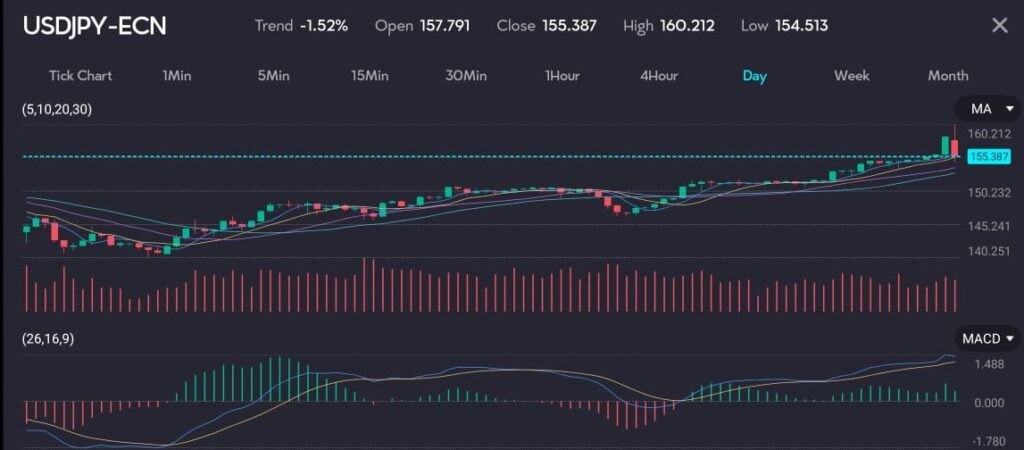
In a dramatic turn of events in Asian markets on Monday, the Japanese yen recorded a surge against the dollar, appreciating by 5 yen, with traders attributing this sharp recovery to heavy dollar-selling by Japanese banks. This intervention seemed to be a response to the yen touching fresh 34-year lows earlier in the day.

Picture: Japanese yen surged against the dollar as seen on the VT Markets app.

The dollar’s drop was pronounced, falling from 160.245 to around 158 and then dipping further to 155.25 yen. By 0500 GMT, the yen stood stronger at 155.86, marking a 1.6% gain during a quieter trading session during Japan’s Golden Week holiday.

Dramatic movements like these typically indicate bank intervention. This move comes after a nearly 11% decline in the yen this year, which had markets alert for any potential action from Japanese authorities.

Data from the Commodity Futures Trading Commission highlighted an increase in yen short positions by non-commercial traders, which includes speculative trades and hedge funds, reaching 179,919 contracts by the week ending April 23 — the highest since 2007.

Market Response to BoJ Policy

The yen’s volatility was also evident last Friday, moving nearly 3.5 yen between 158.445 and 154.97. This occurred as traders expressed their disappointment following the Bank of Japan’s decision to maintain its policy settings and provided little indication of a reduction in its Japanese government bond purchases. Such a move might have supported the yen’s value.

The timing of Japan’s suspected intervention is crucial, occurring just days before the Federal Reserve’s May 1 policy review. With U.S. inflation figures remaining high, and Fed officials, including Chair Jerome Powell, indicating that any plans for rate adjustments would be data-dependent, markets had been bracing for potential delays in U.S. rate cuts.

Currently, the Fed is expected to maintain its benchmark interest rate at 5.25%-to-5.5% during the April 30-May 1 meeting, with market projections now leaning towards possibly just one rate cut this year, likely by November.

Yen’s Impact on Euro and Sterling

The ripple effects of the yen’s movements were also felt by other major currencies, with both the euro and sterling experiencing gains, although they remained within the volatile ranges observed during Friday’s trading session. Sterling was noted at $1.2541, up by 0.4%.

With the Fed’s decision highly anticipated in the context of persisting high U.S. inflation rates and potential rate adjustments, CFD traders might find opportunities to leverage these insights into their strategies, particularly in the dollar-yen pairs. CFD trading allows investors to respond quickly to market changes without owning the underlying asset, providing a flexible way to capitalise on the Bank of Japan’s stance.

Start trading today. Click here to open a CFD trading account.

Rupee Under Pressure From Delayed US Rate Cuts

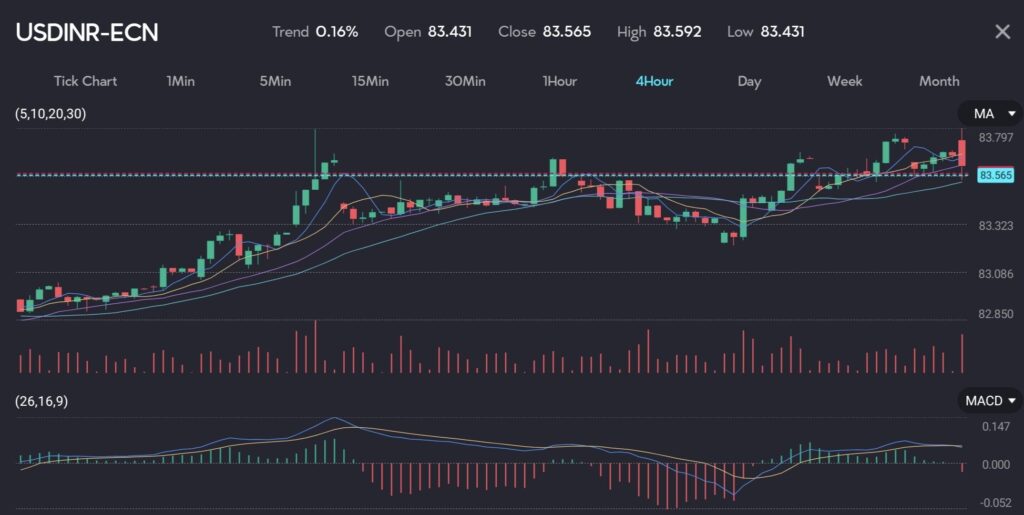
The Indian rupee closed lower against the U.S. dollar on Monday, settling at 83.41, down from its previous session’s close of 83.34.

SEE: USD makes significant gains against INR on VT Markets trading app.

Factors such as increased dollar purchases by foreign banks and weakness across Asian currencies shaped this outcome, driven by expectations that the U.S. might delay interest rate cuts.

Yen Rebounds, Dollar Index Dips

In global markets, the dollar index fell by 0.3% to 105.6 as the yen rebounded after briefly falling below the 160-per-dollar mark. This movement occurred during a trading session thinned by a holiday in Japan, which affected market liquidity and volatility.

You might be interested—Sakura Viewing in Japan is Now Cheaper with Weakening JPY – VT Markets

Indonesian Rupiah Declines

Among regional currencies, the Indonesian rupiah fell by 0.2%, marking the largest drop in the region. Analysts link these losses to a shift in expectations for U.S. monetary policy. Data showing stronger-than-expected U.S. inflation and economic activity has led to a reevaluation of when the U.S. will cut rates, which in turn has pushed up U.S. bond yields and strengthened the dollar.

A state-run bank’s foreign exchange trader noted that despite some early weakness in the rupee, where it approached 83.45 against the dollar, the currency might soon show some resilience.

Anticipating Federal Reserve Policy Decision

This week, the market’s focus will turn to the Federal Reserve’s policy decision on Wednesday. The central bank is likely to hold interest rates steady, but investors will closely watch Chair Jerome Powell’s comments for clues about the future direction of U.S. interest rates.

Market expectations now reflect a more conservative outlook for U.S. monetary easing, with only one rate cut expected in 2024.

Start trading today. Click here to open a CFD trading account.

Australian Shares Rise with an Eye on Upcoming Federal Reserve Meeting

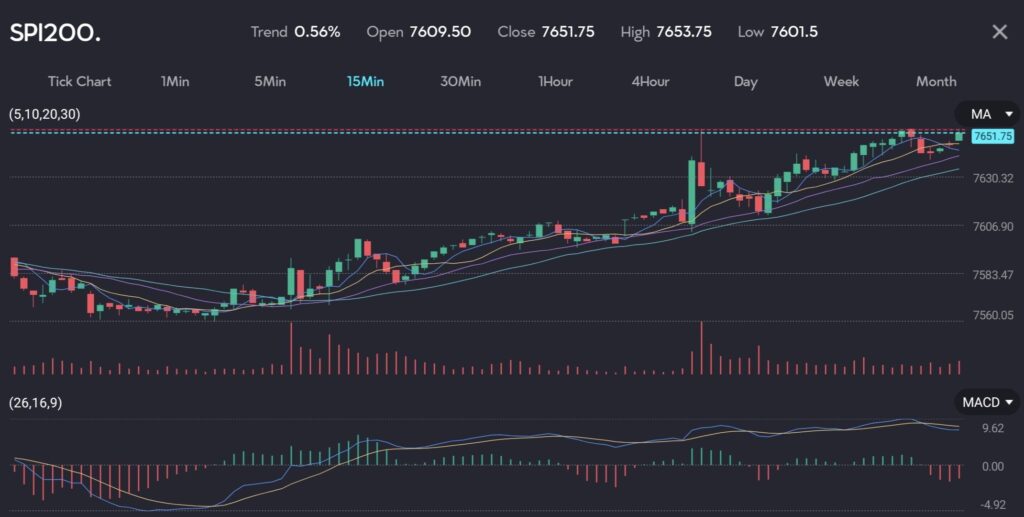
Australian shares climbed on Monday, driven by gains in financial and healthcare sectors. The S&P/ASX 200 index saw an uplift of 0.8%, marking its best performance since April 22, closing at 7,637.4 points.

Chart showing ASX upswing, closing at 7651.75 on VT Markets trading app.

SEE: ASX sees upswing, closing at 7651.75 on VT Markets trading app.

This rise mirrored the positive trends on Wall Street as investors await the U.S. Federal Reserve’s policy meeting this week, which could shed light on future interest rate decisions.

Interest Rate Speculation

The Fed’s meeting, set to start on Tuesday, has the market abuzz, although the central bank is likely to maintain current rates. However, the market will be paying close attention to any hints regarding future rate adjustments.

Given recent U.S. economic data, expectations lean towards no rate cuts before September. Market predictions now show a 58.4% likelihood of a rate cut in September.

Inflation data from the last quarter indicated a slower than anticipated decrease in inflation rates, causing a shift in local interest rate cut forecasts. The Reserve Bank of Australia will likely wait for the Fed’s actions before making any rate changes.

Sector-wise, financial stocks gained with the financial sub-index rising by 0.6%. The major banks saw their shares increase by between 0.3% and 0.8%. Healthcare stocks also performed well, with the sector index climbing 1.2%, supported by gains in biotechnology leader CSL and Ramsay Health Care, which increased by 0.6% and 2.02% respectively.

Mining and Technology

Mining stocks showed moderate gains, with the mining sub-index rising 0.5%. Notable miners Rio Tinto and Fortescue Metals recorded increases of 0.1% and 0.3%, respectively. Conversely, BHP Group saw a slight decline of 0.4% amidst rumors of a potential increased offer for Anglo American.

Gold and technology sectors also experienced gains, with gold stocks rising 0.5% and technology stocks jumping 1.7%, echoing the positive trends seen in international markets.

Sakura Viewing in Japan is Now Cheaper with Weakening JPY 

Pictured: You enjoying the beautiful sakura beneath a pastel blue sky

While the entire of Japan has been seeing the Sakura blossom throughout April, the Japanese Yen continued to depreciate following the announcement from the Bank of Japan on maintaining its current interest rate. With that, the JPY/USD fell to a 34-year low of 156, a price level last seen in May 1990. 

Impact of the Weakening Japanese Yen 

Export 

From the perspective of export business, the weakening Yen helps large Japanese companies with global operations, as the value of their repatriated overseas profits also would increase accordingly. 

Tourism 

The weak Japanese Yen increases the buying power of foreign tourists, boosting the country’s already established status as a popular destination, and even exceed pre-pandemic levels. Combined with the cherry blossoms happening from March to May every year, the streets of Kyoto are filled with more tourists than ever. Bloggers speak about how visiting Japan feels cheaper than other first world countries such as Switzerland, Australia or New Zealand, and this is particularly true for tourists whose income are denominated in the US Dollar or Euros. 

If you must ask whether this is a good time to take a vacation to Japan, the answer is a resounding yes. Book that flight, pack your bags, go – while the cost is still relatively low. 

Day-to-Day Consumption 

On the downside, a soft yen makes imports of energy and food more expensive, hitting domestic consumers hard. Although in March 2024, big companies in Japan agreed to raise wages by 5.28%, which is also the heftiest in 33 years, consumption remained soft and there is much more room for the Japanese Yen to improve. 

What’s Next for the Bank of Japan (BoJ)?  

BoJ governor Kazuo Ueda has stated that the overall policy settings of Japan will remain accommodative, meaning there will not be a major interest hike unless inflation runs hotter than expected. The key point to be observed will be whether consumption recovers. 

Will JPY Remain Weak or Recover? 

That will largely depend on the trajectory of the interest rate gap. 

From the Perspective of JPY 

What governor Ueda said seems to indicate that the rate gap between JPY and USD will remain wide. If such measures were to be maintained, it is no surprise that the selling momentum of the JPY will continue, while strengthening the USD. 

From the Perspective of USD 

On the flip side however, there is a slight rebound of the JPY after Fed chairman Jerome Powell indicated that the US central bank will maintain its plan of cutting rates three times in 2024 despite bumpy inflation. Such dovish move by the US Fed will tighten up the rate gap later in 2024 and would support the strength of the JPY. 

Oil Prices Drop in Face of Strong USD and Inflation

Looking at today, 29th April 2024, oil prices moved downward in early Asian trading on Monday. Brent crude futures saw a reduction of 75 cents, or 0.84%, landing at $88.75 a barrel, while West Texas Intermediate futures fell 65 cents, or 0.78%, to $83.20 a barrel by 1221 GMT. This decline comes after a period of gains, demonstrating the market’s sensitivity to economic indicators.

US Interest and Commodities

The recent U.S. inflation rate of 2.7% over the past 12 months through March has exceeded the Federal Reserve’s target. The persistent inflation suggest the possibility of ‘higher-for-longer’ interest rates, leading to a robust U.S. dollar and exerting downward pressure on commodity prices.

The correlation between a strong dollar and commodity prices is evident as the dollar’s rise makes oil more expensive for holders of other currencies, dampening demand. This relationship is crucial to understanding the short-term movements in oil prices.

Potential Price Swings

Despite the current downward trend, oil prices may rebound if upcoming U.S. inventory data and China’s PMI index reflect positive changes. These indicators traditionally serve as barometers for economic health and will be closely watched by investors.

Friday’s trading session ended with Brent crude up 49 cents and WTI up 28 cents, amid concerns over supply interruptions due to developments in the Middle East. Naturally, these gains underscore the market’s ongoing concern with geopolitical tensions and their potential impact on oil supply.

Supply Disruption

Market participants seem to have disregarded potential supply disruptions from drone strikes on oil refineries in Russia’s Krasnodar region. Following the attack, operations at the Slavyansk refinery were partially suspended, as stated by a plant executive.

This situation could have implications for the global supply if escalations continue.

Start trading today with one of the best forex trading brokers. Click here to open a live account.

Week Ahead: China Manufacturing Due for Review, More US PMI Data

Shanghai skyline at night with Oriental Pearl Tower illuminated in red and surrounding skyscrapers.

Last week, global financial markets saw a variety of movements, with US equity markets climbing thanks to strong earnings from tech giants like Tesla, Microsoft, and Alphabet.

These gains helped offset concerns from the US’s lower-than-expected GDP growth for the first quarter of 2024 and higher inflation figures.

In contrast, Australia’s ASX 200 faced challenges, particularly influenced by a drop in BHP’s shares following its failed acquisition bid for Anglo American.

Recap of Last Week’s Economic Data

The US Durable Goods Orders showed a promising increase of 2.6% in March, exceeding analyst expectations. However, the US GDP growth did not meet the anticipated 2.5%, recording only a 1.6% increase quarter-over-quarter.

In Europe, the Eurozone Composite Flash PMI demonstrated its fastest growth in eleven months, reaching 51.4. Meanwhile, Australia’s inflation cooled to 3.6% year-over-year in the first quarter, though this was still above what many had forecasted.

What Will Happen This Week?

This upcoming week holds several key economic events:

Tuesday, April 30

Insights into China’s manufacturing sector will be updated with the release of the NBS and Caixin Manufacturing PMIs. Additionally, first-quarter GDP data from Germany and the broader Eurozone will help gauge the pace of economic recovery in these regions.

The China NBS and Caixin Manufacturing PMIs are closely monitored as indicators of the economic health of China’s manufacturing sector, which plays a crucial role in the global economy.

A positive reading can boost investor confidence in China’s market stability and growth prospects, potentially lifting global markets, especially in sectors reliant on manufacturing and exports.

Conversely, a contraction can raise concerns about slowing economic growth in China, affecting commodity prices and global supply chains. The Caixin PMI, in particular, is noted for its sensitivity to market risk sentiment.

Wednesday, May 1

New Zealand’s unemployment rate will shed light on the economic conditions in the region. In the US, the ADP Employment report and Consumer Confidence Index are expected to provide vital information about the labor market and consumer sentiment.

Thursday, May 2

The US will release its ISM Manufacturing PMI and JOLTS Job Openings, offering further clarity on the manufacturing sector and job market. The Federal Open Market Committee (FOMC) will also announce its decision on interest rates, which is likely to remain unchanged due to ongoing inflation concerns.

An unexpected rate hike could strengthen the USD and lead to a drop in stock prices, whereas signals of future rate cuts could do the opposite.

Friday, May 3

The US Non-Farm Payrolls will be closely watched as an essential indicator of the country’s economic health and could impact the Federal Reserve’s policy decisions in the coming months.

Strong job growth will suggest a robust economic environment, potentially leading the Fed to consider tightening monetary policy, which could bolster the USD and impact bond yields.

Conversely, weak job growth might raise concerns about economic stagnation, possibly leading to lower Treasury yields and a weaker dollar.

Saturday, May 4

The week will conclude with the US ISM Services PMI, providing a snapshot of the service sector’s status, which dominates the US economy.

As with key events like these, this week’s economic events are likely to cause market fluctuations. Traders should pay close attention to the releases and central bank activities, as these could sway market expectations regarding future monetary policies, especially in the US.

Start trading now — click here to create your live VT Markets account.

TODAY: Gold Sees Slight Uptick Ahead of U.S. Inflation Data

Gold prices saw a modest increase on Friday, with spot gold climbing 0.3% to $2,339.32 per ounce by 0640 GMT, and U.S. gold futures also rising 0.4% to $2,351.20. This slight uptick comes as markets anticipate the release of key U.S. inflation data.

Weekly Gold Price Dynamics

Despite Friday’s increase, gold is poised for its first weekly fall in six weeks, with a 2.3% drop. This marks the most substantial weekly decrease since the beginning of December. The easing of concerns regarding a major escalation in the Middle East crisis has contributed to this weekly decline. Gold prices have receded nearly $100 from the all-time high of $2,431.29 reached on April 12.

Gold prices experienced a notable drop earlier in the week and have since remained relatively stable. While gold prices are typically influenced by factors such as yields and the U.S. dollar, the current market appears to be insulated by China’s reserve accumulation.

U.S. Economic Data and Fed Stance

Recent data indicated that the U.S. economy grew more slowly than expected in the first quarter, yet an uptick in inflation echoes the sentiment of Federal Reserve members, suggesting the central bank is not in a rush to cut interest rates. Higher interest rates traditionally diminish the attractiveness of non-yielding assets like gold.

Inflation Measures and Rate Outlook

Attention is now shifting to the core Personal Consumption Expenditures (PCE) index for March, due later on Friday, which is the Fed’s preferred inflation gauge. According to IG market strategist Yeap Jun Rong, an acceleration in the PCE figures could temper expectations for multiple rate cuts by the Fed within the year.

Silver, Platinum, and Palladium Movements

In the metals market, spot silver experienced a 0.7% increase to $27.61 per ounce, while spot platinum rose by 1.2% to $925.40. Palladium also saw a gain of 1.5% to $988.63. Despite these increases, all three metals were on a trajectory for a weekly decline.

Start trading today. Click here to open a live account.

Back To Top
server

Hello there 👋

How can I help you?

Chat with our team instantly

Live Chat

Start a live conversation through...

  • Telegram
    hold On hold
  • Coming Soon...

Hello there 👋

How can I help you?

telegram

Scan the QR code with your smartphone to start a chat with us, or click here.

Don’t have the Telegram App or Desktop installed? Use Web Telegram instead.

QR code