
Back

RBC Economics expects Bank of Canada rates unchanged into 2026, despite oil supply disruptions and geopolitical spikes

RBC Economics said higher oil prices caused by current supply disruptions are unlikely to lead to a major change in Bank of Canada policy. It expects the Bank to keep interest rates on hold through 2026. The note compared today’s move in oil with 2015, when the Bank cut the overnight rate by 50 basis points after prices fell. It said the 2015 drop was linked to a rise in US production capacity seen as structural.

Oil Shock Seen As Temporary

It said current disruptions are linked to geopolitics and may not be seen as lasting enough to change long-term investment trends in Canada’s oil sands. It added that oil prices could stay high if conflict continues, but it is still hard to judge duration. Bank of Canada Deputy Governor Sharon Kozicki recently said the policy response to supply shocks depends on their size and duration. Short-lived shocks with limited economic effects are often met by a “look-through” approach. The article said higher energy prices lift headline inflation but can also cut household purchasing power and weaken demand elsewhere, widening the output gap. It said the recent oil price rise has been large, but that it is too early for the Bank to act without clearer information. Given the Bank of Canada is expected to hold rates steady, we should not position for rate hikes in response to the recent oil price spike to over $115 for WTI. The central bank is clearly signaling it sees this as a temporary geopolitical event, not a structural shift like we saw back in 2015. This means any derivative trades based on a hawkish BoC pivot are likely to underperform in the coming weeks.

Rates Volatility Strategy

This expectation of stability suggests a strategy of selling volatility in the interest rate market. Implied volatility on options for Bankers’ Acceptance futures (BAX) should decline as the market prices out the possibility of a near-term rate move. We remember the volatility during the 2022 and 2023 hiking cycles, and the current environment feels much calmer, making short straddles or strangles on short-term rates a viable approach. The Canadian dollar’s reaction will be crucial, as its link to oil may weaken if interest rate differentials with the U.S. don’t move in its favor. While high energy prices are supportive, the lack of a policy response from the BoC could cap the loonie’s gains, especially against the US dollar. We could see USD/CAD remain stubbornly high or even climb, creating opportunities in currency options that bet against significant CAD strength. Recent data supports the Bank’s cautious stance and our trading view. The latest CPI figures for February 2026 showed headline inflation rose to 3.1% due to energy, but core measures held steady near 2.5%. Furthermore, January’s retail sales data showed a 0.5% contraction, indicating higher energy costs are already pinching consumers and weakening domestic demand. Create your live VT Markets account and start trading now.

Start trading now – Click here to create your real VT Markets account
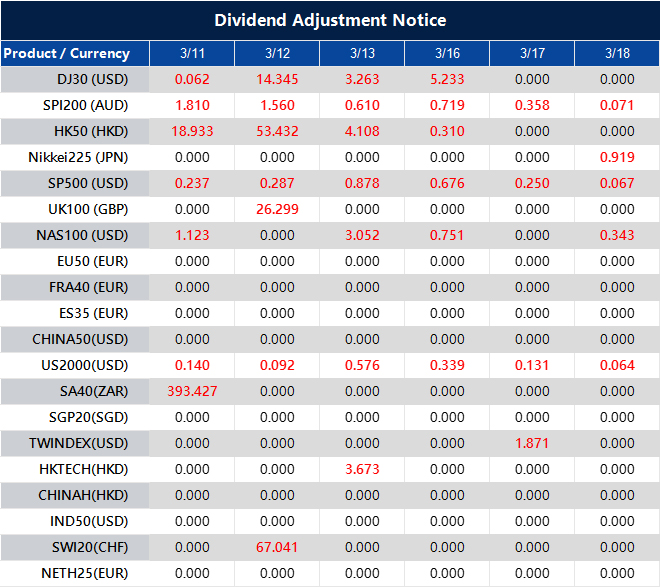
Dividend Adjustment Notice – Mar 11 ,2026

Dear Client,

Please note that the dividends of the following products will be adjusted accordingly. Index dividends will be executed separately through a balance statement directly to your trading account, and the comment will be in the following format “Div & Product Name & Net Volume”.

Please refer to the table below for more details:

Dividend Adjustment Notice

The above data is for reference only, please refer to the MT4/MT5 software for specific data.

If you’d like more information, please don’t hesitate to contact [email protected].

AUD/USD climbs near 0.7170, approaching a three-year peak as hawkish RBA expectations lift the Aussie

AUD/USD rose to about 0.7170 in early Wednesday trading, placing the Australian dollar near a three-year high against the US dollar. The move followed expectations of a more hawkish Reserve Bank of Australia. RBA Deputy Governor Andrew Hauser said rising oil prices could push inflation above the 4.2% forecast, with the impact dependent on how large and lasting the shock is. Markets are pricing in nearly a 75% chance of a 25 basis point rise to 4.1% next week.

Technical Picture And Key Levels

On the charts, the pair remains above the rising 100-day exponential moving average and trades near the upper Bollinger Band. The RSI is around the mid-60s, still positive and not at extreme levels. Support is seen at 0.7120, with nearby levels at 0.7100 and the Bollinger mid-band just below 0.7050. Further support sits at 0.7020 and 0.6960, while resistance is at 0.7240 and 0.7300. The Australian dollar is often influenced by RBA interest rates, Chinese economic demand, and commodity prices such as iron ore. Iron ore is Australia’s largest export at $118 billion a year, based on 2021 data. Looking back at the analysis from 2025, we saw a strong bullish case for AUD/USD approaching 0.7200. This was driven by expectations of a Reserve Bank of Australia rate hike due to inflation fears, which seemed very credible at the time. Today, however, the situation has completely inverted, and holding onto that bullish bias would be a significant mistake.

Strategy Implications For Derivative Traders

The primary driver last year, a hawkish RBA, has now faded. Australian inflation has cooled considerably, with the latest annual figure from February 2026 coming in at 2.9%, well within the RBA’s target band. Consequently, the central bank has held the cash rate steady at 3.60% for its last four meetings, with market pricing now suggesting a potential rate cut later this year. Furthermore, two of the Aussie dollar’s other key drivers are showing signs of weakness. Iron ore, a crucial export, has seen its price slide to around $115 per tonne, a stark contrast to the highs we saw in 2025. This is largely due to faltering demand from China, whose recent manufacturing PMI registered a contraction at 49.8, indicating ongoing economic headwinds for our largest trading partner. Given this reversal, derivative traders should consider strategies that benefit from range-bound action or further downside in AUD/USD, which is currently trading near 0.6650. Buying put options with strike prices below 0.6600 offers a clear directional play on further weakness. This strategy allows traders to profit from a fall in the currency pair while capping their maximum loss at the premium paid. For those who believe the RBA’s neutral stance will lead to a period of low volatility, selling straddles could be an effective strategy. By selling both a call and a put option with the same strike price, for example at 0.6650, traders can collect premiums from the market’s lack of movement. This position is profitable as long as the AUD/USD stays within a defined range until the options expire. It is crucial to watch the current trading range between roughly 0.6500 and 0.6750. Any options strategy should place stop-losses beyond these boundaries, as a decisive break could signal a new trend. The fundamental picture has shifted from the hawkish outlook of 2025, and our trading positions must now reflect this new, more cautious environment. Create your live VT Markets account and start trading now.

Start trading now – Click here to create your real VT Markets account

Commerzbank says Brent and WTI fluctuate wildly as Hormuz closure forces Middle East producers to cut 6.7 million bpd

Brent and WTI saw sharp price moves as the Strait of Hormuz stayed effectively closed, limiting shipping. Brent traded in a USD81–95 range in one day, a 15% swing. Oil prices fell after US Energy Secretary Chris Wright posted, then deleted, a message saying the US Navy had escorted an oil tanker through the strait. Further market movement followed social media posts from President Trump about mines and calls for Iran to remove any explosives.

Supply Cuts And Market Shock

Saudi Arabia, Iraq, the UAE, and Kuwait cut output due to limited storage capacity. Estimates put the combined reduction at 6.7 million barrels per day, about 6% of global oil supply. G7 governments asked the International Energy Agency to prepare scenarios for releasing emergency oil stockpiles. The IEA oversees the use of OECD oil reserves and said member governments will assess supply security and market conditions before any decision. We remember the extreme price swings in 2025 when the Strait of Hormuz was effectively closed, causing Brent crude to whip between an $81-$95 range. That supply shock, which cut global oil output by an estimated 6.7 million barrels per day, showed us how quickly geopolitical events can dominate the market. The frantic social media messages and the potential for an IEA stockpile release at the time created a blueprint for modern energy crises. That experience from 2025 is critical for us today, as similar tensions continue to affect key shipping lanes. For instance, OPEC+ recently confirmed it will maintain its voluntary production cuts of 2.2 million bpd through the second quarter of 2026, keeping the supply side tight. This underlying tightness means any new disruption could have an exaggerated effect on prices.

Options Strategies For Volatile Markets

Given this backdrop, buying options is a key strategy for navigating potential price shocks in the coming weeks. This provides exposure to large upward or downward moves while defining risk to the premium paid. The CBOE Crude Oil Volatility Index (OVX) has been trading above 30, a level not consistently seen since that crisis period in 2025, suggesting the market is already pricing in significant uncertainty. For those of us wanting to manage costs, using vertical spreads on Brent or WTI futures is a sensible approach. This allows for a defined risk-reward on directional bets without being fully exposed to the high premiums caused by volatility. It is a more conservative way to position for a price move while protecting capital from sudden reversals. We should also anticipate increased hedging activity from major consumers like airlines and shipping companies, who were severely impacted during the 2025 disruption. This demand for upside protection could make call options relatively more expensive than puts. This creates potential opportunities in skew trading for experienced traders who can capitalize on the pricing differences. Looking back, the 15% price swing seen during the 2025 Hormuz disruption was sharp, but it pales in comparison to the volatility spikes during the 2008 financial crisis when oil prices fell over 70% in five months. This history teaches us that supply shocks can be followed by severe demand destruction if the global economy is impacted. Therefore, traders should remain agile and consider downside protection through puts, even as they watch for upside risks. Create your live VT Markets account and start trading now.

Start trading now – Click here to create your real VT Markets account

During the early European session, EUR/JPY rose near 184.00 as yen weakened amid doubts over BoJ tightening pace

EUR/JPY rose to about 183.90 in early European trading on Wednesday, with the Yen easing against the Euro. Markets are unsure about how fast the Bank of Japan will move towards policy normalisation, while Germany’s final HICP reading is due later on Wednesday. A Reuters poll on Wednesday found that all 64 respondents expect the BoJ to keep rates unchanged at 0.75% at next week’s meeting. In the same poll, 60% of economists forecast the policy rate will reach 1.00% by the end of June, compared with 58% in February.

BoJ Outlook And Market Uncertainty

BoJ Governor Kazuo Ueda said last week that interest rates may be held for longer because of possible economic effects from the Middle East conflict. Rising tensions, including threats to the Strait of Hormuz, may support the Yen as a safe-haven currency and limit gains in the pair. Iran’s Islamic Revolutionary Guard Corps warned that Iran could block regional oil exports if US and Israeli attacks continue. On Wednesday, the IRGC said it had begun targeting the enemy’s technological infrastructure in the region, increasing concerns about a prolonged conflict. Looking back to late 2025, we saw the EUR/JPY cross push towards 184.00, driven by uncertainty over the Bank of Japan’s path to normalization. That doubt about the BoJ’s pace was well-founded, as they have been very cautious since. The key driver then, as it is now, is the difference in central bank policy. Today, the Bank of Japan’s policy rate sits at 1.00%, exactly where economists predicted it would be by mid-2025, but it has not moved since. With core inflation in Japan hovering around a stubborn 2.2%, the BoJ remains hesitant to signal further aggressive hikes. This contrasts with the European Central Bank, which has held its main rate at 3.0% to combat its own inflation issues, creating a significant yield advantage for the Euro.

Strategy Implications For Eurjpy Traders

For traders, this wide interest rate differential continues to make the carry trade—holding the higher-yielding Euro against the lower-yielding Yen—an attractive base strategy. We can see this reflected in the options market, where implied volatility for EUR/JPY has settled into a lower range compared to the peaks of 2024 and 2025. This suggests that traders could consider selling puts to collect premium, betting that the interest rate gap will provide a floor for the currency pair. The geopolitical risks in the Middle East that we were watching closely in 2025 remain a crucial wildcard. While a full blockade of the Strait of Hormuz did not materialize, intermittent disruptions have caused periodic spikes in safe-haven buying for the Yen. These events are a key risk to the carry trade, and buying cheap, out-of-the-money EUR/JPY puts can serve as a valuable hedge against a sudden escalation. Therefore, the current environment suggests a strategy of being long EUR/JPY to capture the yield difference, possibly structured through options to define risk. We should stay alert for any hawkish shift from the BoJ or, more critically, any flare-up in global tensions that could rapidly unwind these positions. Data from Japan’s national wage negotiations next week will be a critical indicator of future inflationary pressure and potential BoJ action. Create your live VT Markets account and start trading now.

Start trading now – Click here to create your real VT Markets account

AUD/JPY extends a four-day climb to mid-113s, reaching a 1990 high on RBA hike bets, weak yen

AUD/JPY rose for a fourth day in a row in Wednesday’s Asian session, reaching its highest level since 1990. It traded around the mid-113.00s, up 0.90% on the day. The move followed firmer expectations that the Reserve Bank of Australia could raise interest rates as soon as next week. On Tuesday, RBA Deputy Governor Andrew Hauser said there would be a genuine debate on whether to raise rates at the meeting next week, due to concern about a possible war-driven rise in inflation.

Drivers Behind The Move

The Japanese yen weakened as the chance of an immediate Bank of Japan rate rise eased. Higher oil prices raised worries about slower growth and higher inflation in Japan, a major energy importer. Rising energy costs were linked to the risk of stagflation, which could complicate BoJ policy normalisation. This kept pressure on the yen and supported AUD/JPY. Some market participants expected Japanese authorities to act to limit further falls in the yen. Attention now turns to the RBA policy meeting next Tuesday. A correction dated March 11 at 08:18 GMT clarified the pair reached its highest level since 1990, not an all-time peak.

Looking Back One Year

Looking back at that period a year ago, we saw the AUD/JPY cross break above 113.00, driven by a clear divergence in central bank policy. The market was correctly pricing in imminent rate hikes from the Reserve Bank of Australia while the Bank of Japan was expected to remain passive. This was the classic setup for a strong carry trade. That fundamental trend did indeed play out, as the RBA hiked its cash rate multiple times through 2025 while the BoJ only exited its negative interest rate policy late in the year. This widening interest rate differential provided the fuel for the pair’s sustained rally. We can see from historical charts that buying during any minor dips proved to be a very profitable strategy throughout last year. Today, on March 11, 2026, the situation has matured, with the pair trading significantly higher near 118.00. The RBA cash rate is now holding steady at 4.85% after inflation proved sticky, while the BoJ’s policy rate sits at just 0.10%. The explosive upward momentum has slowed as the bulk of the central bank divergence is now priced in. For derivative traders, this means the simple strategy of buying calls may be less effective than it was when momentum was high. Instead, we should consider strategies that benefit from the large interest rate differential, such as selling out-of-the-money JPY call/AUD put options. This collects premium while the pair likely trades in a more stable, albeit elevated, range. The significant yield gap of over 4.75% still makes being long the Australian dollar attractive for its carry, or positive income. This environment favors strategies like buying AUD/JPY futures contracts and rolling them to collect the funding rate. Any pullbacks should be viewed as opportunities to enter these carry positions at better levels. We must remain vigilant for any verbal intervention from Japanese finance officials, which caused sharp but temporary drops in 2025 when the yen weakened too quickly. Furthermore, Australian inflation data is now the key driver; any signs of a faster-than-expected cooling could bring forward RBA rate cut expectations and unwind this trade. Create your live VT Markets account and start trading now.

Start trading now – Click here to create your real VT Markets account

NZD/USD trades near 0.5930, below 0.5950, as risk aversion offsets NZD strength from 2026 RBNZ hikes

NZD/USD traded around 0.5930 in Asian hours on Wednesday and stayed below 0.5950 after giving up earlier gains. The New Zealand Dollar had found support as markets increased bets on an RBNZ rate rise in 2026, linked to domestic inflation concerns following higher oil prices. Crude oil prices were volatile amid uncertainty around the Iran conflict and shipping through the Strait of Hormuz. The Wall Street Journal reported that the IEA is considering its largest-ever oil reserve release, while shipping disruption through the Strait of Hormuz continued.

Rbnz Rate Expectations And Inflation Outlook

Analysts expect New Zealand inflation to be more persistent than the central bank expects, leading markets to price in rate hikes in 2026. This differs from last month, when the RBNZ indicated the official cash rate would likely stay around 2.25% throughout the year. The US Dollar edged lower after modest gains in the previous session, but could firm on safe-haven demand linked to the Middle East situation. Donald Trump said late Monday the conflict could end soon, while US officials said on Tuesday that military operations were intensifying in Iran and prospects for talks were limited, Reuters reported. The RBNZ targets inflation between 1% and 3%, with a focus near the 2% mid-point. China’s economy and dairy prices can also affect the Kiwi, while shifts in risk sentiment often move NZD. The NZD/USD is caught between Middle East tensions pushing it down and expectations of a local rate hike pushing it up. This environment suggests volatility will be high in the coming weeks. We should consider strategies like buying straddles that profit from a large price move in either direction, regardless of which force wins out.

Near Term Trading Strategy And Volatility

In the immediate term, the path of least resistance appears to be lower as the conflict in Iran intensifies safe-haven demand for the US Dollar. With West Texas Intermediate crude oil recently breaking above $95 a barrel for the first time this year, risk aversion is the dominant theme. We see value in buying near-term put options targeting a move below the 0.5900 level. However, we must watch for a floor to form, as the market is pricing in a rate hike from the Reserve Bank of New Zealand later this year. The last quarterly inflation report from Stats NZ showed the Consumer Price Index at a stubborn 4.5%, well outside the RBNZ’s target range, reinforcing this hawkish outlook. This suggests that any significant dips in the NZD/USD could be buying opportunities for longer-dated call options. We saw a similar pattern back in 2025 when concerns over the Chinese property market initially weakened the Kiwi, only for strong domestic dairy prices to reverse the trend sharply. This historical price action supports our view that while global risk sentiment can dominate for a few weeks, local economic factors will eventually reassert themselves. Therefore, our short-term bearish stance should be managed carefully, with an eye to pivot as sentiment shifts. Create your live VT Markets account and start trading now.

Start trading now – Click here to create your real VT Markets account

Oil’s decline and a softer US dollar leave Canadian Dollar buyers cautious, keeping USD/CAD near lows

USD/CAD stayed under pressure in Wednesday’s Asian session and struggled to rebound from a near one-month low around 1.3525. It traded near 1.3570, down under 0.10% on the day, with mixed drivers. The IEA proposed its largest oil reserve release to reduce crude prices after they rose during the US–Israel war with Iran. Lower oil prices can weaken the oil-linked Canadian Dollar, which can support USD/CAD, but US Dollar selling limited gains.

Market Drivers In Focus

Oil fell back sharply after an early-week rally, easing inflation concerns and weighing on the safe-haven US Dollar amid firmer equity markets. Ongoing Middle East risks, including possible closure of the Strait of Hormuz, may still support the US Dollar’s reserve role. Markets are waiting for the latest US Consumer Price Index, as rising energy costs could push inflation higher. The CPI may affect expectations for the Federal Reserve’s rate-cut path and US Dollar demand, while oil price moves remain a key input for USD/CAD. The Canadian Dollar is influenced by Bank of Canada policy rates, oil prices, economic performance, inflation, and the trade balance. The BoC targets 1–3% inflation and can also use quantitative easing or tightening, while oil price changes often feed quickly into CAD moves. We are seeing the USD/CAD pair continue to trade in a tight range, reflecting the uncertainty that followed last year’s Mideast conflict. The massive release of oil reserves in 2025 successfully pulled crude prices back from their highs, but the market remains tense. This leaves the pair lacking clear direction as we navigate the current economic landscape.

Outlook For The Pair

The price of oil, a primary driver for the loonie, has found a new balance after the volatility of 2025. West Texas Intermediate (WTI) crude is currently trading around $88 a barrel, a level that offers support to the Canadian dollar without triggering new inflation alarms. This stability is a key factor keeping the USD/CAD from making any aggressive moves higher. On the US dollar side, the focus has shifted squarely to inflation and the Federal Reserve’s response. The latest US Consumer Price Index report for February 2026 came in slightly hotter than anticipated at 2.8% year-over-year. This has dampened expectations for imminent rate cuts, providing a solid floor for the US dollar against most currencies. Canada is facing a similar situation, with our own inflation proving stubborn. Recent data from Statistics Canada shows the domestic CPI holding at 2.5%, which is keeping the Bank of Canada in a cautious holding pattern. As long as both central banks appear hesitant to cut rates, we can expect this push-and-pull dynamic in the currency pair to continue. For derivative traders, this environment suggests that betting on a major directional move in the coming weeks is risky. The conflicting pressures from stable oil prices and sticky inflation in both countries point towards continued range-bound trading. Options strategies that profit from low volatility, such as selling strangles, could be advantageous while we await a clearer signal from either the Fed or the Bank of Canada. Create your live VT Markets account and start trading now.

Start trading now – Click here to create your real VT Markets account

Amid BoJ uncertainty, the yen slips under 158.50 as dollar yen rises, with US CPI watched

USD/JPY rose to about 158.30 in early Asian trading on Wednesday as uncertainty over Bank of Japan policy weighed on the yen. Traders are waiting for US inflation data later on Wednesday for direction. Sanae Takaichi has faced renewed scrutiny over the BoJ outlook after reports that she raised concerns about further tightening in a meeting with Governor Kazuo Ueda last month. The reports increased speculation that she could favour a slower pace of rate rises.

Bank Of Japan Policy Uncertainty

Ueda indicated last week that interest rates may be held for longer due to possible economic effects from the Middle East conflict. The BoJ is expected to keep its policy rate unchanged at its meeting next week. US February CPI data is due later on Wednesday. Headline CPI is forecast at 2.4% year on year, while core CPI is forecast at 2.5% year on year. The story was corrected on March 11 at 03:05 GMT to state that Japan’s central bank is expected to maintain its policy rate. The earlier wording referred incorrectly to “the Japanese Yen central bank”. Looking back a year, we saw the USD/JPY pair pushing towards 158.30, driven by uncertainty over Bank of Japan policy. The market at that time in March 2025 was heavily focused on the BoJ’s dovish signals and was awaiting key US inflation data. This environment of a hesitant BoJ created a strong tailwind for dollar strength against the yen.

Shifting Macro And Trading Implications

At that time in 2025, there was significant political speculation about pressuring the BoJ to delay rate hikes. This contrasts with the current situation, where the BoJ was finally forced to end its negative interest rate policy late last year due to persistent inflation. The dynamics have clearly shifted from questioning if the BoJ would act, to wondering how soon they will act again. The slow policy normalization we saw in 2025 contributed to the yen weakening past 160 later that year. Now, with Tokyo’s core inflation for February 2026 coming in at 2.5%, the central bank is under much more pressure to continue tightening. This data point suggests that the fundamental reasons for yen weakness are slowly eroding. On the other side of the pair, we were watching for the US February 2025 CPI report, which was expected to show inflation cooling to around 2.4%. While inflation did ease through parts of last year, the most recent US CPI reading for January 2026 came in hotter than anticipated at 3.1%. This persistence of US inflation suggests the Federal Reserve may not be in a hurry to cut rates. For derivative traders, this means the one-sided trade of shorting the yen is over, and volatility is likely to increase. Options strategies that profit from price swings, such as long straddles, could be effective as the market digests conflicting signals from a hawkish Fed and a slowly awakening BoJ. The pair is no longer a simple interest rate differential play. Therefore, we should be cautious about expecting a return to the easy gains seen in early 2025. The narrowing interest rate gap between the US and Japan will likely cap significant yen weakness. Any moves higher in USD/JPY will probably be met with more selling pressure than we experienced a year ago. Create your live VT Markets account and start trading now.

Start trading now – Click here to create your real VT Markets account

IEA plans its biggest-ever strategic oil release to curb crude prices amid US-Israel Iran tensions

The International Energy Agency (IEA) has proposed its largest-ever release of oil reserves to try to ease crude prices, the Wall Street Journal reported on Wednesday. Prices have risen during the US-Israel conflict with Iran. The planned release would exceed the 182 million barrels released by IEA member nations in two rounds in 2022, after Russia launched its full-scale invasion of Ukraine.

Oil Reserve Release Market Impact

At the time of writing, West Texas Intermediate (WTI) was down 3.25% on the day at $82.09. It had fallen back from over three-year highs of $113.28 reached earlier this week. We remember the market whiplash in 2025 when the US-Israel conflict with Iran sent crude soaring to over $113 before the historic IEA reserve release slammed it back down. That massive intervention temporarily calmed the market, but the underlying geopolitical tensions have not disappeared. The key lesson from last year was that supply can be weaponized and managed by governments on short notice. Currently, we see West Texas Intermediate futures trading with stability around $84 a barrel, a direct result of competing market forces. OPEC+ has maintained its production cuts, with compliance in February 2026 holding strong at over 90%, providing a solid price floor. This is being offset by robust non-OPEC supply, particularly from the US where production is hovering near a record 13.4 million barrels per day. For derivatives, this means implied volatility remains high, with the CBOE Crude Oil ETF Volatility Index (OVX) sitting near 38, well above historical averages. This makes buying options expensive, so traders should consider strategies that sell premium, like short strangles or iron condors, if they anticipate a period of range-bound price action. The memory of last year’s $30 swing, however, makes holding these positions risky without tight stop-losses.

Strategic Reserve Refill Forward Curve

We cannot ignore that the 2025 emergency release drained strategic petroleum reserves to their lowest point since 1983. The market is pricing in the eventual need for governments, particularly the U.S., to aggressively buy back barrels to refill these inventories. This creates a bullish skew in the forward curve, suggesting trades that take advantage of this, such as calendar spreads that buy deferred contracts while selling the front month, could prove profitable. Create your live VT Markets account and start trading now.

Start trading now – Click here to create your real VT Markets account

Back To Top
server

Hello there 👋

How can I help you?

Chat with our team instantly

Live Chat

Start a live conversation through...

  • Telegram
    hold On hold
  • Coming Soon...

Hello there 👋

How can I help you?

telegram

Scan the QR code with your smartphone to start a chat with us, or click here.

Don’t have the Telegram App or Desktop installed? Use Web Telegram instead.

QR code

