Back

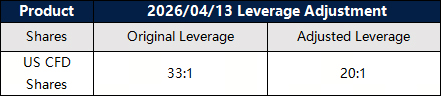
Modifications on Leverage for Shares (33 > 20) – Apr 01 ,2026

Dear Client,

To provide a favorable trading environment to our clients, VT Markets will modify the trading setting of all Shares products. Please refer to the following details:

1. All US Shares products leverage will be adjusted to 20:1.

Modifications on US Shares

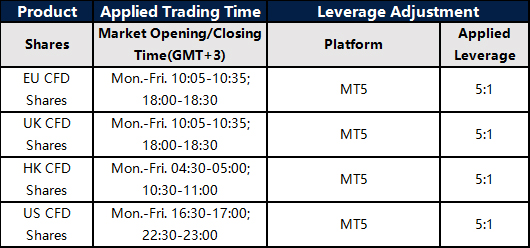
2. MT5 All Shares products dynamic leverage: New positions opened within 30 minutes before market closing and after market opening will start with a leverage of 5:1. After the mentioned period, the leverage will be resumed to original leverage and will not be adjusted back to 5:1.

Modifications on US Shares

The above data is for reference only, please refer to the MT4/MT5 software for specific data.

Friendly reminders:

1. All specifications for Shares CFD stay the same except leverage during the mentioned period.

2. The margin requirement of the trade may be affected by this adjustment. Please make sure the funds in your account are sufficient to hold the position before this adjustment.

If you’d like more information, please don’t hesitate to contact [email protected].

During Asian trading, the US Dollar Index slips near 99.80 below 100.00, as Trump boosts risk appetite

The US Dollar Index (DXY) fell for a second day and stayed below 100.00, trading near 99.80 in Asian hours on Wednesday. It tracks the US Dollar against six major currencies. The US Dollar weakened as safe-haven demand eased with lower Middle East tension. On Tuesday, US President Donald Trump said the US would be “leaving very soon” from the Iran war, with a withdrawal possible within two to three weeks.

Iran Signals Conditional Deescalation

Iran’s President Masoud Pezeshkian said he would de-escalate if certain guarantees are met. Foreign Minister Abbas Araghchi said Iran wants a full end to the war, not a temporary ceasefire, and called for binding assurances and compensation for damages. Federal Reserve Chair Jerome Powell said long-term inflation expectations remain well anchored. This reduced concern that higher energy prices will quickly lift inflation and change the policy outlook. We recall how the market environment in 2025, driven by de-escalation in the Middle East and dovish Fed commentary, pushed the US Dollar Index below 100. This backdrop of perceived stability and anchored inflation expectations favored riskier assets over the safe-haven dollar. The situation today, however, presents a starkly different picture for traders. In the current environment of April 2026, the DXY is trading significantly stronger, recently hovering around 104.60. This strength is supported by a Federal Reserve that has maintained its key interest rate in the 5.25%-5.50% range, signaling a commitment to fighting persistent inflation. This policy divergence from 2025 suggests that strategies betting on continued dollar weakness are now facing significant headwinds.

Options To Manage Currency Volatility

Given this shift, we should consider using options to manage potential volatility in currency markets. With the CBOE Volatility Index (VIX) recently trading near 15, implied volatility might not fully price in potential economic surprises in the coming weeks. Therefore, purchasing straddles or strangles on currency pairs like EUR/USD could be a prudent way to position for a significant move, regardless of direction. The view from 2025 that long-term inflation expectations were well-anchored has been seriously tested. We’ve seen the latest Consumer Price Index (CPI) data for March 2026 come in at a persistent 3.1% year-over-year, which is well above the Fed’s target. This makes it highly unlikely the Fed will consider rate cuts in the near term, reinforcing the case for a stronger dollar. While the specific Middle East tensions of 2025 have subsided, the geopolitical landscape has merely shifted, not cleared. We are now monitoring other global hotspots, which could reignite safe-haven demand for the dollar unexpectedly. This contrasts with the risk-on sentiment from last year and means traders should be cautious about being overly short the dollar. Create your live VT Markets account and start trading now.

Start trading now – Click here to create your real VT Markets account

Indonesia’s February trade surplus missed forecasts, recording $1.28B against expectations of $1.55B

Indonesia recorded a trade surplus of $1.28bn in February. This was below the expected surplus of $1.55bn. The lower-than-expected trade surplus for February points to weakening export demand or surprisingly strong imports. This development puts downward pressure on the Indonesian Rupiah. We are now watching to see if this is a temporary dip or the start of a new trend for the coming quarter. This miss isn’t a total surprise, as we’ve seen prices for key commodities like palm oil and nickel soften in early 2026. Data from the first quarter shows Newcastle coal futures, a major export, have fallen over 8% since January. This global demand trend directly eats into the country’s export revenues and the value of its currency. Given this outlook, we are considering positions that would benefit from a weaker Rupiah against the US dollar. Buying short-dated USD/IDR call options could be a prudent strategy. This allows us to gain from potential currency depreciation while capping our downside risk if the currency unexpectedly strengthens. We must also watch Bank Indonesia’s response, as a weaker currency can fuel inflation. The latest inflation figures for March 2026 ticked up to 3.1%, which may limit the central bank’s ability to support the economy with rate cuts. Any hints of intervention or a more hawkish stance could introduce volatility into currency markets. We saw a similar pattern during the second quarter of 2025 when a slump in commodity prices led to a shrinking surplus. That period was followed by a 2% depreciation of the Rupiah over the subsequent six weeks. History suggests the current market reaction could have further to run if export figures do not recover quickly.

Start trading now – Click here to create your real VT Markets account

Indonesian February imports rose 10.85%, falling short of the 11.2% forecast for that month

Indonesia’s imports rose by 10.85% in February. A forecast of 11.2% had been expected. The reported figure was 0.35 percentage points lower than the forecast. The update compares actual results with the market estimate. The February import figure of 10.85% came in under the 11.2% we were watching. This suggests that domestic demand inside Indonesia is softer than anticipated, which could mean the economy is cooling down. For traders, this immediately puts a spotlight on the Indonesian Rupiah, as lower import demand means less corporate need for US dollars. We see the path of least resistance for the USD/IDR pair as being downwards in the short term, potentially testing the 15,500 level. With inflation reportedly stable at 2.9% in March, Bank Indonesia has more room to be dovish, further weighing on the dollar against the Rupiah. Derivative traders could consider buying put options on USD/IDR or establishing short forward positions to capitalize on potential Rupiah strength. This weak data also shifts our focus to interest rate derivatives, as the market will start pricing in a higher probability of a rate cut from Bank Indonesia later this year. We can see this reflected in recent government bond yields, with the 10-year yield falling 15 basis points last week to 6.55%. A cooling economy is typically a headwind for the stock market, so we would be cautious about long positions on the IDX Composite index futures. However, we must remain cautious, as external factors can quickly change the picture. Looking at this from our perspective in 2025, we saw a similar situation where weak domestic data initially boosted the Rupiah before unexpected signals from the US Federal Reserve caused a sharp reversal. Therefore, using options to define risk or keeping stop-loss orders tight on any short USD/IDR positions is a prudent strategy.

Start trading now – Click here to create your real VT Markets account

Fed hike expectations lift the US dollar, pushing NZD/USD down to 0.5730 from its weekly peak

NZD/USD rose to about 0.5760, a weekly high, then turned lower and fell to around 0.5730. The move followed a rebound from an over four-month low, while the pair stayed within a downtrend seen for about two months. Market sentiment stayed cautious as talk of easing US–Iran tensions was offset by reports that the UAE wants military action to reopen the Strait of Hormuz. The US continued to deploy extra troops and assets in the Middle East, keeping inflation worries and Federal Reserve rate hike expectations supportive for the US Dollar.

Key Drivers Behind The Pullback

The New Zealand Dollar weakened on expectations the Reserve Bank of New Zealand may wait until Q4 to raise rates, due to concerns that an energy supply shock could slow growth. China’s Manufacturing PMI from RatingDog fell to 50.8 in March from 52.1, adding pressure to the Kiwi and other antipodean currencies. Traders may wait for further geopolitical news before making larger bets. Focus also turns to US data on Wednesday, including ADP private employment, Retail Sales, and the ISM Manufacturing PMI, ahead of Friday’s US Nonfarm Payrolls report. NZD tends to track New Zealand economic conditions, RBNZ policy, China demand, and dairy prices. The RBNZ targets inflation of 1% to 3%, with a focus near 2%. Looking back at the market dynamics from 2025, we saw a strong US dollar driven by Federal Reserve rate hike bets and geopolitical risk. Today, on April 1, 2026, the environment has shifted, with the Fed now hinting at rate cuts later this year as US growth shows signs of slowing. The latest Non-Farm Payrolls report from March 2026 underscored this by coming in at just 150,000, well below consensus forecasts.

Looking Ahead For Nzdusd

The Reserve Bank of New Zealand, which was seen as dovish last year, now faces persistent domestic inflation that registered 3.5% in the first quarter of 2026. This policy divergence, where the RBNZ is forced to hold rates higher for longer compared to a softening Fed, creates a fundamental tailwind for the NZD/USD pair. This is a complete reversal of the rate differential pressures we observed throughout 2025. Furthermore, concerns about a fragile Chinese recovery that weighed on the Kiwi last year have eased significantly. China’s official Manufacturing PMI for March 2026 was a strong 51.5, indicating a solid expansion that boosts demand for New Zealand’s exports. This renewed strength in New Zealand’s largest trading partner adds another layer of support for the currency. Given this backdrop, we should position for NZD/USD strength in the coming weeks. The bearish sentiment of 2025 is no longer justified, making strategies like buying call options or implementing bull call spreads on the pair attractive. These derivatives offer a defined-risk way to capture potential upside as the market reprices the divergent paths of the Fed and RBNZ. The positive outlook is further supported by key commodity prices, a crucial driver for the Kiwi. The Global Dairy Trade index has climbed over 10% year-to-date, boosting New Zealand’s export income. This contrasts sharply with the economic headwinds seen last year and reinforces the case for a higher NZD/USD exchange rate. Create your live VT Markets account and start trading now.

Start trading now – Click here to create your real VT Markets account

Dividend Adjustment Notice – Apr 01 ,2026

Dear Client,

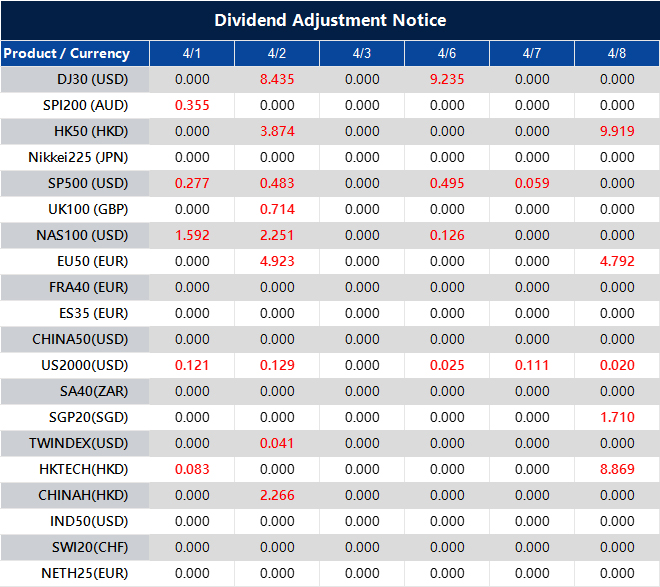
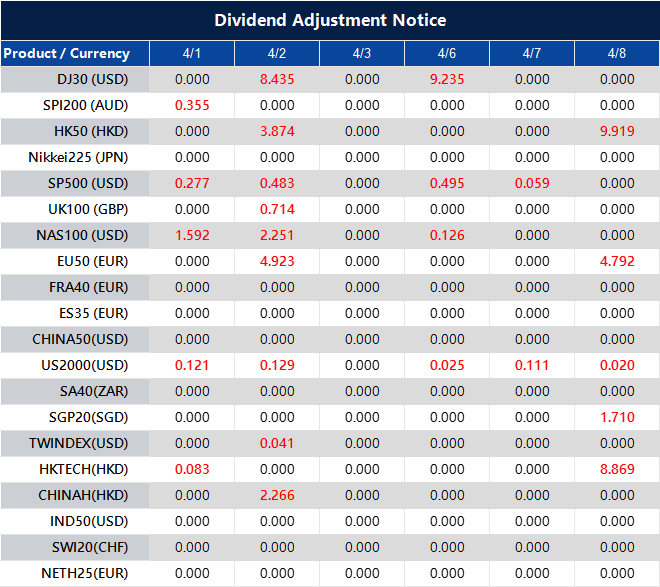
Please note that the dividends of the following products will be adjusted accordingly. Index dividends will be executed separately through a balance statement directly to your trading account, and the comment will be in the following format “Div & Product Name & Net Volume”.

Please refer to the table below for more details:

Dividend Adjustment Notice

The above data is for reference only, please refer to the MT4/MT5 software for specific data.

If you’d like more information, please don’t hesitate to contact [email protected].

Trump told NBC News by phone that he believes the Iran war could end within two or three weeks

In a late Tuesday phone interview with NBC News, US President Donald Trump said he thought the war on Iran was “coming to an end”. He said oil prices would fall once the US left Iran, adding that this would happen “very soon” and prices would “come tumbling down”. On the Strait of Hormuz, he said keeping it open was “not for us” and would be for France or other users of the strait. He also said, “We’re doing great”, and repeated that it was coming to an end.

Market Focus Shifts

Trump said the people the US was dealing with in Iran were “more reasonable” and “not as radicalised”. He said the US would not allow Iran to have nuclear weapons. He said he had “a war to prosecute” and that the US was “finishing the job”. He estimated “in two weeks or maybe a few days longer” to “do the job”, and said the aim was to “knock out everything they’ve got”. Market moves showed the US Dollar Index (DXY) near 99.80, down 0.10% on the day at the time of writing, alongside a return of risk appetite. We remember when these statements were made last year, signalling a major de-escalation and shift in Mideast policy. The initial reaction in 2025 saw oil prices fall sharply, with Brent Crude dropping below $80 per barrel for the first time since the conflict began. This has set the stage for the market’s current complacency. Today, the CBOE Crude Oil Volatility Index (OVX) is trading near 28, a 24-month low, showing how little risk is priced into the market. We’ve seen shipping insurance premiums for tankers passing through the Strait of Hormuz fall by over 60% since the fourth quarter of 2025. This tells us the market fully believes the threat of a major supply disruption from that region is gone.

Trading Implications For Volatility

This period of low volatility presents a clear opportunity for derivative traders. Buying cheap, long-dated call options on Brent or WTI is an effective way to position for any unexpected return of geopolitical tension. The market has forgotten that a US withdrawal from policing the Strait of Hormuz creates a power vacuum, making the supply route fragile to new threats. Historically, after the initial relief of the 2015 Iran Nuclear Deal, oil markets remained volatile due to other factors, like OPEC production disputes and global demand shifts. We see a similar setup now, where the focus has shifted away from a single conflict, leaving the market underpriced for new surprises. A small disruption could now have an outsized impact on prices precisely because the risk premium has vanished. The US Dollar Index’s (DXY) weakness at the time reflected a classic “risk-on” move as war fears subsided. Currently, with Mideast tensions on the back burner, the dollar’s movement is almost entirely tied to inflation data and Fed interest rate expectations. Traders should consider options on currency pairs like the EUR/USD to play future volatility stemming from diverging central bank policies, rather than geopolitics. Create your live VT Markets account and start trading now.

Start trading now – Click here to create your real VT Markets account

WTI trades near $98.60 after 4% prior-session losses, while UAE urges UN action reopening Hormuz

WTI traded near $98.60 per barrel in Asian hours on Wednesday, after falling by over 4% the previous day. Prices rose as the UAE sought military action to reopen the Strait of Hormuz, while Iran warned of further retaliation. The Wall Street Journal reported that Emirati officials are seeking a UN Security Council resolution to authorise a multinational mission to restore navigation through the strait. The UAE is also urging the US and allied countries in Europe and Asia to form a coalition to clear mines, escort commercial ships, and secure positions along the waterway if needed.

Us Iran Deescalation Outlook

US President Donald Trump said US operations could end before the strait fully reopens, with a withdrawal possible within two to three weeks. Iran’s president indicated willingness to end hostilities under certain guarantees, while uncertainty remains due to continued US military presence. A Reuters survey showed OPEC output fell in March to 21.57 million barrels per day, down 7.3 million barrels per day month-on-month and the lowest since June 2020. The American Petroleum Institute reported US weekly crude stocks rose by 10.263 million barrels in the week ending 27 March, after a previous 2.3 million-barrel rise, versus expectations for a 1.3 million-barrel draw. With WTI crude oil trading near $98.50, the market is facing extreme uncertainty centered on the Strait of Hormuz. The push by the United Arab Emirates for a UN-backed military intervention has sent implied volatility soaring. This geopolitical tension is the single most important factor for traders to watch in the coming weeks. We are processing a massive supply shock from the OPEC production drop of 7.3 million barrels per day in March. A supply cut of this scale, representing nearly 7% of recent global demand which hovered around 103 million bpd in late 2025, is a profoundly bullish signal. Traders anticipating further escalation might consider buying call options to capitalize on a potential price surge if the strait remains blocked.

Strategies For Extreme Volatility

However, powerful opposing forces suggest a sharp price reversal is also possible. The prospect of a US withdrawal within weeks and the massive, unexpected build of 10.263 million barrels in US crude stocks create significant downside risk. This scenario supports strategies like buying put options to protect against a sudden price collapse should a diplomatic solution emerge. Given these conflicting signals, betting on a clear direction is highly speculative. A more prudent approach may be to trade the volatility itself, perhaps by using option strategies like a straddle, which involves buying both a call and a put. This strategy profits from a large price move in either direction, which seems probable given the current news flow. We only have to look back to the market volatility in 2025 to see how quickly sentiment can shift based on supply fears. Geopolitical price spikes, like those we saw during the Red Sea disruptions, often lead to sharp but short-lived rallies. This historical pattern suggests any surge from the Hormuz crisis could reverse just as quickly, making flexible option strategies more appealing than rigid futures contracts. In the near term, the key catalyst will be the outcome of any vote at the UN Security Council on the UAE’s proposal. Weekly EIA inventory reports will be crucial to see if the recent massive stock build is an anomaly or a new trend indicating falling demand. The two-to-three-week window mentioned for a potential US withdrawal also provides a critical timeframe for a major market shift. Create your live VT Markets account and start trading now.

Start trading now – Click here to create your real VT Markets account

USD/JPY edges up from weekly lows as yen remains strong; Iran tensions ease, weakening dollars demand

USD/JPY edged up from an over one-week low near 158.45 in Asian trading on Wednesday, but remained below 159.00 and was nearly flat on the day. Trading stayed cautious as markets weighed reports about a possible US exit from the Iran war and awaited further geopolitical news. President Donald Trump said on Tuesday that the US would wind down hostilities with Iran within two to three weeks, and that Tehran does not need a deal with Washington to end the conflict. This lifted risk appetite and eased demand for the US Dollar, limiting USD/JPY upside.

Bank Of Japan Tankan Survey

Japan’s Bank of Japan tankan survey showed improved sentiment among large manufacturers over the three months to March, with the index rising to 17. This was the fourth consecutive quarterly increase and the highest level since December 2021, supporting the yen and capping the pair. A BoJ official said the survey likely did not fully reflect the Middle East conflict, while reports said the UAE is pushing for military action to reopen the Strait of Hormuz. Japan’s reliance on Middle East oil imports has raised concerns about economic strain, which could weigh on the yen. Traders are now watching upcoming US data, including the ADP report and the ISM Manufacturing PMI. Looking back from our current date of April 1, 2026, the mixed signals from early 2025 presented a complex picture. The hope then was that a de-escalation in the Middle East would weaken the US Dollar, while a strong Tankan survey would boost the Yen. This created a bearish consolidation for USD/JPY right below the 159.00 level.

What Happened Next

That optimism proved to be short-lived, as we now know the US withdrawal from Iran did not de-escalate the regional conflict. The subsequent tensions surrounding the Strait of Hormuz caused WTI crude futures to spend most of late 2025 above $95 a barrel, putting immense pressure on Japan’s energy-importing economy. As a BoJ official had worried, this impact eventually surfaced in later Tankan surveys, with business confidence falling through the second half of 2025. On the other side of the pair, the US Dollar’s weakness never materialized due to a resilient domestic economy. Persistent inflation, with the recent March 2026 CPI print coming in at a stubborn 3.1% year-over-year, has kept the Federal Reserve from cutting interest rates. This continued rate differential between the US and Japan has been the primary driver pushing the currency pair higher. As a result, we have seen USD/JPY surge from the 159.00 level of a year ago to its current trading range around 168.50. This sharp ascent has brought the very real threat of direct intervention by Japanese authorities back into focus. We note that Japan’s foreign exchange reserves, last reported at over $1.2 trillion, give them significant firepower for such an action. This elevated risk of a sudden, sharp move makes simple directional trades incredibly risky in the coming weeks. The primary play here is on volatility, as intervention could cause a 500-pip drop in minutes, while a failure to act could see the pair test the 170.00 psychological barrier. We should therefore be positioning in long volatility strategies. Buying options is the most direct way to prepare for a significant price swing without being exposed to the direction. A long straddle, which involves buying both a call and a put option at the same strike price, is an appropriate strategy. This position will profit from a large move in either direction, capitalizing on the market’s current uncertainty. Create your live VT Markets account and start trading now.

Start trading now – Click here to create your real VT Markets account

RatingDog data showed China’s manufacturing PMI eased to 50.8 in March, below 51.6 forecast

China’s RatingDog Manufacturing Purchasing Managers’ Index (PMI) fell to 50.8 in March, down from 52.1 in February, according to data released on Wednesday. The market forecast was 51.6. Following the PMI release, AUD/USD was up 0.30% on the day at around 0.6915 at the time of writing.

China Manufacturing Momentum Fades

The drop in China’s manufacturing PMI to 50.8, while still in expansion territory, points to a clear loss of momentum. This slowdown follows the trend we observed through late 2025, where recovery from ongoing property sector issues remained fragile. The key takeaway is not the expansion itself, but the unexpected pace of its decline. The Australian dollar’s resilience is likely driven by factors outside of China, creating a potential divergence we can trade. We believe the market is pricing in the Reserve Bank of Australia’s hawkish stance, as domestic inflation has remained stubbornly above 3.5% into early 2026. This is temporarily masking the risk from its largest trading partner. This situation directly impacts industrial commodities, especially iron ore. We saw a similar setup in early 2024 when a slowdown in China caused iron ore futures to fall over 30% in one quarter, and current port-side inventories are similarly elevated. Traders should consider buying put options on commodity-exposed equities like BHP or Rio Tinto to position for a potential price correction. Given the AUD/USD is holding firm near 0.6915, it presents an attractive level to initiate bearish positions on the currency. The current strength provides a better entry price for buying AUD/USD put options with expiries in late April or May. We expect the reality of weaker Chinese demand to eventually weigh more heavily on the Aussie than domestic interest rate policy.

Volatility Strategy For Conflicting Signals

The conflicting signals between a slowing China and a strong AUD suggest a period of rising volatility. This environment is ideal for strategies that benefit from price movement, regardless of direction. We should look at purchasing straddles on the AUD/USD, which would profit from a significant move once the market decides which narrative is more important. Create your live VT Markets account and start trading now.

Start trading now – Click here to create your real VT Markets account

Back To Top
server

Hello there 👋

How can I help you?

Chat with our team instantly
Live Chat

Start a live conversation through...

  • Telegram
    hold On hold
  • Coming Soon...

Hello there 👋

How can I help you?

telegram

Scan the QR code with your smartphone to start a chat with us, or click here.

Don’t have the Telegram App or Desktop installed? Use Web Telegram instead.

QR code