
Back

Amid sturdy support, the S&P 500 appears poised to extend gains, with further upside likely

The S&P 500 is holding firm after recent gains, with price action still favouring an upward trend. The move suggests the index remains in a bullish phase rather than reversing lower.

The update points to continued upside potential if the current support levels remain intact. It also notes that the next move may depend on whether the index can push through nearby resistance.

Market Upside Continuation

The market is set for upside continuation, meaning we should position for further gains in the S&P 500. First quarter earnings for 2026 have come in strong, with corporate profits beating estimates by an average of 6.5%, confirming the economy’s solid footing. This trend suggests bullish strategies are the most logical path forward in the coming weeks.

Recent inflation data is also very encouraging, with the March CPI report showing a year-over-year increase of just 2.7%. This has solidified expectations that the Federal Reserve will begin cutting interest rates by the third quarter. A lower rate environment is historically positive for stock valuations.

For traders, this means buying call options with expirations in June and July 2026 is a primary strategy to capture this expected upward move. We should focus on index ETFs like SPY or technology-focused ones that continue to lead the market. This direct bullish bet offers significant upside potential if the trend continues as expected.

Implied volatility has remained low, with the VIX trading consistently below 15. This environment makes selling out-of-the-money put credit spreads an attractive, high-probability trade for generating income. It allows us to profit from both the upward drift and time decay as long as the market avoids a sharp sell-off.

Context For The Current Trend

This current strength is a continuation of the resilience we saw throughout last year. Looking back, the market’s ability to absorb the interest rate uncertainty in early 2025 and push to new highs showed its underlying power. We are now seeing the next phase of that same strong trend.
Create your live VT Markets account and start trading now.

OCBC strategists note USD/JPY nears 160 as safe-haven Dollar demand grows and Japan signals intervention readiness

USD/JPY is nearing 160 again as the US dollar gains from safe-haven flows. Japanese authorities have repeated that they are ready to intervene to address yen weakness.

OCBC expects the Bank of Japan to raise rates by 25bp to 1.0% on 28 April. Markets are also pricing the risk of a hawkish hold.

Bank Of Japan Meeting Risk

If the BoJ does not raise rates, USD/JPY could move into the 160s. That could increase the chance of Ministry of Finance intervention to push the pair back towards 155.

The Swiss National Bank also restated its readiness to intervene to limit Swiss franc strength. The report notes it was produced with the help of an AI tool and reviewed by an editor.

With USD/JPY nearing the critical 160 level, we see a major event risk looming with the Bank of Japan’s meeting on April 28th. The market is pricing in a significant chance of a hawkish hold rather than the 25 basis point hike we expect. This divergence in expectations is a clear setup for a sharp move, making options strategies particularly relevant.

The key for derivative traders is the explosion in expected price swings. One-week implied volatility for USD/JPY has already surged past 15%, reflecting the market’s anxiety over either a policy surprise or direct currency intervention. Traders can look to buy volatility through instruments like straddles, which would profit from a large move in either direction following the BoJ’s announcement.

Historical Intervention Playbook

We only have to look back to the spring of 2024 for a recent playbook on intervention. Back then, Japanese authorities spent a record of nearly ¥10 trillion to defend the currency, causing USD/JPY to drop sharply from similar levels near 160. This historical precedent makes the Ministry of Finance’s current warnings highly credible.

Should the BoJ fail to hike and the pair pushes past 160, we see a high probability of intervention aimed at forcing USD/JPY back towards 155. This scenario would make buying near-term USD/JPY put options an attractive way to position for a sudden and powerful strengthening of the yen. Conversely, if the BoJ does deliver a surprise hike and the dollar’s safe-haven appeal wanes, those same puts could prove profitable.

The risk of a continued upward surge remains if the BoJ disappoints the market and intervention is delayed or less forceful than anticipated. Data shows that with Japan’s core inflation still hovering around 2.5%, well above the central bank’s target, pressure to act is immense. A failure to do so could be seen as a green light for yen bears, making call options with strike prices above 161 a potential, albeit risky, trade.

Create your live VT Markets account and start trading now.

Intervention worries cap USD/JPY below 160.00 as bulls consolidate, eye breakout, and target weekly gains

USD/JPY traded in a bullish consolidation on Friday, moving in a range below 160.00 in early European hours. The pair was set to post gains for the first time in three weeks.

Talk that Japanese authorities may act to limit further Yen weakness supported the JPY and weighed on USD/JPY. Middle East tensions, the US-Iran standoff over the Strait of Hormuz, and reduced expectations for Fed rate cuts supported the USD.

Mixed Signals Keep Pair Supported

Later BoJ rate-hike expectations, linked to an unimpressive National CPI reading, also pressured the Yen. These factors left mixed signals while keeping the pair supported overall.

Since mid-March, price action has stayed within a familiar range after a rebound from the 200-day EMA. The setup points to upward bias, with pullbacks still viewed as potential buying chances.

The RSI was 56.79, positive and not overbought. The MACD remained slightly negative, suggesting upward momentum is present but limited.

A move below about 159.60 could bring buying near 159.00, with range support around 158.30. A clear break lower could open a drop towards the 200-day EMA near 155.03.

Options Strategies To Manage Breakout Risk

Traders may look for sustained trading above 160.00 before adding to long positions. The technical analysis was produced with help from an AI tool.

As we see it, the USD/JPY pair is in a bullish holding pattern just under the key 160.00 level. While the pair looks set to finish the week with gains, the market is hesitant to push decisively higher. This suggests traders should be patient and strategic rather than chasing the price.

The fundamental picture supports a stronger dollar against the yen, as the interest rate difference between the US and Japan remains wide. Recent US inflation data from March 2026 came in at a firm 3.1%, reinforcing expectations that the Federal Reserve will not be cutting rates soon. In contrast, Japan’s latest Tokyo Core CPI for April was a subdued 1.9%, giving the Bank of Japan little reason to tighten its policy aggressively.

However, the primary risk is direct intervention from Japanese authorities, which we saw happen when the pair crossed this same 160.00 level back in late April of 2024. Finance Minister Shun’ichi Suzuki has already issued fresh warnings this week about speculators, stating he is watching the market with a “high sense of urgency.” This history makes buying the pair outright a risky proposition in the coming weeks.

Given this setup, traders should consider using options to manage risk while positioning for a potential move higher. Buying call options with a strike price just above 160.00 allows for participation in a breakout while strictly limiting potential losses to the premium paid. If Japanese authorities do intervene and the pair falls sharply, the downside is capped.

For those who believe the support levels around 159.00 will hold, selling out-of-the-money put options could be an effective strategy. This approach generates income from the premium collected and profits if the USD/JPY stays above the strike price through expiration. It aligns with the view that any dips are likely to be seen as buying opportunities and will be short-lived.

A more conservative approach would be to use a bull call spread, which involves buying a call at a lower strike price and selling one at a higher strike. This reduces the upfront cost of the position but also caps the potential profit. This is suitable for traders who anticipate a modest, controlled rally rather than an explosive move through the highs.

Create your live VT Markets account and start trading now.

After robust UK retail sales, EUR/GBP stays flat near 0.8675, capped below 0.8680, rebounding from 0.8654 lows

The Euro was almost unchanged against Sterling on Friday, trading at 0.8675. Resistance near 0.8680 limited a rebound from Thursday’s low of 0.8654, and UK retail data did not move the pair much.

UK Retail Sales rose 0.7% in March after a 0.6% fall in February, beating forecasts of 0.2%. Core sales, excluding fuel and cars, increased 0.2% after a 0.6% drop, matching expectations.

Uk Surveys And Rising Input Costs

Preliminary UK business surveys showed manufacturing and services still expanding, while input costs reached their highest levels since records began. This added uncertainty about future activity.

The GfK Consumer Confidence index fell to its lowest level in three years. Concerns included rising prices linked to an energy shock, and higher mortgage costs if the Bank of England raises interest rates.

In the euro area, attention turned to Germany’s IFO business climate data, expected to weaken in April due to higher energy costs. Geopolitical tensions also rose after Iran showed footage of a cargo vessel seizure in the Strait of Hormuz, while US President Donald Trump threatened to destroy any ship mining the waterway.

We are seeing a similar dynamic to what we saw in April 2025, when EUR/GBP was stuck below 0.8680 even as UK economic data showed mixed signals. Today, the pair is trading with less direction around 0.8590, as traders weigh conflicting economic forces. The latest data from the Office for National Statistics shows UK retail sales volumes rose by a marginal 0.1% in March 2026, indicating that the consumer remains under pressure.

Policy Convergence And Market Volatility

Last year’s concerns about energy costs and consumer pessimism have evolved, but not disappeared. While the major energy shock of 2025 has passed, UK consumer confidence, as measured by GfK, has only recovered to -22 this month, still well within pessimistic territory. With UK inflation now at 2.9% as of March 2026, the Bank of England is signalling that rate cuts are on the table for this summer, a stark reversal from the hawkish stance we saw this time last year.

This pivot by the Bank of England is now running parallel to the European Central Bank, which is also expected to begin easing its policy in the coming months as Eurozone inflation fell to 2.4% in March. This policy convergence is suppressing volatility in the EUR/GBP pair, which suggests that range-trading strategies or selling options premium might be viable for now. Traders should be prepared for a breakout if one central bank signals a more aggressive cutting cycle than the other.

The specific geopolitical tensions of 2025 involving Iran have been replaced by new concerns over global supply chains and freight costs due to ongoing maritime instability in the Red Sea. These persistent threats mean a sudden spike in inflation remains a key risk, which could quickly alter the path for interest rates. Therefore, holding some long volatility positions through derivatives could be a prudent hedge against an unexpected economic shock that disrupts the current low-volatility environment.

Create your live VT Markets account and start trading now.

Danske’s team reports global equities edged down; tech lagged after software falls, while value beat cyclicals

Global equities finished 0.4% lower as risk sentiment weakened. Value stocks reversed Wednesday’s decline and outperformed cyclical shares in a more defensive session.

The tech sector was the weakest area, driven by a slump in software stocks. Software companies fell 5.1% on the day.

Futures were mostly lower, while Nasdaq futures held up after Intel issued an AI-driven outlook. Asian equity indices traded mostly in the red.

The article was produced using an artificial intelligence tool and reviewed by an editor.

We are seeing a clear split in the market as risk sentiment sours. The tech sector is getting hit, but this weakness is very specific to software, which dropped over 5% in a single day after a major company reported slowing sales. This nervousness is now reflected in the CBOE Volatility Index (VIX), which has crept back above 18, showing traders are paying more for protection.

In response to this, money is rotating into value stocks which are reversing their prior losses. For the week, value-focused ETFs are up nearly 1% while broad growth funds are down over 2%, confirming a defensive shift. This suggests a preference for companies with stable current earnings over those promising future growth.

This is a very different environment from the broad tech rally we saw for most of 2025, where almost all AI-related stocks went up together. Intel’s strong AI-driven outlook shows the theme is not dead, but the market now requires proof of profitability. We are now seeing a clear separation between the AI infrastructure providers and the software firms that use their technology.

Derivative traders should consider buying put options on software ETFs like IGV to hedge against further weakness in that specific area. At the same time, the strength in semiconductor names suggests selling cash-secured puts or using bull call spreads on companies showing tangible AI profits. This sets up a potential pairs trade, being bearish on software applications while remaining bullish on the underlying AI hardware.

After three losing sessions, GBP/USD steadies near 1.3470, as UK retail sales rise 0.7% in March

GBP/USD steadied near 1.3470 in Asian trading on Friday after three days of losses, holding above 1.3450. The move followed UK Retail Sales data for March.

UK Retail Sales rose 0.7% month-on-month in March after a revised 0.6% fall in February, compared with a forecast of 0.1%. Annual Retail Sales increased 1.7% in March versus a revised 1.8% previously, and ahead of the 1.3% expected.

Uk Retail Sales Details

Core Retail Sales, excluding auto fuel, increased 0.2% month-on-month after a revised 0.6% decline. Annual core Retail Sales rose 1.7% in March, down from a revised 2.7% in February.

The pair traded around 1.3465, just above a near two-week low set the prior day. It remained below the 1.3600 area and the two-month high of 1.3599.

Market focus also remained on the Middle East, including a temporary extension of the US-Iran ceasefire and tensions linked to an American blockade of Iranian ports. The US-Iran dispute over the Strait of Hormuz was also noted.

Looking back to early 2025, we saw optimism for Pound Sterling, with strong retail sales data suggesting a potential rebound toward 1.3600. That sentiment was based on a temporary economic boost that did not last. As of today, April 24, 2026, GBP/USD is trading significantly lower, around 1.2550, showing how quickly market conditions can change.

Central Bank Policy Outlook

The Bank of England is now holding its interest rate at 5.25%, a level maintained for several months due to persistent inflation. Recent data from the Office for National Statistics shows the Consumer Prices Index (CPI) at 2.3%, still stubbornly above the 2% target. This makes any upcoming rate cuts uncertain and caps the Pound’s potential upside.

On the other side of the pair, the US Federal Reserve is also signaling a “higher for longer” stance with its funds rate in the 5.25%-5.50% range. US economic data remains more robust than in the UK, strengthening the dollar. This interest rate difference continues to make the dollar a more attractive currency for yield-seeking investors.

Given the uncertainty from both central banks, we should expect continued volatility in the coming weeks. Derivative traders could consider buying options to play on price swings around key data releases, such as the upcoming inflation reports for both countries. Implied volatility is likely to increase, making strategies that benefit from price movement, rather than direction, attractive.

With the dollar’s underlying strength, positioning for further downside or range-bound price action seems prudent. We could look at buying put options to hedge against a fall below 1.2400. Alternatively, selling call options with strike prices around the 1.2700 resistance level could generate income if the pair fails to break higher.

The geopolitical tensions mentioned last year regarding Iran have evolved into a broader global uncertainty that continues to support the US dollar as a safe-haven asset. We saw a similar flight to the dollar during previous periods of instability, such as in 2022. This backdrop suggests any significant strength in the Pound Sterling will likely be limited in the near term.

Create your live VT Markets account and start trading now.

UOB strategists say weakening Eurozone activity pushed EUR/USD lower, likely ranging 1.1665–1.1715 as momentum eases

EUR/USD fell to a two-week low near 1.1680, and it later reached 1.1668 during the New York session. The pair closed down 0.17% at 1.1683, with selling pressure starting to ease.

For the next 24 hours, EUR/USD is expected to trade between 1.1665 and 1.1715. Support is at 1.1685 and 1.1665, while resistance stands at 1.1715 and 1.1750.

Near Term Range And Key Levels

Over a 1–3 week view, EUR/USD is still seen as range-bound, first between 1.1665 and 1.1840, then narrowed to 1.1665 and 1.1795. The latest dip to 1.1668 brought the pair close to the lower edge of that range.

A move towards 1.1625 is expected only if EUR/USD breaks and holds below 1.1665. The risk of a clear break below 1.1665 remains while 1.1750 is not exceeded.

We are watching the 1.1665 support level in EUR/USD very closely, as a sustained break below it would signal more downside ahead. The pair has been weak, hitting a two-week low yesterday, April 23rd, 2025, and downward pressure is building. For now, the price is likely to be contained in a narrow range between 1.1665 and 1.1715.

This technical weakness is supported by a growing difference in central bank policy expectations. Recent US inflation data from March 2025 came in stronger than anticipated, fueling talk of a more aggressive Federal Reserve. Conversely, recent commentary from European policymakers suggests a more cautious approach, echoing the policy divergence we saw in late 2021 when accelerating US inflation pushed the dollar higher across the board.

For traders who believe the 1.1665 support will break, buying put options with a strike price near 1.1650 or 1.1600 is a straightforward strategy. This allows for profiting from a move down towards the 1.1625 target while clearly defining the maximum risk. The cost of the option is the most that can be lost if the pair unexpectedly reverses higher.

Options And Strategy Considerations

If we expect the pair to remain range-bound for the time being, selling an iron condor could be an effective approach. This involves selling a put spread below the 1.1665 support and a call spread above the 1.1750 resistance. This strategy profits from the passage of time and low volatility as long as the EUR/USD stays within this broad range.

The key risk to this bearish outlook is the 1.1750 resistance level. A move above this price would indicate the downward pressure has faded. Any short derivative positions should be reconsidered or hedged if the pair decisively breaks above that mark in the coming days.

Create your live VT Markets account and start trading now.

During Asian trading, the US Dollar Index held near 99.00 weekly highs, seeking support above its 20-day EMA

The US Dollar Index (DXY) held near a weekly high of about 99.00 in Asian trading on Friday. The move came as oil prices stayed elevated amid fears of a prolonged closure of the Strait of Hormuz, a route for almost 20% of global energy supply.

WTI was flat near 95.00 at the time, but up almost 20% from its April 17 low of $78.88. Concerns about Hormuz were linked to stalled US–Iran talks and a continuing US blockade of Iranian sea ports.

Dollar Strength And Oil Driven Inflation

Higher oil prices have pushed up inflation expectations, leading traders to reduce bets on near-term Federal Reserve rate cuts. Markets are waiting for the University of Michigan one-year and five-year Consumer Inflation Expectations for April, due at 14:00 GMT.

Attention then turns to the Federal Reserve policy decision on Wednesday, with rates expected to remain unchanged. On the daily chart, DXY traded around 98.86, just above the 20-day EMA at 98.80.

The 14-day RSI was 50.11, near the midline. Support sits at 98.53, then around 98.00, while resistance levels include 99.16 and about 99.70.

From our perspective on April 24, 2026, the current market shows a strong parallel to the situation we saw around this time in 2025. The US Dollar Index is again showing strength, driven by familiar concerns over energy prices and their impact on inflation. We are watching these developments closely, as they are influencing Federal Reserve policy expectations.

Currently, WTI crude oil is trading firmly around $85 per barrel, reflecting ongoing geopolitical tensions and steady global demand. This reminds us of the surge in April 2025 when prices jumped nearly 20% to $95 following fears of a Strait of Hormuz closure. While that specific threat has subsided, the impact of elevated energy costs on the broader economy remains a primary concern for us.

Key Fed Catalysts Ahead

These higher oil prices are contributing to sticky inflation, with the latest Consumer Price Index (CPI) report showing a year-over-year increase of 3.1%, slightly above expectations. Just as we saw last year, this has forced a reassessment of the Fed’s path, and markets have significantly reduced the odds of interest rate cuts in the near term. We believe this dynamic will continue to support the dollar.

The Dollar Index (DXY) is currently trading near 105.50, a much more robust level than the 99.00 range it was consolidating in during April of 2025. This strength is a direct result of the market pricing in a higher-for-longer interest rate environment from the Federal Reserve. This sustained dollar strength creates headwinds for other major currencies.

Given this backdrop of uncertainty, implied volatility in currency options is likely to rise in the coming weeks. We anticipate that traders will be best served by using derivatives to manage risk or position for sharp moves rather than holding unhedged spot positions. Strategies that profit from price swings, particularly around key economic data releases, should be considered.

All eyes will now be on the Federal Reserve’s upcoming policy meeting in early May for fresh guidance. We are also watching for the next Personal Consumption Expenditures (PCE) inflation data, which will be a critical input for the Fed’s decision-making process. These events will be the key catalysts for the dollar’s direction over the next month.

Create your live VT Markets account and start trading now.

Asian shares were mixed; Nikkei rose as inflation stayed below BoJ target amid oil-price pressures

Asian equities mostly fell on Friday as higher oil prices weighed on markets amid stalled US–Iran peace talks and disruption in the Strait of Hormuz. Japanese shares were mixed as traders reviewed inflation data ahead of next week’s Bank of Japan (BoJ) meeting.

Energy prices stayed elevated due to ongoing supply uncertainty, raising inflation and growth concerns. Many major Asian economies rely heavily on Middle East oil imports, increasing exposure to developments linked to Iran.

Asia Market Snapshot

At the time of writing, Hong Kong’s Hang Seng Index was down 0.2% near 25,860, South Korea’s KOSPI fell 0.93% to near 6,410, and China’s SSE Composite Index declined 0.58% toward 4,050. Japan’s Nikkei 225 was 0.61% higher near 59,500.

Japan’s annual inflation rose to 1.5% in March from 1.3% in February, a near four-year low. Core inflation increased to 1.8% year on year from 1.6%, staying below the BoJ’s 2% target for a second month.

Reports said the US military intercepted two Iranian oil supertankers allegedly trying to evade a blockade, while Tehran continued to threaten vessels in the Strait of Hormuz. In South Korea, technology shares weakened after Wall Street falls and profit-taking, while some defence-related stocks rose, including Hanwha Aerospace and Doosan Enerbility.

Looking back at the stalled US-Iran talks in 2025, we recall how those tensions created significant volatility in energy markets. We saw Brent crude futures surge past $110 a barrel in November 2025 before settling, which shows how quickly prices can react. This suggests that in the coming weeks, we should consider using long-dated call options on oil futures to hedge against any renewed supply disruptions.

Volatility Hedging Ideas

The risk-off sentiment described at the time spread rapidly, hitting most Asian markets and causing implied volatility to spike. We remember the CBOE Volatility Index (VIX) climbing above 30 in the fourth quarter of 2025, creating profitable opportunities for those who were prepared. Therefore, purchasing VIX call options or futures can serve as a cost-effective portfolio hedge against sudden market shocks.

While most of Asia struggled, Japan’s equities were an exception due to inflation remaining below the Bank of Japan’s target. The BoJ did in fact hold its policy steady through the end of 2025, only shifting its stance in early 2026 when core inflation finally stayed above 2% for a third straight month. This indicates a potential pair trade: buying Nikkei 225 futures while selling futures on the KOSPI to capitalize on this policy divergence.

The rotation into defense stocks in South Korea was a clear signal of market anxiety that proved to be a lasting trend. Hanwha Aerospace’s stock gained over 15% in the final quarter of 2025, even as the broader KOSPI index lagged behind. For traders, this means using call options on individual defense-related stocks could be a more precise way to profit from regional uncertainty than shorting a broad index.

Elevated energy prices historically pressure the currencies of major importers like Japan and South Korea. During the peak oil scare in late 2025, the Japanese yen weakened past 160 against the dollar, highlighting this vulnerability. We should therefore use currency options to hedge or speculate on further weakness in the yen or the Korean won if geopolitical tensions re-emerge.

Create your live VT Markets account and start trading now.

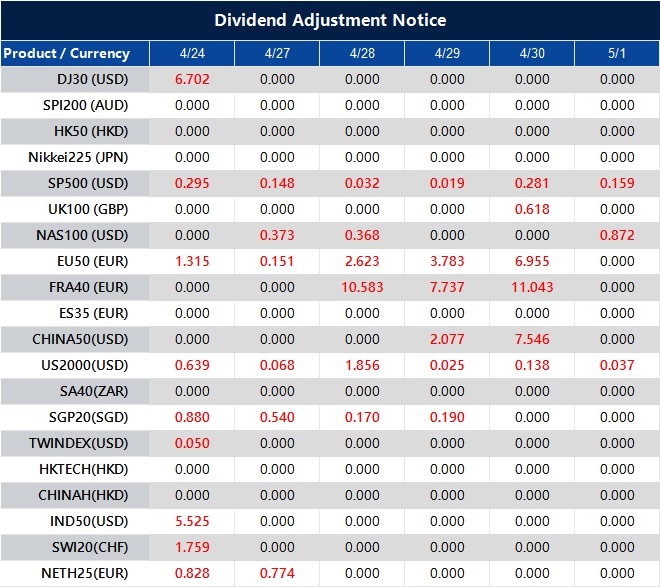
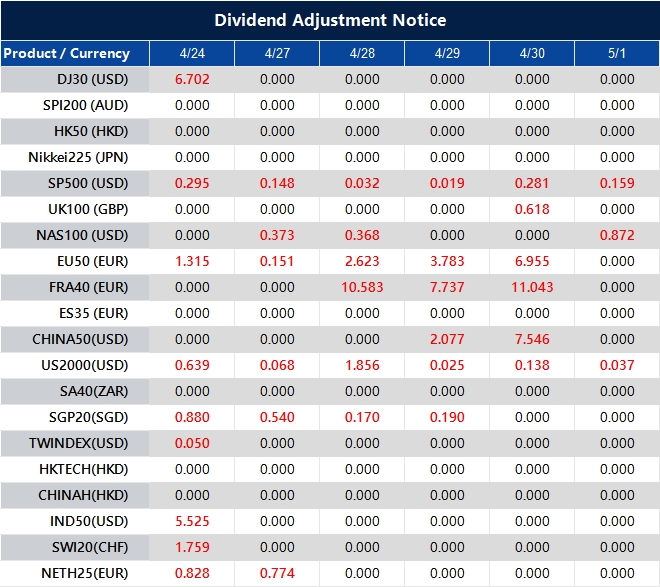
Dividend Adjustment Notice – Apr 24 ,2026

Dear Client,

Please note that the dividends of the following products will be adjusted accordingly. Index dividends will be executed separately through a balance statement directly to your trading account, and the comment will be in the following format “Div & Product Name & Net Volume”.

Please refer to the table below for more details:

Dividend Adjustment Notice

The above data is for reference only, please refer to the MT4/MT5 software for specific data.

If you’d like more information, please don’t hesitate to contact [email protected].

Back To Top
server

Hello there 👋

How can I help you?

Chat with our team instantly

Live Chat

Start a live conversation through...

  • Telegram
    hold On hold
  • Coming Soon...

Hello there 👋

How can I help you?

telegram

Scan the QR code with your smartphone to start a chat with us, or click here.

Don’t have the Telegram App or Desktop installed? Use Web Telegram instead.

QR code


