Weekly Dividend Adjustment Notice – May 25, 2023

Dear Client,

Please note that the dividends of the following products will be adjusted accordingly. Index dividends will be executed separately through a balance statement directly to your trading account, and the comment will be in the following format “Div & Product Name & Net Volume ”.

Please refer to the table below for more details:

The above data is for reference only, please refer to the MT4/MT5 software for specific data.

If you’d like more information, please don’t hesitate to contact [email protected]

Energy trading

Energy commodities are the natural resources used to power transport, electricity, heating technology; virtually all human activity worldwide. Because of this, energy commodities are in high demand globally, and the constant supply and demand make these markets ripe with opportunity for traders.

If you’ve ever wondered what energy trading involves or how you trade energy, read on for our in-depth guide into the industry, the types of trading available, and how to get started with making trades yourself.

Energy commodities

Commodities are the natural materials that much, if not all, of the global economy is built upon. They are both hard and soft commodities, which are divided into four categories:

  • Energies – such as crude oil, heating oil, petrol and natural gas.
  • Precious Metals – like gold, silver and palladium which are mined from the earth. 
  • Agriculture – These are crops and plants which are grown and harvested for human consumption. Examples include sugar and wheat for food production, and wood for lumber and other building materials. 
  • Livestock and meat – Cattle, sheep and hogs which are raised for use as food, or for other products like gelatine and leather.  

Of these categories, energies represent some of the most highly traded and in-demand commodities, because we rely on them for so much of our daily activity. Without energies, key systems such as transportation, technology, computers, mobile phones and manufacturing machinery would all grind to a halt. It’s no wonder that energies trading is such a potentially lucrative and popular market for investors to become involved with. 

There are both renewable and non-renewable sources of energy, both of which can be traded on global markets, these are:

  • Renewable energy — which includes solar power, wind power, hydropower and geothermal power.
  • Non-renewable energy — which covers crude oil and other petroleum products, natural gas, coal and nuclear energy. 

What is the energy trading market?

The energy market is the ecosystem of buying, selling and speculating on energy commodities that takes place in foreign exchanges around the world. The market sets a price for different commodities, based on factors which affect supply and demand. Traders then open or close positions based on their expectations for energy price movement. 

There are various factors to analyse when it comes to what moves the price of energy.

  • Growth in emerging markets — In most developed nations, the demand for energies remains fairly flat. In developing nations however, growth is expected to rise sharply over the coming decades. This increased demand will affect the price of all energy commodities, especially those which rapidly growing nations choose to invest in for the future.
  • Population growth — One factor that can have a major impact on the price of energy is population growth. On a global scale, the earth’s population is only set to rise, which increases competition for available energy resources. This has the potential to impact all nations, but particularly developing powerhouses like China and India, who face both exploding population figures and an increased migration from rural areas to more energy hungry urban cities.
  • Energy penetration — While energy is a huge global market, there are still large swathes of the developing world which have no access to electricity. As these regions are developed and industrialised, energy penetration will increase, and along with it, demand.
  • Industrialisation and developing economies — As new global powers emerge in the coming decades, the way they choose to industrialise and the energies they prefer will rapidly increase in demand. In order to make sound long term investments when trading energy, it’s crucial to keep abreast of the energy technologies that emergent countries like China and India are choosing to supply their domestic energy needs with.
  • Energy efficiency — Finally, energy trading in the future will need to contend with the developed world’s quest for better energy efficiency, including investment in renewables to replace older forms of power. This could produce both flat growth for non-renewables in the developed world, and an increased demand for renewable sources of energy.

How does energy trading work?

In the UK, the energy trading market offers various ways for investors to gain exposure to this huge sector. The most straightforward method is to trade the raw materials, or commodities, themselves. This involves the buying and selling of actual energy assets on a volatile and highly liquid market. However, as most traders don’t have the capacity to physically take possession of large amounts of raw materials, this is perhaps the least popular way of trading in the energy market. 

Different types of energy also have different best practices when it comes to trading. Learning how to trade oil, which is a very highly traded commodity and extremely volatile, may involve very different strategies to trading a commodity like heating oil, which may be more stable and confined to a domestic market.

Energy stocks

With so many major corporations in the energy sector, energy trading via related stocks is a popular way to get involved in the market. Energy stocks in various companies can be bought or sold at a spot price, or traders may choose to bundle a collection of stocks together in order to speculate on price action within the market.

This second method of energy trading is achieved via derivative products, such as energy market spread betting (which is not taxed in the UK), or energy CFDs (contracts for difference, which are taxed in the UK).

Energy ETFs

Another way to trade energies is with energy ETFs, or exchange traded funds. These are investment funds that can give individual traders better access to the underlying assets in a particular market, including stocks.

ETFs are a good way to spread any risk across several assets rather than just one share, because they bundle together multiple stocks in order to shield you from the poor performance of a single one. Energy ETFs also allow you to diversify your portfolio by giving you access to multiple assets at once. 

How to trade energy 

How you decide to trade energy will depend on your goals. You may want to gain exposure to more markets, diversify your portfolio, ride out a volatile market for some short term gains or invest in a longer term strategy. Each different approach can be potentially profitable, but all require you to carefully research market trends, perform fundamental analysis, make use of technical tools and heed expert advice. 

Not all energy trading moves in line with the price fluctuations of the commodity itself. For example, a drop in the price of crude oil may be caused by instability and increased demand, in which case traders may choose to close their positions to reduce further losses. But in the case of oil company stocks, reduced supply could be good for business in the long term, and thus drive up share prices. Understanding the relationship between these factors is essential for trading energy successfully. 

How to become an energy trader with VT Markets

Because energy commodity markets are both highly volatile – allowing you to profit from short term price movements – and often considered a ‘safe haven’ for investors during periods of economic instability, they’re a popular option for traders.

If you want to get started with trading energy stocks, energy commodities or energy ETFs, you may want to first start practising opening and closing positions in a realistic trading environment, without the risk. By creating an obligation free demo account with VT Markets, you can do just that. Once you’ve set up your demo account, you’ll have 90 days to get to know the energy trading market, and begin to understand the way different factors move the price for energy commodities like oil CFDs, energy company stocks and more. 

Using a powerful energy trading platform

Because energy markets are highly liquid and often volatile, you need to trade with a powerful platform that will quickly execute your orders, and has automatic risk management tools like stop-loss orders in place. 

VT Markets uses the powerful MetaTrader 5 (MT5) platform to give our clients access to their trading platform from the comfort of their own computer or mobile device. Not only is it fast and convenient, but MT5 comes with a range of trading tools, including expert advisors, Forex signals and an economic calendar to help you manage your portfolio and perform your own technical analysis and research with ease. 

Staying up to date with energy market news

As well as monitoring price charts, indexes and trend graphs, a strong energy trading strategy should also take into account breaking energy commodity news. You’ll need to stay on top of the latest news that will impact the energy sector, as well as updating yourself with expert analyses that interpret the impact these developments will have on different energy markets. Remember, trading energy stocks may require further analysis – stocks won’t always move directly up or down in line with the commodity price itself. At VT Markets, we offer daily market analysis that clearly outlines what impact breaking news will have on your portfolio. 

Ready to start trading energy commodities?

If you’re ready to trade energies in an intuitive and transparent live trading environment, then VT Markets can get you started and ready to open your first position in just a few minutes. Open your live trading account today, and start finding the right opportunities in the energy market to take your portfolio to new heights.

FAQs

What is energy trading?

Energy trading is the buying and selling of assets and financial derivative products related to energy commodities; which include crude oil, coal, natural gas, wind power, solar power and hydropower. 

Because of frequent fluctuations in price and volume, energy markets are popular options for traders. The energy sector is also home to some of the largest blue-chip companies in the world, making energy trading through relevant company stocks another attractive option for investors. 

How do you trade energy?

There are numerous ways to trade energy commodities and gain exposure to this huge market in order to diversify your investment portfolio. In order to do so successfully, you’ll need a powerful trading platform like MT4, a strong fundamental analysis and the right tools to perform your own technical analysis. AT VT Markets, we make it easy to access the right trading tools and expert analysis, so you can study the markets and gain confidence in trading energies in the global markets.
If you’re looking for more advice before you start trading energies, feel free to contact our team and discover more about our world leading broker services.

How to trade coffee

It’s one of the most highly traded and consumed soft commodities in the world — an indispensable part of many people’s mornings and an industry worth over 100 billion US dollars annually.

With a huge global market that can be affected by many external factors and even the prices of other commodities, coffee trading can offer traders a chance to seize some profitable opportunities. 

In this article, we’ll cover how to trade coffee, the history of this soft commodity, as well as examine some of the factors that move its price and your trading options.

The history of coffee trading

Coffee is a soft commodity, meaning it is a natural product grown like other crops rather than mined or extracted as is the case with hard commodities (learn more about commodities and what they are in our in-depth guide). 

It’s an agricultural product that has been a common staple in diets around the world for centuries. In the Middle East, coffee was a popular beverage from the 15th century, and the Europeans discovered the flavourful bean in the 17th century — merchants quickly began trading for it. Coffee houses themselves were often popular destinations for merchants to meet and discuss trade agreements. 

Today, both the demand for coffee and how we trade it have grown in size, complexity and sophistication. Coffee plantations which were established by European colonists, developed into modern coffee suppliers, and the industry now produces close to 170 million bags of coffee beans for consumption every year. Coffee trading has moved on from barter deals between travelling merchants to offer huge potential for traders. 

Different varieties of coffee

The two main types of coffee traded on a global level are Arabica and Robusta. Both differ in taste and are also affected by external factors that will move their pricing. To decide which type of coffee you want to trade, you’ll need to understand what factors affect the price of each variety. 

  • Arabica  Considered to be of higher quality, Arabica beans have a distinctive flavour and are often used by cafe chains and in quality roasted coffee blends. You may think this means they are traded at a consistently higher price than Robusta, but this is not always the case.

    Arabica coffee beans comprise 60–70% of the world’s coffee supply. It’s the type used by coffee house franchises like Starbucks, sourced mainly from Brazil and Colombia. Arabica is generally considered to follow more stable trends of price fluctuation.
  • Robusta  Robusta coffee is higher in caffeine than Arabica, it grows in warmer climates and at lower altitudes than its higher altitude counterpart. People find the taste of Robusta coffee to be more bitter in general, and it has a more earthy flavour than Arabica, which tends towards acidity and fruitiness.

    It accounts for around 30% of the coffee trading market but can often trade at a higher price. The reason for this is Robusta’s demand among large multinational corporations, such as Nestlé, who use the beans for their global product lines like Nescafé instant coffee. Robusta beans are grown mainly in Vietnam.   

Where is coffee grown?

The demands of the coffea plant mean that it thrives in a specific geographic area, known as the ‘coffee belt’. This belt is a longitudinal area which extends outwards from the equator as far North as the Tropic of Cancer and as far South as the Tropic of Capricorn. Different types of coffee may be grown at different altitudes, but the major producers of most of the world’s coffee supply come from Brazil, Vietnam, Colombia, Indonesia and Ethiopia.

Coffee trading occurs in every part of the world, with the largest importers of beans being the EU, the US, Japan, Russia and Canada. With so many factors involved in growing, harvesting, roasting and transporting coffee, the coffee trade is rife with speculation and has many factors which may move its price. To learn how to trade coffee, you’ll need to become familiar with these fundamental aspects of the market.

Understanding what moves the price of coffee

As you might expect with a physical material that needs to be planted, grown and harvested, there are many factors which need to go right for coffee to successfully arrive in the market and be traded. If some of these triggers arise unexpectedly, the coffee trading market can quickly become volatile. 

This can be advantageous for traders who like the opportunities for short-term profits that volatility offers. However, you may prefer to trade coffee with a more stable price index if you intend to use trends to guide your trading.

  • Climate In 1977, a major frost in Brazil wiped out huge forested areas used for coffee production, sending global costs soaring. Unexpected climate issues like unseasonal weather, flooding, frosts and drought can ruin crops, driving up the price of the existing coffee stores as suppliers struggle to meet demand.

    Conversely, excellent weather conditions can lead to an overabundance of coffee beans and send the price plunging as buyers deal with extra supply.
  • Consumer habits Just as the European discovery of coffee in the 17th century led to a whole new economy of plantations and trade, consumer habits today still affect the demand side of coffee trading. 

The emergence of a more sophisticated coffee culture and specialty roasts has caused prices of certain coffee types and regions to suffer, as have health concerns about the effects of caffeine and the addictive nature of coffee.

Since coffee is less essential than food staples like wheat or rice, financial downturns and reduced consumer spending can also cause the coffee trade to take a hit.

  • Plant disease Coffea plants are fairly sensitive, and their yield can be affected by both climate and plant disease. As fungi like ‘coffee leaf rust’ have overtaken crops and ruined harvests, Robusta has often emerged as the more resilient source of coffee, thus affecting the price of both major coffee bean types.
  • The oil market Yes, the oil market can actually play a big role in the prices of coffee. Because the major producers of coffee — Colombia, Brazil and Vietnam — are located so far away from the major regions that consume coffee, a spike in oil prices will have a significant effect on the costs of coffee transportation, thus driving up coffee trading prices in turn.
  • Distribution costs Not just the oil price related to transportation, but overall shipping and freight costs can also impact the coffee trade and how much.
  • Geopolitics Coffee trading is affected by geopolitical issues and instability. Almost all of the world’s coffee supply is grown in developing nations, which may be less stable than first-world countries and thus have a less stable price.

    Likewise, political crises in nations that make up the majority of consumers will drive increased or decreased demand. The Russia-Ukraine war, for example, has affected the demand from Russia to consume coffee.
     
  • The US dollar Many commodities markets are priced in US dollars — the coffee trade being one of them. Fluctuations in the value of US currency will therefore have a knock-on effect on the price of the commodity market. 

How to trade coffee

If you’re interested in learning how to trade coffee, you’ll first need to choose which trade method you’re interested in.

  • Spread betting on coffee: Spread betting is a financial derivative speculating on coffee’s price movements as an asset. It is tax-free in the UK and well-suited to short-term coffee trading.
  • Coffee CFDs: Similar to spread betting, trading coffee CFDs involves exchanging the difference between a contract’s opening and closing position, which reflects the movements in the price of a coffee market. At the end of the contract, the two parties make the exchange, resulting in either a profit or loss for each party.

    Coffee CFDs attract taxes in the UK and are also a financial product that uses leveraging or margin rate trades. This means that a trader only leverages a percentage margin of the full value of the asset, and it can lead to greater profits, though it also carries a risk of increased losses.
  • Coffee futures: A popular way to trade coffee, coffee futures take full advantage of the coffee market’s volatility, creating an exchange at a nominated future date for a set price, against which the market may or may not move in your favour. 

Ready to open your first coffee trading position? 

If you’re ready to start trading coffee, VT Markets make it easy to get started in a user-friendly trading environment. Start your free demo account and practise trading coffee CFDs and futures on a risk-free platform for 90 days, or jump straight in by creating your live trading account

Not sure how to open your coffee trading account? Talk to us about starting your trading portfolio today. 

FAQs

Is coffee a tradable commodity?

Not only is it possible to trade coffee, but it’s also one of the most highly traded commodities in the world. These days, as with the trade of many soft commodities, traders and investors can gain exposure to coffee markets not just through buying and selling the asset itself, but through the trading of coffee futures and options contracts, often through coffee CFDs. Both Coffee Arabica and Coffee Robusta are traded on the Intercontinental Exchange or ICE.

How valuable is coffee as a trading commodity?

Since coffee is widely consumed, it is a valuable global market from which traders can profit. The sector generates over 100 billion US dollars a year, and the volatility of the market offers active traders a chance to make quick and decisive open and closing positions that can earn short-term profits. 

How is coffee traded?
There are various methods for trading coffee, including trade through coffee CFDs, coffee futures and options. To effectively monitor the coffee trading market and make the right calls in a timely manner, you need a powerful platform that you can easily access during trading hours and which allows for the speedy execution of orders.

At VT Markets, we use the powerful platforms MetaTrader 4 and MetaTrader 5 to give our clients a transparent, restriction-free trading environment where they can execute their coffee trading strategy seamlessly.

Oil CFDs

Oil is a major energy commodity that is relied on globally to produce gasoline, diesel and petrochemicals that power much of the world’s activities. Like all hard commodities, it’s a raw material on which much of the global economy relies — in fact, it’s the most commonly traded commodity in the world. That volume of trading has created many derivative financial products, including oil CFDs. 

The oil and gas industry

There are different types of oil that are traded internationally: crude oil, no lead gasoline, natural gas and heating oils. While some of these oils tend to be traded more locally, crude oil remains the largest of these sectors in terms of trade and is sourced from different points of origin around the world. The volume of crude oil trading and its varied points of origin mean that this asset is particularly vulnerable to geographic, political and economic instability, all of which make the market particularly volatile. 

Volatility in markets spells both risk and opportunity for traders because they increase the size and frequency of price fluctuations. If you want to gain exposure to the oil market and potentially capitalise on some of the profitable opportunities yourself, learning how to trade oil CFDs could be a good method to do so.

In this article, we’ll define what oil CFDs are, how they fit into the oil market and what you’ll need to know before you start trading oil CFDs as an individual trader. 

Understanding how oil CFDs work 

CFDs are a type of derivative financial product that allows traders to get exposure to a market like oil trading without having to take possession of an underlying asset. CFD trading works by creating an agreement between an investor and a CFD broker — or more simply a buyer and seller — to exchange the difference in value of the underlying asset between the opening and closing of the contract. 

Unlike buying or selling the physical asset, oil CFDs (and any kind of CFDs) don’t deal with the buying and selling of a commodity; they make traders profits through the speculation on the changes in price of the asset. The changes are what generate profit or loss in this situation. Successfully trading CFDs requires a trader to understand the reasons and trends behind movements in the market, in order to successfully predict what moves will play out during a CFDs duration.   

What are oil CFDs?

Essentially, oil CFDs allow more traders to gain exposure to the large oil market through the use of leverage and without taking possession of the asset itself. This increased exposure can diversify your investment portfolio and, in doing so, lower your risk. Oil CFDs are used as a conduit for investors to trade in oil spot prices, oil futures and oil options. As the most commonly traded benchmarks of crude oil, most oil CFDs are concerned with WTI or Brent Crude Oil. 

WTI vs Brent Crude Oil prices

If you want to get into trading oil CFDs, it’s almost certain that you’ll be dealing with the two most common types of crude oil in the global market: West Texas Intermediate (or WTI) Crude Oil and Brent Crude Oil. Crude oils are rated for their density and their ‘sweetness’ or ‘sourness’ when it comes to assessing quality. Low density crude oils are preferred because they are easier to process and refine, while sweetness refers to the sulphur content in a given crude oil. The sweeter the oil, the lower the sulphuric content, which also makes refinement and processing cheaper. 

Understanding the key differences between these two and their defining features is a crucial part of fundamental analysis — something you’ll need to be across when trading oil CFDs. At a glance, here’s a snapshot of both types of crude. 

Brent Crude Oil 

  • Sourced from oil drilling in the North Sea
  • Responsible for setting the price of two-thirds of the world’s traded crude oil supplies
  • Defined as a light crude oil, but not as light as WTI Crude Oil
  • Typically refined in Northwest Europe
  • Brent Crude Oil CFDs are traded over a five-day work week 
  • Brent can be particularly vulnerable to crises and instability because it is relatively more widespread 


WTI Crude Oil 

  • Sourced from land based oil fields in Texas, Louisiana and North Dakota
  • One of the two main benchmarks for pricing of global oil markets, along with Brent Crude
  • Graded as ‘Texas light sweet’ oil, both lighter and sweeter than Brent Crude
  • Typically refined in Texas and Oklahoma
  • Land-based drilling can make shipping and transport of WTI Crude Oil more expensive
  • International events and instability have less of an effect on price
  • Traded on the New York Mercantile Exchange (NYMEX)

Now that you have a basis for fundamental analysis of these crude oil markets, you can continue to study these external factors, as well as the price charts and indicators that make up the technical analysis of a market. Trading in oil CFDs requires you to have a good grasp of fundamental and technical analysis in order to ride out the volatile movements of the market.

How to trade oil CFDs

As we’ve mentioned, learning how to trade oil CFDs means learning how to engage in leveraged trading. All oil CFDs have a margin rate, and leveraged trading means that you trade on this margin, rather than the full value of the asset. Keeping control of your leverage and having a risk management plan are essential when trading oil CFDs. 

In order to start trading oil CFDs, you’ll need to follow a few steps: 

  1. Familiarise yourself with live trading. Decide whether you want to trade oil CFDs for Brent Crude Oil, WTI Crude Oil or both. Once you’ve made your choice, you can open a demo account and start practising by monitoring the trading tools and indicators within the trading platform and opening and closing oil CFD trades in a risk-free environment.
  2. Create your oil CFD trading account. When you’ve managed your demo account for a while and feel comfortable with the trading environment, you’re ready to jump in by creating a live trading account, downloading the trading platform and depositing funds.
     
  3. Manage your risk. With your trading markets decided on and your account created, your next step is to establish your risk management tools and strategies, so you don’t end up with more losses than you can deal with.

    We recommend using stop-loss orders and limit-close orders — these tools will automatically close your position if it dips below an acceptable loss threshold you’ve set up.
  4. Study the market. Analysing the oil market and making correct predictions about the movement of oil’s price will take more than a brief overview of the fundamentals. You’ll need to research both fundamental analysis and technical analysis in depth, keep an eye on breaking news and watch trending performance over time in order to recognise patterns.

    Successfully trading oil CFDs will require you to understand both the data behind market movements and the broader social, political and economic context in which they operate.
  5. Formulate a strategy. Do you want to open and close positions on a short-term basis or ride out a trading strategy with a longer-term plan? There are lots of strategies for both long and short-term oil CFD trading, so be sure to decide on one that suits your portfolio and goals and implement it properly.
  6. Think about diversification. Oil CFDs are part of a larger puzzle that fits together with other pieces to create a portfolio that is diversified and has lower overall risk. If you want to trade energies like natural gas, no lead gasoline and heating oil along with crude oil, VT Markets has the advice to get you started. 

Interested in other methods of oil trading? Check out our in-depth guide on how to trade oil.

Trading oil CFD futures

One of the other benefits of oil CFDs is that they allow you to trade oil CFD futures. Futures are agreements between two parties to exchange an asset at a fixed price on a nominated date in the future. Whereas oil futures are traded on local exchanges, oil CFD futures give you as an investor the opportunity to trade on the price movements of these future contracts in the form of an over-the-counter product.

The pros and cons of trading oil CFDs

As with any trading method, oil CFDs have their own advantages and disadvantages, which you’ll need to weigh up before you get started. 

Pros

  • Trading oil CFDs requires you to trade with leverage, which means traders only have to place a percentage margin of the full trade value as a deposit. This can give you increased exposure in oil markets and has the potential to maximise your profits. 
  • Oil CFDs give you the chance to gain full exposure to the oil market without needing to take possession of any physical assets.
  • Trading oil CFDs can be thrilling for investors who want to challenge themselves in volatile markets. 
  • This volatility also opens up more potential opportunities for traders to make a profit. 

Cons

  • It’s worth noting that oil CFD trading is not permitted in the US and is taxed, unlike other methods such as crude oil spread betting​​.
  • Leveraged trading can maximise your profits, but it can also amplify your losses. You should bear this in mind and have a strategy in place for mitigating the risks involved with trading oil CFDs. 
  • The oil market is volatile and requires close monitoring as well as detailed knowledge of your chosen market if you want to trade oil CFDs. 

Learn how to trade oil CFDs with VT Markets 

Learning how to trade oil CFDs definitely takes practice and familiarity with volatile global oil markets. Fortunately, with VT Markets’ demo trading accounts, you can become more confident opening and closing your position in an environment that mimics the experience of a live trading environment. 

We use powerful platforms MetaTrader 4 and MetaTrader 5 to provide our clients with an easy-to-navigate, transparent trading platform that can be downloaded to your computer or mobile device for simple market monitoring. As well as lightning-fast order execution and restriction-free trading, we offer our clients state-of-the-art trading tools and market analysis to give them the insights they need to trade oil CFDs.

Want to jump into oil CFD trading but not sure where to start? Talk to us today about starting to develop your trading style with the help of our platform. 

Dow Jones Falls as Debt Ceiling Concerns Mount

The Dow Jones Industrial Average extended its decline for the fourth consecutive day amidst mounting concerns over a potential default as U.S. lawmakers struggled to reach an agreement on the country’s debt ceiling. The Dow dropped 255.59 points, or 0.77%, closing at 32,799.92, while the S&P 500 and Nasdaq Composite also experienced losses. House Speaker Kevin McCarthy blamed Democrats for delayed negotiations on spending caps and expressed hope for progress. Treasury Secretary Janet Yellen warned of a “highly likely” default in early June, leading to stress in financial markets. The market remained cautious due to overbought conditions and growing fears about an unfavorable debt ceiling outcome.

Despite the Federal Reserve’s minutes indicating uncertainty about raising rates in June, stocks continued to hover near their lows. Investors were selling amid heightened fears, leading to a “pullback mode” in the market. The ongoing earnings season saw surprises as Kohl’s and Abercrombie & Fitch reported unexpected profits, resulting in significant stock increases. Semiconductor giant Nvidia’s results were eagerly anticipated after the closing bell. With June 1 approaching, the market remained apprehensive, awaiting further data releases and developments surrounding the debt ceiling negotiations.

All sectors performance as a result of the decline of the Dow

Data by Bloomberg

On Wednesday, all sectors of the market experienced a decline, with the overall market decreasing by 0.73%. The energy sector was the only one to see a slight increase of 0.52%. The sectors that suffered the most significant losses were real estate (-2.21%), financials (-1.31%), and industrials (-1.27%). Other sectors that experienced declines include materials (-1.12%), health care (-0.66%), consumer staples (-0.65%), utilities (-0.63%), information technology (-0.62%), communication services (-0.60%), and consumer discretionary (-0.23%).

Major Pair Movement

The USD index reached a two-month high of 103.91 due to ongoing uncertainty surrounding the U.S. debt ceiling and rising geopolitical tensions between China and Russia, which increased risk aversion in the market. The dollar held onto its gains as the Federal Reserve Governor Christopher Waller made relatively hawkish comments, expressing concerns about inflation and stating that his decision on whether to raise interest rates in June would depend on upcoming data. The Fed minutes from their May meeting provided no new insights for near-term policy direction, although some participants believed additional policy tightening might be necessary if the economy followed their outlook.

In currency markets, the euro weakened slightly against the dollar, while EUR/GBP saw some buying activity despite higher-than-expected UK inflation. USD/JPY broke above recent resistance levels but retreated from its peak as the Fed minutes failed to provide fresh momentum for expectations of higher U.S. rates. GBP/USD continued its decline amid broader risk-off sentiment related to the debt ceiling crisis, and the UK inflation miss raised doubts about the government’s ability to manage inflation as forecast. In the cryptocurrency market, Bitcoin experienced a 3.5% drop to $26.3k, influenced by the outlook of higher interest rates from the Fed, with support levels at risk of being breached.

Picks of the Day Analysis

EUR/USD (4 Hours)

EUR/USD Continues Downward Trend as US Dollar Strengthens Amid Uncertainty

The EUR/USD pair declined for the second consecutive day, marking its lowest daily close in two months, as a stronger US Dollar remained the dominant factor. The Greenback was supported by higher Treasury yields and risk aversion, causing the pair to retreat towards 1.0750 after a brief recovery during the European session. In economic news, the German IFO Business Climate Index dropped to 91.7 in May, falling short of market expectations. The Euro remained unaffected by the report.

Meanwhile, the Federal Open Market Committee (FOMC) minutes revealed a division among officials regarding future interest rates, with uncertainty surrounding the need for further policy tightening. Market sentiment worsened due to a bleak growth outlook and ongoing debt-ceiling negotiations in Washington. On the horizon, upcoming economic reports in the US include Jobless Claims.

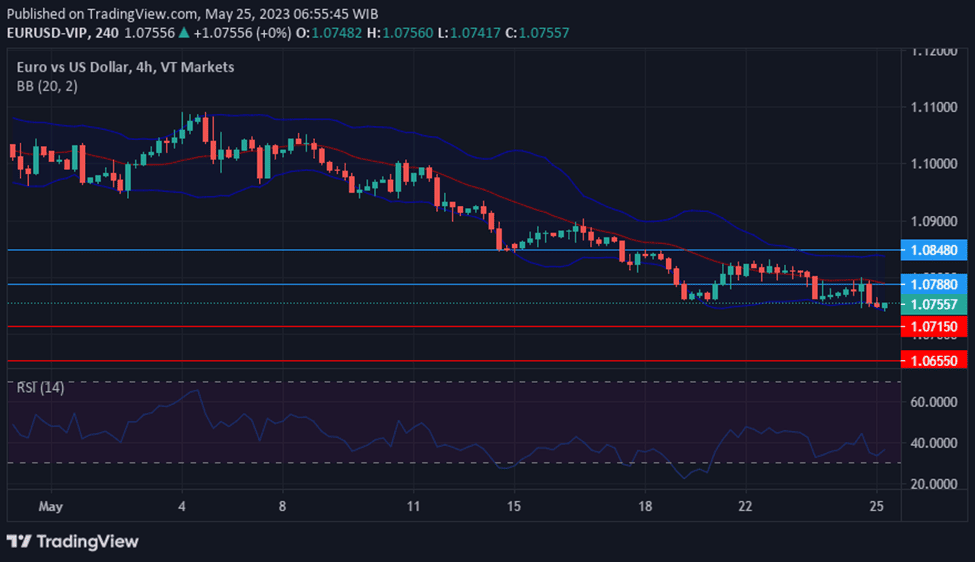
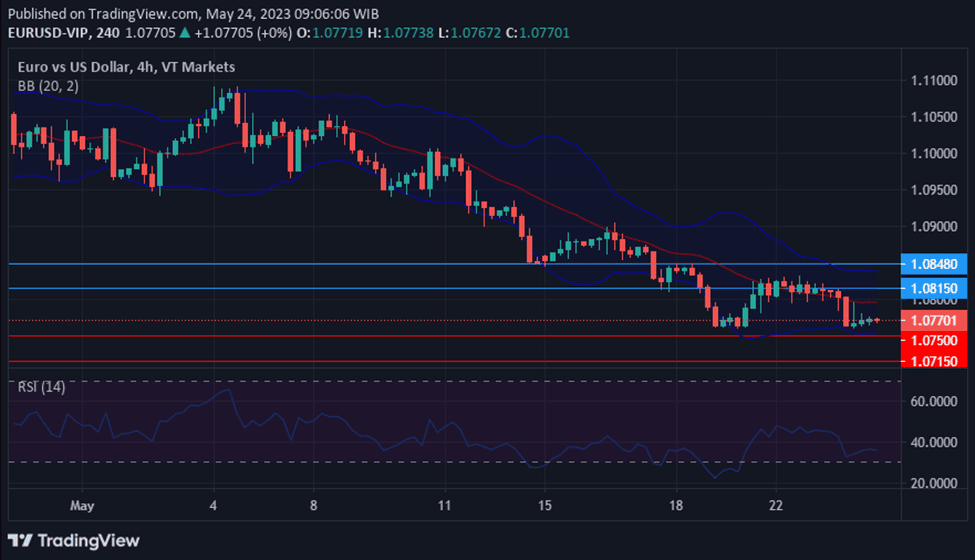
Chart EURUSD after the decline of the Dow

Chart EURUSD by TradingView

According to technical analysis, the EUR/USD pair is currently experiencing a minor consolidation and attempting to break its lowest price, putting pressure on the lower band of the Bollinger Bands. It is expected that the EUR/USD will continue to consolidate and gradually decline. The Relative Strength Index (RSI) is currently at 36, indicating bearish sentiment for the EUR/USD.

Resistance: 1.0788, 1.0848

Support: 1.0715, 1.0655

XAU/USD (4 Hours)

Gold (XAU/USD) Pressured as Risk Aversion and Fed Uncertainty Weigh on Markets

Gold prices (XAU/USD) encountered downward pressure on Wednesday as risk aversion gripped financial markets, leading to a dip in XAU/USD. The cautious sentiment benefited the US Dollar, pushing the price of gold toward daily lows around $1,956. The market unease was fueled by United States House Speaker Kevin McCarthy’s comments, highlighting significant differences in debt ceiling extension talks with President Joe Biden, focusing on spending cuts and opposition to tax hikes. McCarthy, however, expressed optimism about avoiding a default and eventually reaching a deal. Additionally, uncertainty surrounding the Federal Reserve’s future monetary policy further dampened sentiment, as investors eagerly awaited the release of the FOMC meeting minutes for insights. Recent hawkish comments from policymakers regarding possible rate hikes added to the prevailing cautious mood in the market.

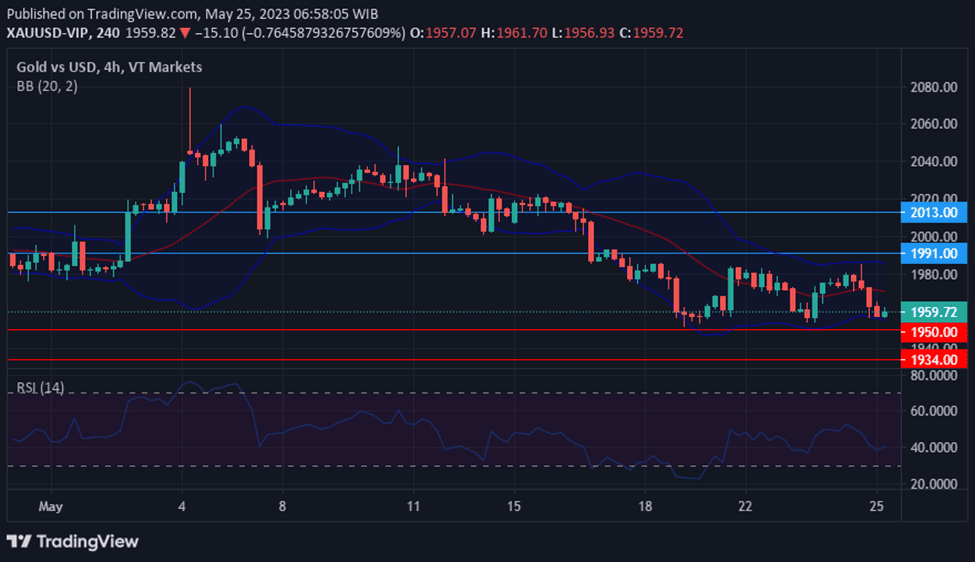
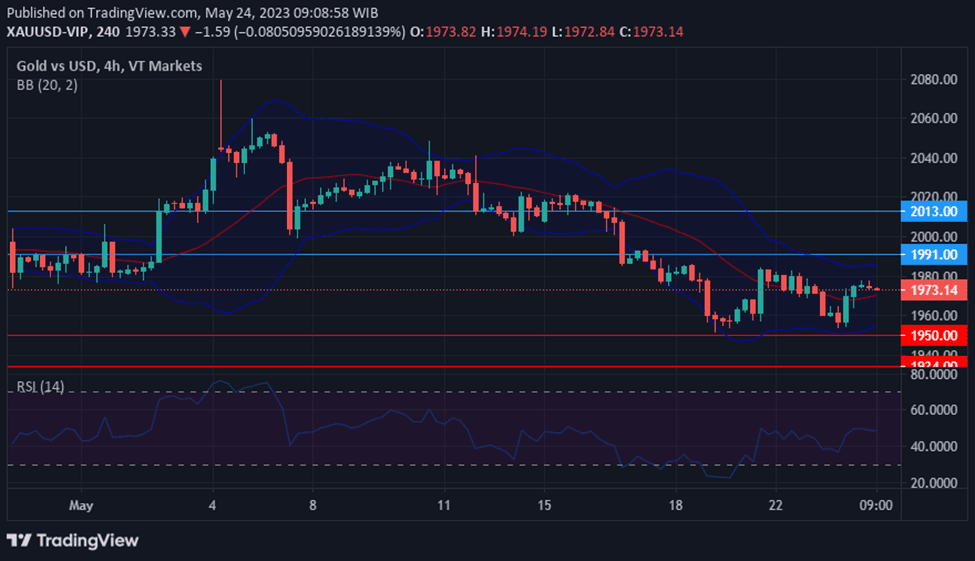
Chart XAUUSD after the decline of the Dow

Chart XAUUSD by TradingView

According to technical analysis, XAU/USD is moving lower on Wednesday and attempting to reach the lowest price of the week while approaching the lower band of the Bollinger Bands. There is a possibility that XAU/USD will continue to fluctuate between the support and resistance levels. Currently, the Relative Strength Index (RSI) stands at 40, indicating that XAU/USD is in a neutral but bearish position.

Resistance: $1,991, $2,013

Support: $1,950, $1,934

Economic Data

CurrencyDataTime (GMT + 8)Forecast
USDPrelim Gross Domestic Product q/q20:301.1%
USDUnemployment Claims20:30249K

How to trade gold

Gold is one of the oldest commodities to be bought and sold, and even though modern gold trading allows for far more sophisticated methods than traditional trading which requires you to physically acquire gold jewellery, bullion or coins, the commodity remains a popular and relatively stable option to include in an investment portfolio. 

If you’ve ever wanted to master how to trade gold, or you’ve been interested in investing in this hard commodity, there are a few things you’ll need to know before you get started. By following our in-depth guide, you’ll be able to discover what gold trading and investing is, what causes its price to fluctuate and how to decide what option for gold trading will serve you best. 

Step 1: Discover what gold trading and investing are

Gold has long been a valuable and highly prized precious metal for its lustre, its unique properties, and as a form of money. Many global currencies were traditionally backed by gold — a concept known as the gold standard. In the UK, currency was originally backed by sterling silver (hence ‘Pound Sterling’) and later became backed by gold. The gold standard was abandoned in the UK in 1931, but gold still remains a valuable commodity, and it is considered a stable asset that holds its value even during periods of economic uncertainty. With the demand for gold worldwide only growing, even as gold mining decreases, an assumed increasing demand also makes investing in or trading gold an attractive proposition for investors.

In order to start trading gold, you need to have a solid understanding of the types of gold assets available to you. Some of these involve taking possession of the physical asset, while others do not. 

  • Physical gold – The oldest and most traditional form of investing in gold is to literally buy a certain amount of the precious metal. Gold jewellery and gold coins do have some value, but the most significant form of investment in physical gold is with gold bullion.

    Because this option requires the security concerns, logistics requirements and insurance associated with holding a store of a physical asset, it is usually not undertaken by individual investors, but more commonly by banks and other financial institutions.
  • Spot price purchasing – Spot price purchasing refers to buying or selling gold upfront, at the price the metal is worth ‘on the spot’. This price is usually calculated per troy ounce, and can allow active investors to get exposure to bullion, without taking physical ownership of it.
  • Gold futures – Futures are contracts which determine a set price for gold and then nominate a date at which an exchange would be made in the future. Gold futures come with an obligation to make the exchange on the nominated date, and deal with speculation on the movement of the market to deliver investors a profitable return.
  • Gold options – Unlike futures, gold options do not obligate a trader to make an exchange, but they do allow for such an exchange to take place. There are two kinds of options: calls and puts. Calls give the right of exchange to buyers, while put options allow for the seller to make an exchange if they so choose.
  • Gold ETFs – An acronym for gold exchange traded funds, ETFs are passive investments which see a basket of shares in gold industry related companies viewed together, and this basket’s movement in the market is tracked. They’re good for giving investors a wider exposure and diversifying their portfolio.
  • Gold stocks – Finally, gold stocks are any stocks in gold production, mining, funding and sales companies which would allow a trader to gain direct exposure to the commodity through gold investment or trading. It’s worth noting that gold stocks won’t always move in line with the price of bullion, and therefore may require a more nuanced approach to understanding their trending price. 

How to trade gold CFDs

Before we move on to what moves the price of gold, let’s also touch on what gold CFDs are, and how to trade them. A CFD is a contract for differences. Gold CFDs allow a client to trade on a percentage margin of an asset’s full notional value, rather than the entire price – a concept known as leverage. 

CFDs, unlike options and futures, don’t have an expiration or pre-determined close date, and they’re good for riding short term market movements in the pursuit of further diversifying your portfolio. They also can be traded 24 hours a day, 7 days a week, unlike gold ETFs.

Step 2: Learning what moves the price of gold

Whether it’s short term movements or a long term investment you’re interested in, to learn how to trade gold successfully, you need to have a grasp on what causes the price of gold to fluctuate in the first place. Here are the major reasons for movement in price: 

  • Mining — As it’s a commodity – that is, a physical raw material – the supply of new gold into the market via mining is a key factor which will determine its price. Although gold can be recycled in a way that, for example, oil or wheat can’t be, it is still a finite resource, and mining globally has slowed over the past decade, with mining companies looking to preserve costs in the face of dwindling reserves.

    The search for new gold deposits continues, but for now this decline in mining suggests a rise in price as the demand for gold continues to rise and the amount of new gold deposits declines.
  • Demand — As mentioned above, the demand side of gold’s supply and demand equation becomes more important to price as the supply side dwindles. Demand for gold has predictably increased since the 70s, quadrupling every year for the last 50 years. Today, half of that demand is for jewellery, while gold ETFs also occupy a significant portion of overall consumption, at around 29% of total demand.
  • Global currencies — Especially the US dollar, but any currency of the G10 countries, tends to have an inverse relationship to the price of gold.

    If the price of gold is rallying against a major world currency like the US dollar, Japanese Yen or the Great British pound, this is traditionally seen as a good time to buy up the precious metal.
  • Interest rates — Typically, a rise in interest rates will cause gold’s value to fall as investors turn to fixed-income assets like property. Drops in interest rates tend to have the opposite effect, pushing investors back to the safe, secure investment that gold has for so long represented.
  • Political, economic and security issues — Gold has traditionally been viewed as a ‘safe haven’ – a reliable investment when uncertainty shakes markets, tanks currencies and threatens global security and stability. Volatility in other areas such as political instability, financial stress and major global events such as the COVID-19 pandemic all cause gold prices to spike.

    Conversely, periods of prosperity, growing GDP and positive financial markets tend to depress the price of gold in favour of oil and bond yields.

Step 3: Deciding how you want to trade or invest in gold

As you can probably tell from the above list of factors that move the price of gold, it can often be a tricky task to pinpoint which specific reason or combination of reasons is driving movement in the price of gold. Often, comparing the performance of gold in different markets to see a pattern of correlation can be insightful, so you may want to bear this in mind when you decide which option for investing in or trading gold is right for your portfolio. 

In general, trading gold is better for maximising exposure and taking shorter term positions, while investing in gold creates a more diverse portfolio geared toward long term gains. Gold ETFs and stocks are good for long term investment positions, while spot trading, gold futures and gold options are better suited for someone who wants to leverage their exposure, hedge their portfolio and not take ownership of any underlying assets. 

If you’re not sure which option to go with, opening up a demo account will allow you the freedom to practise gold trading, experiment with different options and learn more about the market without risk. 

Step 4: Creating your gold trading or investment account

After you’ve honed your skills with a risk-free demo account, you can get started trading in live markets by creating a live Forex account. This only takes a few minutes to set up, and is designed to be easy to use, even if you’re a first time trader. 

Step 5: Finding an opportunity

With your account, you’ll have access to trading tools, technologies and market analysis to find the right opportunity for gold trading. Make sure to take advantage of all the features that platforms like MetaTrader 4 and MetaTrader 5 offer you, so you can choose the right option based on technical indications and market trends. 

Step 6: Opening your first gold trade or investment

Your research of the market may reveal more than one potential opportunity for gold trading, but it’s also important to make sure you manage your risk and don’t over-expose your position. Implementing a tool like a stop-loss order or limit-close order can help you in this regard, providing an automatic threshold under which your trade will automatically be closed. 

Whether you choose to open trading for a spot price gold trade, a gold future, gold option or gold ETFs will depend on whether you want to go long or short on gold. As we’ve touched on, spot gold, gold futures and gold options are good for short term trading, while gold stocks and ETFs suit long term plays. Either way, you’ll need to make sure you’ve done your technical and fundamental analysis before making a move and opening a gold trade.

Step 7: Developing your strategy and closing your position

When your trade is open, VT Market’s powerful platforms make it easy to monitor your profit or loss position, and keep an eye on broader market trends and moves, so you can close your position in the strongest possible place according to your investment and trading strategy. 

Ready to start trading gold

If you’re feeling primed and ready to start trading gold, VT Markets is the perfect platform to help you trade gold using a method that works with your broader investment or trading strategy. From exceptional customer service to our innovative trading platform you can use easily from your own computer or mobile device, we’re here to help empower you to build a diverse portfolio and watch your profits grow. 
From learning how to trade gold and copper to providing expert market analysis and Forex signals, VT Markets makes getting started with market trading transparent, straightforward and simple. Get started by creating your gold trading account today, or get in touch for more information about using our trading tools yourself.

How to trade oil

It’s one of the world’s most vital hard commodities, powering energy and transport all around the globe. If you’ve wondered how to trade oil yourself, it becomes clear that this finite resource emerges as one of the most appealing trading instruments if you navigate the price fluctuations of supply and demand effectively.

In order to do so, though, you’ll need to understand what oil trading is and the different ways you can invest in this volatile asset for both the short and the long term. 

In this article, we’ll break down what oil trading involves and the steps for how to trade oil as an individual investor. 

Step 1: Learn what oil trading is

Understanding oil trading means understanding the resource itself. So, let’s first define what this asset is. Oil is a kind of hard commodity, which is a natural resource mined, collected or extracted from the earth. 

In its least refined form, this asset is known as crude oil. There are different types of crude oil that are categorised according to where they originate from geographically. 

Two primary types are Brent Crude Oil, originating from the North Sea, and West Texas Intermediate (WTI) Crude Oil, originating from oil fields mainly in Texas, Louisiana and North Dakota. Both types of crude oil are preferred for being more ‘sweet’ than other types of crude, making production and refinement cheaper. 

As you’re probably aware, oil is necessary for the creation of diesel, gasoline and other petrochemicals, making it the world’s primary energy source — and thus is in high demand globally.

There are several ways to trade oil, which have different pros and cons, depending on the kind of investment you want to make: 

  • Oil futures  Futures contracts are speculative contracts requiring two parties to agree to exchange an asset at a set price on a certain date. Oil futures are traded on exchanges and are one of the most popular methods of trading oil, allowing investors to trade rising and falling prices. Brent Crude Oil is traded on the Intercontinental Exchange (ICE), and WTI Crude is traded on the New York Mercantile Exchange (NYMEX).

    Oil futures are a mechanism that lets companies lock in an advantageous price for oil and provide a theoretical buffer against unfavourable price movements. Speculative traders may also prefer to trade oil futures because they don’t require taking possession of any physical assets themselves. Trades are made by betting on the price movement of the asset, not the asset’s value itself.
     
  • Oil spot price Unlike oil futures, which set a price for a date in the future, oil spot prices represent the value of the commodity at the point at which the trade is made — ‘on the spot’ — as it were. There’s still some speculation involved with oil spot price trading because you’re betting that the market will rise or fall in a favourable way for you after you make your trade. However, the price at the time of the trade is not speculative; it’s the current market price.
  • Oil options Oil options allow you to buy or sell the right to trade oil at a fixed price — but without any obligation, if you don’t want to. It’s entirely up to you if you exercise your option. Options are divided into two categories: calls and puts. A call option is your go-to if the market is set to rise. If a market fall is expected, a put option is what you’d buy.

    If you want to take an opposing position, you can also sell options in these circumstances. When the market is quiet, selling your options can generate some handy income, but there’s an element of risk involved — if the market turns against you, you may end up losing more.

Oil futures and options will both expire at a nominated date, while oil spot prices do not. One way to trade all these, which offers more flexibility, is with oil CFDs (or contracts for difference) — a financial derivative that doesn’t require you to accept the same obligations trading in oil futures entails.

Step 2: Learn what factors affect the price of oil

So now you know what types of oil trading are out there; it’s time to cover what can cause the price of oil to move. As we’ve mentioned, oil is a potentially very profitable asset due to its volatility. In order to harness that potential, you need to be prepared for major fluctuations in the market. 

Just some of the factors that may cause the price of oil to sharply rise or fall include: 

  • Seasons of demand
  • Economic growth
  • Population increases
  • Natural disasters
  • Geopolitical conflict and war and civil unrest
  • The cost of freight and shipping options
  • Other issues of supply and demand, like the rise of renewable energies

You’ll not only need to have a good overview of these factors, but you’ll also have to keep an eye on breaking news and key price levels in order to make informed oil trades of Brent Crude Oil, WTI Crude Oil, heating oil and no lead gasoline. 

One upside to learning how to trade oil is that it is traded in such large volumes that there is plenty of data — and therefore expert analysis of this data — that you can dive into to better understand the market. This analysis falls into two categories: fundamental and technical analysis. 

  • Fundamental analysis Think of this as the analysis concerned with breaking news and contextual information. Fundamental analysis of oil trading can be news announcements of oil spills, production shortages or corporate acquisitions, company financial statements and analysis of the general economic stability in a particular region. Fundamental analysis may also take the form of op-eds from specialist journalists and columnists in financial news publications.
  • Technical analysis The second part of analysing the market for oil trading is technical analysis. Studying technical aspects of historical price data can help better predict the movements of the market in the future. It encompasses price charts, trendlines, graphs and other market statistics. Technical analysis is predicated on the theory that price charts hold the most salient information about security, that prices move in trends, and that these trends will repeat over time.

Step 3: Start to practise trading oil with a risk-free demonstration account

Once you’ve started to follow oil trading analyses and learned to interpret the data, spot trends and feel more confident in your understanding of the market, you can start to practise making your own trades by opening a risk-free demo account. Here, you can experiment with the decisions you’ll need to make to trade oil before moving into real markets and investments.

Running a demo oil trading account before you jump into live markets can help you test your knowledge and get a feel for the market’s volatility, which can better help you decide how you want to go about oil trading.

For example, some people prefer to engage in day trading, which deals with the relatively smaller fluctuations that occur in a single day of trading from when markets open to when they close. This training period also allows you to familiarise yourself with different platforms. At VT Markets, we use the powerful MT4 and MT5 platforms, which you can download and use on a number of devices, including mobile and PC. 

Step 4: Create your trading account

After experimenting and practising trading oil, you’re ready to dive into a live trading environment. Creating a Forex trading account with top-tier authority regulation only takes a few minutes, and you can usually start building up and managing your portfolio the same day. 

VT Markets allows you to trade multiple securities and commodities, so whether you want to jump straight into oil trading or diversify with energy trading, the choice is entirely up to you. 

Step 5: Find the right opportunity

With plenty of expert knowledge, tools and insider resources at your fingertips, you’ll soon be ready to identify your first opportunity for oil trading. VT Markets offers customers trading tools like expert advice, Forex signals and a detailed economic calendar — as well as daily market analysis so you can track oil’s sometimes volatile movements. 

Step 6: Open your first oil trade

Found the right opportunity? It’s time to open your first oil trade. This may be a decision to buy or sell, depending on how oil prices move. No matter what trade you make, you’ll need to carefully balance the risk involved with the move and make sure that you can mitigate risk with various tools. 

For example, a stop-loss or limit-close order will protect your trades from dropping below a certain unacceptable level of loss automatically. 

Step 7: Develop your strategy and close your position

Once your oil trade has been opened, you can monitor the market’s movements and stay reactive based on breaking news and relevant data. The time you spend riding an open trade through price fluctuations will depend on a number of factors, including whether you want to engage in a long-term or short-term strategy. When you’re ready (or when your stop-loss order is reached), close your position.

There’s no doubt that a lot of study and research is required to understand and successfully navigate oil trades in global markets. Fortunately, with VT Markets, you can access customer support and help you make the most of the powerful trade platforms, tools and analysis available to you.

FAQs

What are the ways to trade oil?

Generally, there are three ways to trade oil; through oil futures, spot price purchasing and oil options. In order to engage with these types of trading, investors can use a number of different methods and derivative products, including crude oil spread betting, oil CFDs (contracts for difference) and oil ETFs (exchange-traded funds).

What is the difference between Brent, WTI and other types of oil?

Not all crude oil is created equal, and some types of crude have a higher density and sulphur percentage, making them more expensive to produce and refine than their ‘lighter’ and ‘sweeter’ counterparts. 

Sour crude oil is less in demand and often less valuable than Brent or West Texas Intermediate (WTI) Crude Oils. Brent and WTI are named after specific geographic regions, the North Sea and areas of the U.S., respectively, and they are considered sweet, light crude oils. 

Brent Crude is responsible for two-thirds of the world’s global oil supply, and both act as global benchmarks for oil prices in all markets. As well as crude oil, which is used for petrochemical, gasoline and diesel production, it is possible to trade oils used for heating and no lead gasoline.

What are commodities and how do you trade them

Commodities are the raw materials that underpin the entire global economy. From food production to manufacturing, tech to the energy sector, commodities are the building blocks for it all. In this article, we’ll discuss what commodities are, how to trade them, and what decisions you’ll need to make if you’re interested in trading commodities yourself. 

What are commodities

Commodities are, simply put, the raw materials that are harvested, collected and processed into food, goods and the services all human beings use for activities every day. 

Trading commodities is different to trading stocks or bonds because they are physical materials and goods. Commodities’ fluctuations in price make them potentially profitable markets to trade in. However, they can also carry more risk than bonds and the stock market, because of unpredictable price movements and the specialised knowledge and research required to stay informed of the market. 

How to trade commodities

Before you start trading commodities, you’ll need to choose which commodity you’re interested in. They are typically divided into two categories. 

  • Hard commodities — These are mined or otherwise extracted natural resources, such as natural gas, coal, oil and precious metals like gold and copper.
  • Soft commoditiesUnlike hard commodities, which are extracted from the earth, soft commodities are grown or harvested. Examples include livestock like hogs and cattle (which may be used for both foods and goods like leather or gelatine) and agricultural crops like coffee, cocoa and wheat, palm oil and timber.

Whether you want to trade energies, learn how to trade oil or trade soft commodities, all of these markets deal with physical goods which must be grown, reared or discovered and then harvested or collected by human labour. This makes them much more vulnerable to a range of outside factors and variable supply and demand than purely financial products (such as stocks and bonds).

Commodities trading

Commodities trading is one of the oldest forms of trade and is the original basis for what modern investing has become today. The process might have started with farmers negotiating prices for their goods outside of harvest time, but these days, wanting to trade commodities involves a more sophisticated process. Trading commodities can be done in a few ways, with each offering advantages and disadvantages, which may or may not suit your portfolio and your approach to trading.  

Commodities futures

One way to conduct commodities trading is through the exchange of different types of assets in the form of futures contracts. Futures contracts allow investors to buy and sell on a futures exchange, with a determined future price for the assets which is agreed to by both parties. Where futures can make traders profits is in the way the actual asset price may differ from this agreed price. The actual price of a commodity could spike or crash due to market forces and external factors — so while a huge fluctuation in price could mean a win for you, it could also expose you to more risk and losses. Commodities futures aren’t involved in the trading of the physical goods and resources themselves — they’re a bet on the movement in price changes only.

Purchasing physical commodities 

Unlike futures, which speculate on the predicted price of goods in the future, some types of commodities can be physically acquired by an investor. Because these transactions can cost more than other investments, they are usually only reserved for very value-dense commodities like precious metals and not for assets like crops, livestock or energy commodities. 

If you’ve been wanting to learn how to trade gold or how to trade copper, this could be the route for you. 

Commodities stocks

Commodities stocks offer a way to trade commodities that are linked to a company producing the asset rather than in the value of the raw asset itself. Commodity stocks allow you to obtain indirect exposure to the commodities market, but they do come with some complex underlying principles. For instance, some commodities stocks move in step with the commodity price, while others have a variable relationship with the commodity price and their own stock price.

Here’s an example: a global shortage of a certain commodity like oil might indicate a drop in an oil company’s stock value, but in the longer term, a supply issue would cause increased demand and allow oil to rise in value, thus making the shortage advantageous to oil company stockholders. 

If you want to invest in something that closely follows the fluctuation of a commodity’s price, commodities stocks aren’t the best way to do this. If you’re interested in gaining exposure to a commodities market without trading on the asset’s market price though, they’re a great way to do this. 

Commodities ETFs

ETF stands for exchange traded funds, and they are a type of investment instrument that works by holding an asset type in a larger commodities basket. Leveraging commodities ETFs is a good way to diversify your portfolio from a single position. However, because commodities ETFs use a process to mimic a commodity’s price, they may not always perfectly reflect the reality of the market. 

Ultimately, you need to weigh up the pros and cons of each of these commodity trade options, as well as stay on top of the expert analysis and trade indicators in order to start trading commodities in a way that’s profitable and sustainable in the long term. 

Factors that might affect commodity trade

We’ve mentioned expert knowledge, research and analysis a few times here, and it’s worth reiterating that commodities trading really does require keeping a close eye on breaking news and events that will affect the market. But more than just keeping an eye on a particular stock market or a narrow range of investor-relevant updates, commodities trading can be affected by many different global socioeconomic, environmental and political factors. Here are some of them:

  • Geopolitics — With so many commodities being sourced and traded globally, the international political situation can have a huge effect on the health of commodities trading in many areas. The most recent war in Ukraine has been a timely reminder of this, with the conflict affecting grain prices, among others. Another example of geopolitics at play: in the past several decades, the political situation in the Middle East has been closely tied to the performance of oil as a commodity.
     
  • Domestic politics — Domestic politics in an asset’s country of origin can also affect the global commodities market. If the majority of a precious metal like copper is mined in a certain country and the labour laws governing those mines suddenly change overnight, this will have a significant impact on the commodity’s price going forward.
  • Weather — Rainfall, drought, unexpected cold snaps and heat waves — weather events have the capacity to change a commodity’s value overnight. From natural disasters to unpredictable wet and dry seasons, weather events have the capacity to impede a commodity’s production at all stages of the supply chain, which means weather needs to be monitored closely.
  • Market competition — Technological changes to the way we produce energy, manufacture large-scale infrastructure or even the technology we use day to day can all evolve, causing a once booming commodity industry to suffer a loss to the new competition (e.g. oil making way for natural gas and renewables). New companies arriving to market can also upset the landscape of commodities trading.
  • Seasonality — With agricultural and livestock soft commodities, there’s a level of predictability around harvest and slaughter times, which will cause an oversupply in the market and generally lead to lower prices. In the period leading up to harvest, good weather forecasts can boost a commodity’s price.
  • Macroeconomics — The health of the economy at large is also going to affect commodities prices. Fluctuations to GDP, inflation, interest rates, the construction and transport industries, wages, trade embargoes and sanctions can all upset a predictable commodities market and create unexpected results.
  • Other environmental factors — Commodities are affected by material conditions in our world in a way stocks and bonds just aren’t. Events like the 2021 Suez Canal obstruction, in which the Ever Given blocked the crucial shipping route for six days, is one such example of this. Disruptions to the supply chain can occur for all sorts of reasons and expose commodities traders to risks they couldn’t have predicted. 

Building a strong portfolio with trade commodities

Because commodities trading is by its very nature higher risk and reward than other kinds of trade, it offers some unique opportunities. However, it can also expose vulnerabilities in your portfolio and requires a trader to be able to weather some short-term losses in order to benefit from longer-term gains. 

For this reason, many investors choose to dedicate a portion of their overall portfolio to trading in commodities markets. For example, 20% of your total portfolio could be dedicated to commodities trading, protecting you from over-exposure but opening you up to big potential wins down the line. 

Ready to create your commodity trading account?

If you’ve been following a commodities market, buffing up on your knowledge of political and environmental factors that might affect it and reading expert insights from financial journalists, you may be eager to open a commodity trading account. At VT Markets, we offer beginner-friendly and globally recognised trading platforms in a user-friendly interface, so you can trade commodities using a transparent and trusted forex trading environment that’s totally secure.

Want to know more about how we’ve designed our systems to meet the needs of clients? Get in touch and we’ll help you with anything you need, from choosing your account type to managing your investment size and leveraging the right commodities trading options to suit you.

FAQs

How do I start trading commodities?

Once you’ve done your research and decided which commodities you want to trade, VT Markets can help you find the right trading opportunity, monitor your commodities and close in a strong position with the help of powerful official trading platforms MetaTrader 4 and MetaTrader 5

If you want to start practising the way you trade commodities before launching into global markets, our demo account is a great jump-off point. This zero-cost method is a good beginner option as you become familiar with different trading options, from oil CFDs to soft commodity and energy trading

What are the most traded commodities in the world?

When it comes to the most traded commodities in the world, the winners, unsurprisingly, tend to be goods that are consumed at a high rate on a daily basis by much of the world’s population. 

Hard commodities that are used for energy consistently top the list, with Brent Crude Oil, West Texas Crude Oil and natural gas often leading the list. They’re followed by highly traded metals like steel and copper and consumer goods like coffee and cocoa. 

Stocks Slide as Debt Ceiling Negotiations Show Little Progress

Stocks experienced a decline on Tuesday as discussions regarding the debt ceiling continued with minimal signs of advancement. The S&P 500 dropped 1.12% to settle at 4,145.58, while the Nasdaq Composite pulled back 1.26% to close at 12,560.25. The Dow Jones Industrial Average also lost 0.69%, or 231.07 points, finishing at 33,055.51. The lack of significant updates on the negotiations left some traders concerned about the lawmakers’ ability to make progress as hoped. Investors have been closely watching the debt-limit negotiations, seeking more certainty as the June 1 X-date, projected by Treasury Secretary Janet Yellen, approaches. Despite the ongoing uncertainty, market stability has impressed experts like Mohamed El-Erian, the chief economic advisor at Allianz, who noted that the S&P 500 remains fairly priced.

While there is an expectation that lawmakers will eventually reach a resolution regarding the debt ceiling, caution prevails due to persistent recession fears and uncertainty surrounding the Federal Reserve’s next rate move. Sandi Bragar, the chief client officer at Aspiriant, emphasized the need for caution, stating that although many investors are eager to participate in the current market conditions, it may not be the time for excessive enthusiasm. Meanwhile, notable stock movements included Apple’s 1.5% decline following the announcement of a multibillion-dollar chip production deal with Broadcom, and Yelp’s 5.7% increase as an activist investor called for the company to explore a sale.

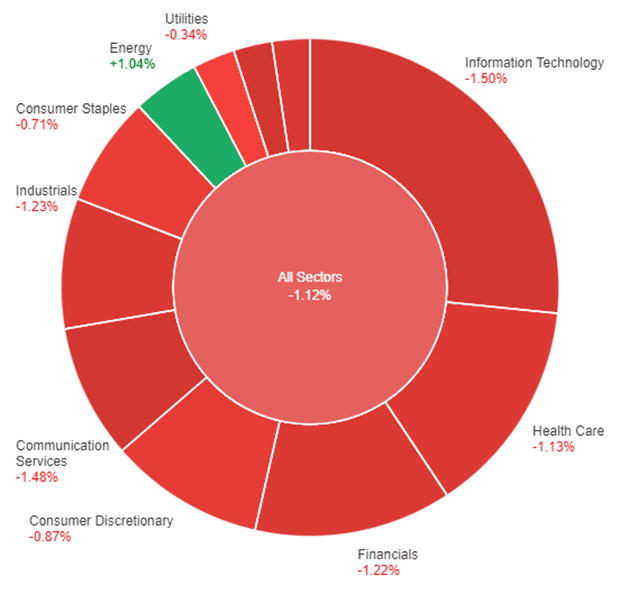
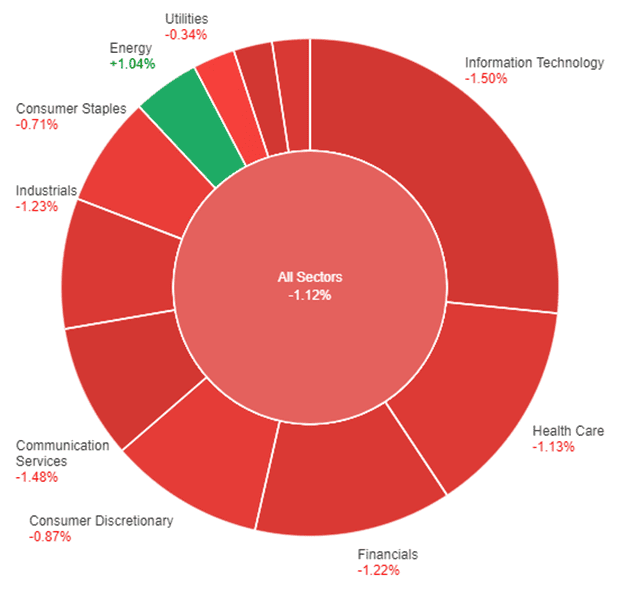
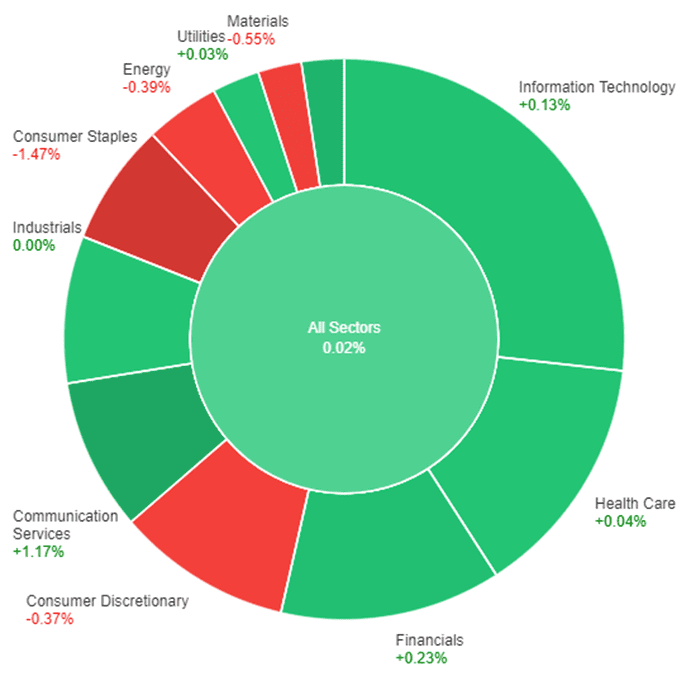
All sectors performance as debt ceiling negotiations show little progress

Data by Bloomberg

On Tuesday, the stock market saw a general decline across all sectors, with the overall market dropping by 1.12%. The energy sector, however, experienced a slight increase of 1.04%. The utilities sector decreased by 0.34%, while consumer staples and consumer discretionary sectors declined by 0.71% and 0.87%, respectively. The health care sector faced a larger decline of 1.13%. Financials and industrials both experienced decreases of 1.22% and 1.23%, respectively. Real estate and communication services sectors saw larger declines of 1.28% and 1.48%, while the information technology sector had the largest decline at 1.50%. The materials sector also faced a significant decline of 1.54% on Tuesday.

Major Pair Movement

On Tuesday, the market focus was on the EUR/USD, which traded lower due to concerns about slower economic growth, leading to increased demand for safe-haven assets. The divergence between the rate paths of the Federal Reserve (Fed) and the European Central Bank (ECB), along with contrasting data from the United States and the euro zone, contributed to the pair’s decline. The euro zone’s composite PMI for May decreased to 53.3, with a deeper contraction in the manufacturing component at 44.6. In contrast, the U.S. Philly Fed services index improved to -16.0, showing growth in the new orders component. This mixed data caused investors to adjust their expectations for the Fed and ECB rate paths, with rate cuts now priced in for both central banks in the Eurodollar and Euribor rates markets.

Consequently, the USD Index rose slightly by 0.27%, and the dollar’s yield advantage increased, reflected in the widening U.S.-German 2-year spreads. In other major pairs, GBP/USD was slightly lower by 0.17%, AUD/USD fell by 0.57%, and today we are expecting the RBNZ rate statement. The market remains attentive to the developments in central bank policies and economic data, as they continue to impact currency pairs. Traders will closely watch the upcoming RBNZ rate statement for any indications of potential changes in interest rates or monetary policy.

Picks of the Day Analysis

EUR/USD (4 Hours)

EUR/USD Slides as Dollar Strengthens Amid Weak Eurozone Data: Market Focus on Upcoming Releases and US Debt Ceiling Negotiation

The EUR/USD continued to fall after a brief recovery, reaching last week’s lows around 1.0760. The euro remains weak compared to the US dollar due to a stronger dollar and disappointing data from the Eurozone. The European Central Bank’s hawkish statements did not provide much support as economic indicators, such as the Manufacturing index, came below expectations. In contrast, the US dollar remained strong, supported by risk aversion, and mixed economic data. Market participants are eagerly awaiting upcoming economic releases from the Eurozone, as well as the FOMC minutes and ongoing debt-ceiling negotiations in the US.

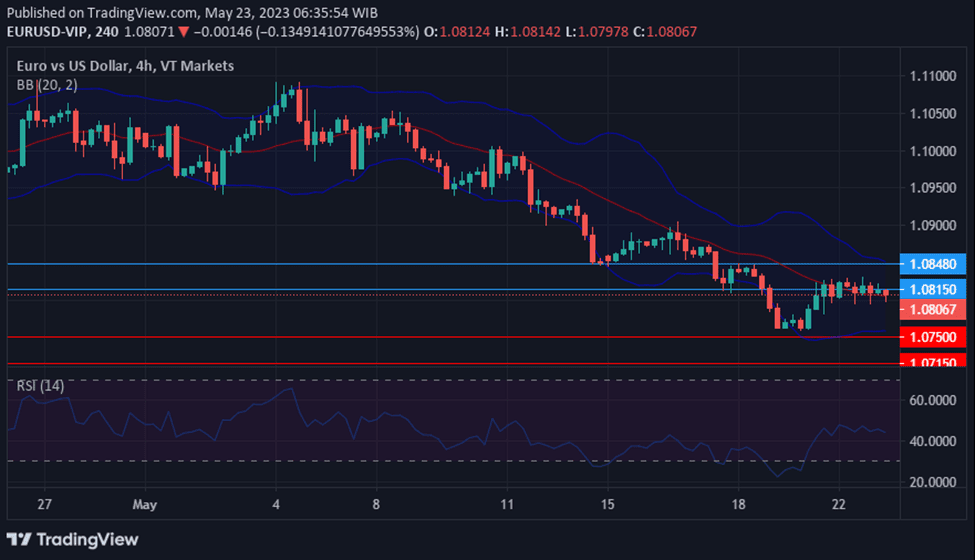
Chart EURUSD as debt ceiling negotiations show little progress

Chart EURUSD by TradingView

According to technical analysis, the EUR/USD pair is currently undergoing a minor consolidation near its lowest price and close to the lower band of the Bollinger Bands. It is expected that the EUR/USD will remain in a consolidation phase throughout the day. The Relative Strength Index (RSI) is currently at 36, indicating bearish sentiment for the EUR/USD.

Resistance: 1.0815, 1.0848

Support: 1.0750, 1.0715

XAU/USD (4 Hours)

Gold (XAU/USD) Prices Recover Slightly as Market Concerns and Fed’s Mixed Messages Weigh on Investor Sentiment

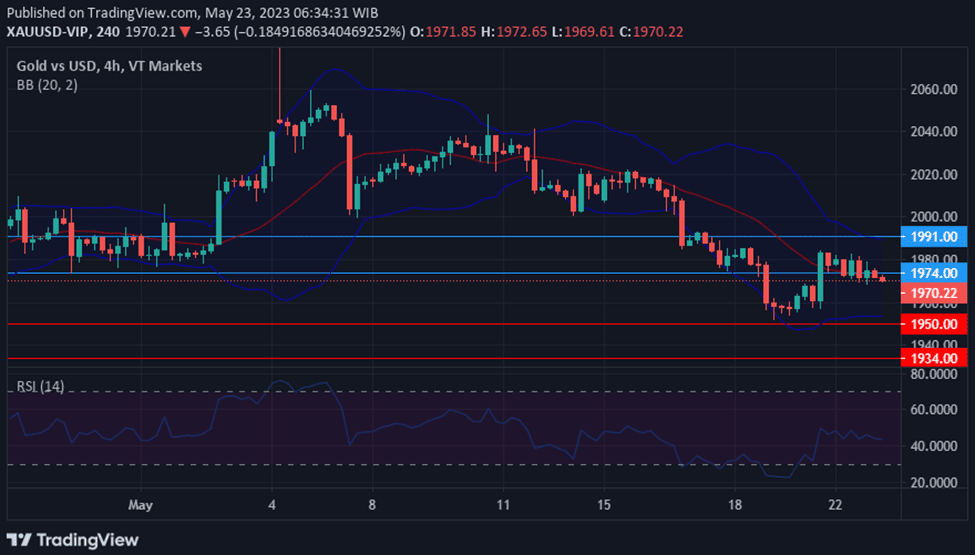
Gold prices (XAU/USD) initially dropped to $1,954.22 during European trading due to concerns in the market favoring the US Dollar. However, gold managed to recover slightly and is currently trading at around $1,972, showing minimal change for the second consecutive day. The financial markets are exhibiting risk aversion due to lackluster macroeconomic data and uncertainty surrounding the Federal Reserve’s future actions. While the Fed had taken a cautious approach in raising rates earlier in May, recent statements from various Fed members have surprised investors with a more hawkish stance, suggesting the possibility of one or even two more rate hikes. The release of the FOMC meeting minutes on Wednesday is anticipated to provide further insight into monetary policy plans. Additionally, S&P Global’s preliminary estimates indicate that the US services sector experienced faster growth than expected, while manufacturing output contracted to a three-month low. Europe demonstrated a similar pattern, with accelerating services output but contracting industrial activity.

Chart XAUUSD as debt ceiling negotiations show little progress

Chart XAUUSD by TradingView

According to technical analysis, XAU/USD experienced a small upward movement on Tuesday and successfully reached our resistance level. It settled around the middle band of the Bollinger Bands. There is a possibility that XAU/USD could continue moving higher and attempt to reach the upper band of the Bollinger Bands. Currently, the Relative Strength Index (RSI) is at 48, indicating that XAU/USD has returned to a neutral position.

Resistance: $1,991, $2,013

Support: $1,950, $1,934

Economic Data

CurrencyDataTime (GMT + 8)Forecast
NZDOfficial Cash Rate10:005.50%
NZDRBNZ Monetary Policy Statement10:00
NZDRBNZ Rate Statement10:00
NZDRBNZ Press Conference11:00
GBPConsumer Price Index (y/y)14:008.2%

Market Holds Steady as Debt Ceiling Meeting Looms and Tech Stocks Lead the Way

On Monday, the S&P 500 index experienced minimal change as investors awaited a crucial debt ceiling meeting and officials worked to prevent a default. The index slightly increased by 0.02% to close at 4,192.63, while the Dow Jones Industrial Average fell by 0.42% to end at 33,286.58. In contrast, the Nasdaq Composite rose by 0.5% to settle at 12,720.78, reaching its highest closing and intraday levels since August. President Joe Biden and House Speaker Kevin McCarthy were scheduled to hold talks concerning the debt ceiling, with only 10 days remaining before a potential U.S. default. Negotiations faced hurdles due to disagreements over government spending cuts and tax increases.

Despite uncertainties in Washington and concerns about inflation, the stock market continued to rise, particularly driven by technology stocks, resulting in a winning week for major averages. The S&P 500 approached the 4,200 level, but market analysts emphasized the need for broader market participation to sustain the rally in the long term. Sylvia Jablonski, CEO at Defiance ETFs, suggested that stronger market breadth might come after the Federal Reserve’s June meeting. Economic data for the week included the second reading for first-quarter GDP on Thursday and the release of the Fed’s preferred inflation measure, the personal consumption expenditures gauge, on Friday. Additionally, investors awaited the Fed minutes from the May meeting, which could provide insights into the central bank’s stance on potential interest rate hikes. Notable upcoming reports included earnings announcements from Zoom Video, Lowe’s, and Dick’s Sporting Goods, signaling the winding down of the first-quarter earnings season.

All sectors performance as debt ceiling meeting looms

Data by Bloomberg

On Monday, the overall market showed a slight increase of 0.02%. Among the sectors, Communication Services performed the best, with a gain of 1.17%, followed by Real Estate, which rose by 0.67%. Financials experienced a modest increase of 0.23%, while Information Technology and Health Care sectors saw smaller gains of 0.13% and 0.04% respectively. Utilities and Industrials sectors remained relatively stable with minimal changes at 0.03% and 0.00% respectively. However, Consumer Discretionary, Energy, Materials, and Consumer Staples sectors all recorded declines, with Consumer Staples suffering the most significant loss at 1.47%.

Major Pair Movement

The US dollar index experienced a rise after comments from Minneapolis Fed President Neel Kashkari and St. Louis Fed President James Bullard suggested a hawkish stance. Kashkari indicated the possibility of interest rates exceeding 6%, while Bullard mentioned the potential for additional rate hikes in 2023. However, San Francisco Fed President Mary Daly took a more cautious approach, awaiting further data and suggesting that tighter credit conditions may be equivalent to one or two rate hikes. Atlanta Fed President Raphael Bostic expressed comfort in observing the economy’s performance given the significant tightening measures implemented thus far. Traders remained cautious due to ongoing debt ceiling negotiations aiming to prevent a US default before the June 1 deadline.
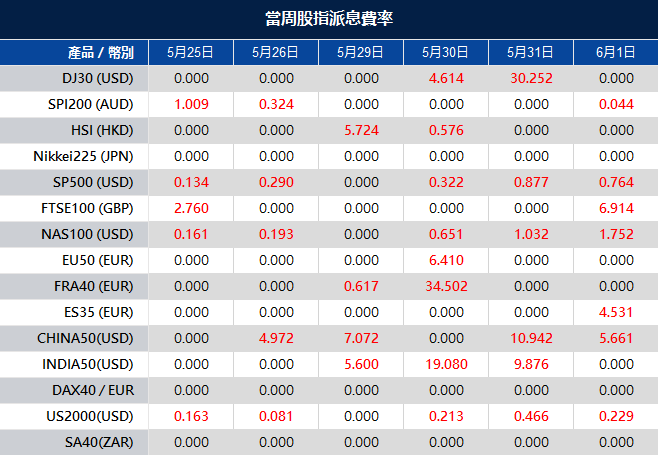
The EUR/USD pair experienced a slight dip, while front-end futures rates saw a modest increase in December 2023 rate cut expectations. USD/JPY rose as US-Japan yield expectations were influenced by the tighter Fed rate outlook. GBP/USD declined, influenced by the hawkish expectations of the Fed, as traders adjusted their positions ahead of important data releases. Bitcoin traded at $26.8k with minimal movement, while gold and silver prices experienced declines due to higher US yields impacting precious metals.

Picks of the Day Analysis

EUR/USD (4 Hours)

EUR/USD Holds Steady Amid Central Bank Talks and Debt Limit Negotiations

The EUR/USD remained steady at 1.0800 level after recovering from a month-low, but the overall sentiment remains negative. The focus shifted to central bank discussions and negotiations around the US debt limit. Federal Reserve officials expressed a hawkish stance, suggesting the need for higher interest rates. The market expects a potential rate hike in June, but chances are around 25%. The release of FOMC minutes and the Core Personal Consumption Expenditures Price Index will be crucial for monetary policy expectations. Additionally, attention is on resolving the debt limit crisis. Increased volatility is expected as European PMI numbers are released, providing insight into economic performance in May. The market anticipates another rate hike from the European Central Bank, although consensus on future actions is starting to waver.

Chart EURUSD as debt ceiling meeting looms

Chart EURUSD by TradingView

According to technical analysis, the EUR/USD pair is currently experiencing a slight upward movement from its lowest price, returning to hover around the middle band of the Bollinger Bands. It is anticipated that the EUR/USD will maintain a consolidation phase during the early session before adjusting its movement based on key events, namely the Flash Manufacturing and Services PMI reports scheduled for today. The Relative Strength Index (RSI) currently stands at 44, indicating that the EUR/USD has returned to a neutral position.

Resistance: 1.0815, 1.0848

Support: 1.0750, 1.0715

XAU/USD (4 Hours)

Gold (XAU/USD) Under Pressure as Markets Await Catalysts and Monitor US Debt-Ceiling Talks and Fed’s Rate Hike Signals

Spot gold (XAU/USD) is experiencing slight downward pressure as it trades at around $1,975 per troy ounce, although it remains at the higher end of Friday’s trading range. The market is eagerly awaiting a new catalyst while keeping an eye on US debt-ceiling negotiations, as a potential default on June 1 looms. Discussions are ongoing but no significant agreements have been reached yet. Tensions are also rising ahead of the release of the FOMC Meeting Minutes next Wednesday, accompanied by statements from several Federal Reserve speakers. James Bullard believes the central bank will raise the policy rate further with at least two more 25 basis points hikes, while Neel Kashkari sees it as a close call and is willing to maintain rates to assess past rate increases’ effects. Mary Daly suggests that tighter credit conditions could be equivalent to one or two rate hikes and emphasizes the need for data-dependent decision-making. Financial markets predict that the US central bank will avoid raising rates in June and July due to concerns over potential harm to the financial system.

Chart XAUUSD as debt ceiling meeting looms

Chart XAUUSD by TradingView

According to technical analysis, on Monday, XAU/USD made a slight upward movement but was unable to maintain its position and dropped below our resistance level, settling around the middle band of the Bollinger Bands. There is a chance that XAU/USD might undergo a modest downward movement and attempt to reach the lower band of the Bollinger Bands. Currently, the Relative Strength Index (RSI) is at 43, signaling that XAU/USD has returned to a neutral stance.

Resistance: $1,974, $1,991

Support: $1,950, $1,934

Economic Data

CurrencyDataTime (GMT + 8)Forecast
EURFrench Flash Manufacturing PMI15:1546.1
EURFrench Flash Services PMI15:1554.0
EURGerman Flash Manufacturing PMI15:3044.9
EURGerman Flash Services PMI15:3055.0
GBPFlash Manufacturing PMI16:3047.9
GBPFlash Services PMI16:3055.5
USDFlash Manufacturing PMI21:4550.0
USDFlash Services PMI21:4552.6
Back To Top
server

Hello there 👋

How can I help you?

Chat with our team instantly

Live Chat

Start a live conversation through...

  • Telegram
    hold On hold
  • Coming Soon...

Hello there 👋

How can I help you?

telegram

Scan the QR code with your smartphone to start a chat with us, or click here.

Don’t have the Telegram App or Desktop installed? Use Web Telegram instead.

QR code