
Back

China’s central bank set USD/CNY at 6.8961, versus 6.9057 prior fix and 6.8874 estimate

The People’s Bank of China (PBOC) set the USD/CNY central rate for Tuesday at 6.8961. This compared with the previous day’s fix of 6.9057 and a Reuters estimate of 6.8874. The PBOC’s main monetary policy aims are price stability, including exchange rate stability, and supporting economic growth. It also works on financial reforms, such as opening and developing financial markets.

Governance And Independence

The PBOC is owned by the state of the People’s Republic of China, so it is not an autonomous body. The Chinese Communist Party Committee Secretary, nominated by the Chairman of the State Council, has key influence over management and direction, and Pan Gongsheng holds both this role and the governor post. The PBOC uses several tools, including a seven-day Reverse Repo Rate, the Medium-term Lending Facility, foreign exchange interventions, and the Reserve Requirement Ratio. The Loan Prime Rate is China’s benchmark interest rate and affects loan, mortgage, and savings rates, as well as the Renminbi’s exchange rate. China has 19 private banks. In 2014, it allowed domestic lenders fully capitalised by private funds to operate in the state-led financial system. Today’s action by the People’s Bank of China to set the USD/CNY rate weaker than market estimates is a significant signal. While the fix is stronger than yesterday’s, the deviation from expectations suggests authorities are comfortable with, or even encouraging, a softer currency. This implies a subtle policy lean towards supporting the external sector of the economy.

Market Implications For Traders

This move aligns with recent economic figures, which we’ve seen show a slowdown in export growth to just 2.5% for the January-February 2026 period. A managed depreciation of the renminbi is a classic tool to bolster export competitiveness, a strategy we recall being used during the period of sluggish global demand in mid-2025. This reinforces the view that stability and growth remain the primary objectives. The central bank is balancing this with domestic policy, having held its key Loan Prime Rate (LPR) steady at 3.35% last month despite calls for stimulus. This careful juggling act is necessary to avoid triggering significant capital outflows, which we saw a hint of with the modest $15 billion dip in foreign exchange reserves for February 2026. Therefore, any currency depreciation is likely to be gradual and tightly controlled. For derivative traders, the PBOC’s strong guidance suggests that large, unexpected swings in the currency are improbable in the near term. This controlled environment makes short volatility strategies, such as selling USD/CNY option strangles for April or May expirations, an appealing prospect. The trade profits from the currency staying within a predictable range, which the central bank is actively engineering. Alternatively, for those wanting a directional view, the official bias towards weakness points towards using call spreads on USD/CNY. This approach allows for a defined-risk bet on a gradual grind higher in the dollar against the yuan, potentially toward the 6.95 level. It is a position that benefits from the policy direction without needing a volatile breakout. Create your live VT Markets account and start trading now.

Start trading now – Click here to create your real VT Markets account

Aussie Dollar Gains On Hawkish RBA Tone

Key Points

  • AUDUSD climbed to around 0.7088, extending gains after a 1.3% rally overnight.
  • The RBA raised rates to 4.10%, with a narrow 5–4 split vote, signalling ongoing inflation concerns.
  • Markets now price a 40% chance of another hike in May, with 4.35% expected by August.

The Australian dollar pushed higher on Tuesday, building on recent momentum as markets reacted to a more hawkish-than-expected tone from the Reserve Bank of Australia.

AUDUSD rose toward 0.7088, adding to a strong rally from the previous session, as traders reassessed the path of interest rates following the RBA’s latest policy decision.

While the central bank’s 25 basis point hike to 4.10% was widely expected, the reaction was driven by forward guidance rather than the move itself. The decision revealed a narrow 5–4 split, highlighting growing urgency among policymakers to address persistent inflation.

Hawkish Messaging Supports the Currency

RBA Governor Michele Bullock emphasised that the disagreement within the board was not about direction, but timing. The key question was whether to raise rates immediately or wait until May.

This distinction reinforced expectations that further tightening remains likely, especially with inflation still running above target. Core inflation at 3.4% continues to exceed the RBA’s 2%–3% target band, keeping pressure on policymakers to act.

Markets responded quickly. The probability of a May rate hike increased to 40%, up from 25%, while a move to 4.35% is now fully priced by August.

If inflation remains sticky, AUDUSD may stay supported. However, any signs of easing price pressures could temper expectations for further hikes and cap upside.

Yield Differentials Add Support

The Australian dollar is also benefiting from supportive yield dynamics. Australian 10-year bond yields are holding near 4.961%, having recently tested the 5.0% level, the highest since mid-2011.

The spread between Australian and U.S. yields has widened to 72 basis points, making Australian assets more attractive to global traders and supporting capital inflows into the currency.

This yield advantage is a key pillar for AUD strength, particularly in a global environment where central banks are reassessing their policy stance.

Technical Analysis

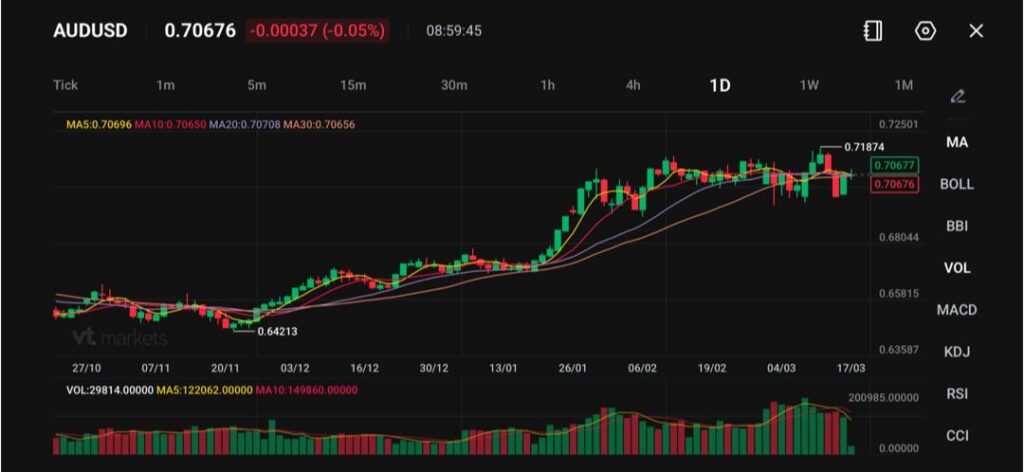
The AUDUSD pair is trading near 0.7067, holding relatively steady despite a slight intraday dip of around 0.05%. Price action suggests the pair is entering a consolidation phase after a sustained uptrend that began in late December, where it rallied from lows near 0.6421 to a recent high of 0.7187.

From a technical perspective, the short-term structure remains supported but is beginning to lose momentum. The 5-day (0.7070) and 10-day (0.7065) moving averages are tightly clustered around the current price, indicating a lack of directional conviction. Meanwhile, the 20-day (0.7071) and 30-day (0.7066) averages are also converging, reinforcing the view that the market is compressing and preparing for a potential breakout.

Immediate support is seen around the 0.7040–0.7050 region, where recent pullbacks have stabilised. A break below this zone could open the door toward 0.7000, a key psychological level. On the upside, resistance remains at 0.7180–0.7200, marking the recent swing high and a barrier that bulls have yet to decisively clear.

Overall, AUDUSD appears to be range-bound in the near term, with the broader bullish structure still intact as long as price holds above 0.7000.

However, the current compression in moving averages suggests that a decisive breakout—either higher or lower—may be approaching, depending on macro catalysts such as US dollar strength or shifts in risk sentiment.

What Traders Should Watch Next

The near-term direction for AUDUSD will likely depend on whether markets continue to price in further RBA tightening.

Key catalysts include upcoming inflation data, RBA commentary, and shifts in global risk sentiment. Traders will also monitor whether the pair can sustain momentum above the 0.7080 area and challenge the 0.7122 resistance level.

For now, the Australian dollar appears supported by a combination of hawkish policy expectations, strong yields, and resilient technical structure, though global uncertainties remain a key risk to the outlook.

Learn more about trading Forex Pairs on VT Markets here.

FAQs

Why is AUDUSD Rising Right Now?
The Australian dollar is gaining strength after the Reserve Bank of Australia (RBA) delivered a rate hike and signalled that further tightening remains likely due to persistent inflation risks.

What Did the RBA Decide at Its Latest Meeting?
The RBA raised its cash rate by 25 basis points to 4.10%, reaching a 10-month high. The decision was closely contested, with a 5–4 split vote among policymakers.

Why Did Markets View the RBA as Hawkish?
Governor Michele Bullock indicated the debate was about timing rather than direction, suggesting further rate hikes are still on the table if inflation does not return to target.

What Are Markets Pricing for Future RBA Policy?
Markets have increased expectations for another rate hike, with around a 40% probability of a move in May, and a rate of 4.35% fully priced by August.

How is Inflation Affecting the Australian Dollar?
Core inflation remains elevated at 3.4%, above the RBA’s target range of 2% to 3%. Persistent inflation supports a hawkish policy outlook, which tends to strengthen the currency.

Start trading now – Click here to create your real VT Markets account

With inflation worries rising, silver dips to about $80.50 as Federal Reserve rate-cut hopes fade

Silver (XAG/USD) traded near $80.50 on Tuesday, down 0.60% on the day. Prices stayed under pressure as expectations for near-term US rate cuts weakened amid inflation concerns linked to the Middle East conflict. Markets expect the Federal Reserve to keep its benchmark rate unchanged at 3.50%–3.75% at Wednesday’s meeting, based on the CME FedWatch tool. This would be a second straight pause after the previous easing cycle, which can weigh on non-yielding assets such as Silver.

Middle East Inflation And Rate Pressure

Rising tensions in the Middle East have pushed Oil prices higher and added to fears of ongoing inflation. Higher US petrol costs are increasing household costs, which may keep inflation expectations elevated and support restrictive policy for longer. The United States recently targeted Iran’s main Oil export hub on Kharg Island, raising concerns about global energy supply. Washington has said the conflict could end within weeks and has discussed an international coalition to protect shipping through the Strait of Hormuz, but uncertainty remains. Geopolitical risk can support demand for safe-haven assets, which may limit further falls in Silver. This support sits alongside pressure from expectations of higher rates for longer. We remember the situation in 2025 when silver was caught between fears of persistent inflation and its role as a safe haven. The Federal Reserve’s prolonged pause in the 3.50%-3.75% range created a significant opportunity cost for holding the metal. This dynamic pinned silver in a tense range, with traders watching both interest rate expectations and Middle East headlines.

March 2026 Shift In The Silver Playbook

The landscape has since shifted dramatically as we stand here in March 2026. The geopolitical risk premium that supported prices throughout 2025 has faded, with the BlackRock Geopolitical Risk Indicator falling to a 15-month low last month. At the same time, the primary headwind has turned into a tailwind, as recent US CPI data for February 2026 came in at a cool 2.8%. This change suggests a new playbook for the coming weeks. With the CME FedWatch tool now indicating an 82% probability of a rate cut by the June 2026 meeting, the fundamental case for non-yielding assets has strengthened considerably. The focus is no longer on safe-haven demand but on the impending monetary easing cycle. Given this, traders should consider strategies that benefit from a steady upward trend rather than a sharp, volatile spike. Implied volatility in silver options, as measured by the VXSLV index, has compressed to just 22%, down from the highs above 35% we saw during the Kharg Island tensions in 2025. This makes long call options or bull call spreads for May and June 2026 expirations attractive ways to position for a Fed-driven rally. Another approach is to take advantage of the lower volatility by selling out-of-the-money puts. This strategy collects premium while expressing a bullish-to-neutral view on silver prices. We are seeing significant interest in put options with strike prices in the $75 to $78 range, suggesting the market sees strong support at those levels ahead of the anticipated rate cuts. Create your live VT Markets account and start trading now.

Start trading now – Click here to create your real VT Markets account
EUR/USD falls under 1.1500 as the dollar strengthens, with attention fixed on upcoming central bank meetings

EUR/USD eased in Asian trading on Tuesday, slipping just below 1.1500 after rebounding from the 1.1415–1.1410 area. The pair remains sensitive ahead of the Federal Reserve decision on Wednesday and the European Central Bank meeting on Thursday. US Dollar demand firmed as markets pared back expectations for near-term Fed rate cuts, supporting the Greenback near its highest level since May 2025. Oil prices have risen sharply since the start of the war in Iran, keeping attention on inflation risks and the policy guidance from both central banks.

Euro Dollar Focus Ahead Of Central Bank Meetings

The Euro faced pressure from concerns that higher energy costs could slow Eurozone growth, given the region’s reliance on imported fuel. Equities held a positive tone after US President Donald Trump urged countries to help reopen shipping through the Strait of Hormuz, which reduced demand for safe-haven positioning. The Euro is used by 20 EU countries and accounted for 31% of global foreign exchange transactions in 2022, with average daily turnover above $2.2 trillion. EUR/USD represents about 30% of all FX trades, followed by EUR/JPY (4%), EUR/GBP (3%) and EUR/AUD (2%). The ECB, based in Frankfurt, holds eight policy meetings a year and aims for 2% inflation, with decisions led by a council including President Christine Lagarde. The four largest euro-area economies—Germany, France, Italy and Spain—make up 75% of the Eurozone economy. We are seeing the EUR/USD pair struggle below the 1.1500 level, a trend driven by a stronger US dollar and persistent weakness in the Euro. The market is increasingly betting the Federal Reserve will delay interest rate cuts, while an energy crisis linked to the conflict in Iran continues to undermine the Eurozone economy. This divergence is creating clear pressure ahead of this week’s central bank meetings. The case for a stronger dollar is supported by recent data, which shows the US economy is more resilient than anticipated. Core PCE inflation, the Fed’s preferred gauge, has remained stubbornly above target, printing at 3.1% year-over-year in the latest January 2026 release. Furthermore, the final Q4 2025 GDP figures showed the US expanding at a 2.9% annualized rate, starkly contrasting with the situation in Europe.

Options Volatility And Key Trading Scenarios

The Eurozone faces a much tougher outlook, with the Harmonized Index of Consumer Prices for February 2026 ticking up to 2.8%, fueled by Brent crude prices that have remained over $90 per barrel. This is happening as the economy stagnates, with Germany’s manufacturing PMI sinking to 44.2 last month, its sixth consecutive month in contraction. This stagflationary environment puts the European Central Bank in an extremely difficult position for its upcoming policy decision. For derivative traders, this setup suggests positioning for increased price swings in the near term. One-month implied volatility on EUR/USD options has risen to 8.2%, up from an average of 6.5% in the final quarter of 2025, indicating the market is bracing for a significant move. Purchasing straddles or strangles could be a viable strategy to capitalize on a breakout post-announcements, regardless of the direction. The fundamental narrative, however, favors further downside for the pair, potentially retesting the lows near 1.1410 that we saw in July of last year. Traders with a bearish bias should consider buying put options or implementing bear put spreads to limit risk while targeting a move lower. The premium paid is the maximum loss, which is prudent given the high-impact event risk this week. We should also be mindful of geopolitical developments, as any de-escalation in the Strait of Hormuz following President Trump’s calls could cause a rapid unwinding of bearish Euro bets. Hedging downside exposure with out-of-the-money call options could provide protection against a sharp relief rally. This would guard against a scenario where the central bank outcomes are unexpectedly dovish for the dollar or hawkish for the euro. Create your live VT Markets account and start trading now.

Start trading now – Click here to create your real VT Markets account

Ahead of the RBA policy decision, AUD/USD slips to 0.7060 after rising 1.25% previously in Asia

AUD/USD slipped after rising more than 1.25% in the prior session, trading near 0.7060 during Asian hours on Tuesday. The Australian Dollar may find support as the Reserve Bank of Australia (RBA) is expected to deliver a 25-basis-point rate rise later in the day, amid inflation risks linked to higher oil prices. The RBA is expected to lift the Official Cash Rate to 4.10% from 3.85%, which would make it the first G10 central bank to restart rate rises. Markets will monitor Governor Michele Bullock’s press conference for guidance on the next steps, while Deputy Governor Andrew Hauser has warned that oil price shocks tied to the Iran conflict could add to inflation.

Rba Decision And Market Focus

A Reuters poll shows economists expect the rate to reach 4.10% in March, with a possible move to 4.35% later in the year. Westpac has shifted to forecasting consecutive rises, and this view may support Australian bond yields and the currency. The US Dollar has eased as tensions around the Strait of Hormuz have moderated. Any further falls may be limited as expectations for US Federal Reserve cuts this year have faded, with higher crude prices raising inflation concerns. Looking back to this time in 2025, we saw the Australian Dollar strengthen on expectations of a Reserve Bank of Australia rate hike to 4.10%. That hike did occur as the RBA became one of the first G10 banks to resume tightening due to oil price fears. The AUD/USD pair was trading firmly above 0.7000 at that point. Today, the situation has evolved significantly, with the RBA having held the cash rate at 4.35% for the last six months. Australian CPI inflation has cooled to 3.1%, which is still above the target band but has taken the prospect of further hikes off the table. Markets are now pricing in a potential rate cut by the fourth quarter, creating a very different trading environment than last year.

Policy Divergence And Trading Implications

In the United States, persistent core inflation, currently at 3.5%, has prevented the Federal Reserve from cutting rates as early as many had hoped. This policy divergence has pressured the AUD/USD, which now trades near 0.6650. The strong US dollar narrative remains a dominant factor for us. The geopolitical risks mentioned last year have resurfaced, pushing WTI crude oil prices back up to $95 a barrel in recent weeks. This renewed inflation threat complicates the outlook for central banks and is increasing market volatility. We see this uncertainty as a key risk and opportunity. Given this backdrop, we believe traders should consider buying volatility on AUD/USD. Implied volatility on 3-month options has risen to 9.5%, up from a low of 7.2% earlier this year, suggesting the market expects larger price swings. Strategies like long straddles could be effective in capitalizing on sharp moves in either direction. Furthermore, with the Fed remaining more hawkish than the RBA, we anticipate continued downward pressure on the pair. Traders could look at buying AUD/USD put options or establishing put spreads to position for a potential move toward the 0.6500 level. This expresses a directional view while managing the cost and risk of the trade. Create your live VT Markets account and start trading now.

Start trading now – Click here to create your real VT Markets account

Amid escalating Middle East turmoil, WTI crude trades near $94.20 in early Asian hours, as Iran conflict persists

WTI, the US crude oil benchmark, traded around $94.20 in early Asian hours on Tuesday, moving above $94.00. Traders are waiting for the American Petroleum Institute (API) report due later on Tuesday. Israel’s military said it detected missiles launched from Iran towards Israeli territory and told people in affected areas to go to shelters. The United Arab Emirates temporarily closed its airspace as a precaution, and its defence ministry said it was responding to missile and drone threats from Iran.

Oil Market Disruption Risks

Attacks linked to Iran on ships, infrastructure, and ports used by oil tankers have raised concerns about wider disruption to oil transit routes. These developments have supported higher oil prices. The International Energy Agency (IEA) said it will release a record 400 million barrels of oil. It also said coordinated emergency releases can add temporary supply and limit sharp rises in oil prices. We are seeing a tense setup in the oil market, driven by the events we saw unfold last year. In 2025, WTI crude spiked above $94 a barrel as direct conflict between Iran and Israel threatened to disrupt critical shipping lanes. This creates a strong bias for higher prices based on fear of a wider supply disruption. This type of geopolitical stress makes options premiums very expensive due to high implied volatility. We saw a similar situation during the 2022 Ukraine conflict, when the CBOE Crude Oil Volatility Index (OVX) jumped over 50% in a matter of weeks. Traders should expect sharp swings and be prepared for volatility to be the main driver of prices, not just fundamentals.

Strategy Considerations For Traders

For those anticipating higher prices, it’s important to remember that strategic reserve releases are not a permanent solution. The record-setting IEA release in 2022 helped cool prices from their peak near $130, but it did not fundamentally alter the upward trend until demand fears took over later that year. A bull call spread could be a calculated way to play further upside while limiting the cost of high premiums. On the other hand, the mention of a 400-million-barrel release from the IEA is a powerful cap on any potential price rally. This is more than double the amount the US released over six months in 2022, representing a significant addition to global supply. With current global demand growth forecasts from the EIA sitting at a modest 1.1 million barrels per day for 2026, this new supply could easily overwhelm the market if the conflict does not escalate further. Given these strong forces pulling in opposite directions, non-directional strategies are worth considering. Buying options straddles or strangles allows a trader to profit from a large price move, regardless of whether it breaks higher on war news or lower on an IEA announcement. The primary bet here is on continued instability rather than picking a specific direction. Create your live VT Markets account and start trading now.

Start trading now – Click here to create your real VT Markets account

Ueda said core inflation is edging towards 2%, with the central bank steering policy to secure it sustainably

BoJ Governor Kazuo Ueda said underlying inflation is gradually moving towards the 2% target. He said the bank will steer policy to achieve the target in a stable and lasting way. The BoJ expects underlying inflation to converge on 2% in the latter half of fiscal 2026 through fiscal 2027. At the time of writing, USD/JPY was up 0.11% at 159.21.

Bank Of Japan Mandate

The Bank of Japan is Japan’s central bank and sets monetary policy. Its mandate includes issuing banknotes and maintaining price stability, with an inflation aim of about 2%. In 2013, the BoJ began an ultra-loose policy to support growth and lift inflation. It used Quantitative and Qualitative Easing (QQE), creating money to buy assets such as government and corporate bonds. In 2016, it introduced negative interest rates and began controlling the 10-year government bond yield. In March 2024, it lifted interest rates, moving away from the ultra-loose stance. Large-scale stimulus weakened the yen against major peers, with added pressure in 2022 and 2023 as other central banks raised rates. The yen’s fall partly reversed in 2024 after the BoJ started to unwind easing. The policy shift followed higher inflation after a weaker yen and a rise in global energy prices, which pushed inflation above 2%. Expectations of rising wages also supported the move.

Implications For Yen And Traders

Governor Ueda’s comments suggest the Bank of Japan will continue its cautious approach. He is signaling that while inflation is moving in the right direction, rate hikes will be slow and gradual, not materializing for some time. For traders, this implies that the fundamental reason for Yen weakness—the wide interest rate gap with other major economies—will persist in the near term. The key dynamic remains the carry trade, fueled by the difference between Japan’s near-zero rates and higher rates elsewhere, such as the US Federal Reserve’s current 4.0% policy rate. As long as this differential exists, there will be underlying pressure on the Yen, keeping pairs like USD/JPY elevated. The current level of 159.21 reflects the market’s belief that borrowing Yen to invest in dollar assets is still a profitable strategy. We can look back at the BoJ’s historic rate hike in March 2024 as a guide. Following that move, the Yen failed to sustain any significant strength because the bank did not signal further immediate tightening, a pattern we saw continue throughout 2025. This history shows that a single move is not enough to reverse the currency’s long-term trend without a clear and aggressive hiking cycle. Recent data supports the bank’s patient stance but also builds pressure for the future. The latest figures for February 2026 showed nationwide core inflation at 2.5%, remaining above the BoJ’s target for over two years. Furthermore, the spring “shunto” wage negotiations just concluded with major firms agreeing to an average pay increase of 4.5%, suggesting inflationary pressures could become more embedded. Given this, a viable strategy for derivative traders is to focus on options that profit from low volatility and the continued slow depreciation of the Yen. Selling out-of-the-money JPY call options or USD put options allows traders to collect premium, betting that the BoJ will not surprise the market with a sudden hawkish shift. This approach capitalizes on the predictable, gradual nature of the central bank’s policy path. However, traders must remain alert to the risk of currency intervention from the Ministry of Finance, which becomes a distinct possibility as USD/JPY approaches the 160 level. We saw authorities step in to buy Yen back in late 2024 when the currency weakened past similar thresholds. Any positions should therefore be managed with tight risk controls to protect against a sudden, intervention-driven spike in the Yen’s value. Create your live VT Markets account and start trading now.

Start trading now – Click here to create your real VT Markets account

Japan’s Finance Minister Satsuki Katayama acknowledged heightened market volatility and vowed action, including in foreign exchange

Japan’s Finance Minister Satsuki Katayama said on Tuesday that financial markets are showing high volatility. She said she is monitoring the situation. Katayama said she will respond to volatility in financial markets, including foreign exchange. She did not give details on what actions might be taken.

Market Volatility And Yen Watch

At the time of writing, USD/JPY was up 0.09% on the day at 159.20. There is high volatility in the markets, and we are being told a response is coming to counter it, including in foreign exchange. With USD/JPY trading at 159.20, this statement is a clear warning of potential government intervention to strengthen the yen. Traders should view levels above 159.50 and 160.00 as extremely risky for long dollar positions. We saw this playbook used before, looking back from our perspective in early 2026. When the pair crossed 160 in October of 2024, the Ministry of Finance stepped in, selling an estimated $55 billion to push USD/JPY back down toward 153 in a matter of days. That history suggests that verbal warnings at these levels are often followed by real action. This threat directly impacts the options market, as uncertainty about the timing of intervention pushes up prices. One-month implied volatility for USD/JPY has already spiked to 13.1%, a significant jump from the 9.8% average seen last month. This makes buying options more expensive, but it reflects the market’s expectation of a large, sudden move.

Options Strategies And Intervention Risk

Given this, traders could consider buying put options with strike prices around 158 or 157 to profit from a sharp drop caused by intervention. Another strategy is to sell out-of-the-money call spreads with a ceiling around 160.50. This position profits if the verbal warnings successfully keep the pair from rising further. The timing of any action remains the biggest question, creating opportunities in the short term. Some may sell weekly call options just above the current price, collecting the high premium while betting that intervention is not imminent within the next few days. This is a risky strategy that should be hedged with longer-dated puts in case the government acts sooner than expected. Create your live VT Markets account and start trading now.

Start trading now – Click here to create your real VT Markets account

Trump stated the US sought postponing his Beijing meeting with Xi by roughly a month amid Iran conflict

US President Donald Trump said the US has asked to delay his planned meeting with Chinese President Xi Jinping in Beijing by “a month or so”, according to CNBC. He linked the change to the ongoing war with Iran. Trump said he did not know if he would still travel to China at the end of March as previously scheduled. He said he wanted to remain in the US because of the war, and that the delay would be limited.

Trade War Definition

A trade war is an economic conflict driven by protectionist measures such as tariffs. These barriers can trigger counter-measures, pushing up import costs and the cost of living. The US-China trade dispute began in early 2018 after the US imposed trade barriers on China over claims of unfair practices and intellectual property theft. China responded with tariffs on US goods, including automobiles and soybeans. The two countries signed the US-China Phase One trade deal in January 2020. The deal required structural reforms and other changes to China’s economic and trade system, while the Coronavirus pandemic shifted attention away from the dispute. After taking office, President Joe Biden kept tariffs in place and added further levies. During the 2024 campaign, Trump pledged 60% tariffs on China and imposed them on 20 January 2025, renewing tensions.

Market Volatility Outlook

Looking back, we can see how the events of early 2025 created significant market instability for traders. The combination of 60% tariffs on China and a new war in Iran caused the CBOE Volatility Index (VIX) to surge, as it briefly spiked above 28 in March 2025. This prolonged period of uncertainty has established a new, higher baseline for implied volatility in equity index options. The currency market reacted exactly as we anticipated, with a flight to safety benefiting the US dollar. The offshore yuan weakened sharply against the dollar last year, with USD/CNH breaking past 7.9 for the first time as capital flowed out of China. Traders should be positioned for further yuan depreciation if trade relations do not improve, using options to hedge exposure. Commodities saw a split reaction, creating distinct opportunities. As we saw during the conflict last year, Brent crude futures briefly topped $115 per barrel on fears of supply disruptions through the Strait of Hormuz. In contrast, agricultural futures, particularly soybeans, remain under pressure, echoing the price patterns we observed during the 2018 trade dispute. The impact of those tariffs is now evident in our inflation data, complicating Federal Reserve policy. The latest CPI reading for February 2026 came in at a stubborn 3.4%, well above the 2% target, limiting the Fed’s ability to lower interest rates. This environment suggests selling call options on rate-sensitive sectors that are unlikely to rally until inflation is controlled. Given the lingering geopolitical tensions, traders should continue to buy protection against sudden market swings. We have seen how quickly headlines can move the market, so holding long-dated puts on multinational industrial companies exposed to tariffs is a prudent strategy. VIX call options also remain a relatively inexpensive way to hedge an entire portfolio against another flare-up. Create your live VT Markets account and start trading now.

Start trading now – Click here to create your real VT Markets account

TD Securities says China began 2026 robustly; industrial output, exports and investment surprised, aided by quasi-fiscal stimulus

China began 2026 with strong economic readings, including higher than expected industrial production and exports. Fixed-asset investment also rebounded, supported by quasi-fiscal measures. Risks to growth have increased due to higher oil prices linked to the Middle East conflict and uncertainty around US–China trade talks. These factors could weigh on the 4.6% GDP forecast for 2026.

Key Market Volatility Setup

If manufacturing input costs rise, authorities may expand fiscal support to prevent firms from cutting output. Measures mentioned include targeted tax cuts and subsidies for small and medium-sized enterprises and manufacturers. A scenario is set out in which oil remains near US$100 per barrel for the next 3 months, which could trigger additional targeted support. The policy focus would shift towards sustaining growth, placing more reliance on fiscal tools than monetary action. The 4.6% 2026 GDP forecast is kept unchanged because any oil-related drag may appear later in the year and fiscal capacity could cushion it. A possible cancellation of a Trump visit to China is described as a risk that could raise the chance of tariffs returning. China’s economy showed a strong start to the year, with industrial output for January and February beating expectations by rising 6.8% from a year earlier. This positive domestic data, however, is being overshadowed by external pressures creating significant uncertainty. For traders, this clash between good local news and risky global events is a classic setup for higher market volatility.

Trading And Hedging Considerations

With Brent crude futures holding stubbornly above $98 per barrel for the past month, we see a direct threat to Chinese manufacturers’ profit margins. We expect Beijing will prioritize growth and stability by offering fiscal support like subsidies, rather than tightening monetary policy to fight inflation. This playbook is similar to measures we saw them deploy during the global supply chain crunch back in 2025. This uncertainty suggests that volatility itself is a tradable asset in the coming weeks. We have already seen the implied volatility on Hang Seng Index options climb to a three-month high of 28% last week, indicating the market is bracing for larger price swings. Strategies that profit from increased chop, such as buying straddles or strangles on major Chinese ETFs, should be considered. The biggest immediate risk is the potential cancellation of President Trump’s visit, with preliminary talks reportedly stalling over tariff disputes. A cancellation would likely trigger a sell-off, making protective put options on indices a necessary hedge for any long positions. We believe the market is currently underpricing the probability of relations souring again, which reminds us of the sudden tariff escalations we witnessed in late 2024. These pressures are also weighing on the currency, with the offshore yuan already testing the 7.30 level against the U.S. dollar. Given the expectation of targeted government easing and ongoing geopolitical tensions, further weakness seems likely. We are looking at call options on the USD/CNH pair as a way to position for a depreciation of the yuan through the second quarter. Create your live VT Markets account and start trading now.

Start trading now – Click here to create your real VT Markets account

Back To Top
server

Hello there 👋

How can I help you?

Chat with our team instantly

Live Chat

Start a live conversation through...

  • Telegram
    hold On hold
  • Coming Soon...

Hello there 👋

How can I help you?

telegram

Scan the QR code with your smartphone to start a chat with us, or click here.

Don’t have the Telegram App or Desktop installed? Use Web Telegram instead.

QR code

