South Korea’s industrial output rose by 0.3% in March. The result was above the 0.2% forecast.
The data points to a small monthly increase in production. It also shows output grew slightly more than expected.
Implications For Korean Assets
We are seeing that South Korea’s industrial output in March grew by 0.3%, which is slightly better than the 0.2% growth that was expected. This small beat suggests some resilience in the manufacturing and tech sectors. For us, this is a signal to look closely at bullish positions on Korean assets.
This data reinforces the idea that the Korean won may strengthen against the dollar. With the economy showing more life than anticipated, the Bank of Korea is less likely to consider a rate cut in its upcoming meetings. We should consider buying KRW/USD call options to capitalize on potential currency appreciation in May.
The positive output is likely driven by the global demand for technology, as recent data shows semiconductor exports were up 18% year-over-year in March. This directly benefits the heavyweights on the KOSPI index. Buying KOSPI futures or call options seems like a solid play for the next few weeks.
Possible Volatility Strategy
When we look back at the trends in 2025, similar economic beats often preceded a period of strength in Korean equities. This positive surprise should also lower market uncertainty. We might consider selling volatility by using short straddles on the VKOSPI, assuming no major external shocks.
South Korea’s industrial output rose 3.6% year on year in March. This was below the forecast of 3.8%.
The March result came in 0.2 percentage points under expectations. No other figures were provided.
Slight Cooling Signals
The March industrial output miss, while minor, suggests a slight cooling in the South Korean economy that was not fully priced in. We see this as an opportunity to consider buying short-dated put options on the KOSPI 200 index. This move anticipates a potential dip as the market digests this sign of weaker-than-expected growth.
This data point adds downward pressure on the Korean won, especially as we have seen it weaken past 1,380 to the U.S. dollar this month. For currency traders, this reinforces a long USD/KRW position through futures or options. The Bank of Korea’s decision to hold rates at 3.5% earlier in April gives it little room to support the currency without new inflation fears.
However, we must weigh this against more current data, as preliminary customs reports for the first 20 days of April 2026 showed semiconductor exports surging by over 12% year-over-year. This indicates the industrial slowdown in March may not reflect the forward-looking strength in the critical tech sector. Therefore, any dip in major tech stocks could be a chance to sell cash-secured puts, betting that the weakness is temporary.
Looking back from our perspective in 2025, we recall the extreme volatility in the semiconductor cycle during the 2022-2023 period. That history suggests we should not treat one month’s industrial data as a definitive trend. The conflicting signals between March’s output and April’s exports will likely increase implied volatility, making strategies like straddles on key industrial ETFs more attractive.
Regional Demand Backdrop
The regional context is also important, as China’s manufacturing PMI for April was just released, holding in expansionary territory at 50.4. This indicates that demand from Korea’s largest trading partner remains stable for now. This could provide a floor for any significant sell-off in Korean equities tied to this output data.
US shares fell despite a stable Fed decision and major tech results due after the close. The DJIA ended near 48,900, down about 0.6% for a fifth straight loss, while the S&P 500 was flat, the Nasdaq edged up, and the 10-year US Treasury yield moved above 4.4%.
Early headlines centred on Iran after Donald Trump posted an AI-made image on Truth Social after 08:00 GMT. Brent crude rose past $110 and WTI returned above $100, and a report about planning an extended blockade of Iranian ports increased focus on the Strait of Hormuz.
Fed Decision And Rates Outlook
At 18:00 GMT the FOMC held the federal funds target range at 3.5% to 3.75%, as markets had priced a 100% chance of no change. The vote had four dissents, with three wanting removal of easing-bias language and Stephen Miran arguing for a cut, and Powell said he will remain on the Board after his 15 May chair-term end.
After 20:00 GMT, Microsoft said Azure grew 40% year on year, Alphabet reported Google Cloud growth of 63%, and AWS grew 28%, its fastest in three years. Qualcomm rose over 13%, with Automotive revenue up 38% year on year to a record, while Microsoft’s cloud gross margin fell to 66% and Amazon dropped more than 3% in extended trade.
Meta lifted 2026 capex guidance to $125 billion to $145 billion, up from $115 billion to $135 billion, while Alphabet set $175 billion to $185 billion and Amazon targeted about $200 billion. Together, the four firms’ 2026 capex totals about $650 billion.
Key releases due include Thursday’s 12:30 GMT Q1 advance GDP and March PCE, with consensus GDP at 2.3% annualised versus 0.5% prior, headline PCE at 3.5% YoY, and core PCE at 3.2% YoY. Friday brings ISM Manufacturing PMI at 14:00 GMT, with Prices Paid expected at 80.
Positioning And Risk Management
Based on yesterday’s market action and headlines, we are shifting to a defensive posture. The Dow’s fifth straight loss and failure to hold 48,900 shows a clear lack of buying conviction. We should not be looking to buy dips but rather to protect against further downside in the coming weeks.
The geopolitical situation with Iran is now the dominant factor, directly fueling inflation fears. With Brent crude pushing past $110 a barrel, this is reminiscent of the price shocks we saw during previous escalations in the Middle East, which consistently led to stubborn inflation. We believe long volatility is the right trade, as options are still reasonably priced with the VIX index hovering around 16.5.
The Federal Reserve’s divided vote signals a significant hawkish shift that the market has not fully digested. Fed funds futures this morning show traders are now pricing out any possibility of a rate cut in 2026, with a small chance of a hike now priced in for September. If today’s PCE inflation data or Friday’s ISM Prices Paid number come in hot, expect bond yields to climb further and pressure equities.
The story in Big Tech is no longer about growth but about the staggering cost of that growth. The combined 2026 capital expenditure guidance of nearly $650 billion for just four companies is a massive figure that raises serious questions about future profitability. This level of spending, which is approaching the size of the entire U.S. defense budget, is becoming a major headwind for a sector that has carried the market.
Therefore, we are using options to build downside protection on the Nasdaq and S&P 500. At the same time, the direct threat of conflict in the Strait of Hormuz makes call options on energy ETFs like XLE a sensible hedge. The market is fragile, and this week’s economic data could easily turn yesterday’s nervous drift into a more significant correction.
Brazil’s central bank kept its benchmark interest rate at 14.5%, matching expectations. The decision maintains borrowing costs at the same level.
The rate decision sets the main policy rate at 14.5%. It is used to guide wider lending and saving rates across the economy.
Policy Rate Held Steady
No change was made to the interest rate at this meeting. The policy setting remains 14.5% after the decision.
With Brazil’s central bank holding the Selic rate at 14.5% as expected, the immediate uncertainty has been removed from the market. This lack of surprise means implied volatility on Brazilian assets, like options on the BRL or the Ibovespa index, should decrease in the coming days. We see this as an opportunity to consider strategies that benefit from lower volatility, such as selling options.
This decision comes after we saw the central bank aggressively hike rates throughout 2025 to combat inflation that peaked at 9.8% last year. With the latest March 2026 inflation report showing a decline to 7.5%, the bank is signaling it will stay vigilant before considering any cuts. The market is now confident that this is the peak of the rate cycle, shifting all focus to the timing of the first cut later this year.
The high 14.5% yield makes the Brazilian Real extremely attractive for carry trades, especially when compared to borrowing in currencies like the Japanese Yen, where rates remain near zero. This predictable and high interest rate differential should continue to provide strong support for the BRL. We expect this stability to draw in more capital seeking high yields in the short term.
Key Data To Watch
Going forward, our attention will be squarely on incoming inflation and economic growth data. Any sign of inflation falling faster than anticipated could lead the market to price in an earlier rate cut, creating opportunities in interest rate futures. Until then, the market will likely trade in a range, focused on collecting the high interest payments.
Looking back at the 2015-2016 cycle, we remember that rates were held at a peak of 14.25% for over a year before the easing cycle began. That historical pattern suggests that while this is the peak, we may see rates remain this high for several more months. This supports the idea of staying in carry trades and being patient before positioning for rate cuts.
Gold fell by over 1% after the Federal Reserve kept rates unchanged and Jerome Powell said he would stay on the Board until a criminal investigation is dropped. XAU/USD traded at $4,546 after a daily high of $4,610.
The FOMC held rates at 3.50%–3.75% with an 8–4 split, the most divided vote since 1992. Stephen Miran backed a cut, while Beth Hammak, Neel Kashkari and Lorie Logan opposed adding an easing bias.
Dollar And Yields Pressure Gold
The US Dollar Index rose 0.37% to 98.96 and the 10-year Treasury yield was up 8 basis points at 4.43%. Money markets priced a 29% chance of a rate rise at the April 2027 meeting, based on Prime Terminal data.
US Core Durable Goods Orders rose 3.3% after 1.6% in February, above the 0.6% forecast. Total orders moved from a 1.2% annual fall to a 0.8% rise, beating the 0.5% forecast.
Gold was near four-week lows around $4,510; below $4,500, supports are $4,482, $4,351 and the 200-day SMA at $4,269. Resistances are $4,600, the 100-day SMA at $4,753 and the 50-day SMA at $4,848.
The divided Federal Reserve vote signals significant uncertainty for the weeks ahead, creating an ideal environment for volatility plays. The sharp rise in Treasury yields to 4.43% and the stronger dollar are the most important immediate reactions we are seeing. Traders should anticipate wider price swings as the market digests this new, less predictable policy landscape.
Options Strategies For A Volatile Fed
With gold breaking below key support levels, bearish positions appear favorable in the short term. Buying put options on gold futures or related ETFs offers a defined-risk way to target the $4,482 and $4,351 support zones. We should remain cautious, as any escalation in the political drama surrounding Powell could trigger a flight-to-safety rally.
The Fed’s reluctance to signal a clear path toward easing is supported by incoming data. This morning’s Core PCE price index reading for March came in at 3.1%, stubbornly above target and reversing the progress we saw late in 2025. This, combined with last week’s jobless claims falling to a six-month low of 195,000, removes any urgency for the Fed to cut rates.
We should expect the US Dollar to remain strong against other major currencies, making call options on the DXY attractive. Similarly, the upward pressure on interest rates suggests a strategy of buying puts on long-duration Treasury bond ETFs. The market is now pricing a non-zero chance of a hike by next year, a dramatic shift from just a few months ago.
Given the deep policy split, buying call options on the VIX index provides a direct hedge against rising market turbulence. This level of internal disagreement at the Fed hasn’t been seen since the early 1990s, a period that was also marked by significant policy uncertainty. Any unexpected headlines from Washington or surprising economic data could now have an outsized impact on asset prices.
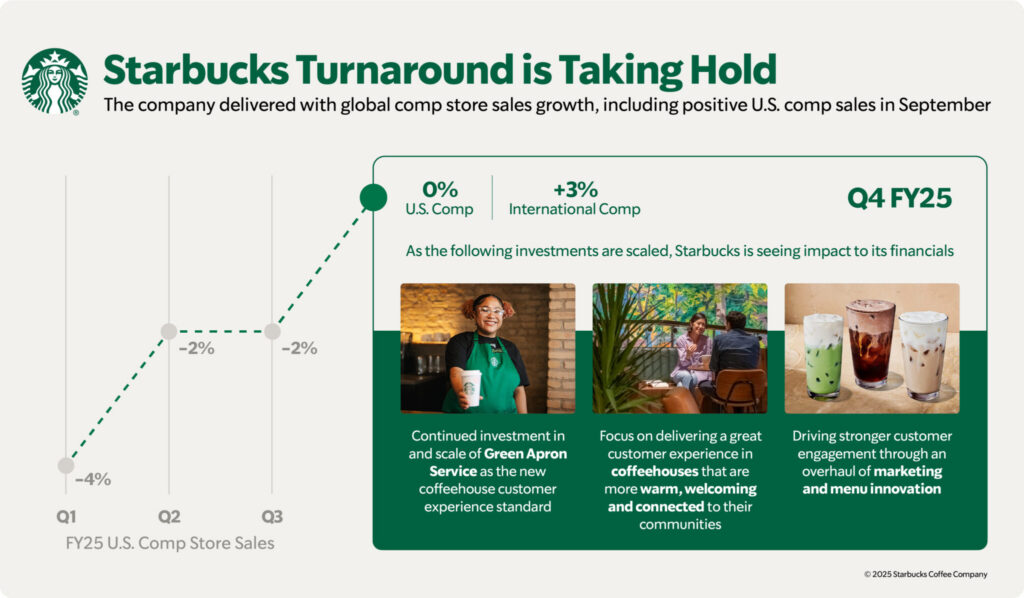
SBUX stock is drawing fresh attention after Starbucks beat Q2 FY26 expectations and raised full-year guidance.
The “Back to Starbucks” turnaround is improving traffic, sales, and customer engagement, especially in the U.S.
Margins remain the key risk as labour investment, coffee prices, tariffs, and product mix weigh on profitability.
The next phase for SBUX stock depends on whether Starbucks can turn stronger sales into cleaner earnings growth.
SBUX Stock Rebounds As The Turnaround Gets Real
SBUX stock is back on investors’ radar after Starbucks delivered the kind of earnings update that turnaround stories need: stronger sales, better traffic, higher guidance, and clearer signs that customers are returning.
For months, the question around Starbucks was simple. Could Brian Niccol’s turnaround plan move beyond strategy decks and start showing up in the numbers? The latest quarter suggests the answer is yes, at least for now.
Starbucks earnings miss forecasts, US sales flat as turnaround efforts continue https://t.co/OfGtZj2hrY
Starbucks reported global comparable store sales growth of 6.2% in Q2 FY26, ahead of market expectations for roughly 3.7%. Revenue rose 9% to $9.5 billion, while adjusted earnings came in at $0.50 per share, above expectations of around $0.43. The company also lifted its FY26 outlook, now expecting global and U.S. comparable sales growth of 5% or more, with adjusted EPS projected between $2.25 and $2.45.
That is a stronger setup than investors had before the earnings release. Starbucks had spent much of the past two years fighting weaker traffic, execution problems, China uncertainty, and questions over whether the brand had lost part of its everyday appeal. The latest results do not erase those issues, but they give the market something firmer to price.
For traders watching SBUX stock, the issue is no longer whether Starbucks has a turnaround story. It does. The better question is whether the stock has already priced in too much of that recovery before margins catch up.
Looking for more equity market setups beyond SBUX stock? Explore daily market analysis and global share CFD opportunities with VT Markets.
U.S. Traffic Is The Cleanest Signal
The strongest part of the Starbucks update came from the U.S. business. North America comparable sales rose 7.1%, supported by higher transaction volumes and stronger customer engagement. That matters because a turnaround built only on price increases would be fragile. A turnaround built on people coming back into stores carries more weight.
Starbucks' loyalty program changes are drawing value-conscious customers https://t.co/C78dKR5eK7
Starbucks has focused on speed, staffing, service consistency, and store experience under the “Back to Starbucks” plan. Reuters reported that consumer visits rose 5.9%, while around 80% of stores met service benchmarks. That suggests the company is not only selling more drinks, but also reducing some of the friction that had hurt the brand in previous quarters.
For SBUX stock, traffic is the metric to watch. Higher footfall can support revenue, restore confidence in the brand, and give the company more room to rebuild margins over time. If transaction growth keeps improving, investors may give Starbucks more patience while management spends on labour and operations.
The risk is that expectations are now rising quickly. Once a stock shifts from recovery doubt to recovery belief, every quarter becomes a progress check. Starbucks has shown that the customer can come back. Now it has to prove that momentum can last.
The Margin Test Has Not Gone Away
The bullish case for SBUX stock has improved, but the margin story is still messy.
Starbucks’ North America operating margin fell to 9.9%, down from 11.6% a year earlier. The company linked the decline to labour investments tied to the turnaround plan, product mix shifts, tariffs, and elevated coffee pricing. Sales leverage helped, but not enough to fully offset those cost pressures.
That puts investors in a familiar position. The company is spending to fix the business, and those investments may be necessary. Better staffing can improve service times, reduce customer frustration, and support higher transaction growth. But the stock market eventually wants proof that those investments can flow through to earnings.
This is where SBUX stock could become more volatile. If sales keep beating expectations but margins remain under pressure, the market may still reward the turnaround, but with less enthusiasm. If sales growth and margin recovery arrive together, the valuation case becomes much easier to defend.
The next few quarters will show whether Starbucks is buying growth at the expense of profitability, or laying the groundwork for a more durable earnings cycle.
China Market Still Needs A Cleaner Reset
Chinese coffee chains have also changed the rules of competition. Luckin, Cotti, Lucky Cup and other local players have pushed hard on lower prices, smaller-format stores, app-based ordering and rapid expansion. That has made coffee more of an everyday value purchase for many younger Chinese consumers, rather than a premium lifestyle spend.
Analysts have also warned that Chinese coffee brands will need more than low prices to win overseas, with quality, localisation and consumer experience becoming more important as they expand abroad. For Starbucks, that creates a two-sided challenge: it must protect its premium image in China while also proving it can compete in a market where speed and price now carry more weight.
The latest quarter showed some improvement, but not enough to call it a clean recovery. Starbucks’ international business benefited from sales leverage and accounting effects linked to China assets being classified as held for sale, but the broader China demand picture still needs careful watching.
For SBUX stock, China matters because it can change the long-term growth multiple. A strong U.S. recovery can support near-term sentiment, but a stable China business would make the global expansion story more convincing. If China stays soft, investors may continue to value Starbucks more like a mature U.S. consumer stock than a global growth compounder.
This does not break the turnaround case. It simply means the market may need more evidence before assigning a higher multiple.
SBUX stock could remain active because the latest earnings update gives both bulls and sceptics something to work with.
The bullish argument is simple. Starbucks is growing again, traffic is improving, guidance has moved higher, and the operational reset appears ahead of schedule. Barron’s noted that the quarter marked Starbucks’ first year-over-year earnings growth since Q4 2023, which gives investors a clear milestone in the recovery story.
The cautious argument is just as clear. The stock has already responded to better news, valuation is no longer cheap, and margin pressure still clouds the earnings path. A strong sales quarter is useful, but it does not fully answer whether Starbucks can protect profitability while paying more for labour, absorbing input cost pressure, and competing harder for daily consumer spending.
That balance makes SBUX stock more of a selective recovery trade than a straightforward value play. The turnaround has improved, but the margin bridge still needs to be built.
Want to track U.S. stocks like Starbucks, Nvidia, Tesla, and Apple in one place? Build your equity watchlist with VT Markets and follow the latest market moves as earnings season unfolds.
What Traders Should Watch Next
Traders should focus on three signals.
First, watch U.S. transaction growth. If customers keep coming back, the turnaround has room to run.
Second, watch North America operating margin. Starbucks needs to show that better sales can eventually translate into stronger profit.
Third, watch China updates. A steadier China business could support the longer-term growth case, while another soft patch may cap valuation upside.
SBUX stock has earned a better narrative, but the market will now demand cleaner proof. Sales have turned. The next test is whether earnings quality follows.
Trader Questions
Why Is SBUX Stock Moving After Earnings?
SBUX stock is moving because Starbucks reported stronger-than-expected Q2 FY26 results, including higher comparable sales, better revenue, stronger adjusted EPS, and upgraded full-year guidance.
Is Starbucks’ Turnaround Working?
Early signs suggest the turnaround is working. U.S. traffic has improved, comparable sales are growing again, and service benchmarks have strengthened. The next test is whether Starbucks can rebuild margins while continuing to invest in store operations.
What Is The Main Risk For SBUX Stock?
The main risk is margin pressure. Starbucks is spending more on labour and operations, while also facing higher coffee costs, tariff pressure, and product mix challenges. If margins do not improve, the stock may struggle to extend its recovery.
How Important Is China For Starbucks Stock?
China remains important because it affects Starbucks’ long-term growth story. A stronger China recovery could support a higher valuation, while weak demand or tougher local competition could limit upside for SBUX stock.
Is SBUX Stock A Buy After Earnings?
SBUX stock looks more attractive than it did before the latest earnings update, but the setup is not risk-free. The sales recovery is encouraging, but investors may want to see clearer margin improvement before treating the turnaround as fully confirmed.
Start trading now – Click here to create your real VT Markets account
Alphabet was the only Magnificent 7 stock to rise in after-hours trading following earnings on Wednesday. Meta Platforms, Amazon and Microsoft fell despite all four firms beating analysts’ earnings and revenue forecasts.
Alphabet shares rose 5.8% after-hours, from just under $350 to $370. Meta dropped over 6%, while Microsoft and Amazon each fell by about 2%.
Alphabet Earnings And After Hours Reaction
Alphabet reported GAAP earnings per share of $5.11, above the $2.67 analyst estimate. First-quarter revenue was $109.9 billion, around $3 billion above consensus.
Net income rose by over 80% year on year, mainly due to unrealised gains on nonmarketable equity securities. These securities nearly tripled in value over the past year to almost $37 billion.
Google Cloud revenue rose 63% from a year earlier to $20 billion. Search revenue increased 19% to $60.4 billion.
YouTube advertising revenue grew 11% year on year to nearly $10 billion. Subscription, platforms and devices revenue rose 19% year on year to $12.4 billion.
Options Positioning And Trading Setup
Other Bets and Google Network recorded small revenue declines.
Given the after-hours move to $370, we should expect a significant “IV crush” in Alphabet’s options. Traders who sold puts or short strangles ahead of the announcement are likely seeing significant profits as the uncertainty has been resolved. The focus now shifts from pre-earnings speculation to post-earnings momentum.
The market has clearly signaled its preference, making bullish strategies on GOOGL attractive for the coming weeks. We should look at buying call options or implementing bull call spreads targeting the $400 psychological level. The strong performance in its core Search and Cloud segments provides a fundamental tailwind for this momentum.
This earnings season is creating a clear divergence, which is ideal for pairs trading. Consider buying GOOGL calls while simultaneously buying puts on a competitor like Meta, which showed weakness despite a beat. This strategy bets on Alphabet’s continued outperformance against its hyperscaler peers, insulating the position from broader market risks.
This selective reaction reminds us of the market’s behavior back in 2025, when the initial AI hype gave way to a demand for tangible results. During 2025, we saw many companies make AI promises, but now investors are rewarding only those who demonstrate clear monetization and profit growth. Alphabet is now being viewed as a primary beneficiary, not just a participant.
Google Cloud’s 63% year-over-year revenue growth is a critical statistic that justifies this enthusiasm. Recent industry reports from Q4 2025 showed Google’s cloud market share climbing to nearly 15%, taking share directly from Amazon Web Services. This acceleration is evidence that Alphabet’s AI investments are successfully translating into high-growth enterprise contracts.
Looking ahead, traders should be positioned for further updates at the upcoming developer conference. Given the CEO’s confidence in the Gemini App, we could see further product integrations that act as the next catalyst for the stock. Longer-dated call options could be a prudent way to maintain exposure to this unfolding AI narrative through the summer.
The US Dollar Index (DXY) traded near 99.00 on Wednesday after the Federal Reserve kept interest rates unchanged. It was Chairman Jerome Powell’s last meeting as Fed chair.
The decision passed 8–4, the most divided FOMC vote since October 1992. Stephen Miran dissented for a quarter-point rate cut, while Beth Hammack, Neel Kashkari, and Lorie Logan supported holding rates but opposed adding an easing bias to the statement.
Geopolitics And Market Reactions
US President Donald Trump said he would maintain a blockade in the Strait of Hormuz if Iran does not accept his nuclear terms. He also said he “Will knock out the rest of the missiles and systems if we don’t make a deal with Iran.”
EUR/USD fell towards 1.1660, with markets focused on Thursday’s ECB meeting. GBP/USD slipped towards 1.3470 ahead of the Bank of England decision due Thursday.
USD/JPY traded near a two-year high at 160.40. USD/CAD was near 1.3680 after the Bank of Canada left rates unchanged.
WTI rose to $106.95 per barrel, while gold fell towards $4,540 amid a firmer dollar. The UAE said it will leave OPEC, with limited impact on oil prices.
Thursday’s diary includes China PMI, French Q1 GDP, eurozone ECB rates, Canada February GDP, and US Core PCE, Q1 GDP, jobless claims, and income data. Friday includes Australia PPI, Switzerland retail sales, Canada manufacturing PMI, and US ISM manufacturing PMI.
Looking Back And Looking Ahead
Looking back to this time in 2025, we saw a very divided Federal Reserve delivering Jerome Powell’s final meeting with a hawkish hold. This decision, combined with geopolitical tension, sent the US Dollar Index soaring near 99.00. That strength pushed USD/JPY to a peak of 160.40, a level that has proven to be remarkably persistent over the last year.
The dollar’s dominance continued through much of 2025, but the landscape is now shifting in April 2026. With recent core PCE inflation figures finally cooling to 2.8%, chatter about the Fed’s first rate cut is growing louder, with markets pricing in a 75% chance of a cut by the third quarter. Traders should consider options strategies that profit from a potential decline in the dollar, as this pivot marks a significant change from last year’s hawkishness.
Last year’s surge in WTI crude to over $106 a barrel was a direct result of threats to the Strait of Hormuz. While those specific tensions have eased, the market remains tight, with WTI currently trading near $85 a barrel. Last week’s EIA report showed a surprise crude inventory drawdown of 2.5 million barrels, suggesting demand is robust, and any new supply disruption could send prices climbing again.
The USD/JPY pair is a key focus, as the 160 level we saw in 2025 is once again being tested. The interest rate difference between the US and Japan remains wide, providing underlying support for the pair. Derivative traders should be cautious of direct intervention from Japanese authorities but could use options to trade the high volatility expected around this historic level.
Gold took a hit this time last year, falling as the dollar strengthened. Now, the opposite scenario is taking shape, with gold trading firmly above $3,800 an ounce. With the Fed poised to cut rates and central banks like China’s continuing their strong buying trend—adding 160,000 troy ounces in the first quarter of 2026 alone—the environment looks increasingly supportive for gold bulls.
GBP/USD stayed in a negative intraday move on Wednesday after the Federal Reserve held interest rates unchanged at Jerome Powell’s final meeting as Fed Chair. The pair traded near 1.3480, down 0.30%, ahead of Powell’s press conference.
The pound fell towards the 1.3480 area as the US Dollar strengthened before the Fed decision. US Dollar demand was also supported after the United Arab Emirates exited OPEC, which lifted safe-haven flows.
Market Focus Shifts To Central Banks
During the European session, GBP/USD was broadly sideways around 1.3500. Traders were waiting for monetary policy updates from both the Federal Reserve and the Bank of England.
Looking back at late 2025, we can see the market was nervous about the end of the Powell era at the Fed. The pound was trading around 1.3500 against the dollar then, a level that seems very distant from where we are today. That period marked a clear turning point for the dollar’s strength.
Since then, the policy paths of the two central banks have split dramatically. The new Fed leadership has been forced to keep rates elevated to fight stubborn US inflation, which latest figures show is still hovering around 3.8%. In contrast, the Bank of England has softened its stance as UK inflation has cooled to 2.5%, shifting its focus more towards avoiding a recession.
This divergence is backed by the latest economic data from just last week. US jobless claims came in at a strong 205,000, while the UK reported a surprise 0.7% fall in retail sales for March. These numbers reinforce the view of a robust US economy versus a fragile UK one, keeping downward pressure on the GBP/USD pair, now trading near 1.2250.
Trade Ideas And Volatility Watch
For traders, this suggests that bearish strategies on the pound remain attractive. We should consider buying GBP/USD put options with strike prices around 1.2100 to profit from further downside in the coming weeks. For those expecting a slower grind down, selling out-of-the-money call options provides a way to collect premium while maintaining a bearish bias.
Volatility in the pair could also pick up around upcoming central bank meetings. Any hint from the Bank of England that it is preparing for a rate cut would likely accelerate the pound’s decline. This makes long volatility positions, such as straddles, an interesting play ahead of those key dates if you expect a large move but are unsure of the direction.
The Federal Reserve kept the Fed funds target range unchanged at 3.50%–3.75% at its April meeting, as expected. The decision passed 8–4, with one dissenter backing a cut and three opposing the inclusion of an easing bias.
The FOMC said economic activity has been expanding at a solid pace, while job gains have been low on average and the unemployment rate has changed little. Inflation remains elevated, with global energy prices, and developments in the Middle East adding to uncertainty.
Policy Path Less Certain
Jerome Powell said policy is not on a preset course and remains appropriate, with risks on both sides of the dual mandate. He cited PCE inflation at 3.5% in March and core PCE at 3.2%, with near-term inflation expectations higher and longer-term expectations consistent with 2%.
Powell said the policy rate is at the high end of neutral and slightly restrictive, and that the Fed is positioned to move in either direction. He said no one is calling for a rate hike now, but the Fed would signal before any hike or cut.
After the announcement, the US Dollar Index rose towards 99.00 as Treasury yields moved higher. The CME FedWatch Tool pointed to about an 80% probability that rates stay where they are by end-2026, with little to no chance of a cut until at least September.
The Federal Reserve is holding rates steady, but the ground is clearly shifting underneath us. Uncertainty from the Middle East and its effect on energy prices has created a situation where policy could move in either direction. This means the path of multiple rate cuts we anticipated back in late 2025 is no longer a certainty.
Market Positioning And Volatility
With headline PCE inflation at 3.5% and WTI crude oil holding above $90 a barrel, the market’s focus has changed. We’ve seen this before; during the energy shocks of the 1970s, sustained high oil prices forced central banks into a much more aggressive stance. Derivative markets are now pricing out rate cuts for the remainder of the year, reflecting the serious risk that inflation will remain elevated.
The US Dollar Index (DXY) pushing towards the 99.00 level shows that traders are positioning for a stronger dollar. This is reinforced by rising US Treasury yields, which make holding dollar-denominated assets more attractive. Options strategies that benefit from a stronger dollar, or at least hedge against a weaker one, should be considered in the coming weeks.
The split 8-4 vote within the Committee signals significant internal disagreement, which is a recipe for market volatility. With the next 60 days being critical, we should expect sharp moves on every major data release, especially CPI and employment reports. This environment is favorable for traders using volatility-based strategies, like straddles or strangles, on major indices and currency pairs.
The upcoming change in leadership at the Fed, with Kevin Warsh expected to take the helm, adds another layer of hawkish risk. Looking back at his commentary from the late 2010s, he has historically been more concerned with inflation than many of his peers. The market will likely begin pricing in a less accommodative Fed leadership, further reducing the odds of rate cuts this year.