
Back

OCBC strategists say Asian currencies weakened as surging Brent, inflation concerns and hawkish Fed repricing dampened sentiment

Most Asian currencies weakened as Brent rose towards USD120 per barrel, adding to inflation risks and a shift towards a more hawkish Federal Reserve outlook. Concerns about demand destruction also weighed on sentiment.

Moves were uneven across the region. The South Korean won faced fresh pressure, while the Philippine peso and Thai baht, which are more sensitive to oil prices, continued to trade lower.

Oil Supply And Pricing Focus

China’s renminbi held up better than peers, even though it also softened against the US dollar. The main focus remained oil supply and pricing.

Ongoing US–Iran tensions were linked to a tighter oil market and the risk of further increases in oil prices. This could continue to weigh on Asian currency performance.

Reports cited preparations to extend a naval blockade on the Strait of Hormuz until a nuclear deal is reached, while CNN reported that Iran may submit a revised plan soon. The situation was described as fluid, and any easing of tensions and oil prices could reduce depreciation pressure on Asian currencies.

We are seeing a familiar pattern emerge, reminiscent of the oil shock we saw back in 2025 when tensions in the Strait of Hormuz flared up. With Brent crude currently holding firm near $95 a barrel as of May 1, 2026, the pressure on Asian currencies is building once again. The Federal Reserve’s hawkish stance, reinforced by last week’s non-farm payrolls report which showed unexpected strength, continues to support the dollar.

Pair Trading Opportunities

The impact remains uneven, creating clear opportunities for pair trading. The currencies of major oil importers, like the South Korean Won, are showing significant strain, with USD/KRW now testing the 1380 level. The Thai Baht and Philippine Peso are similarly vulnerable to any further oil price spikes, a dynamic we also witnessed last year.

This environment suggests traders should consider buying volatility on the most sensitive pairs. Implied volatility in USD/THB options has already climbed over 12% in the last month, but it remains below the peaks seen in 2025, suggesting there is still room to move. Strategies like long straddles could prove effective to capitalize on a significant move in either direction.

The Chinese Renminbi is not the reliable anchor it was previously. While it has been more resilient than its regional peers, recent weak export data from China is causing concern about its stability. This makes using it as a funding currency to go long on other Asian FX a much riskier proposition than it was a year ago.

We are watching geopolitical developments closely, as any signs of de-escalation between major powers could see oil prices ease and reverse these trends quickly. Traders can use options to define their risk, such as buying USD call spreads on pairs like USD/PHP. This provides upside exposure to continued currency weakness while capping the premium spent if the situation suddenly improves.
Create your live VT Markets account and start trading now.

Commerzbank expects India’s growth near 6.5%, aided by demand, GST 2.0 reforms, pro-investment budgets, risks rising

Commerzbank analysts expect India’s GDP growth to be about 6.5% in fiscal 2026–2027. They link this to domestic demand, planned GST 2.0 reforms, and budgets aimed at supporting investment.

Domestic demand is described as the main growth driver. It is supported by higher wages, firmer private consumption, and ongoing public and private investment, helped by the 2026–2027 Union Budget and earlier monetary easing.

Growth Drivers And Policy Support

Risks mentioned include higher oil prices, El Niño-linked weakness in agriculture, and wider external pressures. The government is pursuing fiscal consolidation, with a budget deficit target of 4.4% of GDP for 2026–2027, down from 4.5% in the prior fiscal year.

The current account deficit was projected at 1% of GDP for FY2025–2026. The report notes this could rise to 2% if oil prices stay higher, as India imports about 87% of its crude oil needs.

Energy sourcing has changed, with 46% of crude imports coming from the Middle East. This compares with more than 60% before 2022.

We are seeing a resilient domestic economy, which suggests continued strength in Indian equity indices. Recent data for the quarter ending March 2026 showed GDP growth at a robust 6.8%, reinforcing the case for buying Nifty 50 call options to capture further upside. This strategy bets on the strong domestic consumption and investment story playing out in the coming weeks.

Hedging For External Shocks

However, the risk from higher oil prices is significant and should not be ignored, especially with Brent crude recently touching $95 a barrel. This directly pressures the rupee, which has already weakened past 84.50 against the dollar this past week. We believe buying USD/INR call options is a prudent hedge against further currency depreciation driven by a widening import bill.

We saw a similar dynamic back in 2022, from our perspective in 2026, when oil price shocks significantly widened the current account deficit and put sustained pressure on the currency. The current projection for the deficit to potentially double to 2% of GDP this fiscal year is a clear warning sign. This historical precedent supports the need for currency hedging strategies.

This divergence between a strong domestic outlook and clear external threats creates an environment ripe for volatility. The India Meteorological Department’s April forecast for a below-normal monsoon adds another layer of uncertainty for rural-focused sectors. Buying VIX futures or Nifty index straddles could be an effective way to profit from the expected increase in market choppiness.

On a sector-specific level, the government’s investment-friendly budget continues to favor infrastructure and capital goods companies, and we see opportunities in long call positions on leaders in these areas. Conversely, companies with high crude oil input costs, such as paint manufacturers and airlines, remain vulnerable. We would consider buying put options on these specific equities to protect against downside risk from oil price inflation.

Create your live VT Markets account and start trading now.

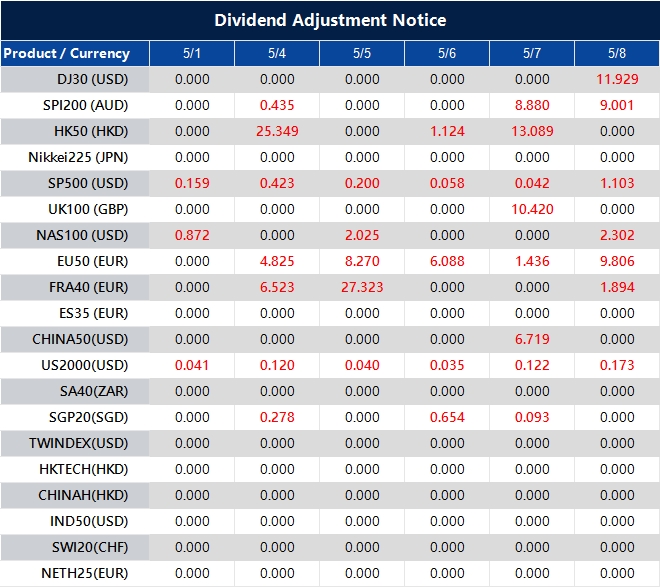
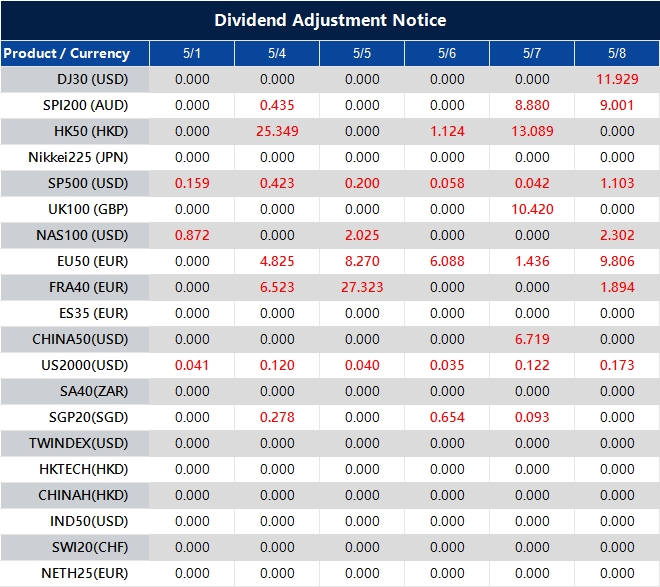
Dividend Adjustment Notice – May 01 ,2026

Dear Client,

Please note that the dividends of the following products will be adjusted accordingly. Index dividends will be executed separately through a balance statement directly to your trading account, and the comment will be in the following format “Div & Product Name & Net Volume”.

Please refer to the table below for more details:

Dividend Adjustment Notice

The above data is for reference only, please refer to the MT4/MT5 software for specific data.

If you’d like more information, please don’t hesitate to contact [email protected].

EUR/USD inches up as dollar weakens after Tokyo action, while bulls hold 200-day SMA below Fibonacci level

EUR/USD moved up as the US Dollar weakened after possible foreign exchange action by Japan to support the yen. EUR/USD traded near 1.1726, up about 0.42%, while the US Dollar Index was around 98.16, down about 0.80%.

The ECB kept all three policy rates unchanged. It said Middle East tension is lifting energy prices, which raises inflation and weighs on growth, while it aims for 2% inflation over the medium term.

Inflation Pressures Return

Preliminary data showed April HICP inflation at 3% year on year, up from 2.6% in March and the highest since September 2023. Energy prices were a main driver.

On the daily chart, EUR/USD stayed above the 200-day SMA at 1.1676 and traded below the 50% Fibonacci level at 1.1747. RSI (14) was 54.4, MACD was slightly negative, and ADX was near 22.2.

Resistance sits at 1.1747, then 1.1826 and 1.1924. Support is at 1.1676 and 1.1667, then 1.1555 and 1.1411.

The report was corrected on 30 April at 18:33 GMT to state the move occurred on Thursday, not Tuesday.

Shifting Macro Backdrop

Looking back at the situation in April 2025, we see the EUR/USD was consolidating above its 200-day moving average, struggling to break the 1.1747 resistance level. The market was weighing a hawkish ECB against a dollar weakened by potential Japanese intervention. That period of cautious optimism for the Euro seems to have shifted significantly over the past year.

The fundamental picture has now changed. Recent Eurozone manufacturing PMI data released for April 2026 came in at a contractionary 48.9, below forecasts and raising concerns about regional growth. This contrasts sharply with the United States, where the latest non-farm payroll report showed a robust addition of 205,000 jobs, reinforcing the Federal Reserve’s stance on maintaining higher interest rates for longer.

This growing policy divergence between a potentially slowing ECB and a steady Fed suggests downside risk for the pair. We believe traders should consider strategies that benefit from or hedge against a fall in EUR/USD. This could involve buying put options or establishing bear put spreads to define risk while positioning for a move lower.

The implied volatility for EUR/USD options has been climbing, recently hitting a three-month high of 9.2%, indicating the market is pricing in larger price swings. This makes selling premium through strategies like bear call spreads potentially attractive for those with a moderately bearish view. We should be cautious, as higher volatility also increases the cost of buying options.

We remember the sharp decline in the Euro during the 2022 energy crisis, which showed how sensitive the currency is to economic shocks and policy divergence with the US. While the situation is different now, that historical precedent serves as a reminder of how quickly sentiment can turn against the Euro. This supports a defensive posture on the pair in the weeks ahead.

Create your live VT Markets account and start trading now.

Markets lift GBP/USD 0.78% as investors anticipate Bank of England tightening, targeting 1.3600 amid bullish engulfing pattern

GBP/USD rose about 0.78% on Thursday, even though the Bank of England kept interest rates unchanged. The pair was trading at 1.3581, with a bullish engulfing pattern close to forming.

The technical view is neutral but leans upwards after GBP/USD moved above a resistance trendline near 1.3560/65. The RSI jumped above 60, which points to stronger upward momentum.

Bullish Engulfing Breakout Scenario

A break above 1.3600 would confirm the bullish engulfing pattern and could lead to a test of the 11 February high at 1.3711. If 1.3711 is broken, the next target is 1.3800.

If price reverses near the 29 April high at 1.3528, GBP/USD could fall towards 1.3500. A firm break lower would bring 1.3468/67 into view, where the 100-day and 20-day SMAs meet, followed by the 23 April low at 1.3448.

We are seeing the GBP/USD pair show considerable strength, pushing toward the 1.2900 handle as markets anticipate more aggressive action from the Bank of England. This comes even after the BoE held rates steady last week, as recent data shows UK core inflation remains sticky at 3.1%, well above the bank’s target. The market is increasingly pricing in at least one more rate hike by autumn, creating a bullish environment for the pound.

Given the strong upward momentum and a bullish-engulfing pattern forming on the charts, traders should consider buying call options. A move through the 1.2900 level could open the door for a challenge of 1.3000 in the coming weeks. Purchasing call options with a strike price around 1.2950 offers a way to capitalize on this potential move with a defined and limited risk.

For a more measured approach, we could implement a bull call spread to reduce the initial cost of the trade. This would involve buying a call option at a lower strike, like 1.2900, and simultaneously selling a call option at a higher strike, such as 1.3000. This strategy profits if the pair moves toward the higher strike price by the options’ expiration date, aligning with the current technical outlook.

Downside Risk And Hedging Plan

We must also prepare for a potential reversal, especially if the pair fails to decisively break key resistance. If GBP/USD falls back below the 1.2820 mark, it would signal that the bullish momentum is fading. In this scenario, purchasing put options could serve as a hedge against existing long positions or as a direct bet on a downward move toward support around 1.2750.

This situation feels familiar, reminding us of a similar setup we saw in the third quarter of 2025 when expectations of policy divergence between the Fed and the BoE drove a multi-week rally in the pound. The current divergence is even more pronounced, with futures markets now pricing in a 70% chance of a US rate cut by September while BoE hike odds remain firm. This historical precedent strengthens the case for a sustained move higher in the pair.

Create your live VT Markets account and start trading now.

Standard Chartered warns UK local elections may pressure Starmer, spark Labour challenge, while gilts remain central focus

UK local elections on 7 May cover over 5,000 council seats across England, plus all seats in the Scottish and Welsh parliaments. The results may raise political pressure on Prime Minister Starmer and increase the risk of a Labour leadership challenge.

Labour holds around half of the council seats up for election. With poll ratings falling, the party could face heavy losses in these contests.

Post Election Reset And Policy Direction

After the elections, Starmer may seek a reset through a cabinet reshuffle. Policy could also shift towards closer ties with the EU and measures aimed at boosting growth.

Any possible successor would be judged on fiscal plans and budget discipline. Gilt yields would be watched as a measure of how markets assess the economic credibility of each leadership option.

Looking back at the May 2025 local elections, we saw how the risk of a leadership challenge to Prime Minister Starmer directly impacted market sentiment. The heavy council losses for Labour, which were widely anticipated, introduced significant uncertainty into UK assets. This period serves as a crucial reminder of how domestic politics can drive market volatility.

The Gilt market, as we noted at the time, acted as the key barometer for the government’s fiscal credibility. Following the poor election results last year, we saw the 10-year Gilt yield swing by over 25 basis points as traders repriced the risk associated with a potential policy shift or leadership change. In the coming weeks, traders should remain highly sensitive to any rhetoric from cabinet members that echoes last year’s instability, as Gilt yields will likely be the first to react.

Sterling Volatility And Derivatives Positioning

This political instability translated directly into currency markets, with implied volatility on three-month GBP/USD options rising above 8% in the weeks after the 2025 vote. This reflected a heightened demand for protection against sudden drops in Sterling’s value. We should now watch for similar patterns in the options market as a leading indicator of renewed political anxiety.

A year later, the government’s pivot towards closer EU ties has yet to deliver the anticipated growth, with UK GDP growth for Q1 2026 reported at a sluggish 0.2%. This lingering economic weakness keeps the pressure on the current administration and makes Sterling vulnerable. Therefore, positioning through derivatives that profit from GBP weakness against the Euro or Dollar remains a viable strategy.

Given this backdrop, we believe traders should consider buying protection against a sudden spike in Gilt yield volatility. Options on Gilt futures, such as straddles or strangles, offer a way to capitalize on price movement regardless of direction ahead of any major fiscal announcements. This approach hedges against the kind of sharp repricing we witnessed in the wake of the political turmoil last year.

Create your live VT Markets account and start trading now.

WTI oil retreats to near $101.45, yet holds above $100 as Hormuz tensions sustain supply concerns

WTI fell on Thursday after three days of gains, trading near $101.45 and down 3.70% on the day. It stayed above $100.

Tensions around the Strait of Hormuz continued to raise supply concerns. The Associated Press reported that US President Donald Trump is exploring ways to end the shutdown of the route.

Pressure On Iran Strategy

The reported plan does not include lifting the US naval blockade on Iranian ports. It focuses on working with allies to increase pressure on Iran.

The Strait of Hormuz is a key route for Middle Eastern crude exports. Disruption to shipping there can tighten global supply and affect prices.

Danske Bank reported that tensions linked to the Iran conflict have supported energy prices. It said markets remain sceptical about a quick return to normal maritime traffic.

WTI is West Texas Intermediate, one of three major crude benchmarks alongside Brent and Dubai. It is a US-sourced “light” and “sweet” crude that is traded via the Cushing hub.

Key Drivers And Market Signals

WTI prices are driven by supply and demand, global growth, political instability, wars, sanctions, OPEC decisions, and the US Dollar. Weekly API and EIA inventory reports can move prices; their results are within 1% of each other 75% of the time, and OPEC has 12 members that set output quotas twice a year.

We remember the market tension in 2025 when WTI crude pushed above $100 per barrel amid the near-shutdown of the Strait of Hormuz. With prices today hovering near $82, the market seems to be discounting the potential for another supply shock. This complacency presents an opportunity, as the core issues from that period have not been resolved.

The fundamental picture is already tightening even without a major geopolitical event. Just this week, the Energy Information Administration (EIA) reported a surprise crude inventory draw of 6.4 million barrels, far exceeding expectations and signaling strong underlying demand. This drain on supply comes just as we head into the peak demand of the summer driving season.

Recent naval activity in the Gulf, including aggressive maneuvers by patrol boats near commercial tankers, is uncomfortably similar to the events that preceded the 2025 price spike. The market, however, has not yet factored in a significant risk premium for a potential disruption. This creates a disconnect between the calm market sentiment and the growing on-the-ground reality.

Considering this backdrop, buying out-of-the-money WTI call options for the next few weeks is a sensible approach. This strategy provides exposure to a potential sharp rally if Hormuz tensions escalate further. With broad market volatility relatively low, as the VIX index sits below 16, the cost of securing this upside protection is still quite reasonable.

We only have to look at historical precedents, such as the drone attacks in 2019 that caused oil to spike nearly 15% in one session, to understand how quickly the situation can change. A similar incident today would likely see crude prices rapidly test the $95 level we saw during the crisis last year. The current setup offers a limited-risk way to position for a high-impact event.

Create your live VT Markets account and start trading now.

Driven by Caterpillar earnings, the Dow surged roughly 730 points, recovering from below 48,500 above 49,500

The Dow Jones Industrial Average rose about 730 points, or 1.5%, on Thursday after moving from an overnight low below 48,500 to a high just above 49,600. The S&P 500 gained roughly 0.5%, while the Nasdaq Composite added 0.2% as large technology shares fell.

Caterpillar shares jumped about 10% after reporting results above expectations and raising its annual revenue outlook. Other industrial stocks also moved higher, supporting the Dow.

Market Drivers And Sector Moves

Meta fell roughly 9% after raising capital expenditure guidance and reporting softer user growth. Microsoft dropped about 5% after saying capital spending would reach $190 billion this year, partly due to higher memory costs.

US Q1 GDP was 2% annualised, below the 2.3% consensus and up from 0.5% in Q4 2025. March headline PCE inflation was 3.5% year on year and core PCE was 3.2%, while initial jobless claims were 189K versus 215K expected.

The Employment Cost Index rose to 0.9% in Q1, and Chicago PMI fell to 49.2 in April. WTI oil fell about 2% to above $104 a barrel, and Brent dropped roughly 3% to above $114 after a Wednesday rally linked to Iran blockade preparations.

The Federal Reserve kept rates at 3.5% to 3.75% in an 8–4 vote, the largest dissent since 1992. Traders adjusted expectations for cuts later this year, with incoming Chair Kevin Warsh in the dovish minority.

We are seeing a major split in the market that presents a clear opportunity for pairs trading. The Dow’s strength, fueled by industrials, against the Nasdaq’s weakness from tech suggests going long Dow futures while shorting Nasdaq 100 futures. This quarter, the Dow has already outpaced the Nasdaq by over 8%, the widest gap we’ve seen since the rotation of 2022.

Trading Opportunities And Volatility

The punishing of mega-cap tech for heavy AI spending is increasing volatility, which we can use to our advantage. With implied volatility on the Nasdaq 100 (VXN) now pushing above 35, selling out-of-the-money call and put options on names like Meta and Microsoft could be a profitable strategy. This allows us to collect premium from the elevated fear in the tech sector.

Caterpillar’s strong performance is not an isolated event but a sign of resilience in the physical economy. We should look at call options on other industrial and materials companies, as firming copper prices and strong global demand support this trend. The industrial sector ETF (XLI) has seen consistent inflows for six straight weeks, confirming this broader rotation.

The Federal Reserve is clearly conflicted, which creates uncertainty around the path for interest rates. The 8-4 vote split, the most divided since the early 1990s, means their next move is unpredictable. This is an ideal environment to buy straddles or strangles on Fed Funds futures, positioning us to profit from a large rate move in either direction later this year.

Sticky inflation remains the biggest obstacle for the market, making any potential rate cuts difficult for the Fed to justify. With the core PCE price index holding firm above 3% and the Employment Cost Index rising, the situation feels similar to the inflationary pressures we saw in 2025 before the last series of hikes. This suggests bets on further rate cuts may be premature and risky.

Geopolitical tensions are keeping oil prices elevated and volatile, creating opportunities in energy derivatives. The pullback in WTI crude is likely temporary as long as the threat of an extended blockade in Iran looms. Buying call options on WTI or Brent futures for the coming months offers a way to profit from another potential spike, much like the one we saw in late 2025 when Mideast tensions first escalated.

Create your live VT Markets account and start trading now.

Amid speculation of Japan intervening, a softer US Dollar leaves USD/CAD near 1.3612, down 0.53%

USD/CAD fell on Thursday, trading near 1.3612 and down about 0.53% on the day. A weaker US Dollar and soft US data supported the Canadian Dollar.

The US Dollar came under pressure on reports of possible Japanese foreign-exchange action. Reuters cited Nikkei as saying Japan may have bought Yen and sold US Dollars, with no official confirmation.

Japanese Yen Intervention And Dollar Weakness

USD/JPY dropped more than 2% after testing 160, a level linked to past Japanese action. The US Dollar Index traded near 98.16, down about 0.80% on the day.

US GDP grew at a 2% annualised rate in Q1 2026, up from 0.5% in the prior quarter but below the 2.3% forecast. The PCE price index rose 0.7% month-on-month in March, up from 0.4% in February and the strongest since June 2022.

Core PCE increased 0.3% month-on-month, down from 0.4% and in line with forecasts. In Canada, GDP rose 0.2% month-on-month in February, up from 0.1% in January and matching expectations.

First-quarter Canadian GDP was tracking about a 1.7% annualised pace, with risks including US tariffs, CUSMA renewal uncertainty, and Middle East tensions. US-Iran tensions continued, with a naval blockade and reports of planning around the Strait of Hormuz, keeping oil prices elevated.

Implications For Usdcad Outlook

Given the sharp drop in the US Dollar, we believe the path of least resistance for USD/CAD is lower in the coming weeks. The US Dollar Index (DXY) breaking below 100 to 98.16 is a significant technical development, marking a steep decline from the 104-106 range we saw for much of 2025. This weakness is being driven by both slower US growth and direct foreign exchange intervention from major central banks.

The suspected intervention by Japanese authorities to defend the Yen is a major catalyst for broad US Dollar weakness. We saw this playbook back in 2022, when the Bank of Japan spent over $60 billion to support its currency, showing they have the willingness to act forcefully. This creates a ceiling for the US Dollar against other major currencies, including the Canadian Dollar.

On the data front, the softer-than-expected US Q1 GDP growth of 2% supports a more cautious Federal Reserve. While headline inflation remains hot, the easing in the core PCE figure is what the Fed watches most closely, making further interest rate hikes less likely. This contrasts with the Bank of Canada, which may have less reason to cut rates given its steady economic performance.

The ongoing US naval blockade of Iran provides a strong pillar of support for the Canadian Dollar through higher energy prices. With West Texas Intermediate (WTI) crude oil now trading firmly above $95 a barrel, the terms of trade are shifting in Canada’s favor. Historically, periods of elevated oil prices, like the surge in 2022, have corresponded with significant strength in the CAD.

For derivative traders, this environment suggests buying put options on USD/CAD to capitalize on further downside. The increased market volatility makes options an attractive tool for defining risk. We would look at expiries in late May or June, targeting strikes around the 1.3500 level.

To manage risk, one could use a bearish put spread, which involves buying a put option and selling another at a lower strike price to reduce the initial cost. This strategy would still profit from a moderate decline in USD/CAD but with a capped maximum gain. It is a prudent way to express a bearish view while accounting for the recent spike in volatility.

Create your live VT Markets account and start trading now.

With inflation risks returning, the Bank of England deliberately held the base rate steady at 3.75%

The Bank of England kept its Bank Rate at 3.75%. The decision was expected, but it was framed as an active choice rather than a passive pause.

The vote was 8–1, with Huw Pill backing a rise. Policymakers pointed to inflation risks linked to higher energy prices feeding into the economy.

Policy Focus On Second Round Effects

Governor Andrew Bailey said policy cannot stop the first impact of higher global energy costs. He said it aims to stop these shocks feeding into wages and wider price-setting.

Bailey warned against waiting for firm proof before responding. The Bank indicated it may act early if price pressures spread.

The Bank also signalled it is not moving quickly towards more tightening. It held rates instead of cutting, to lean against inflation pressures.

The outlook depends on energy prices and the crisis in the Middle East. A longer energy shock raises risks to inflation and growth.

Implications For Sterling And Rates Markets

The BoE sets UK monetary policy with a 2% inflation target. It moves base rates, which affects borrowing costs and the Pound Sterling.

When inflation is above target, higher rates can support Sterling; lower rates can weaken it. QE expands credit by buying assets and can weaken Sterling, while QT reduces bond holdings and can support Sterling.

The Bank of England’s decision to hold rates at 3.75% should be seen as an active tightening signal, not a passive pause. The 8–1 vote split, with one dissenter pushing for a hike, reveals a clear hawkish bias within the committee. This signals that the tolerance for sticky inflation is wearing thin.

We are seeing the Bank’s concerns reflected in the latest data, with headline CPI inflation for March holding at 3.2%, still significantly above the 2% target. More importantly for policymakers, wage growth remains stubbornly high at an annual pace of 6.0%, fueling fears of these price pressures becoming embedded. This is precisely the “second-round effect” the Governor is determined to avoid.

The outlook is complicated by global energy markets, as ongoing geopolitical tensions have kept Brent crude prices firm, trading consistently above $85 per barrel. This external pressure directly feeds into UK inflation, making the Bank’s job much harder. It creates a difficult trade-off between controlling prices and avoiding a slowdown in growth.

For us in the derivatives market, this means re-evaluating any positions that bet on imminent rate cuts. The ‘higher for longer’ narrative is gaining strength, suggesting value in paying fixed on interest rate swaps to hedge against rates staying at these levels. Volatility in short-term interest rate options is likely to increase as the market digests this pre-emptive stance.

Looking back at the rapid rate-hiking cycle of 2023, we know the Bank is not afraid to act decisively when inflation expectations become unanchored. This hawkish hold, therefore, provides a supportive floor for the pound sterling against currencies with more dovish central banks. Trading strategies should consider renewed strength in GBP, as higher interest rates make the UK more attractive for global capital.

Create your live VT Markets account and start trading now.

Back To Top
server

Hello there 👋

How can I help you?

Chat with our team instantly

Live Chat

Start a live conversation through...

  • Telegram
    hold On hold
  • Coming Soon...

Hello there 👋

How can I help you?

telegram

Scan the QR code with your smartphone to start a chat with us, or click here.

Don’t have the Telegram App or Desktop installed? Use Web Telegram instead.

QR code


