






Key Takeaways
- The Strait of Hormuz disruption is driving oil, forex and crypto markets at the same time.
- Higher energy prices support the US dollar and pressure energy-importing currencies.
- Crypto acts like a risk asset in the short term but still functions as a real-time financial system.
- The real driver is not the price but how long the disruption lasts.
Why the Strait of Hormuz is the Defining Macro Story of 2026
There is a narrow strip of water, roughly 21 miles wide, sitting between Iran and Oman that is currently exerting more influence on currency markets and crypto prices than any central bank decision or earnings report.
The Strait of Hormuz has become the defining macro story of early 2026. Traders in forex and crypto who have not fully mapped its implications are operating with a serious blind spot.
Beginning on March 4, Iranian forces declared the Strait closed, threatening and in some cases attacking vessels attempting to transit it. What followed was not just an oil story. It became a cascading shock across every major asset class, with second-order effects that are still unfolding and far from fully priced.
How the Strait of Hormuz Closure Impacts Global Energy and Forex Markets
The Strait of Hormuz handles roughly 20% of global oil consumption, alongside a significant share of liquefied natural gas flows, particularly from Qatar. Any disruption here does not gently move markets. It forces a repricing.
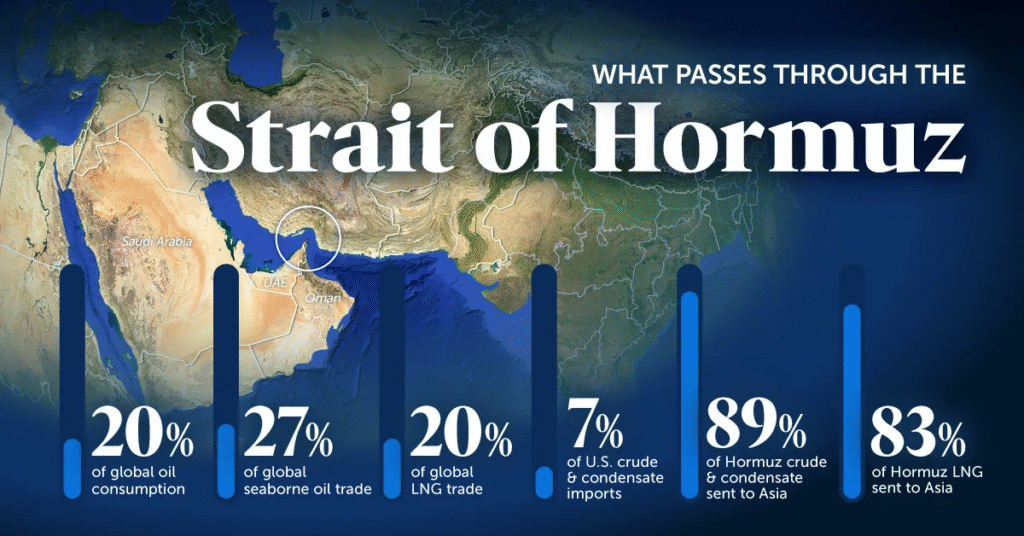
Source: Visual Capitalist
During the recent escalation, Brent crude moved above 100 dollars per barrel for the first time in four years, peaking near 120. While exact intraday highs vary across contracts, the direction is what matters. A sharp and aggressive repricing of energy.
Energy is never just about energy.
How does the Strait of Hormuz closure impact the USD?
The impact across currencies follows a consistent structure.
The United States sits in a relatively advantaged position. As one of the world’s largest energy producers and a major LNG exporter, it benefits on a relative basis when prices rise. Higher oil supports the dollar through improved terms of trade and safe-haven demand. At the same time, elevated energy prices complicate the Federal Reserve’s path to rate cuts, reinforcing dollar strength.
The euro area faces a structural vulnerability. Heavy reliance on imported energy means rising oil and gas prices push inflation higher while pulling growth lower. This creates a stagflationary setup. The European Central Bank is left constrained and unable to ease aggressively without risking persistent inflation. The result is sustained pressure on EURUSD.
Japan and broader Asia face a similar dynamic. Economies such as Japan, South Korea, India and China remain heavily dependent on imported energy, much of it historically routed through the Gulf. When shipping risks rise and prices spike, trade balances deteriorate. This translates into depreciation pressure on currencies like JPY, KRW and INR, unless offset by policy intervention.
There is also the Russia factor. Disruptions in Middle Eastern supply increase the relative importance of alternative producers. Russia’s discounted crude becomes more attractive to major importers such as India and China, supporting export revenues and indirectly stabilising trade-linked currency flows.
The takeaway is straightforward but often underestimated.
Energy is not just a commodity variable. It is a primary driver of currency markets.
Forex Chain Reaction: Impact of Strait of Hormuz Disruption
| Currency | Market Position | Impact of Disruption | Economic Drivers |
| US Dollar (USD) | Strong / Bullish | Benefits on a relative basis as a safe haven. | US is a major energy producer/LNG exporter; high oil prices complicate Fed rate cuts. |
| Euro (EUR) | Weak / Bearish | Faces sustained pressure and a stagflationary setup. | Heavy reliance on imported energy; rising costs push inflation up while pulling growth down. |
| Japanese Yen (JPY) | Weak / Bearish | Significant depreciation pressure. | Heavily dependent on imported energy historically routed through the Gulf. |
| Indian Rupee (INR) | Weak / Bearish | Trade balances deteriorate, leading to currency weakness. | High dependency on Middle Eastern energy imports. |
| South Korean Won (KRW) | Weak / Bearish | Vulnerable to shipping risks and price spikes. | Heavy reliance on energy imports to sustain the economy. |
| Russian Ruble (RUB) | Stabilising | Increased importance of alternative supply. | Discounted crude becomes more attractive to major importers like China and India. |
Is Bitcoin a Hedge or a Risk Asset? The Impact of Geopolitical Shocks on Crypto
Geopolitical shocks reveal what markets truly are, not what narratives suggest they should be.
In the immediate aftermath of major headlines, Bitcoin and the broader crypto market typically sell off. Liquidity tightens, volatility rises, and risk appetite fades. In these moments, crypto behaves less like a hedge and more like a high beta risk asset, closer to technology equities than digital gold.
But that is only half the story.
Crypto markets operate continuously. They do not close or pause. When geopolitical developments occur outside traditional trading hours, crypto becomes one of the only venues for real-time price discovery. This gives it a structural role that traditional markets cannot replicate.
During periods of heightened tension, trading volumes across major crypto exchanges tend to increase as participants react instantly to new information. This is observable behaviour embedded in market microstructure.
There is also a growing real economy dimension. In regions facing sanctions, capital controls or restricted access to banking infrastructure, crypto usage increases. It becomes not just a speculative asset but a functional alternative for settlement and value transfer.
Perhaps most tellingly, reports have emerged of vessels paying transit-related fees in Chinese yuan or even crypto to navigate the Strait under heightened risk conditions. These cases are still marginal, but they signal something more important. When traditional financial rails are disrupted, alternative systems are not just theoretical. They are used.
Crypto in this context carries a dual identity.
In the short term, it behaves like a risky asset.
In the longer term, it continues to evolve as a parallel financial system.
The Structural Tailwinds Beneath the Noise
Despite volatility, the broader trajectory for crypto remains intact.
Institutional participation continues to expand through Bitcoin exchange-traded funds (ETFs). Regulatory frameworks in the United States are gradually taking shape, with developments such as the CLARITY Act pointing toward a more defined operating environment. Meanwhile, stablecoins are quietly embedding themselves into the global financial system.
The scale is already significant.
In 2025, stablecoin transaction volumes exceeded 34 trillion dollars, surpassing the combined volumes of Visa and Mastercard. That figure carries more weight when viewed alongside real-world scenarios where digital assets are being used in high-friction geopolitical environments.
The underlying infrastructure is not slowing down, even when markets are.
Market Outlook: What Happens if the Strait of Hormuz Remains Closed?
Energy shocks do not hit markets in a single wave. They evolve.
At the outset, the reaction is driven by uncertainty and risk repricing. If disruptions persist, the impact becomes tangible. Shipping delays accumulate, inventories tighten, and volatility becomes sustained rather than temporary.
For traders, positioning becomes less about prediction and more about understanding the path forward.
If the situation stabilises and the Strait reopens, oil prices are likely to retrace from elevated levels. Inflation pressures ease, central banks regain flexibility, and risk assets, including equities and crypto, find support. Energy-importing currencies recover as external pressures fade.
If the disruption persists, the opposite dynamic takes hold. Elevated energy prices keep inflation stubborn, forcing central banks to maintain tighter policy for longer. Growth slows, the US dollar remains firm, and currencies tied to energy imports stay under pressure. In this environment, crypto becomes increasingly sensitive to liquidity conditions rather than acting as a defensive asset.
The market is not pricing where oil is today.
It is pricing how long this disruption will last and how deep its effects will run.
The Big Questions
1) How does the Strait of Hormuz closure impact global oil prices?
The Strait of Hormuz handles approximately 20% of global oil consumption and a significant share of liquefied natural gas (LNG). Any disruption forces aggressive repricing; during the March 2026 escalation, Brent crude spiked above 100 dollars per barrel, peaking near 120 dollars.
2) Why does the US Dollar (USD) strengthen during Middle East energy shocks?
The United States is one of the world’s largest energy producers and a major LNG exporter, which improves its terms of trade when prices rise. Additionally, elevated energy prices fuel inflation, making it harder for the Federal Reserve to cut interest rates, which further reinforces dollar strength.
3) How does the Hormuz disruption affect the Euro (EUR) and Japanese Yen (JPY)?
Both the Eurozone and Japan are heavily dependent on imported energy. Rising oil and gas prices create a stagflationary environment for the Euro—pushing inflation higher while pulling growth lower—and cause trade balances in Asia to deteriorate, leading to sustained depreciation pressure on the EUR, JPY, KRW, and INR.
4) Is Bitcoin a safe haven during geopolitical conflicts?
In the short term, Bitcoin typically behaves like a high-beta risk asset, similar to technology equities, often selling off when liquidity tightens and risk appetite fades. However, it functions as a parallel financial system in the long term, offering real-time price discovery and an alternative for settlement in regions with restricted banking access.
5) What is the role of stablecoins in global finance during disruptions?
Stablecoins are becoming a fundamental part of the global financial system, with 2025 transaction volumes exceeding 34 trillion dollars—surpassing the combined volumes of Visa and Mastercard. They provide critical infrastructure for value transfer in high-friction geopolitical environments where traditional rails are disrupted.
6) What happens to markets if the Strait of Hormuz reopens?
If the situation stabilises, oil prices are expected to retrace, inflation pressures would ease, and central banks would regain policy flexibility. This would likely lead to a recovery in risk assets, including equities and crypto, as well as energy-importing currencies.
Start trading now – Click here to create your real VT Markets account







