






Key Points
- USDCNH traded at 6.78125, down 0.0156, or 0.23%, after touching 6.77996.
- The onshore yuan touched 6.7803 per dollar, its strongest level since 9 February 2023.
- The PBOC set the midpoint at 6.8318, its strongest fixing since 15 February 2023, but 438 pips weaker than an estimate of 6.7880.
- Hopes for a deal to reopen the Strait of Hormuz weakened the dollar and lifted risk appetite.
The yuan rose to a fresh three-year high against the dollar on Monday as markets priced a higher chance of progress in US-Iran peace talks and a possible reopening of the Strait of Hormuz. USDCNH traded at 6.78125, down 0.0156, or 0.23%, at 05/25 07:35:26 GMT+3. A lower USDCNH rate means the offshore yuan is strengthening against the dollar.
The session high stood at 6.79156, with a low of 6.77996, an open at 6.78775, and a close at 6.79711. The onshore yuan touched 6.7803 per dollar, its strongest level since 9 February 2023, before changing hands near 6.7808 as of 0335 GMT. The offshore yuan also rose to a more than three-year peak and last fetched around 6.7812 per dollar.
The move came as the US dollar slipped in early Asian trading. Hopes of a deal to reopen Hormuz pushed oil below $100 per barrel, with Brent down 5.1% to $98.29 and WTI at $91.76, off 5%. The euro rose 0.3% to $1.1642, the pound gained 0.4% to $1.3485, and the Australian dollar advanced 0.4% to $0.7160.
Hormuz Hopes Lift Risk Appetite
The yuan is benefiting from a broad risk-on shift. Trump said Washington and Iran had “largely negotiated” a memorandum of understanding that would reopen the Strait of Hormuz, although he also said he had told negotiators not to rush into a deal. The strait carried one-fifth of global oil and liquefied natural gas shipments before the war, so even a partial reopening would change the energy and inflation outlook.
That matters for China because lower oil prices ease imported inflation pressure and improve the external backdrop for energy-importing economies. It also reduces demand for the dollar as a safe haven. Risk assets reacted quickly: Nasdaq futures rose 1.2%, S&P futures gained 0.7%, Japan’s Nikkei jumped 3% past 65,000, and MSCI’s broadest Asia-Pacific index outside Japan rose 1%.
Still, the yuan rally is not only about peace hopes. The PBOC also guided the market stronger. Before trading opened, the central bank set the midpoint at 6.8318 per dollar, its strongest setting since 15 February 2023. The fixing was still 438 pips weaker than an estimate of 6.7880, showing that Beijing is allowing appreciation but still trying to slow the pace.
PBOC Keeps Stability In Focus
The PBOC’s message remains balanced. The central bank has been setting softer-than-expected midpoint fixings, which traders read as an attempt to keep the yuan stable and avoid a rapid rise.
That strategy gives Beijing room to manage two risks at once. A stronger yuan helps cool imported inflation and signals confidence. A yuan that rises too quickly can hurt exporters and tighten financial conditions at a time when China still needs policy flexibility.
The spot yuan is allowed to trade 2% on either side of the fixed midpoint each day. That daily band gives the PBOC a powerful tool to guide expectations without forcing a sharp one-way move. Zhu Feng, chief China economist at J.P. Morgan, expects the central bank to keep the yuan stable and avoid excess appreciation. He sees the yuan finishing this year at 6.7 per dollar.
If the US raises rates while China holds rates steady or cuts them, upward pressure on the yuan could ease. That would give Beijing more room to use monetary policy without encouraging a disorderly currency move.
Capital Controls Add A Domestic Signal
China’s decision to launch a major crackdown on illegal cross-border investment did not move the currency much, but it still matters for the policy backdrop.
The measure signals that Beijing wants to keep capital flows orderly while the yuan strengthens. A stronger currency can attract inflows, but it can also invite speculative positioning. By tightening enforcement on illegal cross-border investment, policymakers can reduce the risk of volatile flows while preserving control over the exchange-rate path.
For traders, this means yuan strength may continue, but Beijing is unlikely to welcome a disorderly rally. The PBOC wants a firm currency, not a runaway one.
Technical Analysis
USDCNH is trading near 6.7812, continuing its broader downtrend as the offshore yuan strengthens against the dollar. The pair remains below all key short-term moving averages, keeping momentum tilted to the downside.
- MA5: 6.7991
- MA10: 6.7969
- MA20: 6.8091
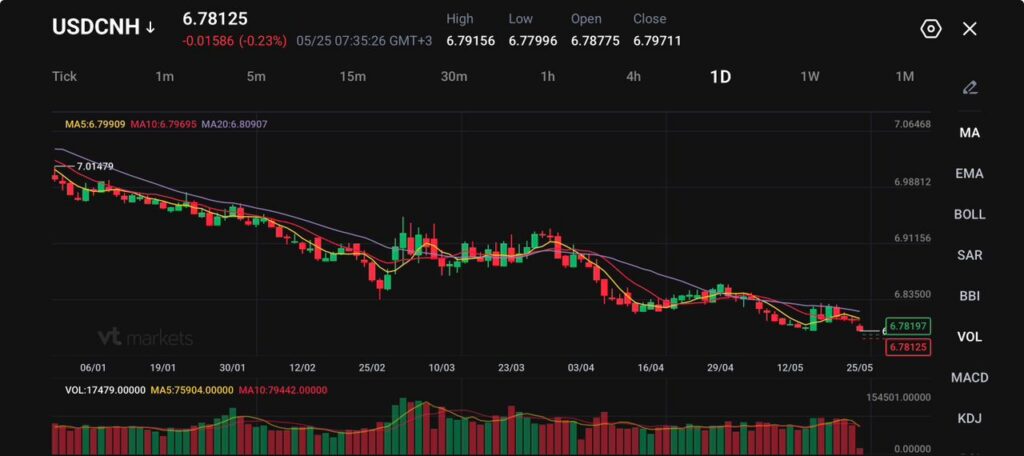
Price is trading beneath the 5-day, 10-day, and 20-day averages, reinforcing bearish pressure. The recent break below the 6.8000 handle has exposed support around 6.7750, with deeper downside potentially targeting the April lows.
Resistance now sits around 6.7960–6.8100, where the moving averages are clustered. USDCNH would need to reclaim that zone to ease short-term downside pressure.
The move reflects broader dollar softness alongside improving sentiment around Chinese markets and policy support expectations. However, traders remain cautious given ongoing concerns around China’s growth outlook and capital flows.
For now, USDCNH maintains a short-term bearish bias while price remains below the moving average cluster and under the key 6.8000 level.
Cautious Forecast
USDCNH may stay under pressure while it trades below 6.80907. A break below 6.77996 would support a move toward 6.7500, especially if Iran peace hopes keep oil lower and the dollar remains broadly offered.
A recovery above 6.80907 would suggest the PBOC’s stabilisation bias is starting to slow yuan gains. The strongest yuan path needs three signals to align: a credible Hormuz reopening plan, continued broad dollar weakness, and PBOC fixings that allow appreciation without triggering concern over excess strength.
Learn more about trading Forex Pairs on VT Markets here.
Trader Questions
Why Is The Yuan Rising Against The Dollar?
The yuan is rising because the US dollar has weakened on hopes that a US-Iran peace deal could reopen the Strait of Hormuz and ease global energy risk. USDCNH traded at 6.78125, down 0.0156, or 0.23%, which means the offshore yuan strengthened against the dollar.
What Is The Current USDCNH Price?
USDCNH traded at 6.78125. The session high was 6.79156, with a low of 6.77996, an open at 6.78775, and a close at 6.79711.
Why Did The Yuan Hit A Three-Year High?
The yuan hit a three-year high as broad dollar weakness, stronger risk appetite, and PBOC guidance supported the currency. The onshore yuan touched 6.7803 per dollar, its strongest level since 9 February 2023.
How Did The Offshore Yuan Perform?
The offshore yuan also rose to a more than three-year high. USDCNH last traded around 6.7812 per dollar, supported by weaker dollar demand and hopes that the Strait of Hormuz could reopen.
Why Does The Strait Of Hormuz Matter For The Yuan?
The Strait of Hormuz matters because it carries around one-fifth of the world’s oil and gas shipments. A reopening would ease oil prices, reduce inflation pressure, and support risk appetite. That can weaken the dollar and support currencies such as the yuan.
Start trading now – Click here to create your real VT Markets account







