






Key Points
- AUD/USD traded at 0.70986, down 0.00073, or 0.10%, after reaching a session low of 0.70864.
- The Aussie slipped 0.1% to $0.7098, after dropping 0.9% overnight to a five-week low of $0.7080.
- The Australia-US 10-year yield spread has narrowed to 40 basis points, down from 75 basis points a month ago.
- Economists expect Australia to add 15,000 jobs in April, with unemployment holding at 4.3%.
The Australian dollar stayed pinned near five-week lows on Wednesday as global stocks sold off and traders priced a tougher rate backdrop. AUD/USD traded at 0.70986, down 0.00073, or 0.10%, at 05/20 07:37:50 GMT+3. The session high stood at 0.7113, with a low of 0.70864, an open at 0.71032, and a close at 0.71059.
In the wider market, the Aussie slipped 0.1% to $0.7098, after falling 0.9% overnight to a five-week low of $0.7080. The move put major chart support around $0.7019 back in focus and left the pair well below its four-year top of $0.7277.
Risk appetite has weakened as war-driven inflation lifts global bond yields. Asian stocks fell for a fourth straight day, with US yields rising after inflation fears tied to the Iran war pushed markets to price higher-for-longer rates. The US 10-year yield rose to 4.687%, while the 30-year yield reached 5.198%, its highest since 2007.
Yield Advantage Narrows Against the Aussie
The Aussie is losing one of its key supports: yield advantage. The spread between Australian 10-year debt and US Treasuries has narrowed to 40 basis points, the smallest gap this year, down from 75 basis points a month ago.
That shift weakens AUD/USD because offshore yields have risen faster than Australian yields. Traders are pricing more rate hikes abroad, especially in the US, while the Reserve Bank of Australia has already lifted rates three times this year to 4.35% and is widely expected to hold rates steady in June.
The US dollar has benefited from this change. Reuters reported that the dollar stood near a six-week high as markets priced more than a 50% chance of a Federal Reserve rate hike in December, with the dollar index at 99.306, up more than 1% in May.
RBA Faces A Growth And Inflation Trap
The RBA is caught between inflation risk and growth risk. Higher oil prices from the prolonged Middle East conflict keep inflation pressure alive, but tighter policy can slow activity. That mix makes the Aussie harder to trade as a simple rate-support story.
The RBA’s current cash rate target is 4.35%, effective 6 May 2026, with the next update due at 2.30 pm on 16 June 2026.
Swaps imply a 20% probability that the RBA will lift rates again in June, but a move in August is about 75% priced in. Rates are expected to peak at 4.6%, with some risk of reaching 4.85%.
That pricing gives AUD/USD some support on dips, but it does not remove the downside risk. If traders see rate hikes as a response to bad inflation rather than strong growth, they may still sell the currency.
Jobs Data Becomes The Next Domestic Test
Australia’s jobs report on Thursday now becomes a key test for the Aussie. A Reuters poll of economists expects 15,000 new jobs in April, with the jobless rate holding at 4.3%.
A softer labour print would add pressure. The RBA already expects growth to slow to a subpar 1.3% by the end of the year as the US-Israeli war on Iran clouds the outlook. Weak jobs data would strengthen concerns that rate hikes and higher fuel costs are starting to hit demand.
A stronger report would not remove the inflation problem, but it could help AUD/USD stabilise. Resilient employment would give the RBA more room to keep policy restrictive without triggering immediate growth stress.
Technical Analysis
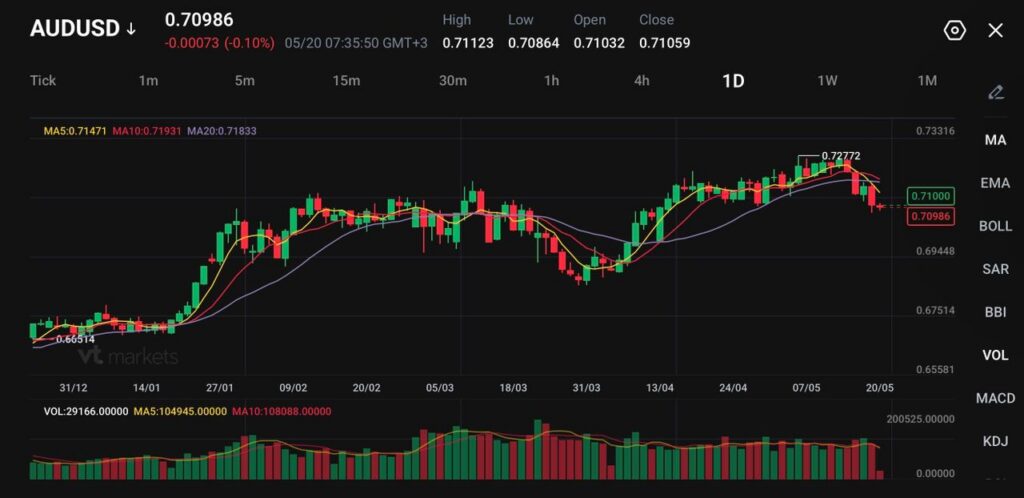
AUDUSD is trading near 0.7099, extending its pullback after the failed breakout above 0.7277 earlier in May. The pair has now slipped below all major short-term moving averages, confirming that bullish momentum has weakened materially over the past several sessions.
Technically, the structure has shifted into a clearer short-term bearish phase:
- MA5: 0.7147
- MA10: 0.7193
- MA20: 0.7183
Price is trading beneath the 5-day, 10-day, and 20-day averages, while the short-term averages themselves are turning lower. That alignment usually signals sustained downside pressure rather than a temporary pause.
The recent breakdown below the 0.7130–0.7150 support region is important. That zone had previously acted as a floor throughout late April and early May. Once support broke, sellers accelerated the move lower.
Key levels to watch:
- Immediate support: 0.7090 → 0.7000
- Major support: 0.6945
- Resistance: 0.7145 → 0.7180
- Major resistance: 0.7277
The 0.7000 psychological level is now becoming the next major downside target if sellers maintain control. Markets often gravitate toward round-number levels during stronger directional moves, especially when momentum and positioning align.
Fundamentally, the Australian dollar remains sensitive to three main themes:
- US dollar strength and Treasury yields
- China growth expectations
- Commodity demand sentiment
Recent stabilisation in the US dollar index has pressured AUDUSD, particularly as traders reassess the timing and scale of Federal Reserve rate cuts. At the same time, softer confidence around Chinese industrial demand has reduced support for commodity-linked currencies.
The chart also shows declining momentum following a long grinding rally from January through April. The inability to make fresh highs after the 0.7277 peak suggests exhaustion among buyers rather than continuation strength.
Volume has stayed relatively stable during the decline, indicating this is a controlled unwinding move rather than a panic selloff. That often points toward a broader corrective phase rather than a single volatility spike.
If AUDUSD remains below the 0.7145–0.7180 resistance cluster, sellers are likely to retain near-term control. A sustained break beneath 0.7090 would increase the probability of a move toward 0.7000 and potentially the March recovery base near 0.6945.
For now, the pair carries a short-term bearish bias, while the medium-term structure remains neutral unless price decisively breaks below the broader April support region.
Cautious Forecast
AUD/USD may stay under pressure while it trades below 0.71471 and 0.71833. A break below 0.70864 would support a move toward 0.7019 and 0.69448, especially if US yields keep rising and Thursday’s jobs data disappoints.
A recovery above 0.71931 would show that buyers are returning and could bring 0.72772 back into view. The strongest rebound path needs three signals to align: Australian jobs beat the 15,000 forecast, global equities stabilise, and the yield gap stops narrowing against the Aussie.
Learn more about trading Forex Pairs on VT Markets here.
Trader Questions
Why Is AUD/USD Falling?
AUD/USD is falling because the Australian dollar has lost yield support while global risk appetite weakens. War-driven inflation has pushed offshore bond yields higher, narrowing the Aussie’s interest-rate advantage.
AUD/USD traded at 0.70986, down 0.00073, or 0.10%.
What Is The Current AUD/USD Price?
AUD/USD traded at 0.70986.
The session high was 0.7113, with a low of 0.70864, an open at 0.71032, and a close at 0.71059.
Why Is The Australian Dollar Near Five-Week Lows?
The Australian dollar is near five-week lows because traders are pricing higher global interest rates, weaker risk appetite, and slower Australian growth.
The Aussie slipped 0.1% to $0.7098, after dropping 0.9% overnight to a five-week low of $0.7080.
Why Is The Yield Spread Important For AUD/USD?
The yield spread affects AUD/USD because investors compare returns between Australian and US bonds.
The spread between Australian 10-year debt and US Treasuries has narrowed to 40 basis points, down from 75 basis points a month ago. That gives investors less reason to favour the Aussie over the US dollar.
How Are Fed Rate Hike Bets Affecting AUD/USD?
Fed rate hike bets are weighing on AUD/USD by supporting the US dollar and US Treasury yields.
If markets expect the Federal Reserve to raise rates again, the dollar gains support. That makes it harder for AUD/USD to recover, especially when Australian yields lag behind US yields.
Start trading now – Click here to create your real VT Markets account







