






Key Points
- USDX traded at 98.799, up 0.313 points, or 0.32%, after reaching a session high of 98.871.
- The Federal Reserve kept its policy rate unchanged at 3.50% to 3.75%, but four policymakers dissented from the decision.
- Markets have fully priced out Fed rate cuts for this year and have started assigning odds to a possible hike in 2027.
The dollar index hovered near 99 on Thursday, holding recent gains after the Federal Reserve kept rates unchanged but delivered a more hawkish signal than markets had expected. The Fed left its benchmark rate at 3.50% to 3.75%, while four officials dissented.
That was the highest number of dissents since 1992, showing that the policy debate inside the Fed has become more divided as inflation risks rise.
The split matters for the dollar. One policymaker wanted a 25 basis point cut, while three opposed language that still pointed toward a possible easing bias. That tells markets the centre of gravity inside the Fed may be shifting away from cuts and toward a more neutral or even hawkish stance.
This has reshaped rate expectations. Markets have now fully priced out Fed rate cuts for this year and have started assigning odds to a possible hike in 2027. That gives the dollar a firmer base, especially when oil prices and geopolitical risk keep inflation concerns alive.
Iran Risk Adds A Safe-Haven Bid
The dollar also drew support from elevated tension in the Middle East. President Donald Trump said the US would maintain its naval blockade on Iran until a nuclear agreement is reached, while Tehran accused Washington of trying to force Iran into submission through economic pressure.
Reports also said Trump had pushed ahead with a prolonged blockade strategy after rejecting Iran’s latest proposal, which had delayed nuclear talks until shipping issues were settled.
This keeps the dollar supported through two channels. First, geopolitical stress tends to lift demand for liquid safe-haven assets. Second, the blockade keeps pressure on oil and energy costs, which can make the Fed more cautious about easing.
That mix favours the dollar over currencies tied to weaker growth or high energy-import costs. It also makes the next move in oil important for USDX. If energy prices stay elevated, the dollar may continue to draw support from inflation hedging and defensive flows.
ECB And BoE Decisions Could Shift The FX Balance
Attention now turns to the European Central Bank and the Bank of England later in the day. The ECB has a monetary policy meeting on 30 April, with its decision scheduled for 14:15 CET and a press conference later in the afternoon.
The Bank of England is also due to publish its April Monetary Policy Summary and minutes on 30 April. Its current Bank Rate stands at 3.75%, with the latest inflation rate listed at 3.3% against the 2% target.
These decisions matter because the dollar has already gained from the Fed’s hawkish tilt. If the ECB or BoE sound more cautious than the Fed, USDX could push higher. If they lean hawkish enough to support the euro or pound, the dollar’s rally may stall near resistance.
Technical Analysis
USDX is trading near 98.80, attempting to stabilise after a recent pullback from the 100.48 high, with price now edging higher within a developing short-term recovery phase. The broader structure still reflects a range-bound environment, but the latest price action suggests buyers are trying to regain control after the mid-April weakness.
From a technical standpoint, momentum is gradually improving but not yet decisive. Price is holding just above the 5-day (98.55) and 10-day (98.38) moving averages, both beginning to turn higher and offering immediate support. The 20-day (98.54) sits tightly clustered around current levels, reinforcing the idea that the market is at a pivot zone rather than in a clean trend.
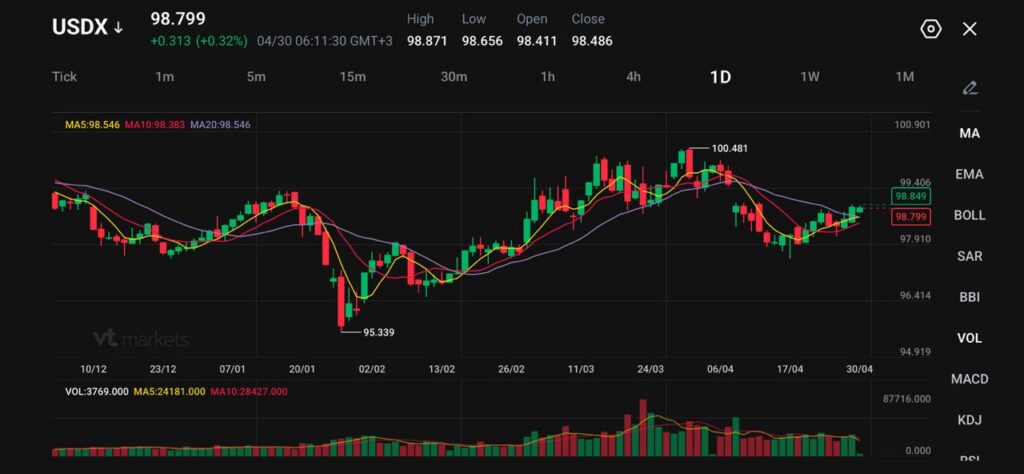
Key levels to watch:
- Support: 98.55 → 97.90 → 96.40
- Resistance: 99.40 → 100.50 → 101.00
Price is now pushing toward 99.40 resistance, a level that has capped recent recovery attempts. A sustained break above this zone could open a move back toward the 100.50 high, where stronger selling pressure previously emerged. Follow-through beyond that would be needed to confirm a broader bullish continuation.
On the downside, 98.55 is acting as immediate support. A break below this level would weaken the recovery structure and expose 97.90, with a deeper retracement possible if downside momentum builds again.
Overall, USDX is trying to base after a pullback, with price action compressing around key moving averages. The near-term direction will likely depend on whether buyers can reclaim the 99.40 zone or if sellers step back in to reassert control below it.
Market Implications
A firmer dollar can pressure commodities, emerging-market currencies, and risk assets. Gold may struggle if USDX extends above 99.406, especially if yields stay firm. Oil remains more complex, because supply risk can keep crude supported even when the dollar rises.
For equities, the message is mixed. A stronger dollar and fewer rate-cut hopes can pressure growth stocks and multinational earnings. At the same time, the dollar may stay bid if traders seek safety from Iran-linked risk.
The cautious forecast favours a firm USDX range while price holds above 98.546 and 98.383. A clean break above 98.871 would support a move toward 99.406. A close above 99.406 could reopen the path toward 100.481. If the ECB or BoE lean hawkish, or if Iran headlines improve, the dollar may lose momentum and retest 98.383 before 97.910.
Learn more about trading Indices on VT Markets today.
Trader Questions
Why Is The Dollar Index Holding Near 99?
The dollar index is holding near 99 because the Federal Reserve kept rates unchanged but sounded more hawkish on inflation.
USDX traded at 98.799, up 0.313 points, or 0.32%, after reaching a session high of 98.871.
What Did The Federal Reserve Do?
The Federal Reserve kept its policy rate unchanged, as markets expected.
The key shift came from the tone. Four policymakers dissented from the decision, arguing the Fed should no longer signal a bias toward easing. That showed rising internal division over the policy outlook.
Why Did The Fed Sound More Hawkish?
The Fed sounded more hawkish because inflation concerns have grown, partly due to higher oil prices and the Iran conflict.
If energy prices stay high, transport and production costs can rise. That makes it harder for inflation to fall and gives the Fed less room to cut rates.
Are Markets Still Expecting Fed Rate Cuts This Year?
No. Markets have fully priced out Fed rate cuts for this year.
Traders are also starting to assign odds to a possible rate hike in 2027. That shift has supported the dollar because higher-for-longer rates tend to make the currency more attractive.
How Is The Iran Conflict Supporting The Dollar?
The Iran conflict is supporting the dollar through safe-haven demand and inflation risk.
President Donald Trump said the US would maintain its naval blockade on Iran until a nuclear agreement is reached. Tehran accused Washington of trying to force Iran into submission through economic pressure. This keeps geopolitical risk high and supports demand for the dollar.
Start trading now – Click here to create your real VT Markets account







