






Key Points
- The spot yuan traded 0.04% lower at 6.8305 against the dollar, after moving in a tight 6.8270 to 6.8313 range.
- The PBOC set the midpoint at 6.8589 per dollar, versus 6.8579 in the previous session, and 307 pips weaker than a market estimate.
- USD/CNH traded at 6.82869 on the chart, up 0.00360, or 0.05%, while the dollar index stood at 98.59.
China’s yuan stayed in a narrow range against the dollar on Tuesday as traders waited for the Federal Reserve’s policy signal. The spot yuan traded 0.04% lower at 6.8305 against the dollar by 0300 GMT, after moving between 6.8270 and 6.8313.
The offshore yuan also softened. USD/CNH traded at 6.8312 yuan per dollar, down about 0.08% in Asian trade. The dollar’s six-currency index stood at 98.59, showing that dollar demand remained firm, but not aggressive.
The move reflects a market that is pausing rather than turning. The yuan is still up 1.0% against the dollar this month and 2.4% firmer this year.
That keeps it in a stronger position than many Asian peers, especially as oil-linked stress weighs more heavily on economies with weaker energy buffers.
PBOC Fixing Slows Yuan Appreciation
The People’s Bank of China set the midpoint rate at 6.8589 per dollar before the market opened. That compares with 6.8579 in the previous session and came 307 pips weaker than a market estimate. The spot yuan can trade 2% either side of the fixed midpoint each day.
This weaker midpoint curbed yuan appreciation. It also showed that policymakers still want control over the pace of currency strength. A stronger yuan can help reduce imported inflation, especially when energy prices stay high. But too much strength can hurt exporters at a time when China still needs trade resilience to support growth.
Uncertainty around US rate policy and geopolitical risk has temporarily supported the dollar. They added that China’s fixing guidance remained broadly on the strong side, helped by resilient exports.
That creates a managed balance. The PBOC appears willing to let the yuan stay firm, but not run too fast. Traders should watch whether future fixings stay weaker than market estimates, as that would suggest Beijing wants a slow grind rather than a sharp rally.
China’s Export Position Supports Yuan Resilience
The yuan has also gained support from China’s role in the energy shock. Some analysts see it as a relative winner from the crisis caused by the Iran war, as China’s export base benefits from demand for renewables, batteries, and solar systems.
Recent data showed China’s clean-tech export receipts rose 30% from February and 52% from the same month in 2025 as the Middle East shock drove demand for home-grown energy supplies worldwide.
That helps explain why the yuan may continue to outperform other Asian currencies. A stronger export position can support capital inflows, trade receipts, and currency confidence. At the same time, a stronger yuan can soften imported inflation pressure, which gives Beijing more room to manage domestic policy.
Still, the benefit has limits. If oil prices keep rising, Asia’s wider current-account stress can still spill into regional FX markets. A broad dollar rebound would also slow yuan gains, even if China’s export story stays firm.
U.S.-China Summit Becomes The Next Test
The next major event for the yuan is the U.S.-China presidential summit in May. The bank expects risks in U.S.-China ties to stay contained. Citi expects the yuan to reach 6.8 in three months and 6.7 in six to 12 months.
That forecast fits the current trend, but it still depends on two conditions. First, the Fed must avoid a fresh hawkish shift. Second, the May summit must keep trade and geopolitical risks under control.
If the summit delivers a calmer tone, yuan bulls may press USD/CNH lower. If the talks sour, traders may rebuild dollar hedges and slow the yuan’s advance.
Technical Analysis
USDCNH is trading near 6.8287, stabilising after a steady decline from the 7.07 highs, with price now moving sideways as selling pressure begins to ease. The broader trend remains downward, but recent price action suggests the pair is entering a short-term consolidation phase near the lows.
From a technical standpoint, the bias remains bearish but softening. Price is still trading below the 20-day moving average (6.8360), which continues to slope downward and caps upside attempts. However, the 5-day (6.8296) and 10-day (6.8239) are flattening around current levels, indicating that downside momentum is slowing and a base may be forming.
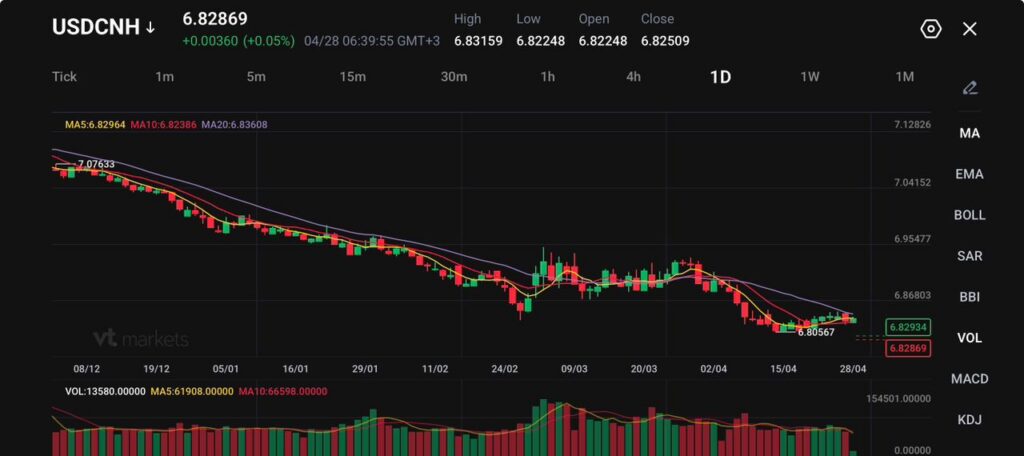
Key levels to watch:
- Support: 6.8050 → 6.7800 → 6.7500
- Resistance: 6.8300 → 6.8600 → 6.9000
The pair is currently consolidating just above the 6.8050 support zone, where recent declines have paused. A break below this level could resume the broader downtrend and open a move toward 6.7800.
On the upside, 6.8300 is acting as immediate resistance. A move above this level could trigger a corrective rebound toward 6.8600, though stronger resistance remains near the 20-day average, which would need to be reclaimed to signal a more meaningful shift in trend.
Overall, USDCNH remains in a controlled downtrend with signs of near-term stabilisation. The focus now is on whether price breaks below 6.8050 to continue lower, or builds a base and attempts a corrective bounce.
Cautious Forecast
The yuan’s near-term bias remains mildly firm while USD/CNH stays below 6.83608. A move below 6.82248 would support a retest of 6.80567, with 6.8 as the next key psychological target.
A hawkish Fed tone could slow that move and lift USD/CNH back toward 6.86803. A softer Fed message, steady PBOC guidance, and calmer U.S.-China signals before the May summit would support Citi’s view for 6.8 in three months and 6.7 in six to 12 months.
Learn more about trading Forex Pairs on VT Markets here.
Trader Questions
Why Is The Yuan Trading In A Narrow Range?
The yuan is trading in a narrow range because traders are waiting for the Federal Reserve’s policy decision on Wednesday.
The spot yuan was 0.04% lower at 6.8305 against the dollar by 0300 GMT, after trading between 6.8270 and 6.8313. That shows a market holding back before the Fed gives clearer guidance on rates.
What Did The PBOC Midpoint Fixing Show?
The People’s Bank of China set the midpoint rate at 6.8589 per dollar, compared with 6.8579 in the previous session.
The fixing was 307 pips weaker than a market estimate, which curbed yuan appreciation. The spot yuan can trade 2% either side of the daily fixed midpoint.
Why Does The Federal Reserve Matter For USD/CNH?
The Federal Reserve matters because US interest-rate expectations drive dollar demand.
If the Fed sounds cautious on inflation and keeps rates higher for longer, the dollar may stay supported. That could push USD/CNH higher. If the Fed signals a softer path ahead, the yuan may regain strength and USD/CNH could move lower.
What Is The Dollar Index Showing?
The dollar’s six-currency index stood at 98.59.
That suggests the dollar remains supported, helped by uncertainty around US rate policy and geopolitical risk. However, the move is not strong enough yet to fully reverse the yuan’s broader recovery this year.
How Has The Yuan Performed This Month?
The yuan is up 1.0% against the dollar this month.
It is also 2.4% firmer this year. That makes it one of the stronger Asian currencies, helped by China’s export resilience and its relative position during the energy crisis linked to the Iran war.
Start trading now – Click here to create your real VT Markets account







