






Key Points
- USDJPY trades near 159.45, with the yen weakening for a third straight session.
- Rising oil prices are pressuring Japan’s economy and weighing on the currency.
- Ongoing Middle East tensions keep safe-haven demand tilted toward the dollar.
The Japanese yen weakened further on Thursday, slipping toward the 159.5 level against the dollar, marking its third consecutive session of losses.
USDJPY is currently trading near 159.45, reflecting renewed demand for the U.S. dollar as geopolitical uncertainty persists.
The move comes as markets react to mixed signals around diplomatic efforts in the Middle East, with little clarity on whether tensions will ease.
Continued uncertainty may keep USDJPY elevated, especially if oil prices remain firm.
Oil Rebound Weighs on Japan’s Economic Outlook
A key driver behind the yen’s weakness is the rebound in oil prices.
Japan’s heavy reliance on imported energy means higher oil prices directly impact its economy, raising costs and increasing inflationary pressure.
This dynamic weakens the yen by worsening Japan’s trade balance and reducing growth expectations.
Even as Japan received two oil tankers that bypassed the Strait of Hormuz, offering temporary relief, the broader supply situation remains uncertain.
If oil prices continue to rise, the yen may face further downside pressure.
Geopolitical Tensions Limit Risk Recovery
The geopolitical backdrop remains a central factor in currency markets.
While the U.S. has indicated that negotiations are ongoing, Iran has rejected direct talks and proposed its own terms, including control over the Strait of Hormuz.
This has reduced expectations of a near-term resolution and kept market sentiment cautious.
In this environment, investors continue to favour the U.S. dollar as a safe-haven asset, limiting any meaningful recovery in the yen.
Policy and Security Considerations Add Complexity
Japan is also weighing broader strategic responses to the crisis.
There have been discussions about potentially deploying warships to secure key shipping routes, highlighting the seriousness of the situation for energy-importing nations.
Such measures reflect the growing link between geopolitical risk and economic stability.
At the same time, currency markets remain sensitive to any signs of intervention, particularly as USDJPY approaches the 160 level, a zone that has previously triggered official action.
Intervention risks may increase if the pair moves closer to or above 160.
Technical Analysis
USDJPY is trading near 159.45, holding steady just below recent highs as the pair continues to press against the upper end of its range. Price action suggests sustained bullish pressure, with the market testing levels last seen near the 159.90–160.00 zone.
From a technical standpoint, the trend remains firmly bullish. Price is trading above all key moving averages, with the 5-day (159.05) and 10-day (159.06) tightly clustered just below current levels, providing immediate support. The 20-day (158.40) and 30-day (157.18) continue to slope upward, reinforcing the strength of the underlying uptrend.
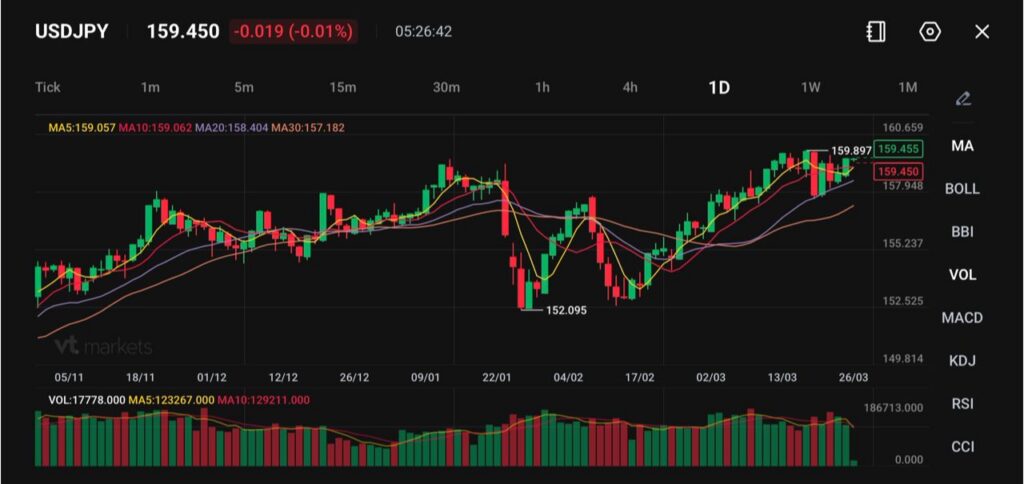
Key levels to watch:
- Support:159.00 → 158.40 → 157.20
- Resistance:159.90 → 160.50 → 161.00+
The pair is currently consolidating just below 159.90, a level that has capped recent upside attempts. A clean break above this resistance could trigger a move toward 160.50, with further upside potential if momentum accelerates.
On the downside, 159.00 is acting as immediate support. A break below this level could lead to a deeper pullback toward 158.40, though such a move would likely be corrective unless broader momentum shifts.
Overall, USDJPY remains in a strong uptrend with shallow pullbacks, indicating continued demand for the dollar against the yen. However, with price nearing the 160 level, traders should remain cautious of potential volatility or intervention risks, as this area has historically attracted heightened attention.
What Traders Should Watch Next
USDJPY remains driven by a mix of macro and geopolitical factors. Key drivers include:
- Oil price movements and energy supply developments.
- Progress or setbacks in Middle East diplomacy.
- Potential intervention signals from Japanese authorities.
- Broader U.S. dollar strength.
For now, the yen remains under pressure, with energy costs and geopolitical uncertainty continuing to shape its direction.
Learn more about trading Forex Pairs on VT Markets here.
FAQs
What is Driving the Recent Weakness in USDJPY?
USDJPY is rising due to strong dollar demand and higher oil prices, which weigh on Japan’s import-heavy economy.
Why Do Higher Oil Prices Weaken the Japanese Yen?
Japan relies heavily on imported energy. Rising oil prices increase costs, worsen the trade balance, and pressure the yen.
Why is the U.S. Dollar Strengthening in This Environment?
The dollar is benefiting from safe-haven demand and the U.S.’s status as a net energy exporter during supply shocks.
What is the Significance of the 160 Level in USDJPY?
The 160 level is a key psychological and policy threshold where Japanese authorities have previously intervened.
Could Japan Intervene to Support the Yen?
Yes, intervention becomes more likely if USDJPY approaches or exceeds 160, especially during rapid or disorderly moves.
How Does the Middle East Conflict Affect USDJPY?
Escalation pushes oil prices higher and increases global uncertainty, supporting the dollar while weakening the yen.
Start trading now – Click here to create your real VT Markets account







