





Key Points
- WTI trades near 89.27, up +0.902 (+1.02%), holding elevated levels after recent volatility.
- Prolonged high oil prices may push central banks toward tighter policy, despite slowing growth risks.
- Markets face a growing trade-off between inflation control and financial stability.
Oil prices are holding firm near elevated levels, with WTI crude trading around 89.27, up +1.02%, as markets continue to absorb the impact of persistent supply disruptions.
The recent price action suggests that oil is entering a consolidation phase after its sharp rally, but the broader structure remains supported by ongoing geopolitical risks and constrained supply.
Crucially, it is not just the level of oil prices that matters, but how long they remain elevated.
Sustained prices near current levels could keep upward pressure on inflation expectations and limit downside in oil.
High Oil Prices Complicate Central Bank Policy
The persistence of high energy prices is creating a complex environment for central banks.
According to market strategists, the longer oil remains elevated, the more policymakers may feel compelled to maintain a hawkish stance, even if economic growth begins to slow.
This dynamic is driven by the inflationary impact of energy costs. Higher oil prices feed directly into consumer prices, making it harder for central banks to justify easing policy.
However, tightening policy in response to supply-driven inflation carries risks.
Unlike demand-driven inflation, where tighter policy can effectively cool activity, supply shocks can lead to higher prices alongside weaker growth, creating a difficult policy trade-off.
Central banks may remain cautious, but a prolonged energy shock could delay rate cuts and tighten financial conditions further.
Growing Tension Between Price Stability and Growth
Markets are increasingly focused on the trade-off between controlling inflation and preserving financial stability.
Efforts to combat inflation through tighter monetary policy can increase borrowing costs, reduce liquidity, and amplify stress across financial markets.
This creates a feedback loop where geopolitical tensions drive oil prices higher, which in turn forces central banks into a more restrictive stance, adding pressure to the broader financial system.
The result is a more fragile market environment, where both inflation and growth risks are elevated.
Financial Stress Risks Begin to Surface
Historical patterns suggest that policy tightening in response to supply shocks can lead to greater financial stress than tightening driven by strong demand.
Higher rates in this context do little to resolve the underlying supply issue, while still tightening financial conditions.
This raises the risk of volatility across asset classes, including equities, bonds, and currencies, as markets adjust to a less supportive policy backdrop.
If oil prices remain elevated, financial conditions could tighten further, increasing the risk of broader market stress.
Technical Analysis
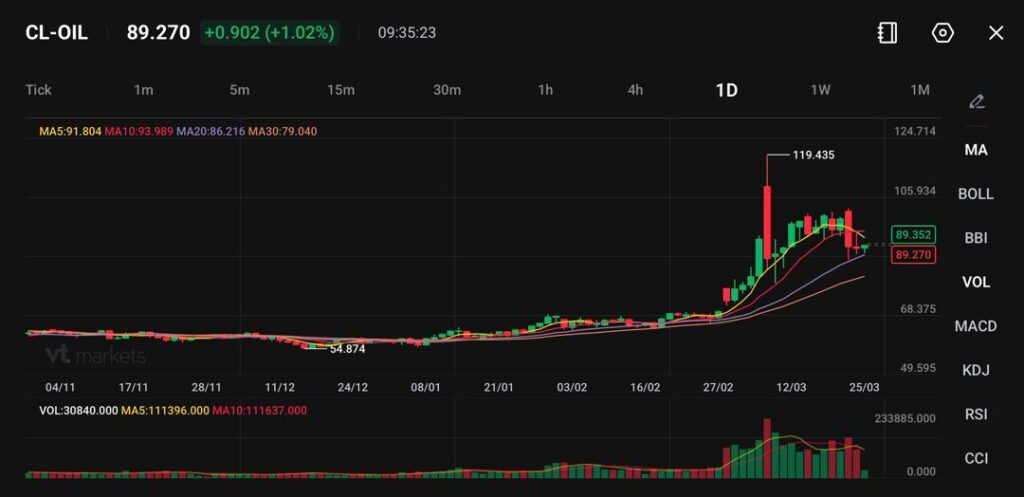
Crude Oil (CL-OIL) is trading near $89.27, up around 1.02%, showing a modest bounce after drifting lower from the recent spike toward $119.43. The move suggests buyers are attempting to defend the lower end of the current consolidation range, though momentum remains fragile.
Technically, oil is now sitting between key moving averages, signalling a transition phase. The 5-day MA (91.80) and 10-day MA (93.99) are positioned above price and trending lower, acting as near-term resistance. Meanwhile, the 20-day MA (86.21) and 30-day MA (79.04) remain upward sloping below price, indicating that the broader uptrend structure is still intact despite the pullback.
Key levels to watch:
- Support:88–89 → 85 → 79
- Resistance:91.80 → 94 → 100+
The $88–89 zone is proving to be an important support area. Holding this level keeps the market within a consolidation range rather than signalling a deeper reversal. A break below it could accelerate downside toward $85, where the 20-day average offers stronger structural support.
On the upside, price needs to reclaim $91.80–94 to regain short-term bullish momentum. A move back above this region would likely shift sentiment toward a retest of $100, though the $105–119 zone remains a major resistance band after the previous spike.
Overall, oil appears to be cooling after a sharp rally, with price action evolving into a range-bound consolidation. The broader trend remains constructive above $85, but short-term direction will hinge on whether buyers can push back above $92–94 or lose the $88 support floor.
What Traders Should Watch Next
Markets are now navigating a delicate balance between inflation and growth risks. Key factors to monitor include:
- Duration of elevated oil prices
- Central bank communication and policy outlook
- Signs of financial stress across asset classes
- Developments in global energy supply
For now, oil remains a central driver of macro conditions, with its sustained strength likely to shape both monetary policy and market behaviour in the near term.
Learn more about trading Energies on VT Markets here.
Refresher Questions
Why Are Oil Prices Still Elevated?
Oil remains high due to ongoing supply disruptions and geopolitical tensions, particularly around key routes like the Strait of Hormuz.
Where is Oil Trading Right Now? WTI crude is trading near 89.27, up +1.02%, holding elevated levels after recent volatility.
Why Do High Oil Prices Matter for Central Banks?
Higher oil prices increase inflation, which can force central banks to keep interest rates elevated or delay rate cuts.
What is the Link Between Oil and Inflation?
Oil directly affects energy and transport costs, which feed into broader consumer prices, making it a key driver of inflation.
Why is Supply-Driven Inflation More Difficult to Manage?
Supply-driven inflation is caused by shortages rather than demand, so raising interest rates does not fix the root issue and can slow growth.
What is the Risk of Central Banks Staying Hawkish?
Prolonged tight policy can increase borrowing costs, reduce liquidity, and create stress in financial markets, especially if growth weakens.
Start trading now – Click here to create your real VT Markets account







