





Key Points
- Gold futures fall 0.6% to $5,095.30 a troy ounce, pushing bullion toward a weekly loss.
- The U.S. dollar index rises 0.3% to 100.06, increasing pressure on dollar-denominated commodities.
- XAUUSD trades at 5075.35, down -4.43 (-0.09%), with MA5 5132.49, MA10 5147.24, MA20 5121.57, and MA30 5062.52.
Stronger Dollar Pressures Bullion
Gold prices weakened as the U.S. dollar continued to strengthen, pushing bullion toward a weekly loss. Futures in New York slipped 0.6% to $5,095.30 a troy ounce, while spot gold hovered around 5075.35, down -4.43 (-0.09%).
A stronger dollar often creates headwinds for gold. When the U.S. dollar index rises to 100.06, up 0.3%, dollar-denominated commodities become more expensive for international buyers. This tends to reduce demand from outside the United States and can weigh on bullion prices.
The dollar’s strength also reflects broader risk dynamics. Traders have moved into the currency as geopolitical tensions and volatile energy markets increase uncertainty.
If the dollar holds near 100.06 or continues climbing, gold may struggle to regain upward momentum in the near term.
Oil Prices Complicate The Inflation Picture
Rising oil prices have introduced another challenge for bullion. Higher energy costs can increase inflation expectations, which complicates the outlook for Federal Reserve policy.
Analysts at ANZ note that the dollar has strengthened partly because the United States is a net energy exporter, meaning rising oil prices can support the U.S. economy relative to energy-importing regions.
This dynamic shifts capital toward the dollar while creating pressure on gold. When energy prices rise, traders may anticipate higher interest rates or a delay in rate cuts as central banks try to contain inflation.
If oil prices remain elevated, markets may continue adjusting expectations for U.S. monetary policy, which could keep pressure on gold.
Fed Policy Uncertainty Weighs On Gold
Uncertainty surrounding Federal Reserve policy remains a central theme for bullion traders. Higher oil prices increase the possibility that inflation pressures return, which could complicate the timing of interest rate cuts.
Gold tends to perform best when interest rates fall or when traders expect easier monetary policy. When rate cuts appear less certain, yields can rise and reduce the appeal of non-yielding assets such as gold.
Markets are therefore balancing two competing forces: geopolitical risks that support safe-haven demand, and monetary policy uncertainty that limits upside momentum.
If incoming data suggests inflation remains sticky, expectations for rate cuts may fade further and gold could remain under pressure despite ongoing geopolitical tensions.
Technical Analysis
Gold (XAUUSD) is trading near 5,075, slightly lower on the session, as the metal continues to ease after the earlier rally that pushed prices to a peak around 5,598.60.
The recent price action suggests the market is undergoing a consolidation phase, with momentum cooling as traders digest the strong gains seen earlier in the year.
From a technical perspective, gold is currently hovering around its short-term moving averages. The 5-day moving average (5,132) and 10-day (5,147) sit just above the current price, indicating mild downward pressure in the near term. Meanwhile, the 20-day moving average (5,121) is close to the market and beginning to flatten, while the 30-day moving average (5,062) remains below current levels and continues trending upward, suggesting that the broader bullish structure is still intact.
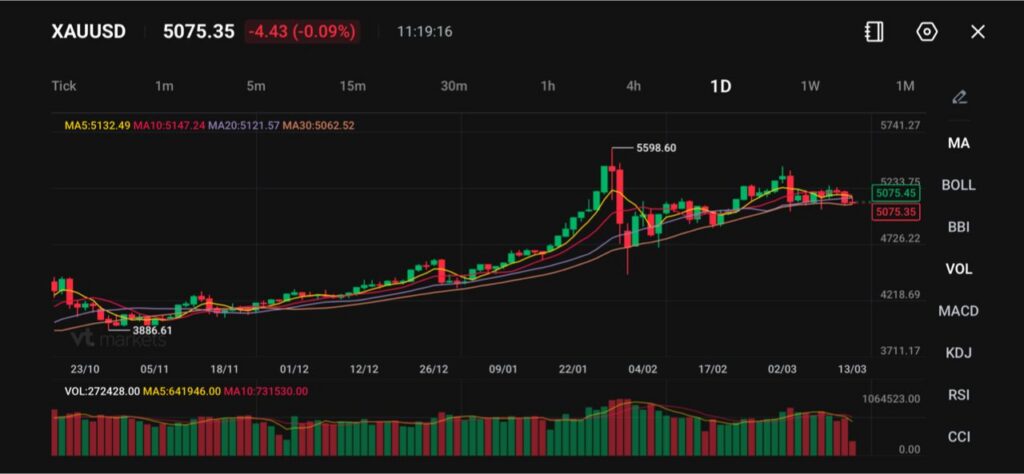
Immediate support is located near 5,050–5,070, where the market is currently attempting to stabilise. A break below this zone could expose further downside toward 4,950–5,000, which represents a stronger structural support area.
On the upside, initial resistance appears near 5,130–5,150, followed by a more significant resistance zone around 5,250–5,300, where recent rallies have stalled.
Overall, gold appears to be consolidating within a broader uptrend, with the current pullback likely reflecting short-term profit-taking rather than a full reversal.
Holding above the 5,000 psychological level would keep the longer-term bullish outlook intact, while a sustained move back above 5,150 could signal renewed upward momentum.
What Traders Should Watch Next
- Movements in the U.S. dollar index, particularly if it remains above 100.06.
- Oil price trends and their impact on inflation expectations.
- Federal Reserve communication and incoming economic data that could influence rate-cut timing.
- Whether gold futures continue trading below $5,100 a troy ounce or stabilise near current levels.
Learn more about trading Precious Metals on VT Markets here.
FAQs
- Why Are Gold Prices Falling This Week?
Gold is under pressure from a stronger US dollar, rising oil prices, and uncertainty over Federal Reserve interest-rate policy. These factors have pushed New York gold futures down 0.6% to $5,095.30 a troy ounce, putting bullion on track for a weekly loss. - How Does a Stronger US Dollar Affect Gold Prices?
Gold is priced in US dollars. When the US dollar index rises to 100.06, up 0.3%, gold becomes more expensive for overseas buyers. This can reduce global demand and weigh on bullion prices. - Why Are Rising Oil Prices Important for Gold?
Higher oil prices increase inflation risks. If inflation rises again, the Federal Reserve may delay rate cuts or maintain a tighter policy. Higher interest rates tend to reduce the appeal of non-yielding assets such as gold. - Why Does the US Dollar Benefit From Higher Oil Prices?
The United States is a net energy exporter, meaning higher oil prices can support the US economy relative to energy-importing regions. This dynamic strengthens the dollar and indirectly pressures gold. - Why is Federal Reserve Policy So Important for Gold?
Gold performs best when interest rates fall or when markets expect easier monetary policy. If rate cuts become less likely, bond yields can rise and reduce the appeal of holding gold.
Start trading now – Click here to create your real VT Markets account







