






Key Points
- The US dollar index (USDX) trades around 99.136, up +0.144 (+0.15%), hovering near its strongest levels this year.
- Brent crude surged above $100 per barrel, intensifying inflation concerns and lifting expectations for tighter central bank policy.
- Markets are pushing back rate-cut expectations as oil-driven inflation risks grow, with traders increasingly pricing delayed easing from major central banks.
The US dollar extended its gains as oil prices surged, pushing the currency toward its strongest levels of the year. Traders have been moving back into the dollar as the global energy shock raises concerns about inflation and forces markets to rethink how quickly central banks can ease policy.
Rising oil prices increase energy costs across economies, which feeds into consumer prices and complicates the inflation outlook. This has strengthened the dollar as traders reduce bets on interest rate cuts and look for safety in the world’s reserve currency.
The move has been broad across the currency market. The euro, yen, sterling and commodity-linked currencies all weakened against the dollar as energy volatility weighed on global risk sentiment.
If oil prices remain elevated, the dollar may continue to find support as markets adjust to the possibility that central banks keep policy tighter for longer.
Energy Dependence Shapes Currency Moves
Currency moves have largely reflected each economy’s dependence on imported energy. Countries that rely heavily on foreign oil and gas face worsening trade balances when energy prices surge.
This dynamic has pressured European and Asian currencies. Europe in particular faces greater exposure to energy shocks because of its dependence on imported oil and gas, which has weighed on the euro despite rising expectations that the European Central Bank may tighten policy.
The Japanese yen also weakened toward the 159 per dollar level, approaching its weakest levels in nearly a year. Japan imports the vast majority of its energy needs, meaning higher oil prices quickly translate into economic pressure.
Commodity currencies have also felt the strain. The Australian and New Zealand dollars both slipped as traders reassessed global growth risks and rising inflation.
If energy prices remain volatile and supply disruptions persist, currencies tied to energy imports may continue to face pressure relative to the dollar.
Rate Expectations Shift Across Central Banks
The surge in oil prices has begun to ripple through interest-rate markets. Traders are increasingly questioning whether central banks can cut rates as quickly as previously expected if inflation pressures rise again.
Swaps markets now show expectations that some central banks could tighten sooner or delay easing cycles. The European Central Bank is increasingly expected to move earlier than anticipated, while the Reserve Bank of Australia may face renewed pressure to raise rates.
In the United States, traders have also scaled back expectations for rate cuts. Fed funds futures show markets pushing potential easing further into the year as inflation risks from energy prices rise.
If inflation expectations continue climbing alongside energy prices, central banks may adopt a more cautious policy stance, which would likely support the dollar and maintain volatility in global currency markets.
USDX Technical Outlook
The US Dollar Index (USDX) is trading near 99.14, up around 0.15%, as the dollar continues to hold its recent gains following the rebound from the 95.34 low earlier this year.
The index has been trending gradually higher over the past few weeks, reflecting renewed demand for the dollar amid heightened global uncertainty and shifting macro expectations.
From a technical standpoint, the index is currently trading above its key short-term moving averages. The 5-day moving average (98.83) and 10-day (98.70) are both trending upward and sitting just below the current price level, while the 20-day (98.07) and 30-day (97.76) remain further beneath the market.
This alignment indicates strengthening bullish momentum in the near term as the dollar attempts to extend its recovery.
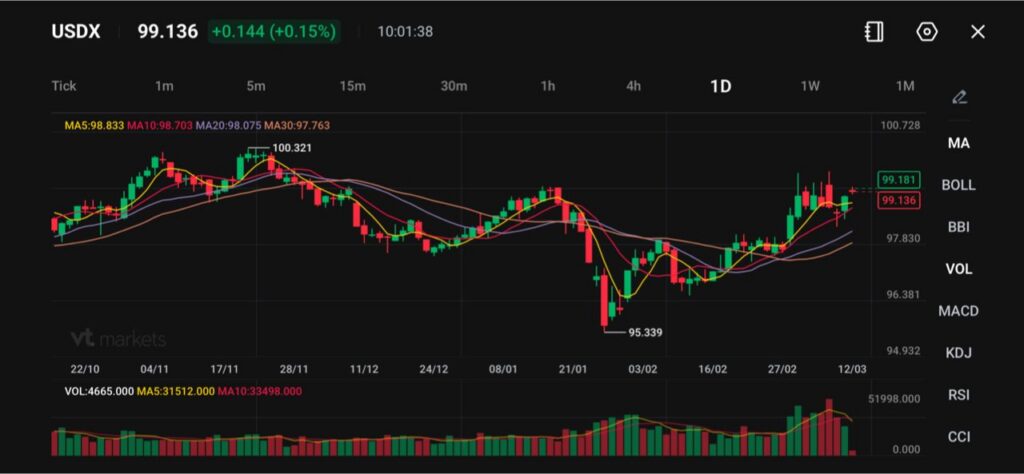
Immediate resistance is located near 99.30–99.50, where recent rallies have stalled. A sustained break above this region could bring the index back toward the 100.00 psychological level, followed by the 100.32 area, which previously capped the broader advance.
On the downside, initial support is seen around 98.70–98.80, with stronger structural support near 98.00, where the 20-day moving average is currently positioned.
Overall, the short-term bias for the dollar remains moderately bullish, with the index consolidating near recent highs. A move above 99.50 would likely strengthen upward momentum toward the 100 handle, while failure to hold above the 98.70–98.80 support zone could trigger a deeper consolidation.
What Traders Should Watch Next
- Oil price volatility and any renewed disruptions to shipping through the Strait of Hormuz.
- Central bank messaging as inflation expectations rise alongside energy costs.
- Currency reactions in energy-importing economies, particularly the euro and yen.
- Whether USDX retests resistance near 100.321 as safe-haven demand strengthens.
Learn more about trading Indices on VT Markets today.
FAQs
- Why is the US Dollar Strengthening Right Now?
The US dollar is gaining support as oil prices surge and raise inflation concerns. Higher energy costs can delay interest rate cuts, which tends to strengthen the dollar because traders seek higher-yielding and safer assets. - What is the US Dollar Index (USDX)?
The US Dollar Index (USDX) measures the strength of the dollar against a basket of six major currencies: the euro, Japanese yen, British pound, Canadian dollar, Swedish krona and Swiss franc. - Why Do Rising Oil Prices Support the Dollar?
Higher oil prices increase inflation risks and push central banks to maintain tighter monetary policy. Since the United States is a net energy exporter, rising oil prices often benefit the dollar relative to currencies of energy-importing economies. - How Does the Strait of Hormuz Affect Currency Markets?
The Strait of Hormuz is one of the world’s most important energy shipping routes. Disruptions there can push oil prices higher, increase inflation expectations and shift global capital flows toward safe-haven currencies like the dollar. - Why Are Interest Rate Expectations Changing?
Surging energy prices increase inflation risks, making central banks more cautious about cutting interest rates. Markets are now pushing potential easing further into the year as policymakers monitor inflation pressures.
Start trading now – Click here to create your real VT Markets account







