






Key Points
- CL-OIL trades at 93.250, up +4.892 (+5.54%), with MA5 88.845, MA10 81.223, MA20 73.091, MA30 70.031.
- The IEA plans to release 400 million barrels from reserves, while the US will release 172 million barrels from its Strategic Petroleum Reserve starting next week.
- The US release will take roughly 120 days, averaging around 1.4 million barrels per day, while total coordinated supply may reach 3.3 million b/d, which ING says is still far below Gulf supply losses.
Oil prices remain firm even after policymakers unveiled a coordinated reserve release. The International Energy Agency plans to release 400 million barrels from emergency reserves to stabilise markets shaken by supply disruptions in the Persian Gulf.
The United States will contribute 172 million barrels from its Strategic Petroleum Reserve, with the release beginning next week. ING estimates the release will unfold over roughly 120 days, equating to around 1.4 million barrels per day from the US alone.
However, the strategy appears too small to offset the disruption. If other countries follow a similar schedule, ING calculates the combined release may reach 3.3 million b/d. That remains well below the supply losses currently linked to the Persian Gulf conflict.
This mismatch between policy action and physical supply loss explains why oil continues to trade with a strong risk premium.
If disruptions persist and reserve releases remain smaller than lost supply, crude may stay elevated even as governments attempt to stabilise prices. If shipping flows resume and exports recover, the reserve release could accelerate a pullback.
Supply Losses Continue to Dominate Oil Pricing
The core driver remains the scale of disrupted Middle East supply. Strategic reserves can smooth short-term shocks, but they rarely replace long-term production losses.
Markets tend to view emergency reserves as temporary relief rather than structural supply. If the conflict continues to constrain exports from the Persian Gulf, traders will keep pricing oil around the expected shortfall rather than the policy response.
Even with coordinated intervention, the market is effectively facing a supply deficit that exceeds the 3.3 million b/d cushion policymakers may provide.
As long as Gulf supply remains impaired, oil may trade with sharp upward bursts. If production or shipping routes reopen faster than expected, prices could fall quickly as the market unwinds the geopolitical premium.
Technical Analysis
WTI crude oil (CL-OIL) is trading near $93.25, up roughly 5.54%, as prices continue to rebound following the sharp correction from the spike to $119.43. The market has stabilised above the $90 level after last week’s volatility, suggesting that buyers are attempting to reassert control following the rapid surge and pullback.
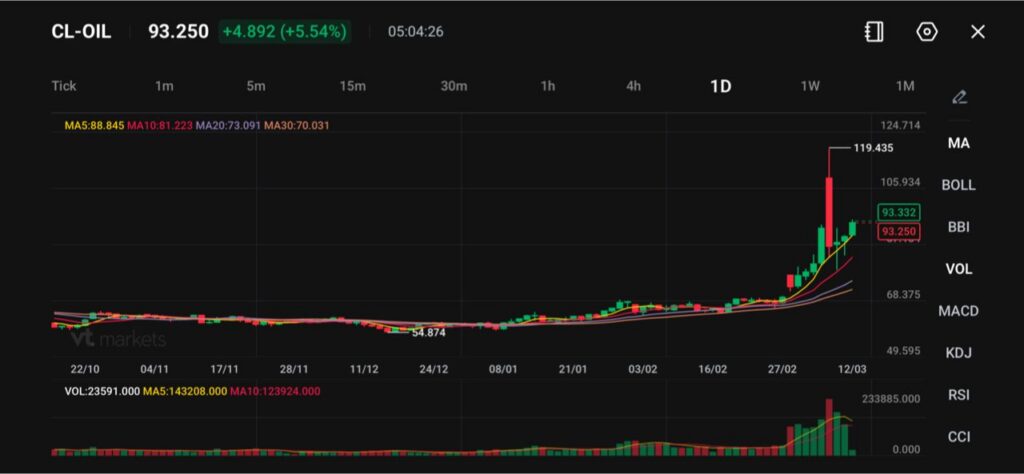
From a technical standpoint, oil remains firmly above its key moving averages. The 5-day moving average (88.85) and 10-day (81.22) are both rising steeply, while the 20-day (73.09) and 30-day (70.03) remain well below current prices. This wide separation between price and the longer-term averages reflects the strength of the recent bullish breakout and indicates that the broader trend remains upward despite short-term volatility.
Immediate resistance now sits around $100–$105, which marks the upper portion of the recent consolidation range following the spike. A break above this zone could reopen the path toward $110–$119, where the previous rally peaked.
On the downside, initial support is seen near $90, followed by stronger support around $85, which aligns with the recent breakout structure and the rising short-term moving averages.
Overall, oil markets remain highly volatile but structurally bullish, with prices attempting to build a new base above the $90 region. Holding above this level would reinforce the current recovery phase, while a sustained move above $100 could signal renewed bullish momentum in the energy market.
Policy Versus Physical Supply
The coordinated reserve release represents a clear attempt by policymakers to prevent a full-scale energy shock. Yet the numbers underline the challenge: 400 million barrels of reserves spread over months cannot fully offset lost exports if major Gulf producers remain constrained.
Energy markets tend to respond most strongly to real-time flows rather than policy signals. Until traders see sustained shipping through key export routes, particularly those tied to Gulf supply, the reserve plan alone may struggle to cap volatility.
Reserve releases can slow price spikes and reduce panic buying. However, if geopolitical risk continues to disrupt exports, crude may remain volatile and sensitive to any news on shipping routes, production recovery, or further policy intervention.
Learn more about trading Energies on VT Markets here.
FAQs
- What is the IEA Planning to Do With Oil Reserves?
The International Energy Agency plans a coordinated release of 400 million barrels of oil from emergency reserves to ease market stress linked to supply losses from the Persian Gulf. - How Much Oil Will the US Release From Its Strategic Petroleum Reserve?
The US will begin releasing 172 million barrels from its Strategic Petroleum Reserve starting next week. - How Long Will the US Release Take, and What is the Daily Rate?
ING estimates the US release will take roughly 120 days. That works out to around 1.4 million barrels per day. - How Big is the Total Coordinated Release in Barrels Per Day?
ING estimates that if other countries follow a similar timeline, the combined release could average 3.3 million b/d. - Why Can Oil Prices Rise Even When Governments Release Reserves?
Markets price the gap between supply and demand, plus risk. If the disrupted Gulf supply exceeds the expected 3.3 million b/d relief flow, traders can keep bidding oil higher because the deficit still exists.
Start trading now – Click here to create your real VT Markets account







