






Key Points
- Gold futures in New York fall 0.7% to $5,204.40 a troy ounce, while spot remains above the $5,200 mark amid mixed Middle East signals.
- ANZ says conflict updates “obscure the outlook for interest rate cuts in the U.S.” and traders withdraw increasing amounts of gold from ETFs.
- XAUUSD trades at 5197.83, up +5.07 (+0.10%), with MA5 5157.19, MA10 5180.30, MA20 5113.12, MA30 5066.82, plus a recent swing high at 5598.60 and prior low at 3886.61.
Gold Faces a Two-way Push From Headlines and Rates
Gold eased in early trading yet stayed above $5,200 as traders weighed mixed messaging on the Middle East conflict. The market had gained in the prior session as a softer dollar and falling oil prices reduced near-term inflation fear. That shift can support bullion because it lowers the hurdle for Fed cuts and trims real yields.
At the same time, traders still struggle to price the rate path. ANZ’s point matters here: “the developments continue to obscure the outlook for interest rate cuts in the U.S.” When the path for cuts looks less clear, gold can lose momentum even if geopolitics stays tense.
If oil continues to fall and the dollar stays soft, gold can hold above $5,200 and try to grind higher. If yields rise again on inflation fear, gold may rotate lower even if headlines keep the safe-haven case alive.
ETF Flows Turn Into A Pressure Point
ANZ flagged that traders are withdrawing increasing amounts of gold from ETFs. ETF flows matter because they often reflect broader portfolio behaviour rather than short-term trading. When traders pull metal from ETFs, it can cap rallies and make breakouts harder to sustain.
This does not mean gold must fall. It does mean gold may need fresh catalysts, such as softer inflation prints or a deeper risk-off move, to offset the flow drag.
If ETF outflows persist, gold may need stronger macro support to reclaim recent highs. If flows stabilise or reverse, price can respond quickly because positioning becomes lighter.
US Inflation Data Sets The Next Direction
Traders now wait for US inflation data later this week for clearer guidance on the interest-rate outlook. CPI and PCE can shift the curve fast because they affect how markets price the next Fed move. Reuters reporting this week has kept that “data first” mindset front and centre for bullion.
The current price action fits that setup. New York gold futures are down 0.7% to $5,204.40 a troy ounce, which reads like caution ahead of data rather than panic selling.
A hotter print can lift yields and pressure gold, even if spot stays above $5,200 early on. A softer print can revive cut pricing and support a move higher, but the market may still react in sharp bursts due to headline risk from geopolitics.
Technical Analysis
Gold (XAUUSD) is trading near 5,198, up modestly by around 0.10%, as the metal continues to consolidate following the pullback from the 5,598.60 peak earlier in the year. Recent price action shows the market stabilising within a relatively narrow range, suggesting a period of digestion after the strong bullish rally seen through January.
From a technical perspective, gold is hovering around its short-term moving averages. The 5-day moving average (5,157) sits slightly below the current price, while the 10-day (5,180) is almost aligned with the market, reflecting a balanced short-term structure.
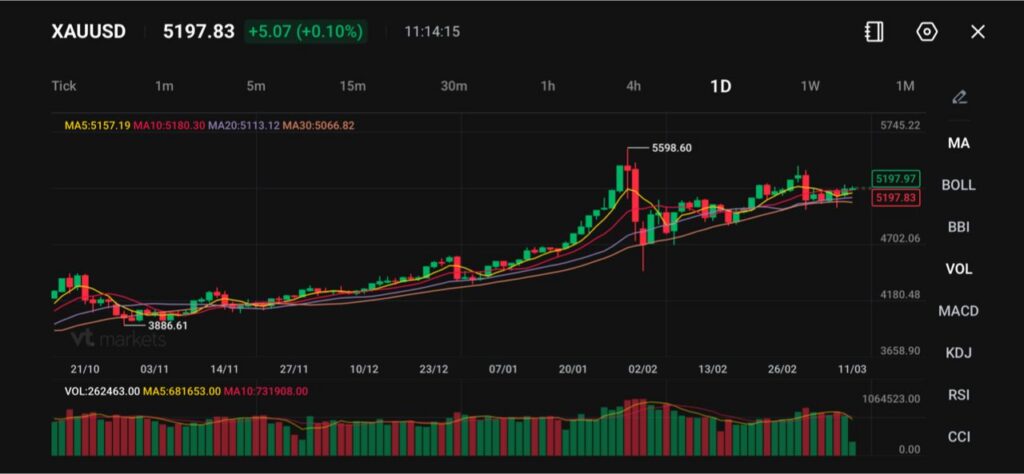
Meanwhile, the 20-day moving average (5,113) and 30-day (5,066) remain below current levels and continue trending upward, reinforcing the broader bullish trend.
Immediate resistance is located around 5,250–5,300, where recent upward attempts have struggled to gain traction. A sustained break above this zone could bring the market back toward 5,400, followed by the previous high near 5,600. On the downside, initial support is seen near 5,100, aligning with the 20-day moving average, with stronger structural support closer to 5,000.
Overall, gold appears to be consolidating within a longer-term uptrend, with price currently moving sideways as the market absorbs earlier gains. Holding above the 5,100 region keeps the bullish structure intact, while a breakout above 5,300 would likely signal renewed upward momentum toward recent highs.
What to Watch Next
- Whether New York futures hold the 0.7% dip at $5,204.40 without follow-through selling.
- Any shift in ETF flow momentum as traders “withdraw increasing amounts of gold from ETFs.”
- CPI and PCE reactions, because rate-cut clarity remains the main driver when the conflict narrative sends mixed signals.
Learn more about trading Precious Metals on VT Markets here.
FAQs
- Why is Gold Still Above $5,200 if Prices Fell in Early Trading?
Gold held above $5,200 because buyers still treat the level as a buffer while the market digests mixed Middle East signals and waits for US inflation data. The pullback looks more like positioning and uncertainty than a clean shift in trend. - What Does “Mixed Messages” on the Middle East Conflict Mean for Gold?
It keeps the safe-haven case alive, but it also increases day-to-day whipsaws. If markets think escalation risk is fading, gold can soften. If traders fear renewed disruption, gold can firm quickly. This push-pull often keeps price range-bound near major levels like $5,200. - Why Did Gold Gain in the Previous Session?
Bullion gained as a softer dollar and falling oil prices eased inflation concerns. When oil falls, markets often assume less inflation pressure, which can make rate cuts more plausible and support gold. - Why Do Interest Rate Cut Expectations Matter for Gold?
Gold does not pay interest. When investors expect fewer rate cuts, yields can stay higher, which raises the opportunity cost of holding gold. That is why ANZ said recent developments “obscure the outlook for interest rate cuts in the U.S.” - What Are Gold ETF Outflows, and Why Do They Matter?
ETF outflows mean investors are reducing holdings in gold-backed exchange traded funds. ANZ said investors withdraw increasing amounts of gold from ETFs. Persistent outflows can cap rallies because they reflect slower, portfolio-level selling rather than short-term trading noise.
Start trading now – Click here to create your real VT Markets account







