






Key Points
- Jensen Huang says AI is “essential infrastructure, like electricity and the internet” and the buildout is only “a few hundred billion dollars” in, with “trillions of dollars” still to build.
- NVIDIA stock sits at 183.69, up +1.96 (+1.08%), with MA5 181.65, MA10 183.07, MA20 185.69, MA30 185.48.
- Layoff messaging keeps colliding with AI optimism: Block cut 40% of staff, Pinterest cut up to 15%, and Goldman sees US unemployment edging from 4.4% to 4.5% by year-end.
The Market Takeaway From Huang’s “Buildout” Message
Jensen Huang is trying to reframe the AI cycle as an industrial capex supercycle, not a software fad. In his March 10 blog post, he calls AI “essential infrastructure, like electricity and the internet”, and says the industry has only put “a few hundred billion dollars” into the buildout so far, with “trillions of dollars” still to go.
For markets, that framing matters because it shifts the debate from short-term AI revenue to long-term demand for power, data centres, networking, cooling, and skilled labour. Huang also argues AI is a “five-layer cake” spanning energy, AI chips, infrastructure, AI models, and applications.
If traders buy the “infrastructure cycle” story, semis and data-centre supply chains can keep attracting capital even in a choppy macro tape. If oil stays volatile and bond yields stay sticky, markets may still fade rallies in high-multiple tech, even if the long-run thesis remains intact.
Jobs Narrative Splits Into Two Tracks
Huang’s key claim is that AI will not become the large-scale job taker many fear, because building and maintaining “trillions of dollars” of infrastructure needs a large workforce. He lists trades such as electricians, plumbers, steelworkers, network technicians and operators, and calls them “skilled, well-paid jobs” that are “in short supply”.
At the same time, the market has fresh evidence that firms are already using “AI efficiency” as a justification for headcount cuts. Block cut 40% of staff, with CEO Jack Dorsey pointing to AI-enabled efficiency. Pinterest cut up to 15% of jobs as it redirected resources toward AI.
Goldman Sachs analysts have described AI job losses as “visible but moderate”, while flagging that AI-driven displacement could lift the US unemployment rate from 4.4% to 4.5% by year-end.
That split matters for risk assets. Markets can price both at once: near-term layoffs that lift margins, plus a longer-term capex wave that lifts demand for equipment and power.
If more companies follow Block-style cuts, equities may like the margin story in the short run, but consumer-facing sectors could feel pressure if job insecurity rises. If capex ramps as Huang expects, industrials and infrastructure-linked names may gain relative strength, but the path will depend on rates and energy costs.
Technical Analysis
NVIDIA (NVIDIA) is trading near $183.69, up around 1.08%, as the stock attempts to stabilise following a period of sideways consolidation that has dominated trading since late November. The daily chart shows the market holding within a broad range after the sharp rally that pushed prices to a peak near $212.10 before momentum faded.
From a technical standpoint, price is currently sitting close to its short-term moving averages. The 5-day moving average (181.65) is slightly below the current price, while the 10-day (183.07) is almost aligned with the market.
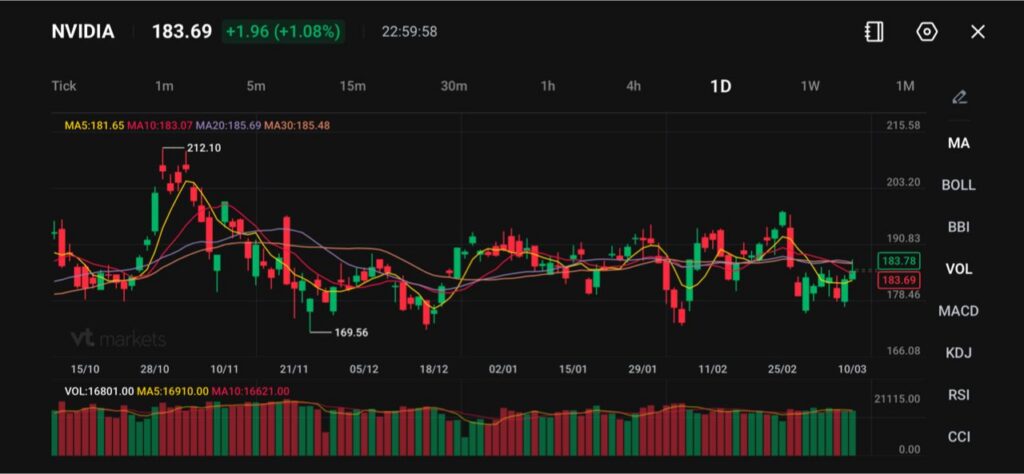
Meanwhile, the 20-day (185.69) and 30-day (185.48) averages sit marginally above the current level, suggesting the stock remains trapped within a narrow consolidation band with no clear directional breakout yet.
Immediate resistance appears near $190–$192, where previous rallies have struggled to sustain momentum. A move above this area could open the path toward $200, followed by the $212 region that marked the prior high. On the downside, initial support lies around $178–$180, with stronger structural support closer to $170, which previously acted as a major swing low.
Overall, NVIDIA appears to be range-bound in the near term, with the market digesting earlier gains. A decisive break above $192 would strengthen the bullish outlook, while a move below $178 could trigger renewed downside pressure.
Macro Link That Traders Should Not Ignore
The buildout pitch lands at a tricky time. AI data centres consume power, materials, and financing. When energy prices rise and yields climb, the market can become less patient with long-duration growth stories. That does not kill the AI thesis, but it can change the timing and leadership within tech.
The job angle also matters for central banks. If unemployment drifts from 4.4% to 4.5% as Goldman outlines, policymakers may face a slower-growth backdrop at the same time that energy and infrastructure spending keep parts of inflation sticky.
If data shows cooling employment without a sharp inflation drop, markets may keep trading a narrow path where quality growth and cash-rich leaders hold up, while rate-sensitive risk stays jumpy.
What to Watch Next
- Follow-through on “trillions” of buildout claims via real orders, capex guidance, and data-centre power build plans.
- Whether “AI efficiency” layoff headlines broaden beyond tech, after Block’s 40% cut and Pinterest’s up to 15% reduction.
- NVIDIA behaviour around 185.48–185.69 overhead and 181.65 support, with 183.69 as the current pivot.
Create a live VT Markets account today to access our platform features, including market insights and educational content.
Frequently Asked Questions
- How Big is the AI Buildout According to Huang?
Huang said the buildout is only “a few hundred billion dollars” in so far, and that “trillions of dollars” of infrastructure still need to be built. - Why Does a “Trillions” Buildout Matter for Markets?
Large infrastructure cycles usually spread demand across multiple industries. Traders may look beyond software into power, data centres, networking, cooling, construction, and industrial labour as second-order beneficiaries. - What Is Huang’s “Five-Layer Cake” Model For AI?
He described AI infrastructure as a “five-layer cake” consisting of energy, AI chips, infrastructure, AI models, and applications. It outlines the chain from power supply through to end-user products. - Why Does Huang Say AI Will Not Be A Large-Scale Job Taker?
He says the buildout needs workers to build and maintain the infrastructure. He listed roles such as electricians, plumbers, steelworkers, network technicians, and operators, and called them “skilled, well-paid jobs” that are “in short supply”. - How Do Layoffs Fit With This Pro-Jobs View?
Companies can cut some roles while still increasing demand for other roles. The article cites examples of firms linking cuts to AI efficiency: Block cut 40% of its staff, and Pinterest and Dow cited AI as the reason to cut a total of more than 5,000 employees between them. - What Does Goldman Sachs Expect For US Unemployment?
Goldman Sachs analysts said AI-driven job losses have been “visible but moderate”, and that AI could lift the US unemployment rate from 4.4% to 4.5% by year-end.
Start trading now – Click here to create your real VT Markets account







