



Key Points
- NVIDIA traded at 223.38, up 1.96, or 0.89%, after reaching a session high of 225.87.
- Revenue increased 85% to $81.62 billion, while adjusted earnings came in at $1.87 per share.
- Data centre revenue surged 92% to $75.25 billion, led by both hyperscale and ACIE customers.
- NVIDIA approved an $80 billion share buyback and raised its quarterly dividend to $0.25 per share from $0.01.
NVIDIA reported another strong quarter, but Wall Street had already priced in a lot of good news. The stock traded at 223.38, up 1.96, or 0.89%, at 05/20 22:59:58 GMT+3. The session high stood at 225.87, with a low of 220.49, an open at 222.61, and a close at 221.42.
The company’s revenue increased 85% to $81.62 billion, while adjusted earnings came in at $1.87 per share. Analysts had expected $78.86 billion in revenue and $1.76 per share. AP also reported that revenue beat the $78.91 billion forecast, while NVIDIA guided for current-quarter revenue of around $91 billion, above analyst expectations of $87.29 billion.
The beat still failed to trigger a clean relief rally. NVIDIA shares fell more than 1% in after-hours and overnight trading, with NVDA down 1.2% at one stage. Traders wanted proof that AI demand remains strong, but they also wanted a wider upside surprise after months of heavy expectations.
Data Centre Growth Still Drives The Story
The data centre segment remains NVIDIA’s engine. Revenue surged 92% to a better-than-expected $75.25 billion, giving traders more detail on where AI demand is coming from.
NVIDIA split the segment into hyperscale and ACIE customers, which cover AI Clouds, Industrial, and Enterprise users. Hyperscaler server revenue grew 115% year-on-year and 12% sequentially to $37.87 billion. ACIE revenue rose 74% year-on-year and 31% sequentially to $37.38 billion.
That breakdown changes the market narrative. NVIDIA is no longer leaning only on Amazon, Microsoft, and Alphabet. Smaller cloud firms, AI operators, industrial customers, and enterprise buyers are becoming a much larger part of demand. ACIE growth outpaced hyperscalers on a sequential basis, showing that AI infrastructure demand is spreading beyond the largest cloud platforms.
Vera CPU Opens A New Growth Track
NVIDIA also pushed deeper into the CPU market. Chief Financial Officer Colette Kress said the Vera CPU opens a new $200 billion total addressable market, adding that the company has visibility to nearly $20 billion in total CPU revenue this year.
The Vera CPU, introduced at GTC 2026 as part of the Vera Rubin AI platform, is an Arm-based processor built for AI and data centre workloads. That puts NVIDIA into more direct competition with Intel and Advanced Micro Devices in server CPUs.
The market reaction showed how quickly that threat can move across the chip sector. Intel and AMD shares dropped 0.7% in the overnight session ahead of Thursday. ARM shares rose nearly 3%, while NVIDIA shares were down 1.2%.
Vera also expands NVIDIA’s total addressable market beyond GPUs. Jensen Huang said the company sees upside beyond its previously discussed $1 trillion revenue visibility from three areas: a larger share of frontier AI model workloads, standalone Vera CPU sales, and adoption of specialised LPX systems. Huang had previously forecast $1 trillion in sales from Blackwell and Rubin AI chips between 2025 and 2027.
AI Demand Broadens, But Supply And China Still Matter
NVIDIA’s wider AI story remains strong. Big Tech is expected to pour more than $700 billion into AI this year, up from around $400 billion in 2025. That spending supports NVIDIA’s chips, systems, and data-centre pipeline.
The risks have also become clearer. NVIDIA’s supply commitments jumped from $50.3 billion to $95.2 billion between the last two quarters of its latest fiscal year.
The company has avoided the worst of the memory-chip crunch so far, but traders are watching whether data-centre capacity, memory costs, chip packaging, and Rubin ramp-up expenses pressure margins later in the year.
China remains another overhang. NVIDIA has yet to sell its H200 chips there, while Beijing continues to push local alternatives. Huang’s recent trip alongside President Donald Trump raised hopes for progress, but the market still needs policy detail before it prices a clean China recovery.
Capital Returns Add Support
NVIDIA added a shareholder-return angle to the earnings story. The company disclosed $30 billion worth of cloud computing agreements, up sequentially from $27 billion.
It also raised its quarterly cash dividend to $0.25 per share from $0.01 per share and approved an $80 billion share buyback. AP reported the same buyback and dividend increase, which helped soften the disappointment from the muted share reaction.
Retail traders stayed firmly behind the stock. On Stocktwits, retail sentiment for NVDA climbed multiple points higher in the extremely bullish zone, with extremely high message volume. After remaining subdued for months, NVDA shares have gained over the past month and are now up 19% year-to-date.
Macro Risk Can Still Cap The Rally
NVIDIA’s earnings arrived while global markets were dealing with higher yields and oil-driven inflation risk. Global stocks fell earlier in the week as the 30-year US Treasury yield rose to its highest level since 2007, while the AI trade faced a major test from NVIDIA’s results.
Oil also remains a pressure point. Brent rose 81 cents, or 0.77%, to $105.83 a barrel, while WTI gained 97 cents, or 0.99%, to $99.23 as uncertainty over the Iran war and inventory drawdowns kept supply concerns active.
Higher oil can feed inflation, lift bond yields, and reduce the valuation room for growth stocks. NVIDIA can still rise on earnings power, but the stock needs AI demand to keep outrunning the drag from rates, energy costs, and China policy risk.
Technical Analysis
NVIDIA is trading around 223.38, consolidating after a powerful breakout rally that pushed the stock to fresh highs near 236.49. The broader trend remains firmly bullish, although momentum has started cooling after an aggressive multi-week advance from the April low near 164.24.
Technically, NVIDIA still maintains a strong uptrend structure:
- MA5: 225.79
- MA10: 222.28
- MA20: 213.52
Price remains above the 10-day and 20-day moving averages, which confirms buyers still control the medium-term trend. However, the stock has slipped slightly below the 5-day average, signalling some near-term consolidation after the recent surge.
The rally since early April has been extremely steep, with NVIDIA climbing nearly 36% in just over a month. Moves of that scale often lead to temporary cooling periods as traders lock in profits and momentum funds rebalance exposure.
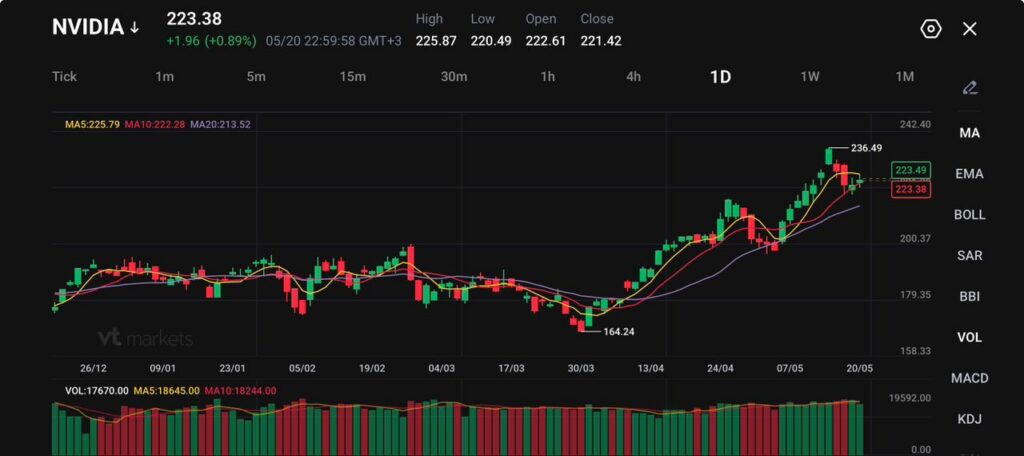
Key levels to monitor:
- Immediate support: 222.00 → 213.50
- Major support: 200.00
- Resistance: 236.50
- Major breakout zone: 242.00 → 250.00
The 236.50 high now acts as the immediate ceiling. Buyers attempted to break through that level but lost momentum, resulting in several smaller-bodied candles and pullbacks around resistance. That usually reflects hesitation rather than outright bearish reversal.
Importantly, the broader structure still resembles a healthy bullish consolidation rather than distribution. The 20-day moving average continues rising sharply, and price remains comfortably above the April breakout zone.
Fundamentally, NVIDIA continues benefiting from relentless AI infrastructure demand, hyperscaler spending, and data centre expansion themes. Markets remain heavily focused on GPU demand, sovereign AI investment, and the company’s dominance in AI training workloads.
Volume has stayed elevated throughout the rally, which supports the idea that institutional participation remains strong. Importantly, the latest pullback has not yet shown panic-style selling volume.
If NVIDIA can stabilise above the 222–223 region, buyers may attempt another push toward 236.50 and eventually the 242–250 zone. However, a break below the 20-day average near 213.50 would weaken short-term momentum and expose a deeper retracement toward 200.
For now, NVIDIA remains in a strong bullish medium-term trend, though the stock appears to be entering a digestion phase after an overheated upside run.
Cautious Forecast
NVIDIA keeps a constructive bias while it holds above 220.49 and 213.52. A recovery above 225.87 would support another move toward 236.49, especially if traders focus on the 92% data-centre growth, $20 billion CPU revenue visibility, and the $80 billion buyback.
A break below 213.52 would weaken the setup and suggest the earnings beat was not enough to defend the current valuation. The strongest upside path needs three forces to align: data-centre demand remains broad across hyperscale and ACIE customers, Vera CPU guidance builds confidence in the next growth leg, and macro pressure from oil, yields, and China policy starts to ease.
Create a live VT Markets account today to access market insights, educational content, and new trading opportunities across AI and Space themes.
Trader Questions
What Is Nvidia Trading At Today?
Nvidia traded at 223.38, up 1.96, or 0.89%.
The session high was 225.87, with a low of 220.49, an open at 222.61, and a close at 221.42.
Why Did Nvidia Stock Fall After Earnings?
Nvidia stock slipped after hours because Wall Street had already priced in a strong quarter.
The company beat expectations, but the upside surprise was not large enough to trigger a clean rally. Shares were down more than 1% in after-hours and overnight trading, with NVDA down 1.2% at one point.
How Strong Were Nvidia’s Q1 Earnings?
Nvidia’s Q1 earnings were strong. Revenue rose 85% to $81.62 billion, while adjusted earnings came in at $1.87 per share.
Analysts had expected $78.86 billion in revenue and $1.76 per share.
How Did Nvidia’s Data Centre Business Perform?
Nvidia’s data centre revenue surged 92% to $75.25 billion.
That segment remains the main driver of Nvidia’s growth, supported by AI chip demand, global data centre expansion, and stronger spending from cloud and enterprise customers.
What Are Hyperscale And ACIE Customers?
Hyperscale customers include major cloud players such as Amazon, Microsoft, and Alphabet.
ACIE refers to AI Clouds, Industrial, and Enterprise customers. Nvidia said ACIE revenue rose 74% year-on-year and 31% sequentially to $37.38 billion.
Start trading now – Click here to create your real VT Markets account