






Key Points
- USD/JPY traded at 158.467, up 0.085, or 0.05%, after reaching a session high of 158.580.
- The yen weakened to around 158.5 per dollar and was set for a weekly loss of more than 1%.
- Markets are pricing a 44% chance of a Fed rate hike in December, up from 22.5% one week earlier.
- Japan’s wholesale inflation rose 4.9% year-on-year in April, above the 3.0% forecast and faster than March’s 2.9% rise.
The Japanese yen weakened to around 158.5 per dollar on Friday, putting it on track for a weekly loss of more than 1%. Broad dollar strength has rebuilt pressure on the yen as traders price a higher chance that the Federal Reserve raises rates later this year.
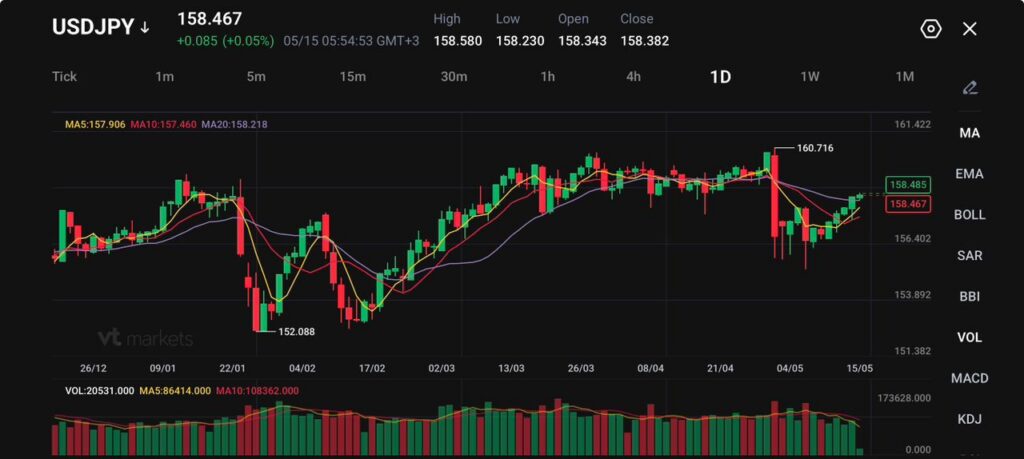
USD/JPY traded at 158.467, up 0.085, or 0.05%, at 05/15 05:54:53 GMT+3. The session high stood at 158.580, with a low of 158.230, an open at 158.343, and a close at 158.382.
The dollar has gained support from US inflation and resilient activity data. The dollar is heading for its largest weekly gain in over two months, with markets now pricing a roughly 44% chance of a Fed hike in December, up from 22.5% a week earlier. The same report placed the yen near 158.45 per dollar as intervention concerns returned.
US Inflation Rebuilds The Rate Gap
Hot US inflation has shifted the FX trade back toward the dollar. Energy costs and shipping disruption tied to the Iran war have raised price pressure, while stable US jobless claims and stronger retail sales point to an economy that can still absorb tighter policy.
That combination hurts the yen. A higher Fed path keeps US yields attractive, while Japan still faces a more cautious policy cycle. The wider the rate gap looks, the more traders are willing to buy USD/JPY on dips.
The yen has now surrendered roughly half of the gains triggered by multiple rounds of government intervention that began on April 30. That recovery in USD/JPY shows that intervention can slow yen weakness, but rate spreads can pull the pair higher again when US data keeps backing the dollar.
Understanding the markets is the first step toward becoming a more confident trader. In our upcoming webinar, we’ll explore how US Indices work, what moves the market, and how beginners can approach trading with a structured mindset.
Oil Shock Keeps Pressure On Japan
Persistently high oil prices have added another layer of pressure. Japan depends heavily on imported energy, so a prolonged Middle East conflict can weaken the yen through higher import costs, weaker trade terms, and rising domestic inflation.
Japan’s wholesale inflation data shows the strain clearly. The Corporate Goods Price Index rose 4.9% year-on-year in April, beating the 3.0% forecast and accelerating from 2.9% in March.
Month-on-month, wholesale prices jumped 2.3%. Petroleum and coal goods prices rose 5.3%, while chemical goods linked to naphtha rose 79.4% from a year earlier. The yen-based import price index climbed 17.5%, its steepest rise since December 2022.
Those numbers raise the stakes for the Bank of Japan. A weak yen and high energy prices can feed directly into imported inflation. If those pressures spread across more goods and services, the BoJ may face stronger pressure to tighten policy sooner.
Intervention Risk Returns Near 158 To 160
Tokyo’s intervention threat is now back in focus. Japanese authorities are believed to have stepped into the market several times in recent weeks to slow the yen’s decline. US Treasury Secretary Scott Bessent also voiced support for Japan’s recent measures aimed at stabilising the currency, which traders viewed as a sign that Washington is not pushing back against Tokyo’s actions.
That support matters for psychology, but it does not guarantee a stronger yen. Japan has no set limit on how often it can intervene and remains in daily contact with US authorities. It also quoted FX strategists arguing that solo intervention is less powerful than joint action, especially if the US believes yen weakness reflects slow BoJ rate hikes rather than speculation alone.
The cautious forecast is that intervention risk rises as USD/JPY moves closer to the 160 area. A sudden yen rally remains possible if Tokyo steps in again. Still, the pair may recover quickly unless US yields fall or the BoJ signals a clearer tightening path.
BoJ Signals Grow Louder
Bank of Japan board member Kazuyuki Masu argued that interest rates should rise as soon as possible if there are no clear signs of economic slowdown. His comments add to the pressure on policymakers as energy-linked inflation becomes more persistent.
BoJ board members have already debated the need to raise rates if the Iran war prolongs the energy shock. Under a risk scenario of elevated oil prices and a weaker yen, the BoJ projects core inflation near 3% for two years in a row.
That keeps a rate hike in play. If Japan’s price data keeps accelerating and the yen weakens further, the BoJ may need to act before inflation expectations move higher. A hawkish BoJ shift would limit USD/JPY upside, but traders may want more than verbal warnings before selling the pair aggressively.
Technical Analysis
USDJPY is attempting to recover after the sharp selloff from the 160.71 peak, with the pair now trading around 158.47 as buyers gradually regain short-term momentum. The rebound suggests the market is stabilising following the violent volatility seen earlier in May, although the pair still remains below its recent highs.
Technically, the structure has improved in the near term:
- MA5: 157.91
- MA10: 157.46
- MA20: 158.22
The short-term moving averages have begun turning higher again after the steep decline, while price has reclaimed the 5-day and 10-day averages. That usually signals recovering momentum, though the pair is still battling around the 20-day average near 158.20.
Key levels to watch:
- Immediate support: 157.50 → 156.40
- Major support: 153.90 → 152.08
- Resistance: 158.80 → 160.70
The recent rebound from the 156 area has been relatively orderly, with buyers steadily rebuilding upside momentum after what appeared to be a sharp unwinding move earlier in the month. The market is now testing the next resistance band near 158.80–159.00.
If USDJPY breaks cleanly above that region, traders may begin targeting a retest of the broader high near 160.71. However, that level also remains highly sensitive due to ongoing speculation surrounding potential Japanese government intervention.
The earlier collapse from above 160 reflected how aggressively authorities may react when yen weakness accelerates too quickly. That risk remains a major factor limiting sustained upside momentum in the pair.
Fundamentally, the broader backdrop still supports medium-term USDJPY strength. Yield differentials between the US and Japan remain wide, while the Bank of Japan continues maintaining a relatively accommodative policy stance compared with the Federal Reserve.
However, markets are increasingly balancing that against the risk of intervention and shifting US rate expectations. Any softer US inflation data or dovish Fed signals could weaken the dollar further and pressure USDJPY lower again.
Volume during the rebound phase appears steadier than during the sharp breakdown candle, suggesting the current move resembles stabilisation rather than a full momentum breakout.
For now, USDJPY carries a cautiously bullish short-term bias while holding above 157.50, though the pair is likely to remain highly volatile near the psychologically sensitive 160 region.
Cautious Forecast
USD/JPY keeps a mildly bullish bias while it holds above 158.218 and 157.906. A break above 158.580 would support another move toward 160.716, especially if US yields stay firm and markets keep pricing Fed hike risk.
A drop below 157.460 would warn that intervention fears or BoJ rate-hike expectations are starting to bite. Traders should watch US inflation expectations, Japan’s wholesale price data, oil prices, Tokyo intervention signals, and whether Masu’s rate-hike message gains wider support inside the BoJ.
Learn more about trading Forex Pairs on VT Markets here.
Trader Questions
Why Is The Japanese Yen Falling Against The Dollar?
The Japanese yen is falling because broad US dollar strength and rising Fed rate-hike bets are pressuring USD/JPY higher.
USD/JPY traded at 158.467, up 0.085, or 0.05%, after reaching a session high of 158.580. The yen was also set for a weekly loss of more than 1%.
What Is The Current USD/JPY Price?
USD/JPY traded at 158.467.
The session high stood at 158.580, with a low of 158.230, an open at 158.343, and a close at 158.382.
Why Are Fed Rate Hike Bets Hurting The Yen?
Fed rate hike bets are hurting the yen because higher US rates make dollar assets more attractive.
Markets are pricing a 44% chance of a Fed rate hike in December, up from 22.5% one week earlier. That wider US-Japan rate gap supports USD/JPY.
How Is US Inflation Affecting USD/JPY?
Hot US inflation is lifting USD/JPY by strengthening expectations for tighter Federal Reserve policy.
Inflation linked to the Iran war and higher energy costs has pushed traders to price a more hawkish Fed path. That keeps the dollar supported against lower-yielding currencies such as the yen.
Why Do Oil Prices Weigh On The Japanese Yen?
High oil prices weigh on the yen because Japan relies heavily on imported energy.
When oil rises, Japan’s import bill increases, trade terms worsen, and inflation pressure builds. That can weaken the yen, especially when the dollar is already supported by higher US yields.
Start trading now – Click here to create your real VT Markets account







