






Key Points
- The Nikkei 225 rose 1.38% to close at 60,537.36, finishing above 60,000 for the first time.
- The Topix climbed 0.5% to 3,735.28, while the Nikkei has gained 18.6% so far this year.
- The chart shows Nikkei225 at 60,259.15, up 204.17 points, or 0.34%, with 60,000 now acting as the main sentiment line.
Japan’s Nikkei 225 has done what many traders were watching for: it closed above the key 60,000 mark for the first time. The benchmark index rose 1.38% to finish at 60,537.36, while the broader Topix climbed 0.5% to 3,735.28. The move puts the Nikkei up 18.6% so far this year.
The rally shows how far the market has leaned into Japan’s AI, semiconductor, automation, and robotics story. Wall Street gave Tokyo a strong lead after major US indexes closed at record highs on Friday. Intel beat its earnings estimate, helped by surging demand in the artificial intelligence sector, while the Philadelphia SE Semiconductor Index extended its record run of gains to 18 consecutive sessions.
That helped Japanese tech and factory automation names lead the move. Keyence and Fanuc surged by their daily trading limit, nearly 16%, after both companies reported better-than-expected profit after Friday’s close. SMC also joined the top gainers, rising 7.1%, after reports said activist fund Palliser Capital had made a sizeable investment in the factory automation company.
The Rally Is Strong, But Narrow
The headline close looks powerful, but the market breadth tells a more careful story. There were 94 advancers in the Nikkei index against 130 decliners. That means the rally came from a tight group of heavyweights rather than a broad market advance.
This matters for the next move. A narrow rally can keep climbing when large index names attract global flows, especially in a price-weighted index such as the Nikkei 225. But it also means traders should watch for sharp profit-taking if the leaders stall.
Rohm showed that stock-specific risk remains high. The chipmaker fell 9.19% after Denso said it was considering withdrawing its takeover offer.
Reports over the weekend said Denso had struggled to win Rohm’s support for the tie-up, which could shift focus back to Rohm’s talks with Toshiba and Mitsubishi Electric-linked chip operations.
Iran Proposal Helps Risk Appetite Recover
The Nikkei fell into negative territory shortly after the open, but then rallied after reports said Iran had given the United States a new proposal to end the war and reopen the Strait of Hormuz. The offer was reportedly delivered through Pakistani mediators and would push nuclear talks to a later stage while focusing first on reopening maritime access.
That helped risk appetite because the Strait of Hormuz remains central to the inflation trade. If the strait reopens, oil risk may cool, import pressure may ease, and Japanese manufacturers may face less pressure from energy and logistics costs.
Still, the relief trade does not remove the risk. Discussions to settle the two-month-long conflict stalled over the weekend, and higher oil prices still pose a threat to Japan’s resource-dependent economy. Japan’s record bull run faces pressure from Middle East conflict, supply-chain stress, and higher energy prices, even as early earnings reports have held up better than feared.
BOJ Risk Has Not Gone Away
The Bank of Japan adds another layer to the trade. The BOJ is likely to hold rates at its April 27 to 28 meeting, with sources saying the central bank may wait because the Middle East conflict has made the outlook harder to read. The current policy rate sits at 0.75%, and markets have largely priced out an April hike, while traders still look for signs of a possible move as early as June.
This creates a mixed setup for equities. A cautious BOJ can support stocks by keeping liquidity conditions easier for longer. But a weaker yen can raise import costs, especially if oil stays high. That can squeeze margins for companies that cannot pass on costs.
For now, equity traders appear willing to reward earnings strength and AI demand. The risk is that a hawkish BOJ tone, a fresh oil spike, or a stronger yen could trigger a fast reset after such a steep rally.
Technical Analysis
Nikkei 225 is trading near 60,259, pushing back toward the upper end of its range as the index extends its recovery from the March lows. Price action remains constructive, with a clear sequence of higher lows and steady upside continuation as buyers maintain control.
From a technical standpoint, the bias is firmly bullish in the near term. Price is holding above all key moving averages, with the 5-day (59,548) and 10-day (59,324) trending upward and acting as immediate support. The 20-day (57,151) sits well below and continues to slope higher, reinforcing the strength of the current uptrend.
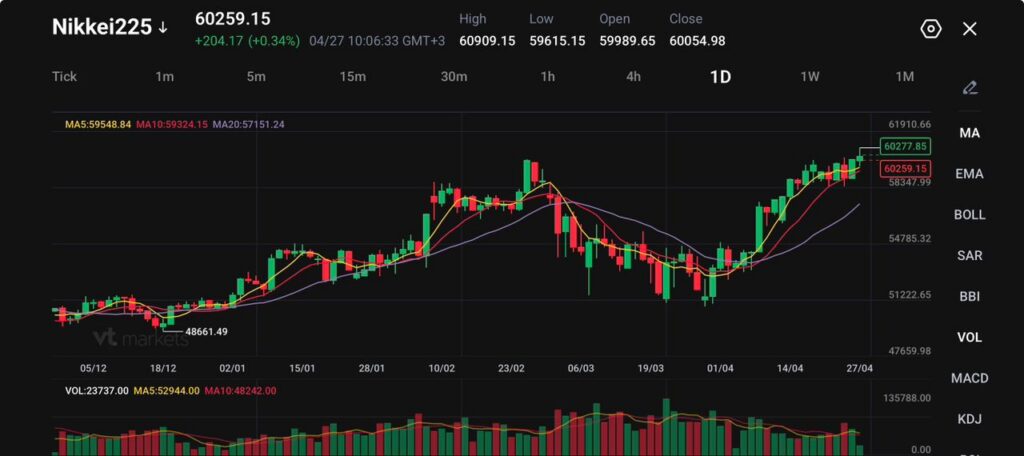
Key levels to watch:
- Support: 59,500 → 59,300 → 57,150
- Resistance: 60,900 → 61,900 → 63,000
The index is currently testing the 60,900 resistance zone, which aligns with recent highs and marks a key breakout level. A clean move above this area could extend the rally toward 61,900, with further upside potential if momentum remains strong.
On the downside, 59,500 is acting as immediate support. A break below this level could lead to a short-term pullback toward 59,300, though such a move would likely remain corrective as long as price holds above the rising 20-day average.
Overall, the Nikkei 225 is trending higher with sustained momentum, now approaching a critical resistance area. The near-term focus is on whether buyers can clear 60,900 to confirm continuation, or if the index pauses and consolidates after the recent run.
Cautious Forecast
The near-term bias stays constructive while the Nikkei225 holds above 60,000 and the 59,548.84 to 59,324.15 moving-average band. Strong earnings from Japanese automation names and continued AI demand can keep buyers active on dips.
A move above 60,909.15 would support a test of 61,910.66. Failure to hold 60,000 would warn that traders are locking in gains after the 18.6% year-to-date rise. A deeper pullback below 59,324.15 could shift attention back toward 58,347.99 and 57,151.24, especially if Middle East talks stall or the BOJ sounds less patient than expected.
Learn more about trading Indices on VT Markets today.
Trader Questions
Why Did The Nikkei 225 Rise Above 60,000?
The Nikkei 225 rose above 60,000 for the first time as strong earnings optimism outweighed concern over the Middle East conflict.
The benchmark Nikkei 225 Index gained 1.38% to close at 60,537.36, while the broader Topix climbed 0.5% to 3,735.28.
How Much Has The Nikkei Gained This Year?
The Nikkei has gained 18.6% so far this year.
The rally has been driven by strong demand for AI, semiconductor, automation, and robotics-related stocks, helped by record highs on Wall Street and strong results from key Japanese firms.
Which Stocks Led The Nikkei Higher?
Keyence and Fanuc led the move after both companies reported better-than-expected profit after Friday’s close.
Shares of factory automation provider Keyence and industrial robot maker Fanuc surged by their daily trading limit, nearly 16%. SMC also rose 7.1% after reports said activist fund Palliser Capital had made a sizeable investment in the company.
Why Did AI Stocks Support Japan’s Market?
AI stocks supported Japan’s market after Intel beat its earnings estimate, helped by surging demand in the artificial intelligence sector.
The Philadelphia SE Semiconductor Index also extended its record run of gains to 18 consecutive sessions, which lifted sentiment across Japanese semiconductor, robotics, and factory automation stocks.
How Did Middle East News Affect The Nikkei?
The Nikkei briefly fell into negative territory after the open, but then rallied after reports said Iran had given the United States a new proposal to end the war.
The report helped ease concern over the Strait of Hormuz and supported risk appetite. Traders viewed the proposal as a possible step toward reducing oil supply risk and calming pressure on global markets.
Start trading now – Click here to create your real VT Markets account







