






Key Points
- NZDUSD trades at 0.59162, up 0.00255 (+0.43%), after touching 0.59207 and moving close to the recent five-week high zone.
- New Zealand CPI rose 0.9% in Q1, while annual inflation held at 3.1%, above the RBNZ’s 1% to 3% target band for a second straight quarter.
- Markets lifted the implied chance of a 25 basis-point RBNZ hike next month to about 45%, up from 27% a day earlier, while 2-year government yields jumped 9 basis points to 3.555%.
The kiwi moved higher because the inflation report was firm enough to push the market back toward a more hawkish view of rates. Quarterly CPI rose 0.9%, ahead of the softer disinflation profile many traders had hoped for, while annual inflation held at 3.1%.
That left price growth above the Reserve Bank of New Zealand’s target band for a second consecutive quarter and pushed rate-hike expectations higher.
A hotter inflation print gives the currency clearer domestic support via rates. The market no longer has the luxury of assuming inflation will drift back into line without another policy response.
A cautious near-term view still favours support for NZDUSD while inflation stays sticky enough to keep hike risk alive.
Yields Turn Supportive
The bond market reacted quickly. The implied probability of a quarter-point hike next month rose to about 45%, from 27% the previous day. Markets now price about 82 basis points of total tightening, up from 70 basis points a day earlier. New Zealand’s 2-year government yield rose 9 basis points to 3.555%, ending a five-day run of declines.
That gives NZDUSD more of a rate cushion than it had a week ago. In a market still highly sensitive to central-bank repricing, even a moderate shift in rate expectations can move the currency sharply, especially when the US dollar is not trending decisively higher.
The kiwi is now being supported less by broad risk appetite alone and more by a specific domestic inflation problem that the central bank may have to address.
Recovery Remains Uneven
The complication is that inflation is not the whole story. Business confidence has deteriorated sharply. A private survey showed a net 4% of firms expect business conditions to worsen, compared with 48% optimism in the prior quarter.
That is a brutal swing and a reminder that the domestic recovery remains fragile even before the full effect of the Middle East energy shock comes through.
That leaves the RBNZ with a familiar problem. Inflation is too high, but the growth backdrop is not clean enough to make tightening comfortable.
Governor Anna Breman said last week that she still expects the economy to grow in 2026, especially if the ceasefire in the Middle East holds, but the central bank has already warned it may have to act if inflation becomes entrenched.
A cautious forecast still sees the kiwi supported by rate repricing in the short term, but the rally likely becomes harder to extend if growth data continues to soften.
Iran Shock Remains Inflation Driver
The inflation report only captured the first phase of the energy shock, which is why markets reacted so aggressively. Oil and logistics stress from the Iran conflict have already pushed up costs across Australia and New Zealand, and the second-quarter numbers may show that more clearly.
Recent reporting has already flagged the pressure on airlines, exporters, logistics firms, and building-material costs across the region.
The current CPI result is particularly important, as it holds more weight than a standard quarterly report. It suggests that inflation was already entrenched before the full impact of war-related costs had a chance to materialise. This raises the likelihood that the RBNZ may need to maintain a restrictive policy, even if economic growth remains lacklustre.
NZDUSD Technical Outlook
NZDUSD is trading near 0.5916, extending its recovery from the recent swing low around 0.5681, with price now stabilising just below short-term resistance. The pair has shifted from a clear downtrend into a corrective rebound phase, supported by improving short-term momentum.
From a technical standpoint, the bias is turning cautiously bullish in the near term. Price has reclaimed the 5-day (0.5897) and 10-day (0.5877) moving averages, both of which are now sloping upward and acting as immediate support. The 20-day (0.5807) remains below and is beginning to flatten, suggesting that downside pressure is fading while a base forms.
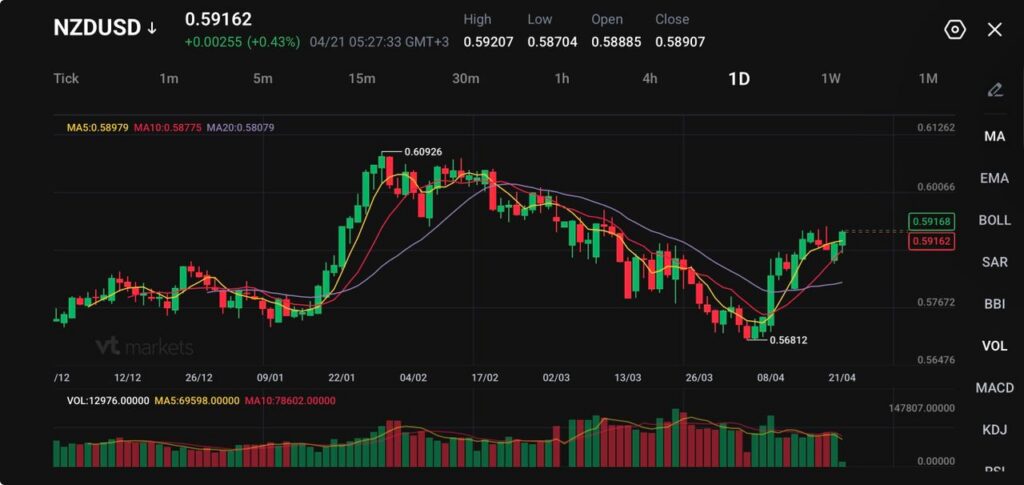
Key levels to watch:
- Support: 0.5900 → 0.5875 → 0.5800
- Resistance: 0.5930 → 0.6000 → 0.6090
The pair is currently consolidating just under the 0.5930 resistance zone, which aligns with recent highs in this recovery leg. A clean break above this level could open the path toward the 0.6000 psychological level, with further upside potential toward 0.6090 if momentum builds.
On the downside, 0.5900 acts as immediate support. A break below this level may see a pullback toward 0.5875, though such a move would likely remain corrective unless price slips back below the 0.5800 region.
Overall, NZDUSD is showing early signs of a trend shift, with buyers stepping in after the March decline. The near-term focus remains on whether price can clear 0.5930 to confirm continuation, or if it stalls and returns to range-bound behaviour.
What Traders Should Watch Next
The next move depends on whether the inflation story keeps dominating the weaker growth story. Another round of firm domestic inflation or labour data would support the case for tighter policy and keep NZDUSD supported near the highs.
A softer activity backdrop or a renewed global risk scare could slow that move quickly. The cross with the Aussie carries weight, because part of the kiwi’s strength has come from rate expectations shifting faster in New Zealand than in Australia.
Learn more about trading Forex Pairs on VT Markets here.
Trader Questions
Why Did NZDUSD Rise After The Inflation Report?
NZDUSD moved higher because the first-quarter CPI reading came in hot enough to revive the chance of another RBNZ hike. Quarterly inflation rose 0.9%, while annual inflation held at 3.1%, leaving it above the 1% to 3% target band for a second straight quarter.
Why Does A 3.1% Annual CPI Reading Matter So Much For The Kiwi?
Because it keeps inflation above the RBNZ’s target range and makes it harder for the central bank to sound relaxed. That usually supports the currency by lifting rate expectations.
How Much Did Rate-Hike Expectations Change?
Markets lifted the implied chance of a 25 basis-point RBNZ hike next month to about 45%, up from 27% a day earlier. Total expected tightening also rose to about 82 basis points, from 70 basis points.
Why Did New Zealand Bond Yields Jump?
The inflation surprise pushed traders to price a more hawkish RBNZ path. That sent the 2-year government bond yield up 9 basis points to 3.555%, ending a five-day decline.
Why Has The Kiwi Not Broken Higher More Aggressively?
Because the growth backdrop is still shaky. A private business survey showed a net 4% of firms expect conditions to worsen, compared with 48% optimism in the previous quarter. That weak confidence reading limits how far traders want to push the tightening story.
Start trading now – Click here to create your real VT Markets account







