






Key Points
- CL-OIL trades at 89.637, up 0.017 (+0.02%), after a high of 90.302 and a low of 89.347.
- Brent fell 0.8% to $98.57 and WTI dropped 1.1% to $93.61 in early Europe as diplomacy improved sentiment.
- The market still sees tight physical supply because the Strait of Hormuz has been disrupted for seven weeks, affecting about 20% of global oil supply.
Crude has moved lower because the market is stripping out part of the war premium that built through March. A 10-day ceasefire between Israel and Lebanon and fresh talk of possible US-Iran discussions have reduced the need for immediate panic buying. That shift has pushed Brent back below $100 and pulled WTI closer to the low $90s.
The decline still looks more like a repricing of fear than a return to normal conditions. Traders are no longer treating every headline as a straight line toward escalation, but they are also not pricing a clean recovery in Gulf energy flows. That keeps oil softer than the March highs without turning the market outright bearish.
A cautious near-term view still favours headline-driven volatility with prices supported above pre-war levels.
Hormuz Still Controls The Floor
The biggest reason the downside has stayed limited is that the physical bottleneck has not been solved. The Strait of Hormuz remains the central issue because it handles roughly one-fifthof global oil supply, and disruption there continues to distort flows, freight costs, and insurance pricing.
ING estimated the interruption at roughly 13 million barrels per day of affected supply.
That means the market can fall on diplomacy without collapsing on it. Traders still need to see a more reliable reopening path before they price crude as though the supply shock is finished. Until then, every ceasefire headline removes some premium, but not all of it.
Market Focus on Trade Flow, Not Politics
The pricing now reflects a simple distinction. Political calm helps. Physical normalisation matters more. Even if negotiations continue, crude stays supported as long as shipping remains patchy and inventories outside the Gulf keep doing more of the balancing work.
That is why the recent weakness in oil has been orderly rather than aggressive. Traders are more willing to sell the spike, but they are not yet willing to price a fully restored supply chain. The market still sees enough friction in the physical system to keep a floor under prices.
The Broader Macro Story Has Improved, But Only Partly
Lower oil has helped risk assets because it eases the inflation shock that had been tightening financial conditions. That support has shown up in equities and in a softer dollar tone.
At the same time, crude is still far above the levels that would signal a fully normal energy backdrop, and that leaves central banks with less room to relax.
That makes the current oil move important for two reasons. First, it reduces immediate stagflation fear. Second, it still leaves enough supply stress in place to stop markets from getting too comfortable. That balance is why oil has come off the highs while remaining fundamentally elevated.
CL-OIL Technical Outlook
CL-OIL is trading near 89.64, continuing to drift lower after pulling back sharply from the recent high around 119.43, with price now stabilising near the lower end of its recent range. The selloff has been steady, and recent price action suggests the market is attempting to find a base, though upside momentum remains weak for now.
From a technical standpoint, the structure has shifted into a short-term bearish correction within a broader uptrend. Price is trading below the 5-day (91.45) and 10-day (97.01) moving averages, both of which are sloping downward and acting as dynamic resistance.
The 20-day (97.43) sits just above, reinforcing a strong resistance cluster and signalling that bearish pressure is still in control in the near term.
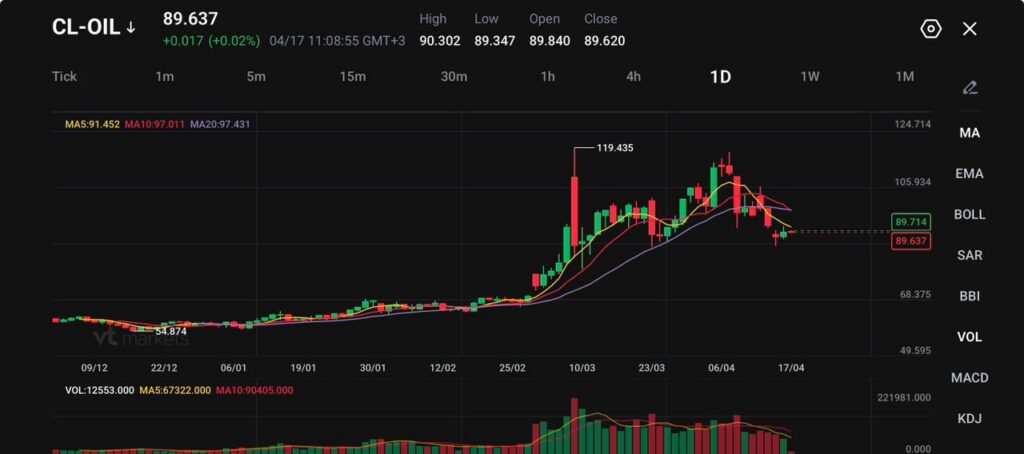
Key levels to watch:
- Support: 89.30 → 87.15 → 68.30
- Resistance: 91.50 → 97.00 → 105.90
Oil is currently hovering just above the 89.30 support area. A break below this level could open the path toward 87.15, with further downside risk if selling pressure accelerates.
On the upside, 91.50 is acting as immediate resistance. A move back above this level could trigger a recovery toward 97.00, though stronger confirmation would be needed to suggest a broader trend reversal.
Overall, CL-OIL is in a corrective phase with bearish momentum still present, as the market digests the prior rally. The next move will likely depend on whether support at 89.30 holds or gives way to further downside.
What Traders Should Watch Next
The next move depends on whether diplomacy produces real improvement in Gulf flows or just a pause in escalation. Watch the pace of shipping through Hormuz, the tone of any weekend US-Iran discussions, and whether Brent can stay below $100 without triggering fresh concern over supply tightness. If flow confidence improves, crude can keep easing. If talks stall and transport remains constrained, the current dip may start to look too deep.
Learn more about trading Energies on VT Markets here.
Trader Questions
Why Did Oil Prices Fall After The Ceasefire News?
Crude eased because the market removed part of the war premium after a 10-day ceasefire between Israel and Lebanon and fresh discussion of possible US-Iran talks reduced immediate escalation risk. That pushed Brent to $98.57 and WTI to $93.61 in early European trade.
Why Haven’t Oil Prices Fallen More Sharply?
The market still sees tight physical supply. Shipping disruption through the Strait of Hormuz, higher insurance costs, and operational friction are still limiting how quickly flows can normalise.
Why Does The Strait Of Hormuz Still Matter So Much?
Because it handles about 20% of global oil supply. Even partial disruption can keep freight costs high and leave the physical crude market tighter than headline diplomacy alone would suggest.
Does A Ceasefire Mean The Oil Shock Is Over?
No. The ceasefire reduces immediate panic, but the supply story is still unresolved. The market still needs evidence that Gulf flows are moving more reliably before it prices a full return to normal conditions.
Why Is Oil Still Elevated Compared With Pre-War Levels?
Because supply risk remains embedded in the market. Traders have cut some of the premium, but not all of it, since disrupted Middle East production and transport bottlenecks are still feeding into physical pricing.
Start trading now – Click here to create your real VT Markets account







