






Key Points
- USDJPY trades at 159.141, up 0.148 (+0.09%), after a high of 159.242 and a low of 158.896.
- The yen is still down about 2% since the conflict began, even after the ceasefire cooled oil and eased some stagflation pressure.
- Markets remain focused on Kazuo Ueda and the April 28 BOJ decision, with traders still trying to judge whether the next move is a hike or another cautious hold.
The yen has stabilised rather than strengthened decisively. USDJPY is trading at 159.141, which shows that lower oil has helped, but only to a point.
The two-week ceasefire between the US and Iran cooled crude and reduced some of the pressure on Japan’s import bill, which gave the yen a bit of room to recover from the most stressed part of the move.
That relief has not turned into a clean reversal. The pair is still sitting close to the upper end of the recent range, and the market is still carrying the memory of the move toward 160.461. Traders are treating the ceasefire as temporary and conditional, not as a durable end to the energy shock.
A cautious near-term view still favours choppy trade in the upper 150s while the truce remains fragile.
Lower Oil Helps Japan, but the Damage Has Not Disappeared
The yen’s earlier weakness was tied directly to the energy shock. Japan imports most of its energy, so higher crude lifted import costs and worsened the growth-inflation mix. That is why the yen stayed weak even when safe-haven logic might normally have helped it.
The ceasefire has softened that problem, but it has not removed it. Shipping through Hormuz is still not fully normal, Israeli strikes on Lebanon continue to cloud regional sentiment, and the market still doubts how durable the current arrangement really is.
The drop in oil prices has reduced immediate stagflation fear, yet it has not fully repaired confidence in Japan’s external outlook.
That leaves the yen with partial support rather than a full macro tailwind.
BOJ Expectations Are Now the Main Domestic Driver
With the oil panic easing slightly, attention has shifted back to the Bank of Japan. Governor Kazuo Ueda has kept the tightening bias alive, but markets still do not know how forceful the next signal will be.
The BOJ left rates at 0.75% in March and said rising oil costs could feed underlying inflation, while officials have also stressed that financial conditions remain accommodative and real rates are still negative.
That creates a narrow and unstable balance. If the BOJ leans clearly toward another hike, the yen can find more support.
If Ueda stays cautious and emphasises the economic risks from the Middle East conflict, traders may conclude the BOJ wants more time, which would leave USDJPY vulnerable to another push higher.
Markets have already been pricing a meaningful chance of a move around the April 27–28 meeting window, so the risk is no longer just about direction. It is about whether the BOJ delivers the confidence traders expect.
USDJPY Technical Outlook
USDJPY is trading near 159.14, holding steady after pulling back from its recent high around the 160.46 level. Price action shows a pause in momentum following the prior rally, with the pair now consolidating in a tighter range just below key resistance.
The structure suggests buyers are still present, but upside momentum has cooled as the market digests gains near the upper boundary.
From a technical standpoint, the trend remains constructively bullish but softening in the near term. Price is hovering around the 5-day (159.19) and 10-day (159.23) moving averages, which are now flattening and offering immediate support.
The 20-day (159.18) sits just beneath, reinforcing a clustered support zone, while the broader structure continues to hold above the rising 30-day (157.18), keeping the underlying uptrend intact.
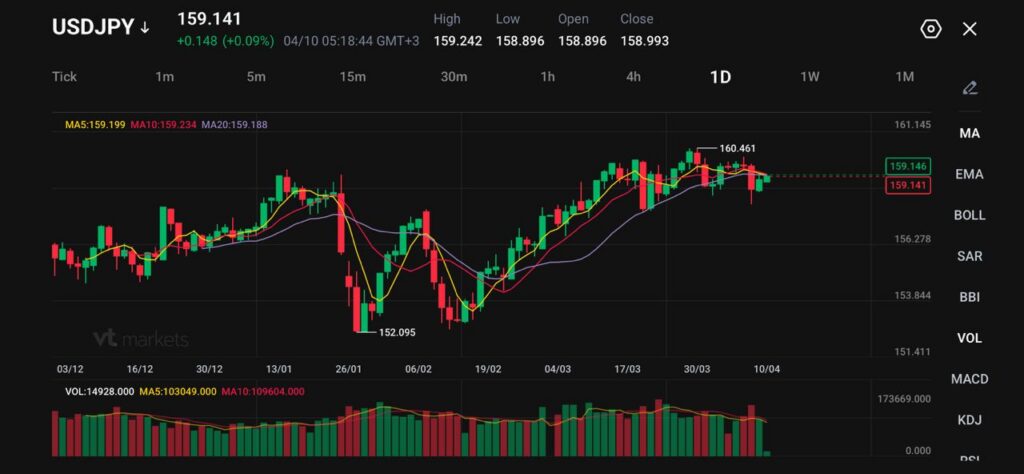
Key levels to watch:
- Support: 159.00 → 158.40 → 157.20
- Resistance: 159.90 → 160.50 → 161.10
The pair is currently consolidating just below the 159.90–160.00 resistance area. A clean break above this region would likely reopen the path toward 160.50, with scope for further upside if momentum builds.
On the downside, 159.00 is acting as immediate support. A break below this level could trigger a deeper pullback toward 158.40, though such a move would likely remain corrective unless the broader trend structure weakens.
Overall, USDJPY is in a controlled consolidation within an uptrend, with price holding above key moving averages. The next directional move will likely hinge on whether buyers can reclaim the 160.00 level or if sellers push the pair into a deeper retracement.
What Traders Should Watch Next
The next move depends on three linked drivers: whether the ceasefire holds, whether oil stays off the highs, and whether Ueda sharpens or softens the BOJ’s pre-meeting message. If crude stays lower and BOJ language firms up, the yen can extend its recovery.
If the truce weakens or the BOJ hesitates, USDJPY may stay pinned near the highs and start leaning back toward 160.
Learn more about trading Forex Pairs on VT Markets here.
Trader Questions
Why Is USDJPY Holding Near 159 Instead Of Falling More Sharply?
Lower oil prices have taken some pressure off Japan’s import bill, but the yen is still dealing with Bank of Japan uncertainty and a ceasefire that markets view as fragile rather than permanent. That has kept USDJPY close to 159.14 instead of driving a deeper drop.
How Did The US-Iran Ceasefire Help The Yen?
The ceasefire triggered a sharp fall in oil and reduced near-term stagflation fears. Japan is highly exposed to imported energy costs, so any cooling in crude usually gives the yen some relief.
Why Has The Yen Still Fallen About 2% Since The Conflict Began?
The broader move still reflects the damage from the earlier oil shock. Higher fuel costs worsened Japan’s growth-inflation mix and weakened the yen even when risk aversion was high. The current pullback in USDJPY has only recovered part of that move.
What Are Markets Expecting From The BOJ Now?
The BOJ kept rates at 0.75% in March, but markets have continued to price a meaningful chance of another move around the late-April meeting. The uncertainty is no longer just about whether the BOJ can hike, but whether Kazuo Ueda will signal that clearly enough before the decision.
Why Does BOJ Guidance Matter So Much For USDJPY?
USDJPY is sitting close to a crowded level, so even small shifts in BOJ language can move expectations quickly. A clearer tightening message would support the yen, while another cautious hold-or-wait tone could leave the pair leaning back toward 160.
Start trading now – Click here to create your real VT Markets account







