






Key Points
- CL-OIL trades at 97.607, up 1.137 (+1.18%), after a high of 98.332 and a low of 96.197.
- Forecasts still point to firm prices, with 2Q Brent seen at $98.00 and WTI at $92.50.
- Shipping through the Strait of Hormuz remains constrained by security fears, insurance costs, and operational bottlenecks, which limits how much supply can return quickly.
Oil sold off hard on the first ceasefire headlines, but the rebound shows the market no longer believes a truce automatically means smooth energy flows. Prices are now rebuilding because traders are starting to focus on what happens after the headline.
Cargoes still need safe passage, insurers still need to price risk, and shipowners still need confidence that routes will stay open.
That is why the correction may have already gone too far. The market removed a large part of the war premium quickly, but physical conditions in the Gulf still look too strained for a clean return to pre-crisis movement.
A cautious near-term view still favours elevated prices while the ceasefire remains fragile and actual transit conditions lag the political message.
Hormuz is Open in Name More Than in Practice
The main issue is not whether a diplomatic pause exists. The issue is whether enough oil can move through Hormuz without disruption, delay, or extreme cost. The latest reporting shows the strait remains logistically constrained by security threats, mine risks, political control measures, and elevated insurance premiums. That keeps effective supply tighter than a ceasefire headline alone would suggest.
Traffic has improved only marginally from the worst point of the disruption. That matters because crude does not need a full shutdown to stay expensive. A market can stay tight when flows are partial, slow, expensive, or highly selective. The energy system prices reliability, not just theoretical access.
That leaves oil supported even after the steep initial drop.
LNG May Move Faster Than Crude
One exception may be LNG cargoes. The latest shipping read suggests some LNG vessels are already loaded and could move on relatively short notice if passage risk becomes manageable. That creates a split inside the energy complex.
Gas cargoes may recover somewhat faster than crude if operators judge the route passable, while oil stays more heavily affected by insurance, shipowner caution, and wider physical bottlenecks.
That distinction matters because it limits the idea of a full energy normalisation. Some segments may recover sooner, but the oil market is still treating the supply chain as damaged rather than healed.
The Market is Repricing From Panic Into Scarcity
The move now looks less like panic and more like a slower scarcity trade. Forecasts for the second quarter still sit at $98.00 for Brent and $92.50 for WTI, which fits a market where the worst-case supply shock has eased but normal flows have not returned.
The rebound toward the high $90s lines up with that view. Prices no longer need to stay above $110 to signal stress. They only need to remain high enough to reflect limited confidence in the physical restart.
That also explains why the market is no longer trading in a straight line. The first leg was driven by war premium. The current phase is being driven by how much of that premium should remain embedded while shipping stays constrained.
A cautious forecast still points to a choppy but supported market rather than a clean collapse back toward pre-crisis levels.
CL-OIL Technical Outlook
CL-OIL is trading near 97.61, pulling back sharply after failing to sustain momentum near the recent highs around 119.43. Price action shows a clear rejection from the upper range, with the latest move breaking below short-term structure and signalling a shift from bullish continuation into a corrective phase.
The drop toward the 97–98 zone reflects increasing selling pressure as the market unwinds part of its earlier rally.
From a technical standpoint, the trend is transitioning toward neutral. Price has slipped below the 5-day (105.79) and 10-day (102.90) moving averages, both of which are now turning lower and acting as overhead resistance.
The 20-day (98.54) is being tested, and its ability to hold will be key in determining whether this remains a pullback or develops into a deeper trend reversal.
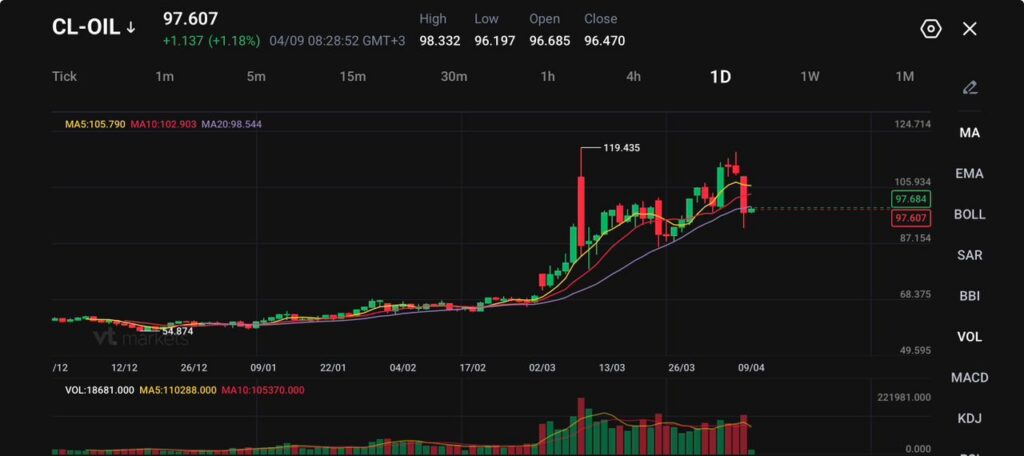
Key levels to watch:
- Support: 97.00 → 93.90 → 87.15
- Resistance: 100.00 → 102.90 → 105.90
The immediate focus is on the 97.00 support zone, which price is currently testing. A break below this level could open the path toward 93.90, signalling a deeper correction within the broader move.
On the upside, 100.00 is now acting as near-term resistance. A move back above this level would suggest stabilisation and could lead to a recovery toward 102.90, where stronger resistance is likely to emerge.
Overall, oil is undergoing a corrective pullback after an extended rally. The loss of short-term moving average support suggests momentum has weakened, and unless price can reclaim the 100–103 region, the risk remains tilted toward further downside or consolidation in the near term.
What Traders Should Watch Next
The next move depends on physical flow, not just diplomatic language. Watch whether ship traffic through Hormuz actually improves, whether insurance costs ease, and whether LNG movement starts to recover faster than crude.
If transport remains patchy and expensive, the market can keep oil close to current levels even without a full return to war panic. If flows normalise faster than expected, the correction can extend further.
Learn more about trading Energies on VT Markets here.
Trader Questions
Why Did Oil Prices Rebound Even After The Ceasefire Announcement?
Oil rebounded because the ceasefire reduced panic but did not restore normal supply conditions. Security concerns, high insurance costs, and operational bottlenecks are still limiting how much crude can move through the Strait of Hormuz.
Why Is The Strait Of Hormuz Still So Important For Oil Prices?
The market still treats Hormuz as the key risk point because supply is only useful if it can move safely and reliably. If transit stays partial, slow, or expensive, oil can remain supported even without a full shutdown.
Does A Ceasefire Mean Oil Prices Should Fall Straight Away?
No. A ceasefire can remove part of the war premium, but prices may stay firm if physical flows do not recover quickly. Traders are now watching actual shipping conditions more closely than diplomatic language alone.
Why Could The Initial Selloff In Oil Have Been Too Deep?
The first move lower priced in relief quickly, but the market is now reassessing whether enough supply can really return. Forecasts still point to 2Q Brent averaging $98.00 and WTI averaging $92.50, which suggests prices may not fall back to pre-crisis levels soon.
Why Might LNG Recover Faster Than Crude?
Some LNG cargoes are already loaded and may be able to move on short notice if passage conditions improve. Crude faces a heavier drag from insurance, shipowner caution, and broader operational friction.
Start trading now – Click here to create your real VT Markets account







