






Key Points
- EURUSD trades at 1.14696, up +0.00071 (+0.06%), but the euro ended March below $1.15 after losing more than 2% against the dollar during the month.
- Markets now expect at least two ECB rate hikes in 2026, replacing earlier pricing that implied a 40% chance of a rate cut.
- Rising energy costs and a largely blocked Strait of Hormuz are feeding inflation fears across Europe and weighing on the euro.
The euro closed March below $1.15, leaving the single currency close to its weakest level in nearly two weeks. The broader picture is more telling than the small day-to-day moves. Over the month, the euro lost more than 2% against the dollar as traders worked through the economic fallout from the deeper Middle East conflict.
That decline reflects a market that has become less confident in Europe’s near-term growth outlook. When energy costs rise sharply, the euro zone tends to feel the pain quickly because it remains heavily exposed to imported energy.
That mix can hurt growth, keep inflation high, and leave the euro caught between weak activity and tighter policy expectations.
If energy prices stay elevated and the conflict remains unresolved, EURUSD may struggle to build a strong rebound and could stay heavy around the mid-1.14 area.
Oil Shock Forces a Sharp Rethink on ECB Policy
The biggest shift this month has been in rate expectations. Soaring oil prices have pushed inflation fears higher across Europe, and that has forced markets to radically reprice the European Central Bank path.
Investors now anticipate at least two interest rate hikes in 2026. Earlier, the market had been pricing a 40% chance of a rate cut instead. That is a sharp swing in expectations, and it tells you just how much the energy shock has changed the tone.
In theory, more rate hikes should help the euro. In practice, the euro has still weakened because the market sees the hikes as defensive rather than growth-positive. Tighter policy in response to an oil shock does not necessarily improve the outlook for risk assets or the currency if the economy is also slowing.
French central bank chief François Villeroy de Galhau reinforced that cautious tone by saying the ECB remains committed to containing energy-driven inflation, but also warned it is “too early” to say when any move will come.
If ECB officials keep sounding worried about inflation but reluctant to commit on timing, EURUSD may remain range-bound rather than stage a clean recovery.
Middle East Tensions Keep Pressure on the Euro
Geopolitics remains at the centre of the move. A Wall Street Journal report said former US President Donald Trump had signalled a possible end to the US military campaign against Iran, even if the Strait of Hormuz remained largely blocked.
That is important because the market is no longer trading just the risk of war. It is trading the risk of an energy bottleneck that may outlast the most intense phase of direct military action. A blocked or partially blocked Strait keeps freight, insurance, and crude costs elevated. Europe feels that quickly.
This helps explain why the euro has not benefited much from any relief headlines. Traders are looking past diplomatic tone and focusing on physical energy flows.
Even if the conflict cools at the political level, EURUSD may stay under pressure if oil routes remain disrupted and inflation stays sticky.
Technical Analysis
EURUSD is trading near 1.1470, hovering just above recent lows as the pair struggles to recover from its broader decline following the rejection from the 1.2080 high. Price action shows continued downside pressure, with rallies failing to hold and sellers stepping in on strength, keeping the pair under sustained resistance.
From a technical standpoint, the trend remains bearish. Price is trading below all key moving averages, with the 5-day (1.1506) and 10-day (1.1535) positioned just above current levels, acting as immediate resistance. The 20-day (1.1550) and 30-day (1.1620) continue to slope downward, reinforcing the weakness in the broader structure and confirming that momentum remains tilted to the downside.
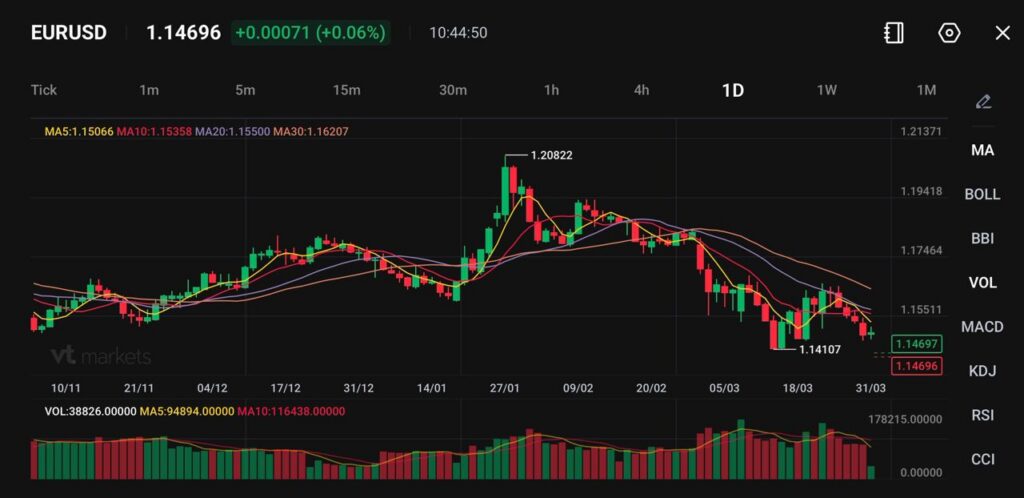
Key levels to watch:
- Support: 1.1410 → 1.1350 → 1.1300
- Resistance: 1.1500 → 1.1550 → 1.1620
The pair is currently consolidating below the 1.1500–1.1550 zone, which has capped recent upside attempts. A break above this region would be needed to ease immediate bearish pressure and open a move toward 1.1620, though momentum would still need to build to sustain a broader recovery.
On the downside, 1.1410 remains the key near-term support. A break below this level could trigger a move toward 1.1350, with further downside risk if selling accelerates.
Overall, EURUSD remains in a clear downtrend, with price action suggesting continued pressure on support levels. Unless the pair can reclaim the 1.1550 area, rallies are likely to be sold into, keeping the bias skewed to the downside in the near term.
What Traders Should Watch Next
The euro now sits at the intersection of three forces: energy prices, ECB repricing, and geopolitical headlines. For the next move, traders will need to see whether oil stays high, whether the ECB becomes more explicit about the new rate path, and whether the Strait of Hormuz remains effectively constrained.
If oil cools and freight risk eases, EURUSD could stabilise quickly. If Europe keeps importing an energy shock while policy turns more defensive, the euro may stay under pressure even with rate-hike expectations rising.
Learn more about trading Forex Pairs on VT Markets here.
Trader Questions
Why Did EURUSD End March Below 1.15?
EURUSD ended March below $1.15 because the euro lost more than 2% against the dollar during the month as traders priced the economic damage from the Middle East conflict and the inflation shock caused by higher energy costs.
Why Can the Euro Fall Even if Markets Expect Ecb Rate Hikes?
The euro can still weaken when rate hikes are driven by an oil shock rather than stronger growth. Markets now expect at least two ECB rate hikes in 2026, but the euro zone is also more exposed to expensive imported energy, which hurts growth and offsets the usual support from higher rates.
What Has Changed in ECB Expectations?
Markets have swung from pricing a 40% chance of a rate cut earlier to pricing multiple ECB hikes in 2026. Reuters reported that markets are now forecasting three rate hikes in 2026, with the first expected by June, which shows how sharply the energy shock has changed rate expectations.
Why Does the Strait of Hormuz Matter So Much for EURUSD?
The Strait of Hormuz matters because it carries about 20% of the world’s oil and a large share of LNG. If it stays largely blocked, Europe faces higher import costs, higher inflation, and weaker growth, which can keep pressure on the euro.
Did Relief Headlines Around Trump Help the Euro?
Only briefly. Reuters reported that the Wall Street Journal said Trump was open to ending the military campaign even if Hormuz stayed shut, which gave markets some relief. But oil stayed elevated and traders kept focusing on energy flows rather than political tone alone.
What Did François Villeroy De Galhau Say About ECB Policy?
Villeroy said the ECB is ready to act against energy-driven inflation, but that it is too early to discuss the timing of any rate hike. That message supports a hawkish bias, but it does not yet give traders a firm timetable.
Start trading now – Click here to create your real VT Markets account







