






Key Points
- WTI crude trades near 93.83, down -1.398 (-1.47%), as oil pauses after a sharp rally.
- Brent crude slips to $102.28, offering temporary relief to global equity markets.
- Markets now turn to the Federal Reserve decision, with risks of a more hawkish outlook amid persistent inflation pressures.
Oil prices pulled back slightly on Wednesday, offering a brief reprieve to global markets after a period of intense volatility driven by escalating tensions in the Middle East.
WTI crude is trading at 93.83, down -1.47%, while Brent crude eased 1% to $102.28 per barrel. The decline reflects a temporary pause rather than a structural shift, as underlying supply risks remain firmly in place.
Despite the pullback, the broader narrative has not changed. The Strait of Hormuz remains largely shut, and geopolitical tensions continue to disrupt energy flows, keeping markets on edge.
If disruptions persist, oil prices may resume their upward trajectory after this consolidation phase.
Geopolitical Escalation Keeps Supply Tight
The latest developments in the Middle East continue to reinforce supply concerns. Israel has intensified its military actions, while Iran has renewed strikes on oil infrastructure in the United Arab Emirates.
At the same time, signals from Iranian leadership suggest no near-term de-escalation, increasing the likelihood of a prolonged disruption to global energy markets.
The Strait of Hormuz, a critical artery for global oil shipments, remains a key focal point. Any sustained closure or restriction of traffic through the strait could tighten supply conditions significantly.
According to JPMorgan, the current stability in oil prices may reflect temporary buffers such as regional inventories and policy interventions. However, if the strait remains constrained, markets may need to reprice oil higher as global inventories are drawn down.
Focus Shifts to Federal Reserve Outlook
With oil volatility dominating recent market moves, attention has now turned to the Federal Reserve’s policy decision, which is expected later in the day.
The Fed is widely expected to keep interest rates unchanged, but the key focus will be on updated economic projections and the “dot plot,” which could signal fewer or no rate cuts in the near term.
Markets are particularly sensitive to how policymakers interpret the oil shock. The key question is whether it will primarily slow economic growth or drive persistent inflation.
Analysts warn that if the Fed leans toward the inflation narrative, it could adopt a more hawkish stance, reinforcing higher interest rates for longer.
A hawkish shift in Fed expectations could strengthen the dollar and weigh on commodities, including oil, in the near term.
Technical Outlook
Crude oil (CL-OIL) is trading around $93.83, down roughly 1.47% on the session, as the market pauses following an aggressive rally that pushed prices to a recent high near $119.43.
The pullback appears corrective rather than structural at this stage, with price action still well-supported above prior breakout levels.
Technically, the trend remains firmly bullish despite the near-term retracement. Price is holding above the 10-day moving average (90.56) and well above the 20-day (79.55) and 30-day (74.23), indicating that the broader uptrend remains intact.
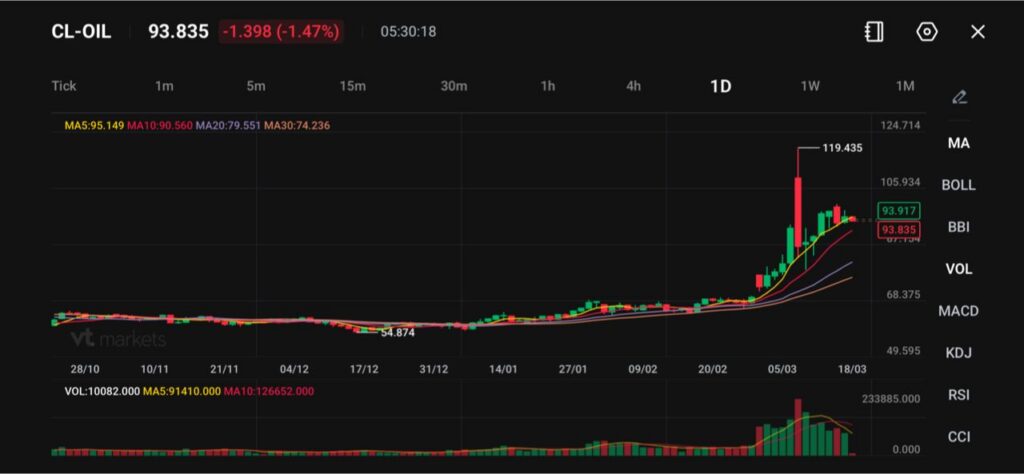
The 5-day moving average (95.15) is now starting to flatten and roll slightly lower, reflecting short-term exhaustion after the sharp vertical move.
In terms of key levels, immediate support is seen around $90–91, aligning with the 10-day average and recent consolidation.
A deeper pullback could test $87–88, where prior breakout structure sits. On the upside, resistance remains near $100–105, followed by the spike high at $119.43, which now acts as a major technical ceiling.
Overall, oil appears to be entering a consolidation phase after a parabolic rally, with momentum cooling but the underlying trend still supported by elevated risk premiums.
As long as prices hold above the $90 region, the bullish structure remains valid, though further sideways movement or short-term pullbacks are likely before any attempt to retest recent highs.
What Traders Should Watch Next
Markets remain highly sensitive to both geopolitical and policy developments. Traders should monitor:
- Updates on the Strait of Hormuz and Middle East conflict
- The Federal Reserve decision and forward guidance
- Whether oil can hold above the 90–95 range
- Signs of renewed supply disruption or inventory drawdowns
For now, oil’s pullback appears to be a pause rather than a reversal, with geopolitical risks still firmly anchoring the market’s upside bias.
Learn more about trading Energies on VT Markets here.
Frequently Asked Questions
Why Did Oil Prices Pull Back After Rallying?
Oil prices eased as markets paused after a sharp rally driven by geopolitical tensions. The pullback reflects short-term profit-taking and temporary stability rather than a shift in the broader bullish trend.
Where is Oil Trading Right Now?
WTI crude is trading around 93.83, down -1.47%, while Brent crude has slipped to $102.28 per barrel.
Is the Oil Rally Over?
Not necessarily. The broader trend remains supported by supply risks, particularly with disruptions linked to the Middle East conflict and restricted flows through the Strait of Hormuz.
Why is the Strait of Hormuz So Important?
The Strait of Hormuz is a key global energy route, handling roughly 20% of the world’s oil shipments. Any disruption can significantly tighten global supply and push prices higher.
How Are Geopolitical Tensions Affecting Oil?
Escalating conflict, including attacks on energy infrastructure, increases uncertainty and raises the risk of supply disruptions, which tends to support higher oil prices.
Start trading now – Click here to create your real VT Markets account







