






Key Points
- CL-OIL trades at 88.500, up +3.522 (+4.14%), with MA5 83.948, MA10 76.379, MA20 70.500, MA30 68.349 and a recent spike marker near 119.435.
- Trump said the war was ahead of schedule and “very much complete”, which eased risk pricing, while traders also weighed strategic reserve releases and potential relief on Russia oil sanctions.
- Tanker traffic through the Strait of Hormuz remains the key proof point, after Reuters data showed daily transits dropped to zero from 37 just before the conflict escalated.
Oil Trades Headlines, But The Strait Sets The Floor
Markets welcomed President Trump’s signal that the war against Iran was ahead of schedule and “very much complete”. That kind of language usually pulls air out of the risk premium because traders stop pricing a worst-case supply outage as the base case.
Our research desk pointed to two policy levers that can cool pricing pressure: a strategic reserve release and the prospect of easing oil-related sanctions on Russia.
Still, the oil market does not clear on speeches alone. It clears on flows. Reuters’ shipping analysis showed the number of daily tankers passing through Hormuz fell to zero as of Wednesday from 37 on Friday, February 27. Until that number rises in a steady pattern, traders will keep paying for supply anxiety even if they also trade de-escalation headlines.
If tanker transits stay near zero or remain patchy, crude can stay volatile and hold a supply-risk premium. If shipping resumes at scale and stays stable for several sessions, oil can retrace faster than many expect because the market has already priced extreme disruption risk.
Supply Relief Options Shift The Risk Premium
Analytical framing matters because it reflects how policymakers can lean on the market. A strategic reserve release can add prompt barrels and calm panic bids. The market has already started to debate that path, but Reuters reporting says G7 finance ministers discussed the issue and saw broad agreement not to release reserves immediately, while stressing they stand ready to act if needed.
On Russia, Reuters reporting says the Trump administration has reviewed options that include easing sanctions on Russian oil as part of a wider package to curb spiking prices. That can change sentiment because it offers a substitute supply valve if Middle East flows stay constrained.
If officials announce clear, credible supply relief such as targeted sanctions exemptions or a coordinated reserve release, oil can soften even without perfect shipping conditions. If policymakers only signal readiness without action, traders may keep buying dips because the physical risk still dominates.
Technical Analysis
WTI crude oil (CL-OIL) is trading near $88.50, up around 4.14%, as prices attempt to stabilise after the extraordinary spike that pushed the market to a high near $119.43.
The recent surge marked an aggressive breakout driven by supply shock dynamics, but the sharp rejection from the highs suggests the market is now entering a phase of volatility and price discovery.
From a technical perspective, oil remains well above its key moving averages despite the pullback. The 5-day moving average (83.95) and 10-day (76.38) are rising steeply, while the 20-day (70.50) and 30-day (68.35) remain far below current price levels.
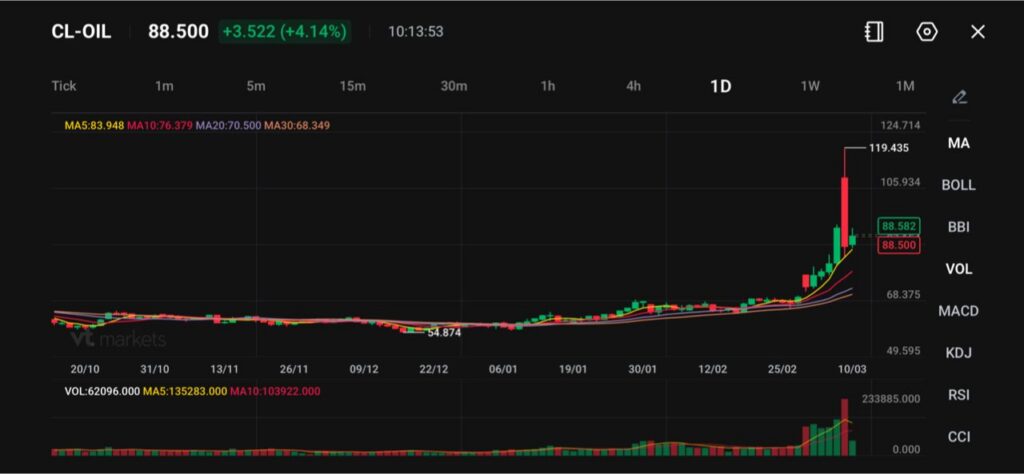
This wide separation reflects the intensity of the recent rally and confirms that the broader trend remains strongly bullish, even as prices retrace part of the spike.
In the near term, $95–$100 now represents the first major resistance zone following the rejection from the $119 peak. A move back above $100 would suggest renewed bullish momentum and could reopen the path toward the $110–$120 region.
On the downside, immediate support appears around $85–$88, followed by stronger structural support near $80, which aligns with the recent breakout area before the surge.
Overall, oil markets remain highly volatile but structurally bullish, with the sharp correction likely reflecting profit-taking after the historic rally. As long as prices hold above the $80–$85 region, the broader upward trend remains intact, though short-term consolidation may persist as the market absorbs the recent shock.
What Traders Should Watch Next
- Evidence that Hormuz traffic recovers from zero daily transits toward pre-shock flow levels, because that decides whether the move stays a supply event or fades into a risk premium unwind.
- Any confirmed policy action on strategic reserves after the G7 decision to wait, because timing will matter as much as volume.
- Any formal move on Russia oil sanctions relief, because even a targeted exemption can shift how traders price forward supply.
Learn more about trading Energies on VT Markets here.
FAQs
- Why Did Oil Pull Back After the Earlier Spike?
Markets reacted to President Trump saying the war against Iran was ahead of schedule and “very much complete”, which reduced the immediate risk premium. Danske Bank also flagged two extra relief levers: a possible easing of oil-related sanctions on Russia and the release of strategic reserves. - Does “Very Much Complete” Mean Oil Risk is Over?
Not yet. Even with calmer messaging, traders still need proof that physical flows normalise. Danske Bank said it wants more definitive signs that traffic picks up through the Strait of Hormuz again. Without that, the market can reprice higher on any fresh shipping or security headline. - What is the Market Watching in the Strait of Hormuz Right Now?
It is watching the shipping flow and insurance conditions. If tanker traffic remains thin, supply risk stays elevated even if leaders claim the operation is finishing. If traffic restarts in size, the risk premium can fade faster. - How Do Strategic Reserves Affect Oil Prices?
Strategic reserve releases can add near-term barrels and calm panic bids. They work best when the problem is a short-term supply fear. They work less well if the issue becomes a persistent logistics blockage, because barrels still need safe routes and functioning distribution. - How Would Easing Russia Oil Sanctions Move the Market?
Easing sanctions can increase available supply or improve routing flexibility. Traders treat that as a bearish input for oil, because it can help offset Middle East disruption risk. The market will still demand clarity on timing, volumes, and enforcement before it prices a lasting impact.
Start trading now – Click here to create your real VT Markets account







