






Key Points
- USDX trades at 99.349, up +0.600 (+0.61%), with MA5 98.977, MA10 98.406, MA20 97.786, MA30 97.484.
- The euro fell 0.72% to $1.1534 and sterling dropped 0.79% to $1.3319, while USDJPY rose 0.48% to 158.59.
- Traders now price around 35 basis points of Fed easing by year-end, down from more than 55 basis points in late February.
The US dollar jumped on Monday as soaring oil prices pushed investors into cash. The market did not treat this as a normal risk-off session. It sold a wide set of assets at once and bought the currency with the deepest liquidity.
The trigger came from energy. Oil prices spiked to just shy of $120 per barrel, and traders worried that a protracted Middle East war could disrupt supplies and weaken global growth.
A Financial Times report later said G7 finance ministers would discuss a joint release of emergency oil reserves coordinated by the International Energy Agency, which helped oil retreat slightly and cooled the dollar’s surge in the Asian afternoon.
If oil keeps hovering near the $120 area and shipping risk stays elevated, the dollar can keep its bid, even if intraday pullbacks appear after policy headlines.
Markets Reprice Fed Cuts as Inflation Risk Returns
Friday’s weak US jobs data briefly slowed the dollar and lifted rate-cut hopes, but the oil shock reversed that tone. Traders were last betting on around 35 basis points of Federal Reserve easing by year-end, after pricing more than 55 basis points in late February.
This shift matters because it tightens the path for risk assets. Higher oil can lift inflation expectations, and that can limit how quickly central banks can ease, even if growth slows.
If oil stays near the $120 area, the market may keep cutting back Fed easing bets, which can support the dollar. If oil falls sharply on policy action or de-escalation, rate-cut pricing may rebuild and cap USD strength.
Technical Analysis
The US Dollar Index (USDX) is trading near 99.35, up around 0.61%, as the dollar continues to strengthen following its rebound from the late-January low near 95.34. The index has been steadily climbing in recent sessions, suggesting renewed demand for the dollar after a period of weakness earlier in the year.
From a technical perspective, the index is now trading above its key short-term moving averages. The 5-day moving average (98.98) and 10-day (98.41) are trending upward, while the 20-day (97.79) and 30-day (97.48) remain below current price levels and are beginning to slope higher.
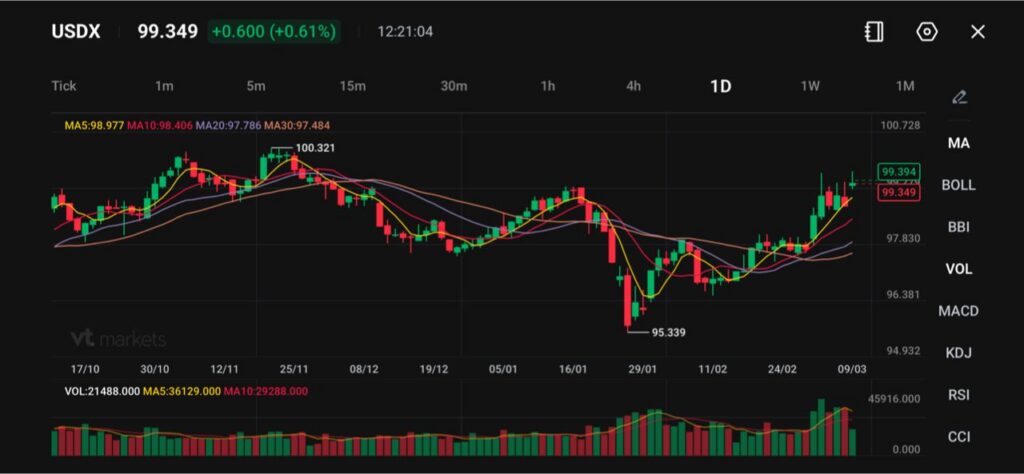
This alignment of moving averages indicates improving bullish momentum and suggests that the recent recovery may continue if the dollar maintains its current trajectory.
Immediate resistance is located near 100.32, which previously capped gains and represents a key psychological level. A decisive break above 100 could strengthen the bullish outlook and potentially open the path toward the 101.00–101.50 region.
On the downside, initial support is seen around 98.80–99.00, followed by stronger structural support near 97.80, where the 20-day moving average is currently positioned.
Overall, the short-term bias appears constructive for the dollar, with the index attempting to reclaim the 100 handle. However, the market may experience short-term consolidation as it approaches this resistance zone before determining the next directional move.
War Headlines Drive the Tail Risk Premium
The conflict has entered a phase where traders focus on the plumbing of energy supply. Iran has targeted shipping in the Strait of Hormuz and attacked regional energy infrastructure. Reuters reporting says the conflict has already led to the suspension of around one-fifth of global crude and natural gas supplies.
Qatar’s energy minister told the Financial Times he expects Gulf producers to shut down exports within weeks, and warned oil could reach $150 a barrel.
If markets keep treating supply disruption as open-ended, the dollar can stay supported and volatility can remain elevated. If shipping resumes and the “one-fifth” disruption risk eases, the dollar’s haven premium may shrink quickly.
What to Watch Next
- Whether USDX can hold above 98.406 and keep pressing the 100.321 area on the chart.
- Any confirmed signal from the G7 and the IEA on a joint release of emergency oil reserves, beyond the discussion reported.
- EURUSD at $1.1534 and GBPUSD at $1.3319 for signs of forced selling versus stabilisation.
- USDJPY at 158.59 as traders weigh oil, yields, and Japan’s tolerance for speed.
- The market’s pricing of 35 basis points of Fed easing, because any further unwind can extend USD strength.
Learn more about trading Indices on VT Markets today.
Frequently Asked Questions
- Why Did the US Dollar Jump Today?
The dollar jumped because investors rushed into cash as oil prices surged and war risk raised fears of weaker global growth. This “cash dash” tends to favour the most liquid reserve currency, especially when markets sell stocks, bonds, and metals at the same time. - What is USDX, and What Does a Move to 99.349 Mean?
USDX measures the US dollar against a basket of major currencies. A reading of 99.349, up +0.600 (+0.61%), signals broad-based dollar strength rather than a move driven by one single currency pair. - Why Does Oil Strengthen the Dollar in This Scenario?
Higher oil can lift global inflation risk and reduce appetite for risk assets. The US also benefits from its net energy exporter status compared with much of Europe, so traders often treat the dollar as a relative winner when energy prices jump. - How Does the G7 Oil Reserve Talk Affect the Dollar and Oil?
A coordinated release of emergency reserves can reduce immediate supply fear and cool oil prices. When oil retreats, the dollar can give back some gains because the market’s inflation panic eases. That is why the dollar pared gains after the report that G7 ministers will discuss a joint release coordinated by the IEA. - What Do Fed Easing Bets Tell Us About Dollar Direction?
They show how traders see the interest-rate path. Markets now price around 35 basis points of Fed easing by year-end, down from more than 55 basis points in late February. Fewer expected cuts often support the dollar because it keeps US yields relatively attractive.
Start trading now – Click here to create your real VT Markets account







