






Key Takeaways
- Global fuel prices are largely driven by crude oil markets, with benchmarks such as Brent and WTI setting the tone for petrol costs worldwide.
- Geopolitical events, including supply disruptions and conflicts affecting key shipping routes, can trigger sudden price spikes.
- Taxes, refining capacity, and currency strength can significantly influence what consumers ultimately pay at the pump.
Fuel Prices Explained: What Drives Petrol Costs Around the World
Fuel prices are among the most visible indicators of economic conditions. When petrol prices rise or fall, the effects ripple through transportation costs, consumer spending, and inflation.
Although drivers experience fuel prices locally at the pump, the forces behind them are global. Oil supply and demand, geopolitical tensions, refining capacity, government policy, and currency movements all combine to determine what consumers pay.
Understanding these dynamics helps explain why fuel prices can change rapidly and why they remain one of the most closely watched indicators in the global economy.
The Oil Market: The Foundation of Fuel Prices
At the centre of fuel pricing is crude oil, the raw commodity refined into petrol, diesel, and aviation fuel.
Global oil prices are typically measured against benchmark contracts such as Brent crude and West Texas Intermediate (WTI). These benchmarks act as reference points for oil traded across international markets.
When crude oil prices rise, fuel prices usually follow.
Oil prices move based on several core factors.
- Supply decisions by major producers
Groups such as the Organisation of the Petroleum Exporting Countries (OPEC) regularly adjust output levels to manage global supply. - Global energy demand
Economic growth increases demand for transportation, shipping, and industrial activity. - Supply disruptions
Extreme weather, infrastructure failures, or geopolitical conflicts can interrupt production or transport routes.
Strategic shipping routes also play a critical role. For example, the Strait of Hormuz handles roughly one fifth of the world’s oil shipments, making it one of the most important energy corridors in global trade.
Interested in trading Energies? Download the VT Markets app and monitor real-time CFD price action on Crude Oil (CL-OIL) and other energy-related charts.
The Fuel Price Formula
Fuel prices are not determined by crude oil alone. Several cost layers are added before petrol reaches the pump.
A simplified version of the fuel price structure looks like this:
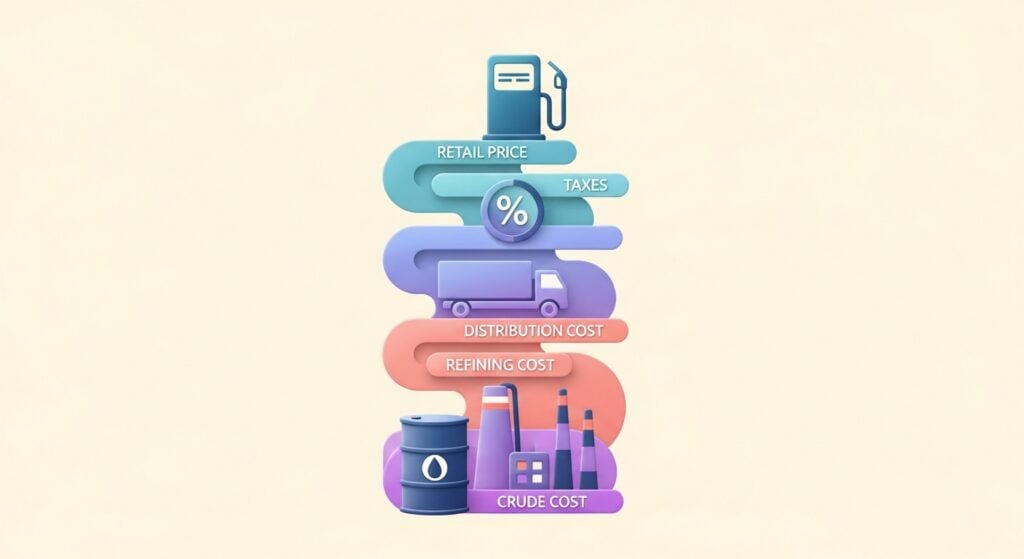
Fuel price = crude oil cost + refining cost + distribution + taxes + retail margin
Each component contributes to the final price drivers see.
- Crude oil typically represents the largest share of the cost
- Refining converts crude oil into petrol and diesel
- Distribution and transport move fuel through pipelines, ships, and trucks
- Taxes and duties can account for a significant portion of retail fuel prices in many countries
- Retail margins cover operating costs for fuel stations
Because these components vary by country, petrol prices can differ significantly between regions even when crude oil prices are similar.
Geopolitics and Fuel Price Volatility
Energy markets are highly sensitive to geopolitical events.
Conflicts involving oil-producing nations, sanctions on exporters, or instability along shipping routes can restrict supply and push oil prices higher. Even the threat of disruption can trigger market volatility as traders anticipate shortages.
Recent years have demonstrated how quickly geopolitical tensions can affect fuel prices, particularly when major energy producers or transportation routes are involved.
For example, supply disruptions in the Middle East or production cuts by major exporters have historically led to sharp price movements in global oil markets.
Refining Capacity and Supply Chains
Once crude oil is extracted, it must be refined into usable fuels.
Refineries convert crude into products such as petrol, diesel, and jet fuel. When refining capacity becomes constrained, whether due to maintenance shutdowns, regulatory limits, or operational issues, the supply of refined fuels may tighten even if crude oil production remains stable.
Transport logistics also influence fuel prices. Shipping, pipelines, and trucking networks are required to move refined fuel from refineries to storage terminals and retail stations.
Any disruption within these supply chains can push prices higher.
For more market commentary, explore the latest Analysts’ report on oil markets on VT Markets.
The Role of Currency in Fuel Prices
Oil is traded globally in US dollars, meaning exchange rates can significantly influence fuel prices.
When the US dollar strengthens, countries importing oil must pay more in local currency terms. This can push fuel prices higher domestically even if global oil prices remain stable.
Conversely, when the dollar weakens, imported oil becomes cheaper for many countries, easing pressure on fuel prices.
Currency movements, therefore, play an important role in how global energy costs translate into local pump prices.
Fuel Prices and the Global Economy
Fuel prices influence far more than transportation costs.
Energy is a fundamental input for industries such as logistics, manufacturing, agriculture, and aviation. Rising fuel prices can increase operating costs for businesses, which may ultimately pass those costs on to consumers.
As a result, energy prices often feed directly into inflation data. This is why central banks and policymakers closely monitor oil and fuel markets.
For investors and traders, movements in oil and fuel prices can signal broader shifts in economic growth, supply chains, and geopolitical risk.
Fuel Prices in Today’s Market
In recent years, oil markets have experienced significant volatility due to shifting geopolitical conditions, production adjustments, and changes in global demand.
Brent crude, the international benchmark, has frequently traded between the range of $70 and $90 per barrel, while WTI crude has typically followed a similar trend at slightly lower levels.
Events such as production cuts by major exporters, supply disruptions, or geopolitical tensions can quickly push prices toward the higher end of this range.
Because crude oil remains the largest component of fuel costs, these market movements often translate directly into fluctuations at the pump.
Fuel prices reflect the intersection of global oil markets, geopolitical developments, refining capacity, taxation, and currency movements. While consumers experience these costs locally, the forces shaping them are overwhelmingly international.
As global energy demand evolves and geopolitical risks continue to influence supply chains, fuel prices will remain one of the most important indicators of economic conditions worldwide.
Create a live VT Markets account today to access our platform features, including market insights and educational content.
Fuel Prices Refresher
- Why do fuel prices change so often? Fuel prices fluctuate because oil markets react quickly to supply and demand changes. Geopolitical tensions, production decisions by major oil exporters, and shifts in global demand can all move prices rapidly.
- What is the biggest factor influencing fuel prices? The price of crude oil is typically the largest driver of fuel costs. When global oil prices rise, petrol prices generally increase as well.
- Why are fuel prices different in each country? Taxes, government policies, transportation costs, and currency exchange rates all influence fuel prices. These factors vary significantly between countries, leading to different petrol prices even when oil costs are similar.
- Why does a strong US dollar raise fuel prices? Oil is traded globally in US dollars. When the dollar strengthens, importing countries must spend more of their local currency to purchase the same amount of oil, which can increase domestic fuel prices.
Start trading now – Click here to create your real VT Markets account







